


O'Clock and Half Past: A UK Parent's Guide to Telling the Time
One 20-minute lesson for ages 5–6: the two hand rules of o'clock and half past, the drifting hour hand explained honestly, and games that make it stick.
O'clock and half past need just two rules: long hand straight up at 12 means o'clock, with the short hand naming the hour. Long hand straight down at 6 means half past, the short hand sitting halfway between the number it just left and the next. Build a paper-plate clock, teach o'clock first, then half past — and cement both with two-minute daily reads on a real clock.

The short version
- O'clock and half past need just two rules: long hand straight up means o'clock; long hand straight down means half past.
- Teach o'clock first within the same sitting — half past is its mirror image and costs far less teaching.
- Be honest about the drifting hour hand: at half past, it sits halfway between the numbers. Name the number it just left.
- Turn the rules into a body game — arms straight up for o'clock, arms straight down for half past.
- Make your child the family time reporter; real announcements before meals lock the skill in.
- Two-minute daily spot checks on a real clock matter more than any second lesson.
- Age
- Ages 5–6
- Prep
- 10 min
- Play time
- 25 min
- Mess
- None
- Difficulty
- Easy
- Where
- Indoor
Why kids love this
Two rules feels like a secret code, not a school lesson. Children build their own big clock, boss the hands around, then read real times — "half past three — teatime!" — with the air of someone handed a grown-up superpower.
What you'll need
- A paper plate, two card strips (one short, one long, in different colours), a split pin or reusable adhesive, crayons in two colours, and star stickers. A real analogue wall clock for the final step is a bonus.
Before you start
Pre-cut the hands — short and chunky in one colour (red), long and skinny in another (blue) — and draw twelve tick marks around the plate. Pin the hands at the centre so they spin freely, and lay the clock face-down for a big reveal.
How to do it
-
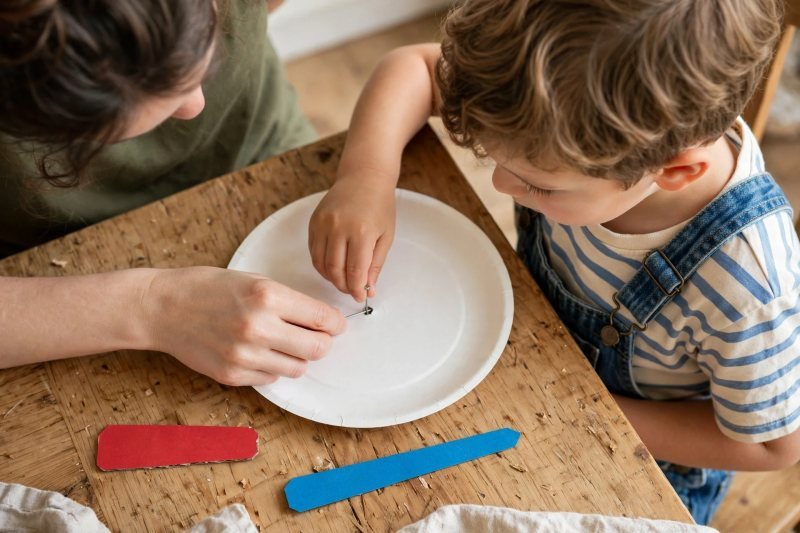
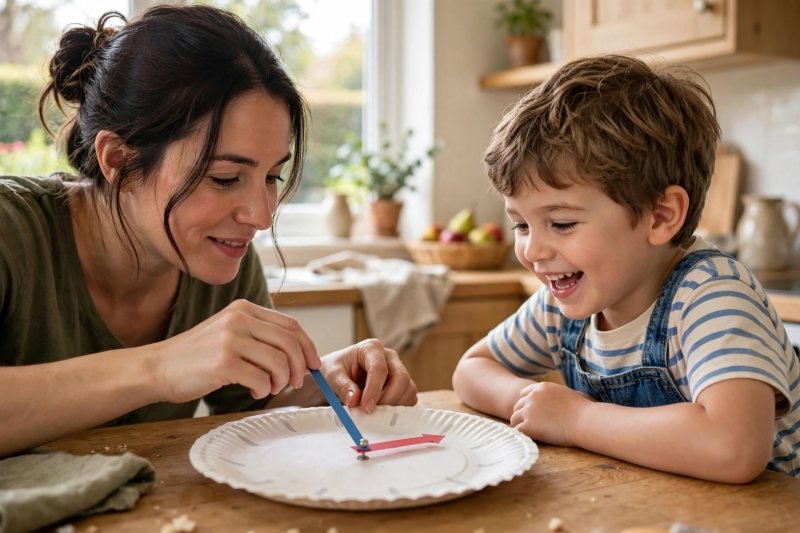
Build the learning clock together. Lay out the plate, hands, pin and crayons, and let your child press the pin through the centre — a clock they built is a clock they'll use. Spin the hands, then let them name the clock. Do these in order, in one sitting. Twenty to twenty-five minutes is plenty — stop while it's still fun.
-
Name the hands with a touch drill. "Short hand — the hour hand — tells us WHICH hour. Long hand — the minute hand — tells us the RULE." Rapid-fire: "Touch the hour hand… touch the minute hand… touch the hour hand." Three clean rounds means the names are in.

-
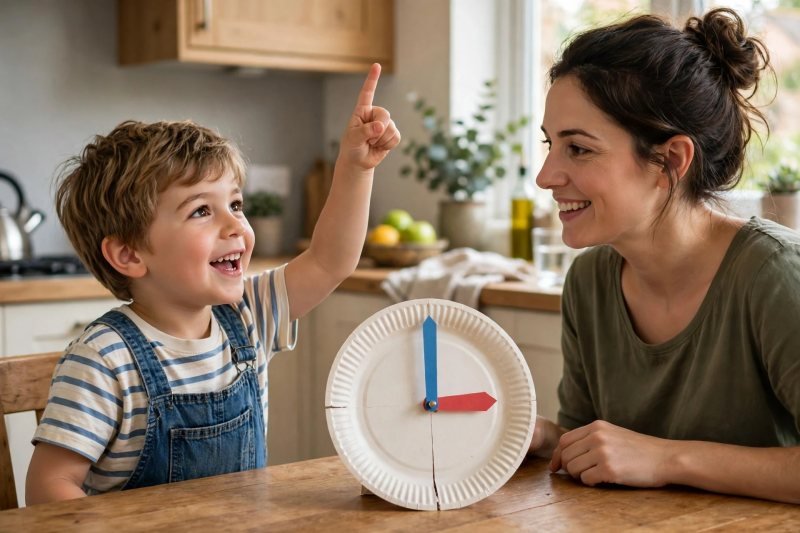
Teach rule one: straight up means o'clock. Slide the long hand straight up. "Long hand straight up? O'clock — and the short hand names the hour." Read 3 o'clock, 7 o'clock and 12 o'clock, long hand up first every time.
-
Stand up and become the hands. This body warm-up makes both rules physical: child stands tall, arms straight UP — "that's o'clock!" — then arms straight DOWN — "that's half past!" Call them out in random order; silly poses are the point, and so is the muscle memory.

-
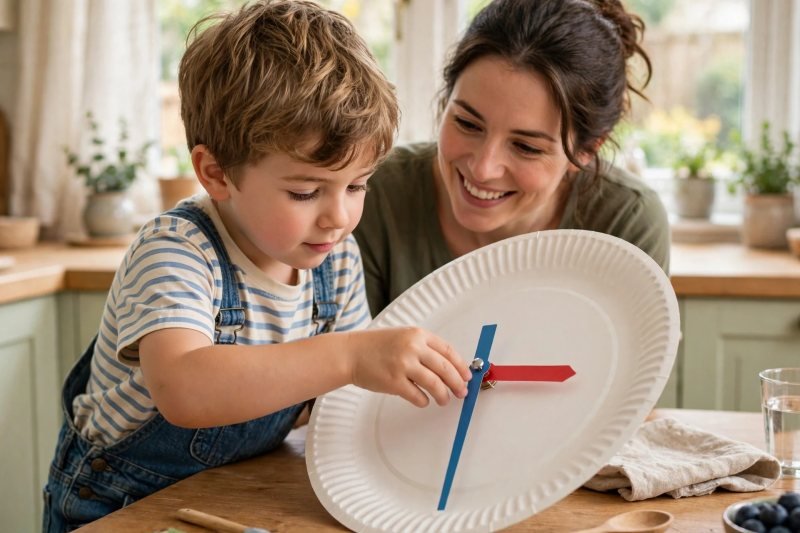
Teach rule two: straight down means half past. Back at the table, slide the long hand straight down. "Long hand straight down? Half past — the clock is halfway through the hour." Chant it together three times: straight up is o'clock, straight down is half past.
-
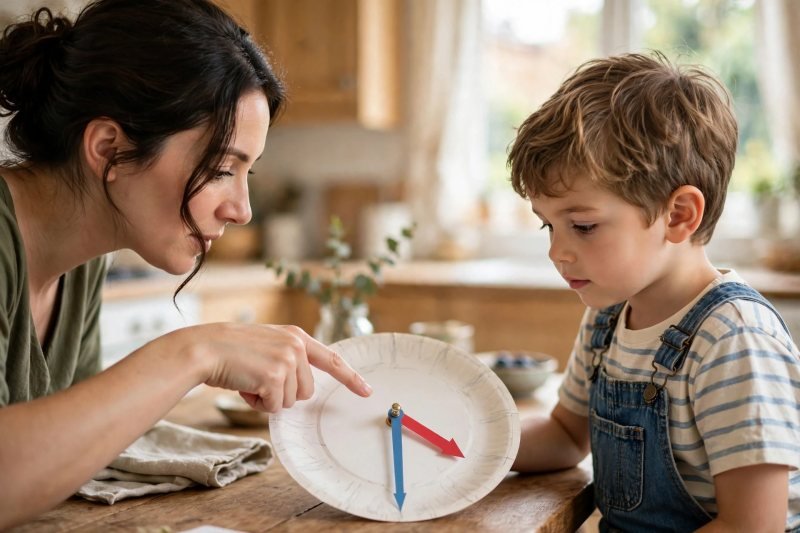
Explain the drifting hour hand honestly. Set 3:30 — long hand down, short hand halfway between 3 and 4. "The long hand walked halfway round, and the short hand crept halfway too — it's leaving 3 and heading for 4." The golden rule: "Name the number it just LEFT — half past THREE, not four."
-
Read your first half pasts. Long hand down first, then name-the-number-it-left: half past 3, half past 7, half past 9. Drumroll each one, and let your child slide the hands themselves — setting is half the learning.

-
Mix the rules: o'clock or half past? Set six mixed times and have your child read each one — no counting from the top, just the check: "Straight up or straight down?" Then swap: they set, you read — and you get two deliciously wrong on purpose.
-
Run the classic trap. Set half past 4 (hour hand between 4 and 5) and ask, deadpan: "Is it half past four or half past five?" When they nail it — "half past FOUR, it just left four!" — celebrate. This is the error that haunts real clocks; you've just vaccinated against it.

-
Crown your time reporter. Give your child the official job: announce the time before every meal — "Dinner is at half past five!" — with a fridge-chart star each time they read it right. Then tease the future: "In Year 2, school adds quarter past and quarter to — you'll already be ready."



Make it easier
If two rules feel like one too many, split the lesson: o'clock today, half past tomorrow — one rule at a time, with our guide to analogue and digital clocks to show both clock styles side by side once each rule is solid. Keep to hours 1–6. If the numerals are the problem, pause and build them up with our number recognition activities first — guessing builds zero confidence.
Make it harder
Ready for more? Have them draw the hands on a blank clock face for half past times — the Year 1 skill of drawing, not just reading, the hands. Then the 30-minute connection: the long hand reaches the 6 with six jumps of five (our skip-counting by 2s, 5s and 10s practises the counting). Number order practice helps too — our number order activities keep 1–12 in sequence, which is exactly what the dial runs on. Finally, the kitchen wall clock, whose identical-looking hands are the real boss level.
Other ways to play it
- - School-run clock: practise on the times your child actually lives — "We leave at half past eight, school picks up at half past three." Real stakes make real readers.
- - Teatime timetable: announce the day's schedule in o'clocks and half pasts — "Swimming is at half past four!" — and let your child declare it when the kitchen clock agrees.
- - Human-clock freeze dance: play music, and when it stops, call "o'clock!" or "half past!" — your child freezes with arms up or down. Fast, loud, and it burns the rules into the body.
How it changes by age
- Fits ages 5–6, squarely in UK Year 1, when most children count to 20 and recognise numerals 1–12. Some four-year-olds are ready; some six-year-olds do better with the rules taught on separate days. A child who can't name the dial's numbers yet should build those first — the clock waits patiently.
What they're learning
Number recognition and sequencing (hours run 1–12 in order); the fraction idea of "half" — halfway round the clock, halfway between the numbers; that clock position carries meaning; fine-motor control from building and spinning the hands; and the time vocabulary UK classrooms use — hour hand, minute hand, o'clock, half past.
Clearing up
Recycle the offcuts, cap the crayons, done. Keep the learning clock on the fridge for daily spot checks — two-minute mealtime reads are what lock this in. One honest note: digital clocks just show the answer and teach nothing; do the checks on a real analogue clock whenever you can.
Questions parents ask
How long does it take a five-year-old to learn o'clock and half past?
My child keeps mixing up "straight up" and "straight down". What helps?
Should we practise on a real clock or the homemade one?
What if my child doesn't recognise the numbers 1–12 yet?
How do I teach the drifting hour hand without confusing them?
Can a five-year-old read a real wall clock yet?
If the combined lesson felt rushed, split it with no shame — one rule per sitting, o'clock first, then half past. For number confidence first, our counting to 20 activities build the 1–12 recognition the dial runs on. Once both are solid, our full parent guide to teaching time maps the whole journey: quarters in Year 2, then minutes in fives.

save it for later
Pin this for the next rainy afternoon
Keep it on a board so it is there when you need it, rather than when you happened to find it.
Save to Pinterest


