


Telling Time to the Hour: Read the Clock With Confidence
One playful 15-minute lesson that teaches five- and six-year-olds to read o'clock times: the two hands, the "straight-up" rule, and games that make it stick.
Telling time to the hour means reading o'clock times: the long minute hand points straight up at 12, and the short hour hand points at the hour — three o'clock is the short hand on 3 with the long hand on 12. Teach it in one playful 15-minute lesson with a homemade clock and set-and-read games, then lock it in with two-minute daily spot checks on real clocks.

The short version
- O'clock has one rule: long hand straight up at 12, short hand names the hour.
- One 15–20 minute lesson with a homemade paper-plate clock — big colour-coded hands beat a real clock for learning.
- Make the "straight-up" check a spoken ritual: "Long hand straight up? O'clock! Short hand says… four!"
- Play set-and-read games both ways — and get one deliberately wrong so your child corrects you.
- An o'clock hunt around the house moves the skill to real clocks the same day.
- Don't add half past yet — one rule per lesson is what makes this click.
- Age
- Ages 5–6
- Prep
- 10 min
- Play time
- 18 min
- Mess
- None
- Difficulty
- Easy
- Where
- Indoor
Why kids love this
An o'clock clock is a puzzle with exactly one rule, and children this age love rules they can master fast. They build their own big colourful clock, spin the hands, then read real times — "It's four o'clock! Snack time!" — a grown-up superpower in twenty minutes.
What you'll need
- A paper plate or card circle
- Two card strips for hands (one short, one long)
- A split pin or reusable adhesive
- Crayons in two colours
- A few star stickers
- A real analogue wall clock for the final step is a bonus
Before you start
1. Pre-cut the hands: short in one colour (red), long in another (blue) — the size and colour gap makes them easy to tell apart. 2. Draw twelve tick marks around the plate, pin the hands at the centre so they spin, and set the clock face-down for a big reveal.
How to do it
-
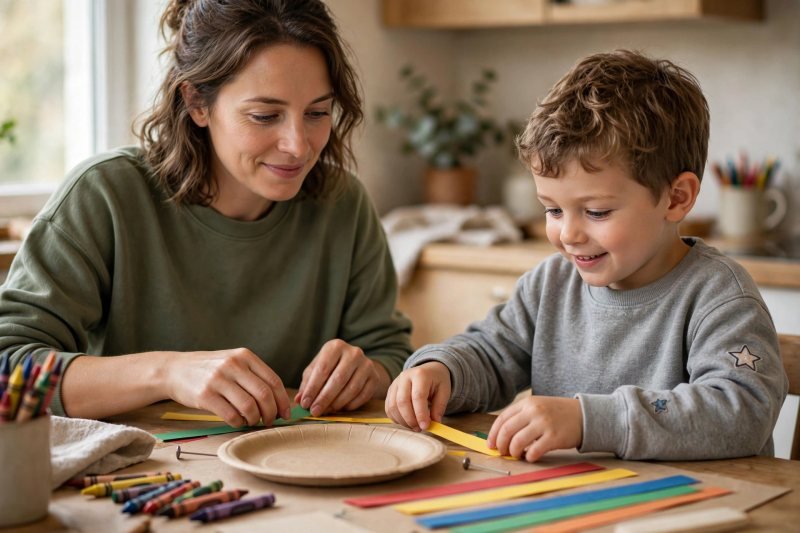
Lay out the supplies together. Spread the plate, hands, pin, and crayons on the table. Let your child pick which colour becomes the short hand — small choices buy big buy-in.
-
Build the learning clock. Pin both hands through the plate's centre, fan them out, and spin them. Let your child name the clock — a named clock gets played with.

-
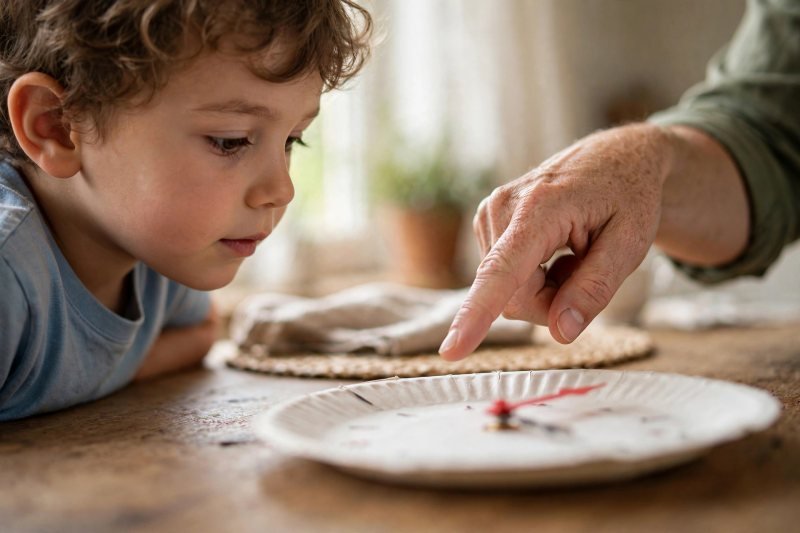
Meet the two hands. "Short hand: the hour hand — it tells us WHICH hour. Long hand: the minute hand — for o'clock, it has one job." Have your child repeat both names while touching each hand.
-
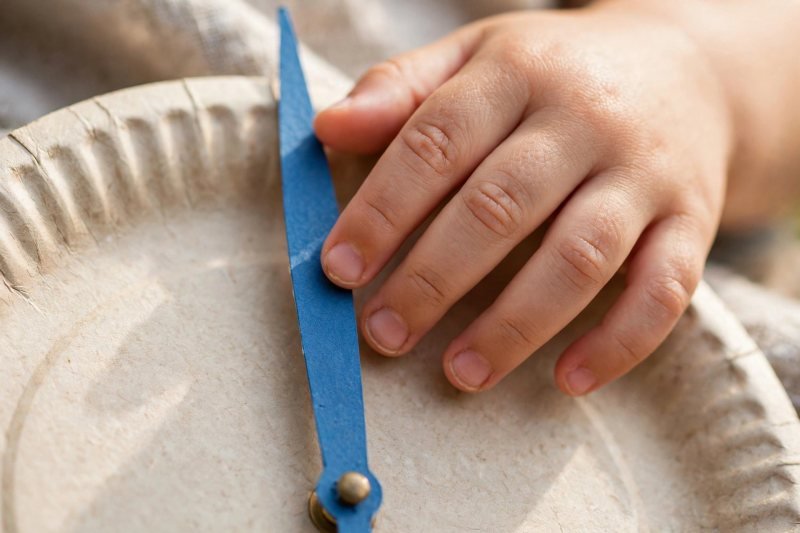
Set the straight-up position. Slide the long hand to point straight up. "When the long hand points straight up, it's an o'clock time. This never changes." Let your child slide it up and back until it feels automatic.
-
Read your first o'clock. Long hand straight up, short hand on the third tick past the top — drumroll it: "Three… o'clock!" Repeat with 7 and 12 o'clock, long hand up first every time.

-
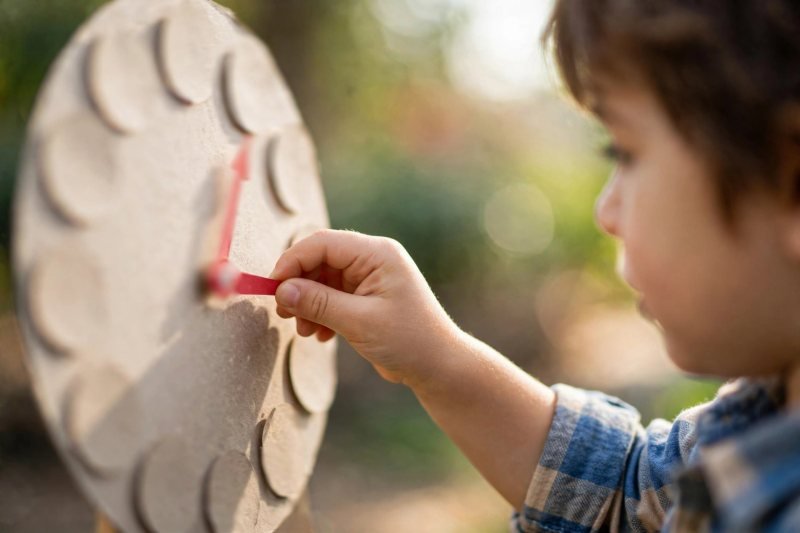
March around the hours. Keep the long hand up; move the short hand from 1 o'clock to 12 o'clock while your child calls out each one — our counting to 20 activities keep the number sequence fresh if they stall. If they stumble, park on that hour and try it twice more.
-
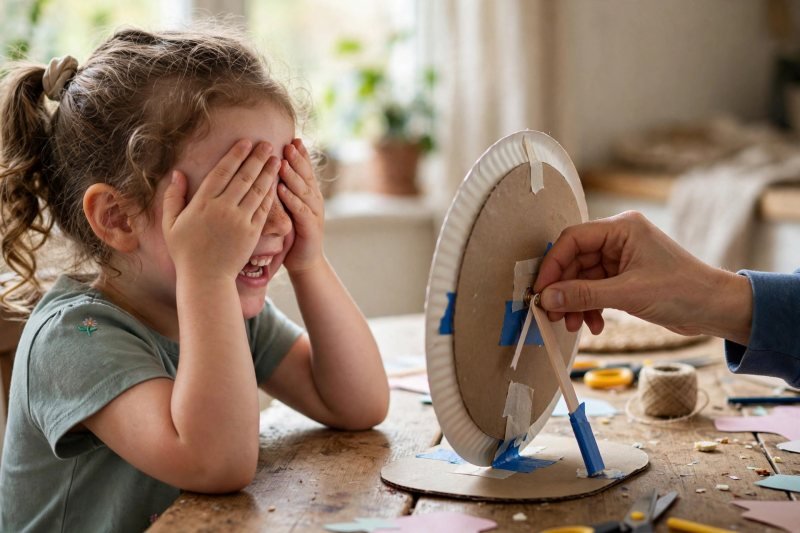
Play "secret setting." Your child covers their eyes while you set an o'clock — say, 5 o'clock. They uncover, check the long hand ("Straight up? O'clock!"), then read the hour. Three or four rounds.
-
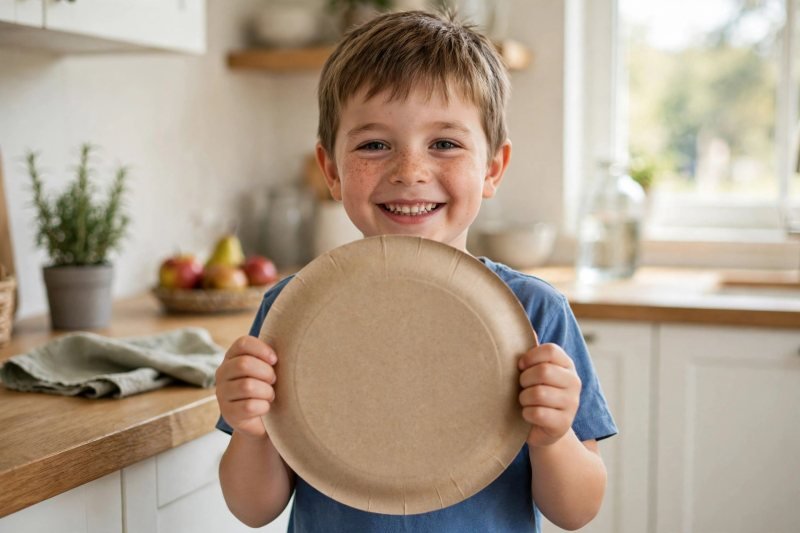
Swap roles and get it wrong. Your child sets the o'clocks; you read them. Get one deliberately wrong — "Nine o'clock!" when it's 4 o'clock — and let them correct you with full drama. Being the expert cements it.
-
Go on an o'clock hunt. Walk the house reading every analogue clock on an o'clock time: "Long hand straight up, short hand on 6 — six o'clock!" None on the hour? Set the learning clock to match the nearest and compare.

-
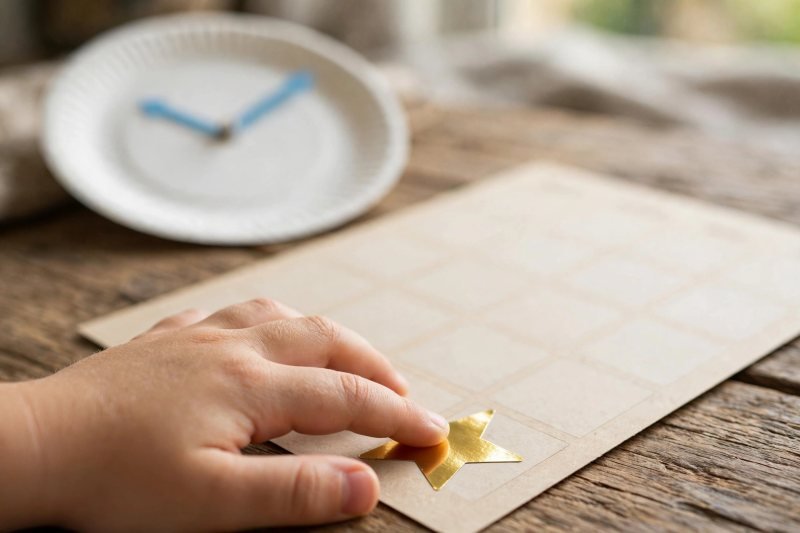
Sticker the win and tease what's next. A star sticker per o'clock read, stuck on the fridge. Then point the long hand straight DOWN and whisper: "Next time, we learn what THIS means."


Make it easier
Hands getting mixed up? Remove the long hand and practise with only the short hour hand — one hand can't be confused with anything. Keep sessions to five minutes and start with hours 1–6. If numerals are the issue, our number recognition activities for preschoolers helps first.
Make it harder
For instant readers: ask which o'clock comes next ("the short hand is nearly on 5 — what's almost here?"), read a real clock with identical-looking hands, run speed rounds against a kitchen timer, or play our skip-counting by 2s, 5s and 10s games to stretch the same clock sense toward minutes. Naming hours 24-hour style — "It's 15 o'clock!" — gets a laugh and stretches the concept.
Other ways to play it
- O'clock meals: announce the day's schedule as o'clocks — "Lunch is at twelve o'clock!" — and let your child declare it when the kitchen clock agrees.
- Bedtime countdown: "Story time is seven o'clock" — checking the clock joins the routine instead of fighting it.
- Toy clock shop: line up stuffed animals; your child "sells" each an appointment, setting the clock and announcing the time per customer.
How it changes by age
- Fits ages 5–6, when most children count to 20 and recognise numerals 1–12 (1–6 is enough to start). Can't name the dial's numbers yet? Do number recognition first — guessing turns a confidence-builder into a frustration. Some four-year-olds are ready; some six-year-olds need the easier version for a week.
What they're learning
Number recognition and sequencing activities for preschoolers (hours run 1–12 in order); the core idea that clock position carries meaning; fine-motor control from building and spinning the hands; and the time vocabulary — hour hand, minute hand, o'clock — that every later skill stacks onto.
Clearing up
Recycle the offcuts, cap the crayons, done. Keep the learning clock on the fridge for daily spot checks — you'll reuse it for half past. One honest note: a real hour hand sits exactly on the number only at the precise hour; by 3:30 it has crept halfway toward the 4. Teach the idealized version first, and mention the creeping hand when you start half past.
Questions parents ask
How long does it take a child to learn to tell time to the hour?
My child keeps mixing up the hour hand and the minute hand. What helps?
Should I teach o'clock on an analogue clock or a digital clock?
What if my child doesn't recognise the numbers 1–12 yet?
Can I teach half past at the same time as o'clock?
Why does the hour hand look "between" the numbers on our real clock?
Don't add half past "while you're at it" — one rule per lesson is this method's whole power. If o'clock is shaky after one sitting, replay the games tomorrow. Three real o'clocks read in a row without hesitation means they're done — our full parent guide to teaching time maps out what follows.


