


Analogue vs Digital Clocks: Help Kids Read Both
A 25-minute bridge lesson for ages 6–8: read both analogue and digital clocks — the colon rule, the five-minute table, and translating 3:30 both ways.
Kids who read digital times like 3:30 can learn analogue by connecting the two: the digits before the colon are the hour, the digits after are the minutes, and each analogue number means five minutes. Times past :30 flip to “to the next hour” — 4:40 is twenty to five.

The short version
- Digital is two jobs split by a colon: hour digits before, minute digits after.
- The five-minute table turns digital minutes into hand positions.
- Minutes past :30 flip to “to the next hour”: 4:40 is twenty to five.
- The hour hand names the hour it LEFT — at 7:55 the hour is still 7.
- 12:00 needs context (noon or midnight); 1:05 is “one oh five.”
- Age
- Ages 6–8
- Prep
- 10 min
- Play time
- 25 min
- Mess
- None
- Difficulty
- Easy
- Where
- Indoor
Why kids love this
Kids this age already feel like digital-clock experts. This lesson makes them bilingual: they crack the "secret code" of the grown-up dial.
What you'll need
- A learning clock with movable hands (our paper plate clock craft shows the 25-minute build); index cards or sticky notes and a marker; a real digital clock: microwave, oven display, or alarm clock.
Before you start
Write eight digital times on index cards: 4:00, 2:30, 7:15, 6:05, 3:30, 4:40, 7:55, 12:15. Check the learning clock's hands spin freely.
How to do it
-
**Step 1 — Warm up with a digital read-aloud.** Work through these in order — each step teaches one translation skill — and stop while it is still fun. Hold up your cards one at a time — 4:00, 2:30, 7:15, 6:05. Your child reads each the way they'd say it: "four o'clock," "two thirty," "seven fifteen," "six oh five."

-
**Step 2 — Name the parts.** Walk to the microwave. "Digits before the colon are the HOUR. Digits after are the MINUTES." Your child covers each side with a finger and names it back.

-
**Step 3 — Chant the five-minute table.** On the learning clock, point at each number: 1 is 5 minutes, 2 is 10, 3 is 15 … 12 is 0. Chant it twice. This table is the engine of analogue reading. If the counting rhythm itself still wobbles, slow down first with our [counting practice for little ones](/activities/counting-activities-for-toddlers/).

-
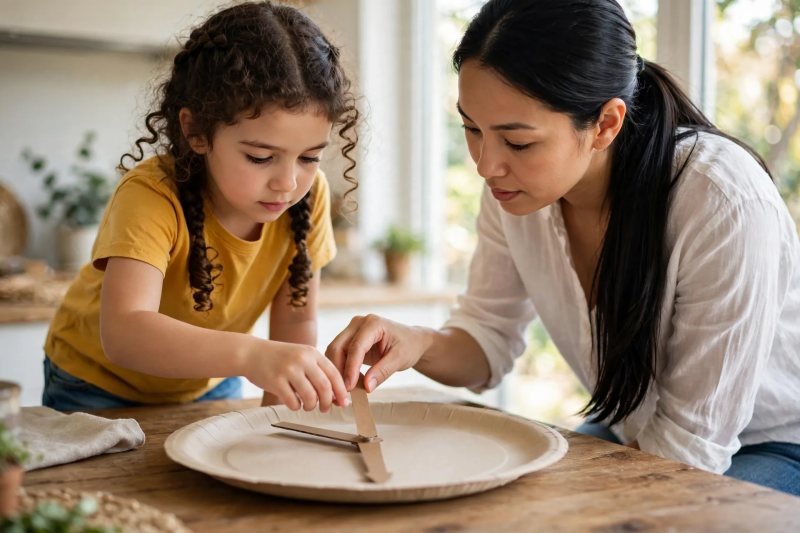
**Step 4 — Build 3:30 on the dial.** "Hour digits say 3 — the SHORT hand goes halfway between 3 and 4. Minutes say 30 — that's the 6 — so the LONG hand points straight down." Set it together: half past three.
-
**Step 5 — Learn the flip with 4:40.** "Forty is past 30, so we flip: 60 minus 40 is 20, toward the NEXT hour." Minute hand on the 8, hour hand nearly at 5: "twenty to five."

-
**Step 6 — Translate backwards: 7:25.** Set the clock: minute hand on the 5, hour hand just past 7. "Five times five is 25 minutes. The hour hand just left 7." Write the digits: 7:25.

-
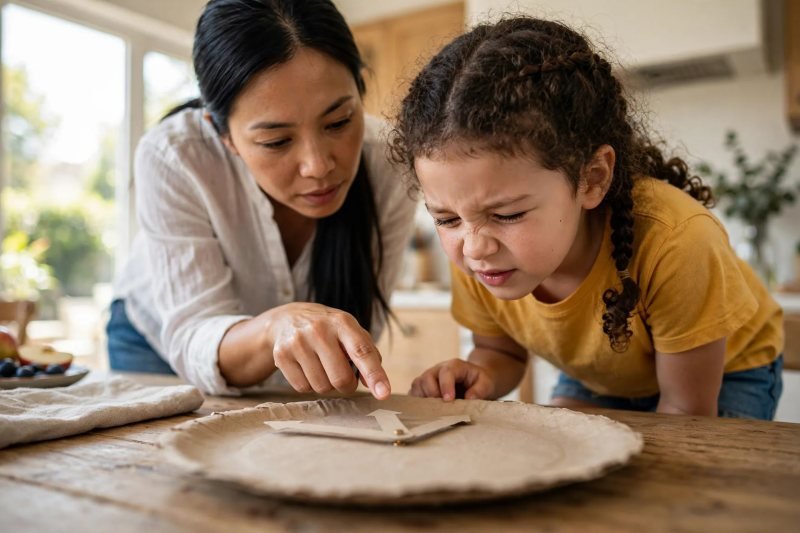
**Step 7 — Catch the drifting hour hand: 7:55.** Minute hand on the 11, hour hand kissing 8. "The digital says 7!" Read it: "five to eight." The hour names the hour it LEFT, never its destination.
-
**Step 8 — Defuse the tricky times.** Lay out 12:00, 12:30, 1:05, 12:15. "Noon or midnight? The digits can't tell you; the light outside can." 1:05 is "one oh five" — the zero means five minutes, not fifty.
-
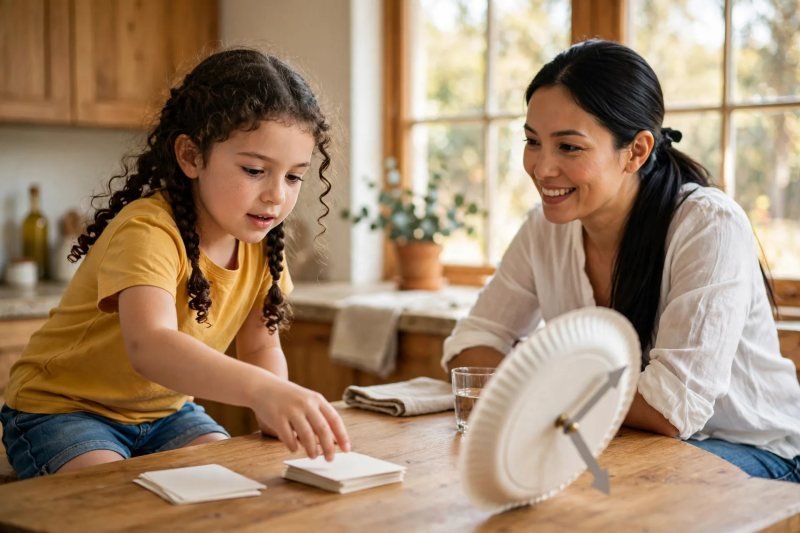
**Step 9 — Play translator.** Deal the cards face down. Your child draws one, sets the clock to match, and says it both ways. Then swap roles.
-
**Step 10 — Scavenger hunt.** Walk the house — microwave, oven, alarm clock, wall clock. At each, your child reads both languages: "the microwave says 6:25, so the wall clock reads twenty-five past six."



Make it easier
Stick to :00, :15, and :30 at first — 3:30 is the friendliest bridge. Cover the right half of the learning clock with a sticky note so early translations use the easy side. Skip the “to” flip at first; add it a week later.
Make it harder
Countdown math — “It’s 3:40. Bedtime is 4:00. How many minutes?” Nearest-five — read odd times like 8:47 by rounding, “nearly ten to nine.” AM/PM detective — 7:00 morning versus 7:00 night.
Other ways to play it
- Magnetic fridge clock — a blank face with magnetic-strip hands, translations all day. Car-dashboard spotting — your child calls the digital time and translates it before the next traffic light. Time detective notebook — log one digital time and its analogue twin each day.
How it changes by age
- Best at 6–8, once a child reads o’clock and half past. A five-year-old who knows the basics can manage steps 1–4; save the flip for six and up.
What they're learning
Two symbol systems for the same information. The five-minute table is skip-counting in disguise; the flip is subtraction (60 − 40 = 20). If the mental math needs sharpening first, these [addition games for kindergarten](/activities/addition-games-for-kindergarten/) build exactly the fluency the flip relies on. Analogue shows time as a journey around a dial, digital as a number.
Clearing up
Stack the cards with a rubber band — tomorrow’s game. Leave the learning clock somewhere visible. Two minutes, nothing to wash.
Questions parents ask
What’s the easiest way to teach the difference between analogue and digital clocks?
Why is digital 3:30 the same as half past 3?
How do kids convert digital time to analogue words?
What does 12:00 mean on a digital clock — noon or midnight?
In American English, “three thirty” is the everyday phrasing and “half past three” the school phrasing. This is the natural next step after telling time to the half hour — and telling time games keep both languages sharp.


