


Number Order Activities: Before, After and What's Missing for Ages 4–5
Ten number order activities for ages 4–5 that teach what comes before, what comes after, and what's missing. Card games, number-line walks and snack math — no worksheets, no drilling.
The best number order activities for ages 4–5 are before-and-after card quizzes, missing-number games where kids spot and fill gaps, and number-line walks where they step one more or one less. Start with 1–10, add 11–20 when ordering is smooth, and keep the full number row visible while "before" questions are still hard.

The short version
- "After" comes free with the counting chant; "before" is a separate, harder skill — teach it with a visible number row.
- Keep the full 1–10 (later 1–20) row on the table while the questions are hard; the row is the teacher.
- Start with 1–10; stretch to 11–20 once ordering is smooth.
- Ten minutes a game, a few times a week, beats drilling.
- The day it feels like a test, switch to the snack game.
- Age
- Ages 4–5
- Prep
- 10 min
- Mess
- None
- Difficulty
- Easy
- Where
- Indoor
Why kids love this
These number order activities feel like detective work, not math. Cards disappear and get hunted down, snacks get lined up and eaten, and a tape line becomes a one-more, one-less runway. Your child fixes the order, finds the missing card, calls the answer — and you keep making it trickier. ## Why is "what comes before 7?" so much harder than "what comes after 7?" Counting only goes forward. Kids chant 1, 2, 3… as one song, so "after" is just the next word. "Before" asks them to run the song backwards or jump into its middle — a different, harder skill. Step 4 pairs "before" questions with the visible card row: the row holds the sequence still while their brain learns the direction. ## Should I teach number order to 10 first, or go straight to 20? Start with 1–10 until ordering is smooth — a week or two of playful games. The 11–20 stretch has trickier names and two-digit symbols, so adding it early just adds noise. When 1–10 is solid, introduce 11–20 as "the same game, longer road."
What you'll need
- 20 index cards or thick paper cut to size
- A thick marker (you write the numbers)
- Painter's tape or chalk
- A small tray or basket for the cards
- Round crackers or wooden counters for the snack game
- Kid-safe scissors for card making
Before you start
Cut 20 cards and write 1–20 on them, one per card — big and bold. Clear floor or table space for a long card row. For the number-line walk (Step 5), lay painter's tape on the floor first. For the scavenger hunt (Step 10), pick 10 easy hiding spots in one room.
How to do it
-
**Make the number cards together.** You cut, your child sorts. Write 1–20 on the cards, saying each aloud. Your child arranges them 1 to 20 face-up; when one lands wrong, ask "does that fit its neighbors?" This deck is your toolkit for every game below. Play the games in order — each builds on the last — starting with cards 1–10; add 11–20 once your child orders 1–10 confidently.

-
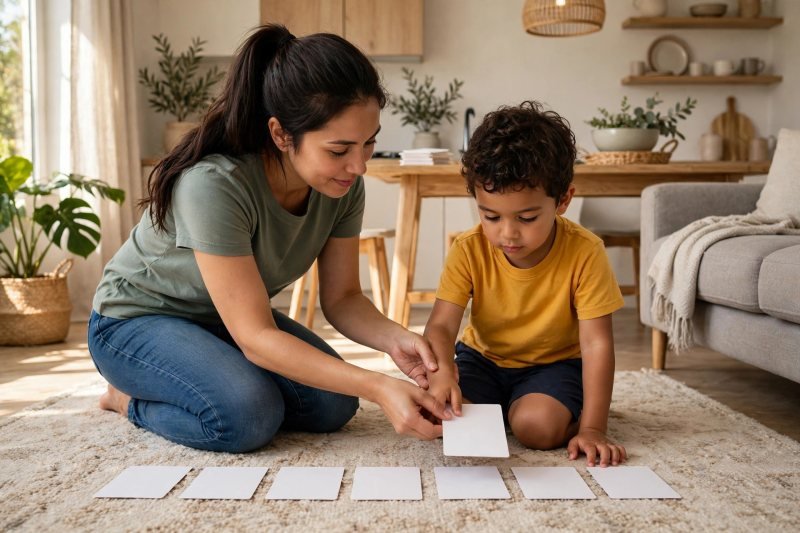
**Lay out 1–10 in order.** Shuffle just cards 1–10 and hand them over one handful at a time. Your child builds the row left to right while you say the sequence together: "1, 2, 3…" When a card lands wrong, point at its neighbors and let them spot the problem.
-
**Play "What's missing?"** Your child covers their eyes (no peeking — drama encouraged). Remove two cards and slide the row closed. Eyes open: "What's missing?" They name the gaps and slot the cards back. Start with one, work up to three.

-
**Ask before and after with one card.** Hold up one card — say 7. "What comes right BEFORE 7? What comes right AFTER 7?" Keep it light, like a quiz show. When they answer a "before" question with the next number, lay the full row out: look left for before, right for after.

-
**Walk the number line.** Place cards 1–10 along your tape line, spaced for stepping. Your child stands on a card you name — say 5 — then you call "one more!" (step forward) or "one less!" (step back), naming each landing card. The body learns what before and after feel like.

-
**Fill the missing-number line.** Set out cards 1–20 with a few flipped face-down (1, 2, ?, 4, 5, ?, 7…). Your child flips each mystery card, or finds the right one from a pile. Read the finished line together — hearing the sequence run clean is the reward.

-
**Play mystery number guessing.** "I am thinking of the number right after 11." Your child whispers the guess in your ear — secrecy makes it stick. Flip the roles: they invent a before-or-after clue and you guess. A child who can quiz you owns the idea.

-
**Run an order shuffle race.** Shuffle all 20 cards and time your child rebuilding the 1–20 line. Note the time; another day, challenge them to beat it — never race them yourself. Celebrate a smoother rebuild, not just a faster one.

-
**Play the sandwich number snack.** Line up 10 crackers. "What number is between cracker 6 and cracker 8?" Your child points, names it — then eats it, because that is the point. Rearrange the snacks so the question changes. Edible math is memorable math.

-
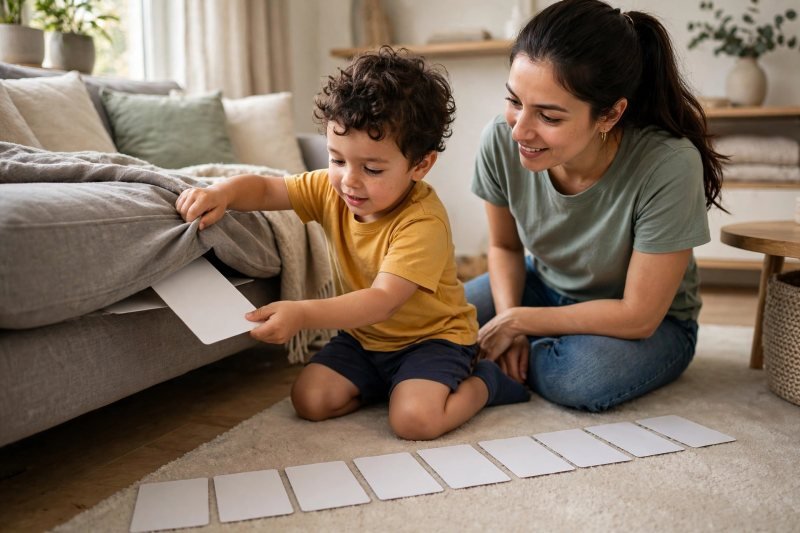
**Finish with a number-order scavenger hunt.** Hide 10 cards around one room while your child waits outside the door. Each found card gets filed into the 1–20 floor line in its place. The game ends with the sequence rebuilt — let them read it aloud for the finale.


Make it easier
Play with cards 1–5 only until the idea clicks. Keep the full number row visible during every before-and-after question. One game a day — a week of short games beats one long session.
Make it harder
Ask "what comes two before 9?" or "two after 14?" Hide four or five cards in the missing-number game instead of two. Ask your child to explain: "How did you know it was 12?" Order 1–20, then read the row backwards from 20 to 1.
Other ways to play it
- **Number-line hopscotch:** draw the line outside with chalk and hop one more, one less.
- **Toy train:** line up toy cars in order; the missing car is the mystery.
- **Calendar countdown:** each morning, name the number that comes before today's date.
- **Reverse dealer:** your child quizzes you — wrong answers allowed.
How it changes by age
- Built for ages 4–5, when most children can chant 1–20 but are learning where each number lives. Younger siblings (3+) can play the 1–5 row as helpers. Nailing before, after and missing to 20? Try our addition games for kindergarten next. Still shaky on the count itself? Our counting to 20 activities and counting games for preschoolers smooth out the sequence first.
What they're learning
Ordinal thinking: each number has fixed neighbors — one before, one after Spotting gaps in a sequence, the foundation of the number line Counting backwards from 20 — the skill "what comes before" actually needs Comparing order: 14 comes after 12, so it is bigger Left-to-right directionality that later supports reading and place value
Clearing up
Three misconceptions to drop first: **"My child can count to 20, so they know number order."** Not yet. Chanting forward is one skill; knowing what sits before 13 without restarting is another. These games build the second. **"Before-and-after is just memory."** It is reasoning — locate the number, step one slot either way. Number-line thinking, not recall. **"Writing the numbers proves understanding."** A child can form every digit and still guess wildly at "what's missing?" These games test the idea, not the handwriting.
Questions parents ask
At what age should a child know what comes before and after a number?
Why is "what comes before 7?" harder for my child than "what comes after 7?"
How can I practice number order at home without worksheets?
My child can count to 20 but can't name the missing number - why?
Should I teach number order to 10 or 20 first?
How is number order different from counting?
Ten minutes a game, a few times a week, is plenty. Drop questions into ordinary moments: "What comes after our house number?" on the porch, "What number is before your age?" at dinner. When "before" answers come out as the next number, walk it back on the card row — it is the teacher, not you. The day it feels like a test, switch to the snack game.

save it for later
Pin this for the next rainy afternoon
Keep it on a board so it is there when you need it, rather than when you happened to find it.
Save to Pinterest
