


How to Teach a Child to Tell Time: A Step-by-Step Parent Guide
How to teach a child to tell time without tears: start with daily routines, then o'clock, half past, quarters and minutes — using a homemade clock and ten minutes of play a day.
To teach a child to tell time, start with time language in daily routines (before/after, first/then), then teach o'clock and half past on a homemade tick-mark clock, then quarter past and quarter to one at a time, then minutes in fives. Ten playful minutes a day over a few weeks beats any crash course.

The short version
- Most children are ready around 5–6, when they can count to 20 and understand before/after.
- Start with an analog clock (tick marks, color-coded hands) — digital comes easily afterwards.
- Teach in order: o'clock, half past, quarter past, quarter to, then minutes in fives — a few days per step.
- Time language in everyday chat (first/then, yesterday/tomorrow) is half the battle.
- Use real moments — mealtimes, baking, sand-timer races — instead of worksheets.
- Never rush quarters; two weeks per quarter is completely normal.
- Age
- Ages 5–6
- Prep
- 15 min
- Play time
- 10 min
- Mess
- Low
- Difficulty
- Easy
- Where
- Indoor
Why kids love this
If you're wondering how to teach a child to tell time without it ending in tears — yours or theirs — you're asking the right question at the right age. Most children are ready around five or six, and the secret isn't drilling or worksheets: it's ten playful minutes a day with a homemade clock, daily routines narrated out loud, and games that make the hands on the dial feel like a puzzle to solve. This guide walks you through it step by step, in the order that actually works: time language first, then o'clock and half past, then quarters, then minutes — with a game for every stage. If your child has only ever seen digits on a screen, read why to start with an analog clock before you begin.
Children are fascinated by grown-up clocks — and this guide hands them the keys. Building their own big clock, moving the hands themselves, and suddenly being able to answer "what time is it?" feels like a genuine superpower. Because every step is a game (beat the sand timer! spot the o'clock!), practice never feels like a lesson.
When is the right age to teach a child to tell the time? Most children are ready to start around five or six — and readiness shows up as language, not maths. If your child understands before and after, first and then, and can count to 20 without tripping, the foundations are in place. O'clock and half past usually click around five; quarters around six; minutes in fives between six and seven. Starting earlier rarely helps, because time-telling leans on sequencing and number sense that aren't there yet at four. The exception is time language itself: narrate routines ("after breakfast we brush teeth") from age three, and the clock comes far more easily later. For more routine-based play ideas, our preschool learning activities at home collection is full of them.
Should I start with a digital or an analog clock? Start analog — always. Digital clocks hand children the answer without the reasoning: 4:30 means nothing about halves or position. An analog clock shows time as space, and space is how young brains understand quantity. The big hand sweeping round teaches halves, quarters, and "nearly" in a way digits never can. Once analog clicks, digital takes about five minutes — and plenty of classrooms still have analog clocks on the wall.
How do I teach o'clock and half past first? These two are the foundation everything stacks onto, so give them a full week or two. With the big hand pointing straight up: "When the big hand points to the top, the little hand tells us the hour." Move the short hand round slowly, then let your child set o'clocks for you to name — getting it "wrong" on purpose and being corrected is comedy gold that cements the learning. Then the big hand straight down: "Halfway round — half past!" Connect it to life: "We have lunch at half past twelve." Quiz gently in passing and celebrate correct answers like lottery wins.
How do I teach quarter past and quarter to without confusing them? One at a time, a week apart — this is where most parents accidentally rush. Teach quarter past first, big hand pointing right: "A quarter of the way round, like a quarter of a cake." Cut an actual apple into quarters if you can; the visual is worth a thousand explanations. Only when quarter past is solid, introduce quarter to: big hand pointing left, and the genuinely weird idea that we name the hour that's coming. "Quarter to five" breaks brains because the little hand is nearly at five already. Validate the confusion, then play: you set quarter-tos, they guess, then swap. Two weeks on quarters is normal.
What about the minute hand — how do children learn to count in fives? Once quarters are comfortable, the minute hand becomes a counting game. Point at each tick mark and count round together: 5, 10, 15, 20… all the way to 60 — as a chant, a song, a race. Repetition with rhythm sticks. Then connect the fives to what they know: "15 minutes past — that's quarter past! 30 minutes — half past!" Watching the pieces join up is the best moment in the whole process. Minutes to the hour ("twenty to") can wait until last — like quarter to, they name the coming hour, which is the trickiest idea of all.
How do I make telling the time actually stick? Use, don't drill. The children who retain time-telling are the ones who use it: "Can you check if it's nearly dinner time?" "What time does swimming start — can you watch for it?" Build clock-checking into the day's real questions and the skill maintains itself. Three games do most of the work. Schedule cards: picture cards of the day's events laid in order, each matched to its time on the learning clock. Beat the timer: sand-timer challenges ("can you tidy the blocks before it runs out?") that teach duration as a feeling. Baking o'clock: real recipes with real waiting — nothing teaches minutes like a cake in the oven. Ten playful minutes a day, woven into life, beats any workbook — and the Bright Playday learning hub has more play-based maths ideas when you're ready.
What you'll need
- Things your family already owns or can find in a drawer: a paper plate (or a circle of card), a split pin or a dab of Blu-Tack, two strips of card for hands (one long, one short), crayons, and a kitchen timer or phone timer. That's the whole kit.
Before you start
Make the learning clock together: draw 12 tick marks around the plate (no numbers yet — ticks only), attach two card hands with a split pin so they spin, and color the short hand differently from the long. The crafting is lovely fine-motor practice — our fine-motor activities for preschoolers has more cut-and-stick ideas in the same spirit. Then pick one daily moment — breakfast, say — as your "clock moment".
How to do it
-
Build the paper-plate clock together. Draw 12 tick marks around the plate (no numbers yet — ticks only), attach two card hands with a split pin so they spin, and color the short hand differently from the long. Say, "You're building a real clock — short hand, long hand, your hands make them move." The crafting is lovely fine-motor practice, and a clock they built themselves is a clock they want to use. Work through what follows in order, a few days per step — ten minutes a day beats an hour on Sunday.

-
Talk time first. Build "time language" into the day before touching the clock: first/then, before/after, morning/afternoon. Narrate routines out loud: "After lunch we go to the park; first shoes, then the gate." Say the words, then hand them over: "What comes after breakfast?" A child who lives in before-and-after will meet the clock face already half fluent.

-
Set and name the o'clocks. Big hand straight up; move the short hand and name the hours together. Let them set o'clocks for you to guess — and get it "wrong" so they can correct you. Say, "Big hand to the top — what does the little hand say?" Being the expert who catches your mistakes is comedy gold that cements the learning.

-
Add half past. Big hand straight down: "Halfway round — half past!" Link it to life: "Lunch is at half past twelve; can you set it?" Quiz gently in passing — "Is it half past yet?" — and celebrate correct answers like lottery wins. O'clock and half past are genuinely useful on their own, so stay here as long as you like.

-
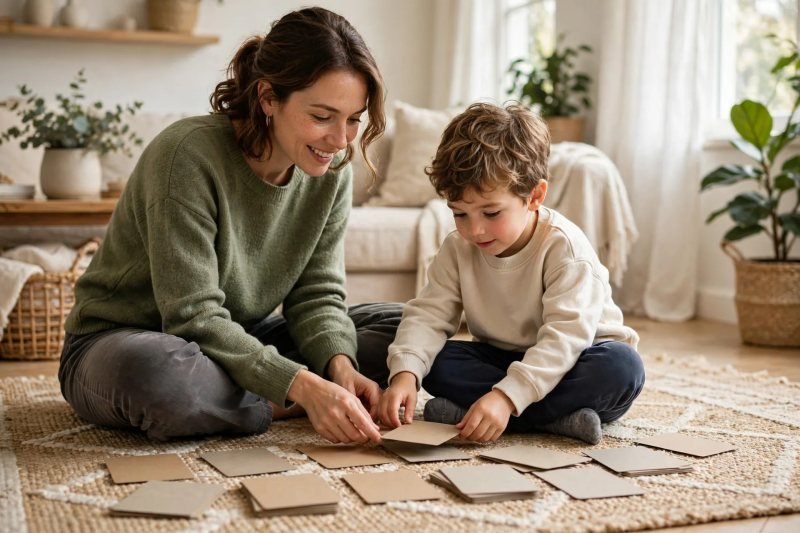
Teach quarter past with cake. One new idea at a time: big hand pointing right, "a quarter of the way round, like a quarter of the cake." Cut an actual apple into quarters if you can; the visual is worth a thousand explanations. Say, "The big hand ate one quarter of the circle — quarter past!" Play it as a game for a full week before anything new.
-
Introduce quarter to. Only when quarter past is solid: big hand pointing left, and the genuinely weird idea that we name the hour that's coming. Say, "Quarter to five — the little hand is nearly at five already, isn't that strange?" Validate the confusion, then play: you set quarter-tos, they guess, then swap. Two weeks on quarters is normal.

-
Count minutes in fives. Point round the dial chanting 5, 10, 15, all the way to 60 — as a chant, a song, a race. Say, "Every tick mark is five minutes — let's race round!" Repetition with rhythm sticks, and the chant turns the whole dial into one countable line.

-
Connect the fives to what they know. Now join the pieces: "15 minutes past — that's quarter past! 30 minutes — half past!" Say, "You already knew this bit — look!" Watching the fives click into the quarters and halves is the best moment in the whole process. Minutes to the hour ("twenty to") can wait until last — like quarter to, they name the coming hour, the trickiest idea of all.

-
Graduate to a real clock. Move from the homemade clock to a real analog clock on the wall and connect it to their day: "Can you tell me when it's four o'clock? That's swimming time." Say, "Same hands, same game — just a grown-up clock." Without the color-coded hands they'll wobble at first; the rhyme "little hand hour, big hand minutes" steadies them.

-
Weave clock-checking into the day. The children who retain time-telling are the ones who use it: "Can you check if it's nearly dinner time?" "What time does swimming start — can you watch for it?" Say, "You're the family's timekeeper today." Ten playful minutes a day, woven into real questions — mealtimes, baking, sand-timer races — beats any workbook, and the skill maintains itself.


Make it easier
Stay on steps 2–4 for as long as needed — time language, o'clock and half past are genuinely useful on their own. Use only the homemade tick-mark clock, and keep sessions to five minutes. Time language in daily chat (before/after, first/then) is half the battle.
Make it harder
For confident clock-readers: minutes one by one past the hour, "quarter to" puzzles ("it's quarter to five — how many minutes until five?"), and reading a real clock without the color-coded hands.
Other ways to play it
- Beat the timer: set the sand timer and tidy up before it runs out — duration you can feel.
- Schedule cards: picture cards of the day's events in order; match each to its clock time.
- Time detective: spot clocks on walks — the church tower, the bus stop, shop windows. For more number play beyond the clock, browse our play-based math hub.
How it changes by age
- For ages 5–6, when children can count reliably to at least 20 and understand before/after. Most children learn o'clock and half past around five, quarters around six, and minutes in fives between six and seven — but the range is wide and completely normal. Never rush; a shaky foundation wobbles for years.
What they're learning
Sequencing and time language; number sense (counting in fives, fractions as quarters and halves — our counting games for preschoolers build the same number muscles); fine-motor control (making and moving the clock hands); real-world maths — connecting numbers to the actual day.
Clearing up
One paper plate, two card strips, done — recycle the offcuts. Wipe the table if the crayons escaped. The clock itself lives on the fridge or a bedroom wall for daily practice.
Questions parents ask
What age should a child learn to tell the time?
Why does my child keep mixing up the hour and minute hands?
Should I teach "quarter to" before or after "quarter past"?
My child can read a digital clock — do they still need analog?
How long does it take a child to learn to tell the time?
What if my child just isn't interested in clocks?
Patience is the method: ten playful minutes daily beats any weekend crash course. Celebrate every "I did it!" — confidence compounds. If quarters stall, park them for a month; o'clock and half past keep things moving. Our counting hub has more number games for this age when you're ready for them.

save it for later
Pin this for the next rainy afternoon
Keep it on a board so it is there when you need it, rather than when you happened to find it.
Save to Pinterest


