


Luau Birthday Party Ideas: A Hawaiian Bash for Kids
A luau birthday party for a 6th birthday: paper leis with a real welcome, lei-making, limbo, Hawaiian music, a tropical feast, and a volcano cake with exactly six candles — a respectful 2-hour plan for ages 5-6.
A luau birthday party for ages 5–6 is a sunny two-hour 6th birthday: a lei welcome with its real meaning, a threaded keepsake lei, limbo and pineapple bowling, dancing to Hawaiian music, a tropical feast, and a volcano cake with exactly six candles lit only by an adult.

The short version
- Plan small and sunny: six to eight guests, a two-hour picture-ordered arc, shade first, and an indoor fallback ready.
- Welcome with meaning: a lei is a flower garland of welcome and celebration — loose, breakaway, and off for active games.
- Play honestly and kindly: limbo is a classic party game, not Hawaiian; hula-inspired movement is respectful storytelling, led by an adult.
- Feast safely: allergies checked in writing, grapes halved lengthways, children seated, cold water poured often.
- The cake carries exactly six candles for a 6th birthday — an adult lights, guards, and removes them; LED torches mark the edges.
- Age
- Ages 5–6
- Play time
- 120 min
- Mess
- Some
- Difficulty
- Medium
- Where
- Outdoor
Why kids love this
A luau birthday party works for five- and six-year-olds because it feels like a trip and a celebration at the same time — and every part of it is something they do, not something they watch. The birthday child is greeted like an honored guest, threads her own keepsake lei flower by flower, tests how low she can go in limbo, rolls a soft ball at a row of pineapples, and moves her hands to tell a tiny story to Hawaiian music. Nothing is scary, loud, or win-or-lose. The games welcome every body and every speed, the feast is food she already loves in tropical colors, and the whole arc lasts about two hours — long enough to feel like a real Hawaiian bash, short enough to end, with a mahalo round and a handmade lei to carry home, while everyone is still happy. For a 6th birthday especially, making, moving, tasting, and blowing out exactly six candles is a complete celebration at exactly her size.
What you'll need
- Blank card stock in tropical colors — for hibiscus-shaped invitations; all cards, packaging, and containers kept blank, with no printing showing
- Tissue paper and sturdy paper in bright tropical shades, plus short paper straw pieces and paper spacers — for threading keepsake leis
- Soft cord or ribbon with simple breakaway joins — for lei strings, prepared by an adult; never tied tight and never worn during active games
- Simple ready-made paper-flower leis for the door welcome — loose, lightweight, and easy to lift off
- Paper for palm leaves, hibiscus flowers, and bunting triangles, plus string for hanging bunting high
- LED garden torches — flameless, placed by adults outside the play zone to mark the party edges
- A limbo bar or long soft pool noodle held by two adults, plus soft balls and clean empty bottles or foam pins decorated as pineapples for bowling — set up by adults
- A speaker for Hawaiian music, kept at a comfortable volume and controlled by an adult
- Fruit for the feast — pineapple, melon, strawberries, and grapes halved lengthways by an adult for every child; plus mini sandwiches with fillings checked against the allergy list
- A volcano-style birthday cake — a rounded cake with a small crater top — with room for exactly six candles, plus the six candles themselves
- Cold water and simple cold drinks, sunscreen, shade, a picnic blanket or party table, and a basic first-aid kit within adult reach
- Plain favor bags — one per child, to hold the handmade lei and one large, age-safe treat
Before you start
1. A week ahead, confirm the small guest list, ask every parent in writing about food allergies, and agree the two-hour time slot — late morning or mid-afternoon, with shade at its best. 2. Two days ahead, cut the hibiscus invitation shapes, palm leaves, and hibiscus decor, prepare the lei strings with breakaway joins, and count exactly six candles into a safe adult-only spot. 3. The morning of, hang bunting high, place the LED garden torches outside the play zone, set the craft table and party table in shade, and walk the yard once for anything sharp, small, or unsafe at child height.
How to do it
-
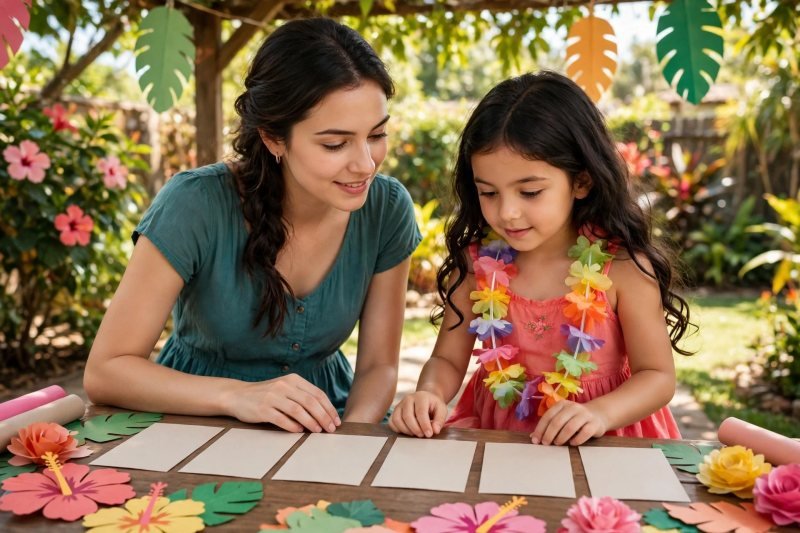
Plan the luau arc. Keep a 6th birthday small on purpose — six to eight guests plus their grown-ups is a backyard full, exactly the scale our 6th birthday party ideas recommend — and plan a friendly two-hour arc: a lei welcome; a keepsake lei craft; limbo and pineapple bowling; dancing to Hawaiian music; the feast and cake; a short splash or chill break; then a mahalo wind-down. Put the running order on a simple picture list the children can follow — a lei, a game, a cake, a splash — because reading the day in pictures is exactly the sequencing practice celebrated in preschool learning activities. Borrowing the calm, small-is-better logic of a 2nd birthday party keeps the day sized for the child, not the theme. Choose the shadiest corner for the craft and feast tables, keep a clear lane for games, and name your indoor fallback before anyone arrives — the living room with the same bunting works if rain appears. Say, "Aloha! Today we celebrate Hawaiian-style — here is our picture plan, and you can check what comes next."
-
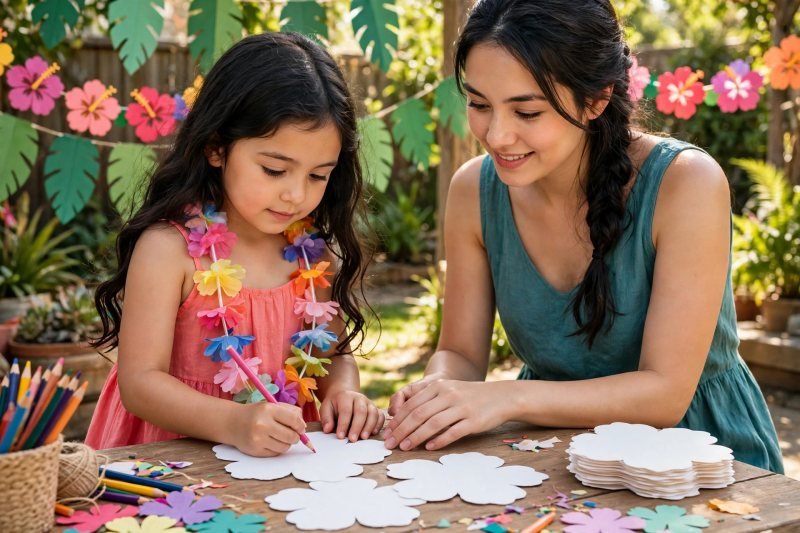
Make the invitations together. Cut blank card stock into simple hibiscus shapes — five rounded petals is plenty — and keep every card completely blank in any photo you take of it, with names, times, and addresses shared only in the parent message, never readable on the card itself. The birthday child's jobs are the joyful ones: coloring each petal in tropical shades, gluing one paper palm leaf to each card, and stacking the finished invitations like treasure. Hand-deliver nearby or photograph the blank cards for parents, putting the time, place, sunscreen note, and your allergy question in the message itself. Say, "You made these — your friends will know the party started with you." An invitation she helped make turns waiting into part of the celebration.
-
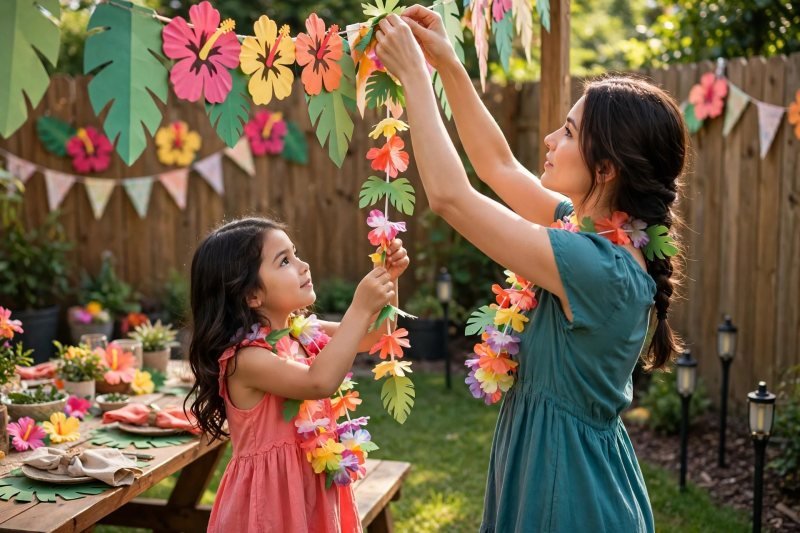
Build the tropical decor. Turn paper into the set: large palm leaves with snipped fronds, layered hibiscus flowers in coral, pink, and yellow, and bunting strung in gentle swags — mixing and layering those tropical shades is the same joyful color play explored in color mixing activities, here with scissors and glue instead of paint. The safety rule shapes the whole look: everything strung goes HIGH — bunting hangs at adult head height or above, well out of reach, and nothing is ever strung at child neck height, across doorways at throat level, or low enough to be pulled down. An adult, and only an adult, places the LED garden torches outside the play zone to mark the party edges; they are simple garden torches, switched on, never carried by children. Tuck paper leaves at path edges where they delight without tripping anyone, and keep walkways clear. Say, "We hang the pretty things high, where everyone can see them and no one can tangle in them."
-
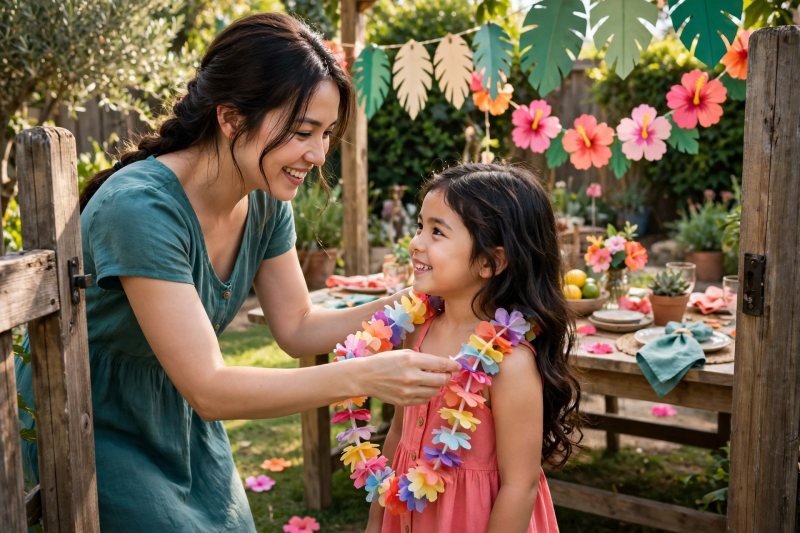
Welcome guests with a lei. Greet every keiki — keiki means children in Hawaiian — at the door the Hawaiian way: with a smile, a warm aloha, which means hello and carries love and welcome with it, and a simple paper-flower lei placed loosely over the shoulders. Pause for the explanation that makes this more than a costume: a lei is a garland of flowers given as a welcome and celebration symbol in Hawaii, offered to honored guests, graduates, and birthday children alike — so today, every guest is honored. Show how a lei sits loose around the shoulders, lifts straight off, and comes off instantly whenever a child wants, with no tying and nothing tight at the neck. Keep this door lei simple — each child will thread a special keepsake lei at the craft table. Say, "Aloha! In Hawaii, a lei is how you say welcome and we are so glad you are here — this one is yours." A welcome with meaning is the first thing guests remember.
-
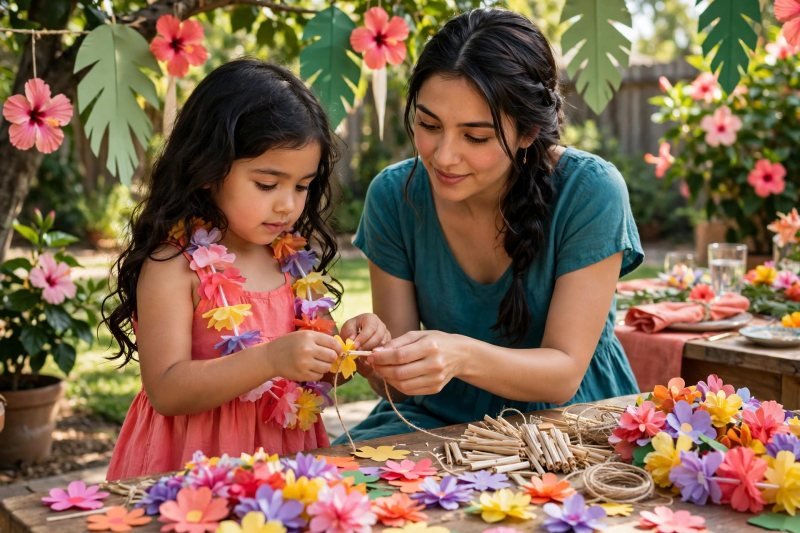
Craft your own lei. Settle everyone at the shaded craft table with a prepared string with a breakaway join, a pile of tissue and paper flowers in tropical colors, and short straw pieces and paper spacers to thread between the blooms — flower, spacer, flower, spacer, until the pattern each child invents fills the string. This is the fine-motor heart of the party: pinching, threading, and patterning small pieces builds exactly the hand strength and patience early writing needs, dressed up as jewelry-making — one of the simplest birthday crafts you can run at a party table. Work alongside them, admire patterns without correcting them, and help only with knots and joins. Remind the table of the lei rule that runs all day: leis are for welcoming, crafting, feasting, and calm moments — they come OFF and rest on the table for climbing, running games, and the splash break, so nothing ever pulls at a neck during active play. Say, "Thread your flowers in any pattern you love — your lei, your design." Finished leis go onto a safe tray, ready to wear again for the feast.
-
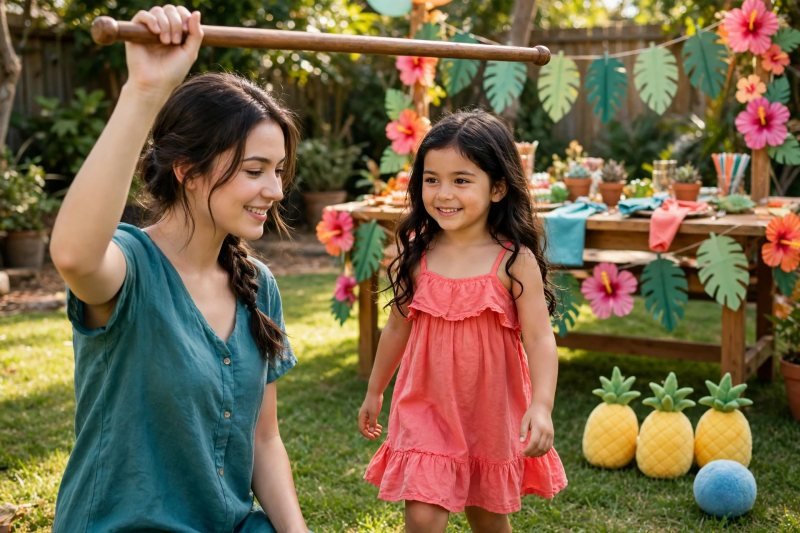
Play luau games. Open the games lawn with limbo, introduced honestly: limbo is a classic party game loved at celebrations everywhere — it is not a Hawaiian tradition, and saying so takes two seconds and models respect. Two adults hold the bar at both ends, starting high enough for everyone to walk under proudly, then lowering it a little each round; children may lean back, crouch, sidestep, or simply walk around and cheer — no one is ever pushed, forced to bend backward, or kept playing past a wobble, and taking the walk-under alternative earns the same applause. Follow with pineapple bowling: foam pins dressed as pineapples at the end of a short lane, soft balls rolled underhand, and every knockdown cheered by name. Leis stay off for both games, and water breaks come between rounds. Say, "Limbo is a party favorite from celebrations all over — how low can you go, your way?" Games with no losers and real choices keep the whole lawn laughing.
-
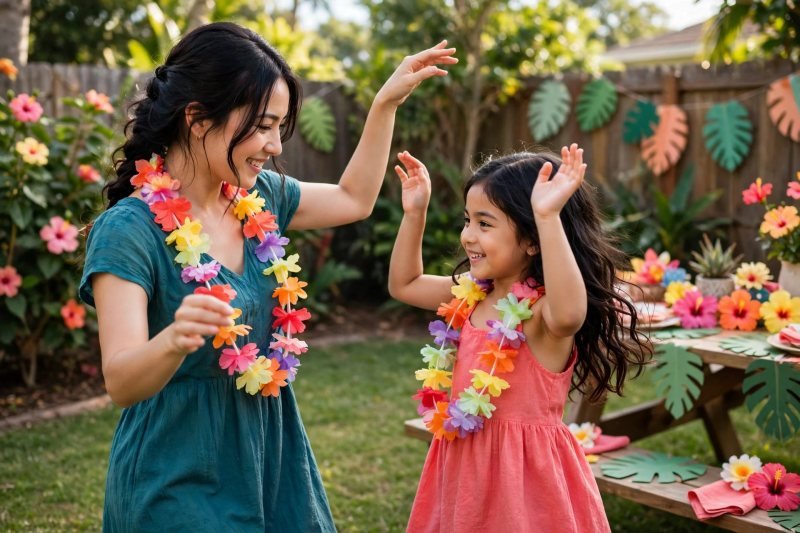
Dance to Hawaiian music. Gather the dancers on flat, clear ground, leis back on over party clothes — no costume changes and no caricatures, just children dancing as themselves — and put on real Hawaiian music at a comfortable volume. Explain, briefly and truly, that hula is a real Hawaiian dance tradition that tells stories: dancers use hands and steps to show waves, wind, rain, and journeys, and today the group borrows that beautiful idea respectfully, letting their hands tell a tiny story. An adult leads simple storytelling movements everyone can copy — hands rolling like gentle waves; arms swaying like palm leaves in a breeze; fingertips pattering like rain; feet stepping a slow, easy pattern in place — with seated dancing fully welcome and no child corrected for inventing a wave of their own. Alternate two short songs with water sips, and end while everyone wants one more. Say, "In Hawaii, dancers tell stories with their hands — let us tell the story of the ocean together." Movement with meaning is dancing children remember.
-
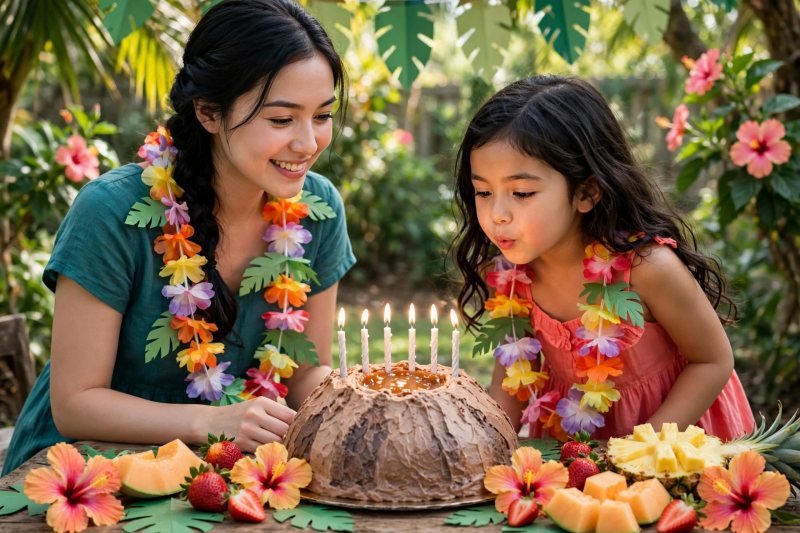
Serve the tropical feast and the cake. Bring everyone to the shaded party table for the feast you checked against the allergy list twice: pineapple and melon pieces, strawberries, and grapes halved lengthways by an adult without exception; mini sandwiches cut small; and cold water poured often in the backyard heat. Eat seated, leis resting aside while chewing, and let the feast be unhurried. Then the moment the whole day leans toward: the volcano-style birthday cake — a rounded cake with a small crater top — carried in by an adult, with exactly six candles on the cake. An adult, and only an adult, lights the six candles, stays beside the cake while the group sings, the birthday child blows, and an adult removes the candles and handles anything warm before small slices are served; there are no smoke or fire effects beyond the six candle flames. Say, "Six candles for six wonderful years — make a wish, birthday star." Photograph the cake before the song so the six candles are on record.
-
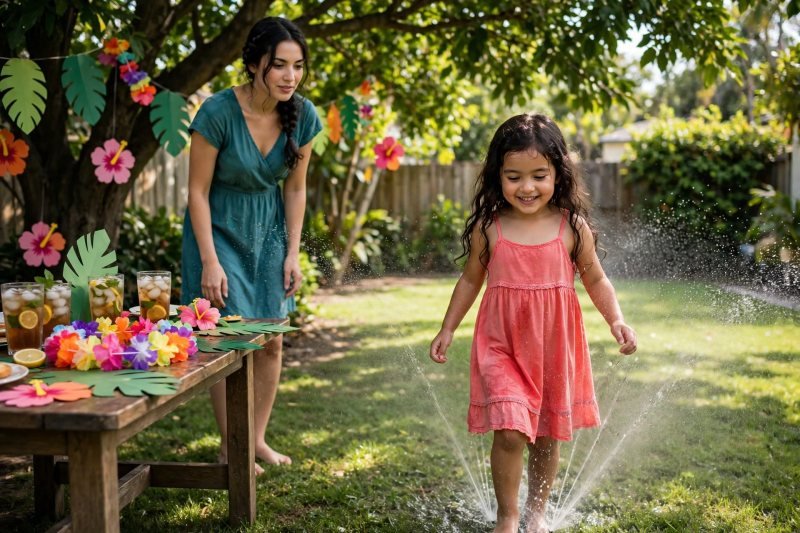
Splash or chill in the shade. Spend the post-cake energy gently: cold drinks all around, seats in the shade — our summer activities for children have more shady, low-energy ideas for hot days — and one calm water option run under a strict, no-exceptions rule — if there is any paddling or pool time at all, a designated adult is in the water or the splash zone the entire time, within arm's reach of every child, with no phone, no chatting breaks, and no swapping out without another adult taking the spot first; if that cannot be guaranteed, skip the pool entirely and use sprinklers on the grass instead, with an adult stationed beside them and children walking, never running, through the spray. Keep this break short, leis dry on the table, and watch for shivering or tired faces — either ends water play for that child, kindly and at once. Say, "Water time is short, shady, and right beside a grown-up — those are our aloha water rules." A calm, closely watched cool-down earns the gentle final step.
-
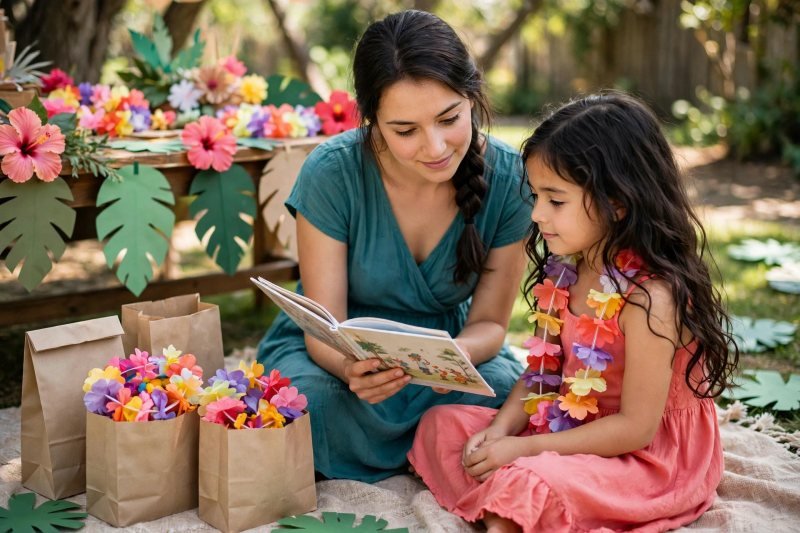
Say mahalo and wind down. Gather everyone back to the blanket for the landing, and teach the last Hawaiian word of the day properly: mahalo means thank you. Go around the circle for a gratitude round — the birthday child thanks each friend for one specific thing (a funny limbo move, help threading a flower, a shared strawberry), and each guest offers one favorite moment back. Then hand each child their favor bag holding their handmade keepsake lei and one large, age-safe treat — nothing small enough to be a choking risk. Close with a short story or calm Hawaiian music, and as each parent takes over, pass the handover notes: what their child ate, any scrape or wobble and how it was handled, and where their lei and bag are. Say, "Mahalo for coming — thank you for making this birthday shine." A party that ends in gratitude is the souvenir that lasts.


Make it easier
Buy the door leis and the hibiscus invitation shapes pre-cut as plain paper pieces and skip the invitation craft — the children's own coloring and threading are the parts that matter. Shrink the arc, not the child: cut pineapple bowling and keep the welcome, one craft, limbo, the dance, and the cake — a 90-minute party that ends happy beats a two-hour party that ends in tears. Feast simply: one tropical fruit, one sandwich filling, cold water, and the cake — presentation on a bright blanket does the celebrating that a long menu only exhausts you with.
Make it harder
Add a pattern challenge to the lei table: invite six-year-olds to thread a repeating three-color pattern and then copy a friend's pattern — early math hiding inside the craft. Grow the games: link limbo and bowling into a gentle island circuit — limbo, bowl, balance a soft ball on a spoon along the leaf path — with a picture card stamped at each stop. Invite the grown-ups in: a parents' paper-hibiscus corner and a family gratitude round at the wind-down give adults a role beyond spectating and photograph beautifully.
Other ways to play it
- Pool-party version: the same arc with the splash step expanded — but the water rules never bend: a designated adult in the water within arm's reach of every child at all times, no exceptions, no diving or roughhousing, leis off, a strict headcount in and out, and the cake served only after everyone is dry and reseated.
- Indoor rainy-day version: the same arc in the living room — bunting high on walls, lei-making at the kitchen table, limbo with a soft noodle between two adults in the hallway, the dance on a cleared rug, and the splash break traded for a shady-feeling chill corner with cold drinks and fans.
- Evening family version: for a later family gathering, keep the same steps but serve the feast first and the cake as the light softens — the LED garden torches glow prettily at the edges, an adult still handles every real flame, and the games finish while there is still light to play by.
How it changes by age
- Age 5: Five-year-old guests thrive with shorter turns and bigger pieces: larger paper flowers and spacers at the lei table, a limbo bar that starts high and lowers only a little, seated dancing welcomed without comment, and feast portions served small and often. Keep their place in every line early while patience is fresh, pair them with a calm adult for the gratitude round, and expect the splash break to be the highlight they talk about — supervise it exactly as strictly for them as for everyone else.
- Age 6: The birthday child's own age runs the full celebration: she can thread a repeating lei pattern, follow the picture running order and predict what comes next, take the lower limbo rounds her way, lead a wave movement in the dance, and blow out six candles after making a wish she has been rehearsing all week. Give sixes jobs — holding a limbo bar end with an adult, handing out door leis, starting the mahalo round — because responsibility at six feels like being honored, and an honored host is a gracious one.
What they're learning
Cultural respect and curiosity: hearing what a lei truly means, using aloha and mahalo correctly, learning that keiki means children and hula tells stories — real words and traditions, learned accurately and kindly. Fine motor control: threading tissue flowers, straw pieces, and spacers into patterns, coloring hibiscus petals, and snipping paper palm fronds — small, joyful hand work that builds writing readiness. Gross motor skills and body awareness: leaning, crouching, and stepping in limbo, rolling soft balls at pineapple pins, and copying storytelling movements in the dance — big movement with balance and control. Gratitude and social grace: the mahalo round — thanking each friend for something specific, offering a favorite moment back, and saying a proper goodbye — the party as a gentle lesson in thankfulness.
Clearing up
Send the handmade leis home the same day — they are favors and craft in one — then walk the yard once with a bag for paper flowers, straw spacers, and stray bunting triangles before they become lawn confetti. Bunting and palm leaves come down from their high lines into one storage box, LED torches are switched off and stored by an adult, and leftover fruit is refrigerated or composted, sandwich remnants discarded, and the cake, once the six candles are fully out and removed, covered and stored out of small reach. Wipe down the craft and party tables, collect the limbo bar and bowling pins for a quick safety check before storage, and photograph the empty, tidy yard — next year's party planning starts with proof of how manageable this one was.


