


Word Ladders for Kindergarten: 10 Chains From Cat to Hat to Hot
Ten ready-to-play word ladders for kindergarten — climb cat to hat to hot, dog to log to leg, one letter at a time — with a session plan, materials, and game twists.
A kindergarten word ladder is a chain of 3–6 simple words where each step changes exactly one letter — cat → hat → hot → hop → pop. Kids read and climb each rung, building phonemic awareness, decoding, and the insight that changing a letter changes the word. Keep chains short and turn every climb into a game.

The short version
- One changed letter per rung; every rung a real English word.
- Four to six rungs is the sweet spot for ages 5–6.
- Use familiar CVC words: cat, dog, sun, pig, box, cup.
- Hopping the rungs boosts focus and memory.
- Ladders teach letter-sound flexibility — not rhyming.
- Celebrate every summit: confidence is the curriculum.
- Age
- Ages 5–6
- Prep
- 10 min
- Play time
- 25 min
- Mess
- None
- Difficulty
- Easy
- Where
- Indoor
Why kids love this
Word ladders for kindergarten feel like a climbing wall made of words. Your child starts at the bottom — cat — changes a single letter, and suddenly they are standing on hat. One more tiny change and it is hot. Every rung is a mini victory, and each chain finishes before the wiggles set in. Kids love the hopping, the letter swapping, and shouting "that rung changed TWO letters — it is broken!" Most five-year-olds ask to climb another the minute the first chain is done.
What you'll need
- About 60 index cards or cardstock squares
- A thick marker
- Painter's tape (for floor rungs)
- Star stickers for summit celebrations
- A kitchen timer (optional, for the speed round)
Before you start
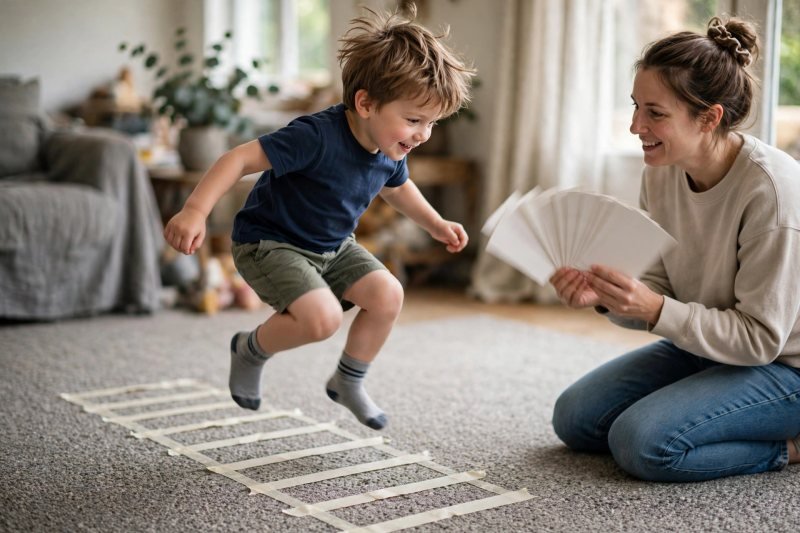
1. Write one word per card for each of the 10 chains below, in big lowercase letters. Keep each chain's cards in its own pile. 2. Lay a ladder on the floor: strips of painter's tape as rungs, one per word in chain 1. Chains 2–10 reuse the same ladder — just swap the cards. 3. Keep the star stickers in your pocket. You are the expedition leader; your child is the climber.
How to do it
-
Climb chain one together, slowly, and teach the one rule. Chain 1 — cat → hat → hot → hop → pop. Teach the one rule: each step changes exactly ONE letter. "Cat… change the c to h… hat!" Your child reads each rung and hops to the next. Star the chain at the top. All ten chains use short CVC words — the same starter set in this CVC words for kids guide.
-
Play cover-and-guess on chain two. Chain 2 — pig → big → bag → bat → bet → bed. Cover the changed letter with your thumb and let your child guess it before you reveal. Six rungs, six guesses, six wins. If your child loves the -at and -ag families hiding in this chain, word-family play with -at words builds the same pattern.

-
Hop the rungs on chain three. Chain 3 — sun → fun → fan → pan → pin → pen. Hop-the-rungs round. Your child stands on each tape rung, reads the card, and jumps to the next — reading plus movement for wiggly five-year-olds.

-
Race the timer on chain four. Chain 4 — dog → log → leg → peg → pen → ten. Speed climb. Set the timer for two minutes and count clean climbs. A stumble just means climb again.

-
Let your child do the swapping on chain five. Chain 5 — red → bed → bad → bag → big → pig. The swapper round. Hand your child the new letter card and let them do the physical swap. Fingers on the letters build the sound change into memory. For more hands-on rounds like this one, these CVC word games turn the same swaps into a full game night.

-
Run the rhyming check on chain six. Chain 6 — map → cap → cat → cot → cog. Ask: "Do all the neighbors rhyme?" They do not — cat and cot don't rhyme, and that is the point. Ladders are about letter changes, not rhymes. Sound boxes make the same point visually — Elkonin boxes for CVC words let your child push a token for every sound they hear.

-
Climb chain seven in silly voices. Chain 7 — box → fox → fix → fin → pin. Silly-voice climb: robot voice, whisper, giant voice. The silliness holds attention; the letter changes still teach.

-
Build chain eight backward. Chain 8 — cup → pup → pop → mop → map → mad. Backward build. Hand your child the last card (mad) first and build downward — same words, new flexibility.

-
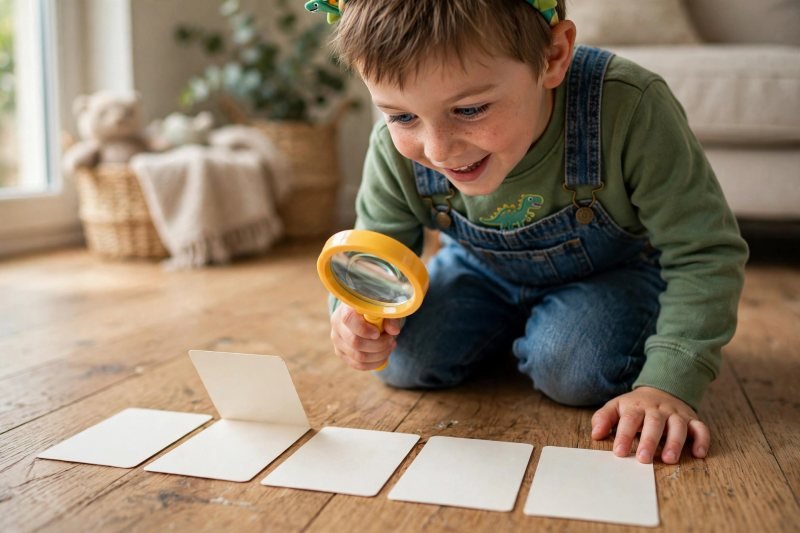
Play detective on chain nine. Chain 9 — hen → pen → pan → pin → pit. Detective round. Lay the chain with one rung face down; your child reads the neighbors, deduces the missing word, then flips to check. Once your child can spot a broken rung, alien words phonics practice tests whether they can tell a real word from a made-up one.
-
Finish with the summit climb on chain ten. Chain 10 — sit → bit → bat → bet → get. The summit climb — normal, whisper-fast, then super-slow. Lay all ten chains in a row and let your child star their favorite. Expedition complete.



Make it easier
Start with 3-rung mini chains (cat → hat → hot) before the full climbs. Let your child hop while you read the rungs — listening still teaches the pattern.
Make it harder
Let your child build their own chain — you check each rung changes exactly one letter. Plant a misstep trap: slip in a two-letter change (sun → fun → funny is broken) and let your child spot it.
Other ways to play it
- Ladder race: two tape ladders side by side — parent and child climb matching chains.
- Mystery ladder: every rung face down — flip, read, climb, repeat.
- Build-a-ladder journal: glue each finished chain into a notebook as a reading trophy.
How it changes by age
- Five-year-olds climb best with you reading alongside them and plenty of hopping. Six-year-olds can usually lead the climb, spot broken rungs, and attempt backward builds. If any chain feels hard, drop back to word-family play first — confidence climbs faster than frustration.
What they're learning
Phonemic awareness: isolating and swapping single sounds inside words. Decoding: blending changed sounds into real words, rung by rung. The alphabetic principle: changing a letter predictably changes the word. Orthographic mapping: repeated climbs wire words like hat and hot into sight memory.
Clearing up
Word ladders are not rhyming chains. The rule is one changed letter, not rhyme — cat → cot is legal even though it doesn't rhyme. Every rung must be a real word. Nonsense steps teach nothing and confuse early readers. One letter means exactly one. Swapping two at once (cat → hot) breaks the ladder. Ladders don't replace reading books. They are a phonics game — wonderful alongside read-alouds, not instead of them.
Questions parents ask
What is a word ladder in kindergarten?
How do word ladders help kids learn to read?
What words are best for kindergarten word ladders?
How many rungs should a kindergarten word ladder have?
Can word ladders help with spelling too?
What if my child can't read the ladder words yet?
Every chain was validated rung by rung: each step changes exactly one letter and is a real English word. A few words climb twice (pen, bat) — deliberate, since repeated encounters wire words into memory faster.

save it for later
Pin this for the next rainy afternoon
Keep it on a board so it is there when you need it, rather than when you happened to find it.
Save to Pinterest


