


CVC Word Games: 12 Kindergarten Favorites (Roll and Read, I Spy, Bingo)
Twelve CVC word games — Roll and Read, I Spy, Bingo, fishing, hopscotch, and more. One set of word cards, zero worksheets.
CVC word games turn sounding-out practice into play: Roll and Read, I Spy, Bingo, fishing, hopscotch, and bowling, all using one set of 10–12 word cards. Short daily sessions build blending and fluency faster than worksheets — start with one vowel family and end while it is still fun.

The short version
- Twelve games, one card set: Roll and Read Rally, I Spy, Bingo, Fishing for Words, Word Hopscotch, Bowling for Words, Feed-the-Monster Toss, Musical Word Freeze, CVC Word Snap, Tic-Tac-Word, Sticky-Ball Word Wall, Pancake Flip Reading.
- Start with 10–12 words from one vowel family; mix families once they feel easy.
- Play 10–15 minutes daily; the word must be read aloud to count.
- End on an easy win so your child asks to play again.
- Age
- Ages 5–6
- Prep
- 10 min
- Mess
- None
- Difficulty
- Easy
- Where
- Indoor
Why kids love this
CVC word games never feel like reading practice, and that is why they work. Your child rolls dice, hunts for hidden cards, reels in paper fish, and feeds a cardboard monster — and in all that fun, reads dozens of words without noticing.
What you'll need
- Index cards and a marker (one set of 12 word cards), one die
- Paper, crayons, small tokens or dried beans
- Toy fishing rod with a magnet, paper fish, paper clips
- Sidewalk chalk (or painter's tape indoors), 6 empty bottles, soft ball
- Cardboard box with a mouth cut in it, music player, soft balls, toy pan and spatula
Before you start
'How many CVC words should I start with?' Pick 10–12 from one vowel family — short a is friendliest: cat, hat, mat, sat, ran, map. Write each big and lowercase on its own card; add a second family (dog, log, hot, pot, top) when those feel easy.
How to do it
-
**Warm up with the word cards.** Spread the cards face up and read through them once together.

-
**Make the set sturdy.** Tape flimsy cards to cardboard — they will be fished, tossed, and bowled over.

-
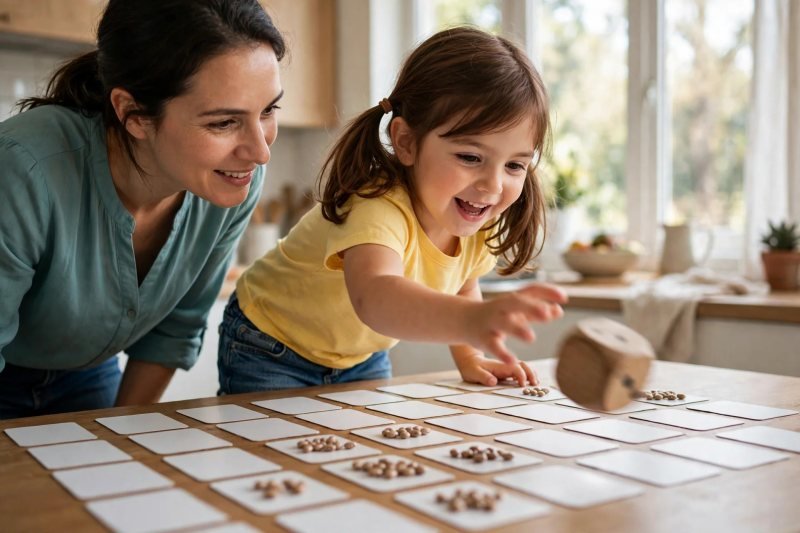
**Play Roll and Read Rally.** Arrange the cards in 6 rows. Roll the die and read every word in that row. Cover finished rows with tokens.
-
**Play I Spy CVC Words.** Hide 6–8 cards around one room. Clue with sounds: "I spy a word starting with /mmm/ that rhymes with hat." Find it, read it, keep it.

-
**Play CVC Word Bingo.** Draw a 3×3 grid per player with nine words. Pull cards from a bag, reading each aloud; cover matches. Three in a row shouts "Bingo!"

-
**Play Fishing for Words.** Paper-clip each card and scatter the "fish" on a blanket. Catch one, read the word, drop it in the bucket.

-
**Play Word Hopscotch.** Chalk a ladder with one card per square. Hop the course, reading each word you land on.

-
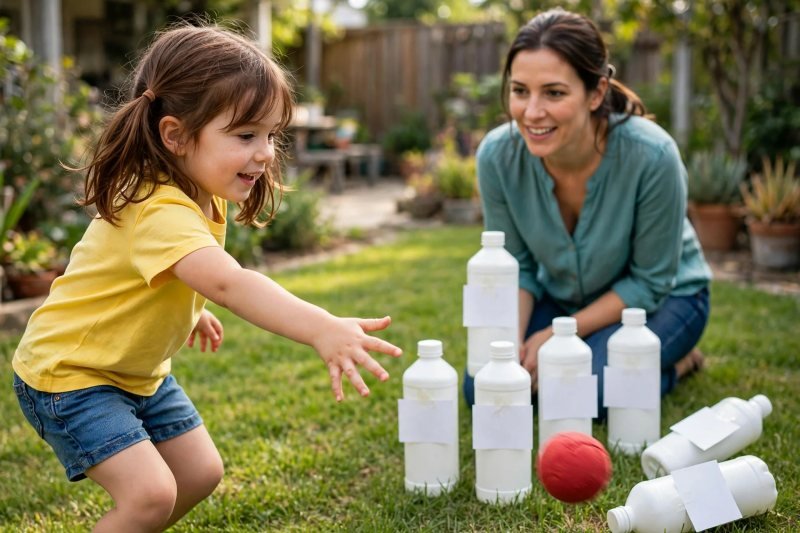
**Play Bowling for Words.** Stand 6 bottles in a triangle, a word card on each. Roll a soft ball; read the word on every fallen bottle.
-
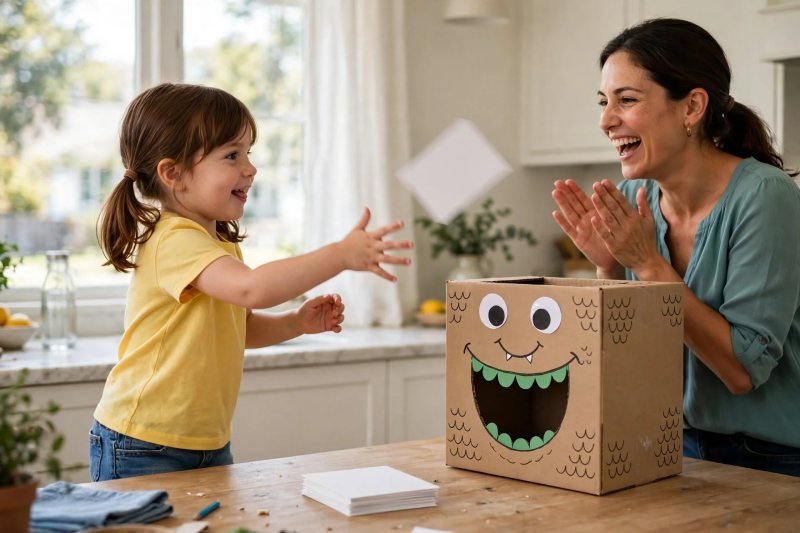
**Play the bonus menu — six more games.** Feed-the-Monster Toss: read a card, then feed it to a cardboard-box monster; Musical Word Freeze: march around a circle of cards — when the music stops, read the nearest one; CVC Word Snap: flip one card each — rhyming pair (cat/hat)? Shout "Snap!" and read both; Tic-Tac-Word: read the word in a 3×3 grid square to claim it with X or O; Sticky-Ball Word Wall: toss soft balls at taped-up cards; read every word you hit; Pancake Flip Reading: flip paper pancakes in a toy pan; read each word before it lands.
-
**End while it is still fun.** Finish with one easy word, read with full fanfare — play 10–15 minutes, one or two games per session, ending while everyone is still smiling.



Make it easier
Play with just 5–6 words from one vowel family (cat, hat, mat, sat, ran, map). / Read each word first and let your child echo you. / In Bingo, use open cards instead of drawing from a bag.
Make it harder
Mix all five vowel families (cat, bed, pig, dog, sun) so words cannot be guessed by pattern. / Add a sand timer: how many words before it runs out? / In Bingo and Snap, use the word in a silly sentence first.
Other ways to play it
- Play over video call: your child reads each card to a grandparent. / Take the cards to the park for I Spy with playground hiding spots. / Theme your weeks: animals (cat, dog, pig, fox, hen), foods (jam, ham, bun, cup), actions (run, hop, sit, dig, tug).
How it changes by age
- **Can a 4-year-old play these CVC word games?** A 4-year-old who knows most letter sounds can play the movement games — I Spy, Hopscotch, Fishing — with five words and echoing. Save turn-based games (Bingo, Snap, Tic-Tac-Word) for 5–6.
What they're learning
**Blending:** stretching and blending consonant-vowel-consonant words — the core skill of early decoding. / **Fluency:** repeated playful encounters with the same words build speed and confidence. / **Phonemic awareness:** rhyming rounds sharpen ears for shared sounds. / **Sportsmanship:** rules, winners, and gracious losers in training.
Clearing up
**Games are not "just playing" — they are the lesson:** thirty words read across three games is serious practice. / **Do not correct mid-game like a quiz.** Model a misread word warmly — "Listen: sss-uuu-nn… sun. Your turn!" — and keep playing. / **Winning is not the goal.** Take turns winning and celebrate effort. The prize is a child who asks to play again tomorrow.
Questions parents ask
What are the best CVC word games for kindergarten?
How many CVC words should a kindergartner practice at once?
How long should a CVC word game session last?
What if my child guesses CVC words instead of sounding them out?
Can CVC word games help a struggling reader?

save it for later
Pin this for the next rainy afternoon
Keep it on a board so it is there when you need it, rather than when you happened to find it.
Save to Pinterest

