


Elkonin Boxes: The Sound-Box Method That Teaches CVC Spelling
Elkonin boxes make speech sounds visible: draw one box per sound, slide a token in for each sound, then blend into a word. A 10-step parent guide for ages 4–5.
Elkonin boxes are a sound-sliding method: draw one box for every sound in a word (not every letter), and your child pushes one token into each box while saying the sounds left to right. Then they sweep a finger under the boxes and blend the sounds into the word. For spelling, each box gets its matching letter.

The short version
- One box per sound, not per letter; one token pushed in per sound, left to right.
- Four moves: say the word slowly, push tokens, sweep-and-blend, stretch into spelling.
- Model it, do it together, then hand it over — never ask a child to segment cold.
- Mystery word and box puzzles build blending; the spelling stretch builds spelling.
- Sh shares one box, teaching digraphs before any worksheet does.
- Ten minutes, a few times a week, beats long drilling.
- Age
- Ages 4–5
- Prep
- 5 min
- Play time
- 20 min
- Mess
- None
- Difficulty
- Easy
- Where
- Indoor
Why kids love this
Sound boxes look like a board game and feel like a magic trick: slide a token in per sound, sweep one finger underneath, and the word snaps back together — speech made touchable.
What you'll need
- Plain paper and a thick dark marker (you draw the boxes)
- 8–10 small tokens: pom-poms, dried beans, buttons, or bottle caps
- A short pencil for the spelling stretch in Step 8
- Optional: picture cards of CVC words (cat, sun, dog)
- Optional: magnetic letter tiles
Before you start
1. Draw 3 empty boxes across one sheet — two-inch squares, straight left-to-right. 2. On a second sheet draw 4 boxes, for later words like frog or tent. 3. Put the tokens in a small bowl beside the paper. 4. Pick a starter word (cat, sun, dog) and stretch it slowly to yourself first: /s/ ... /u/ ... /n/. 5. Keep it play-based. Fifteen happy minutes beats thirty tired ones.
How to do it
-
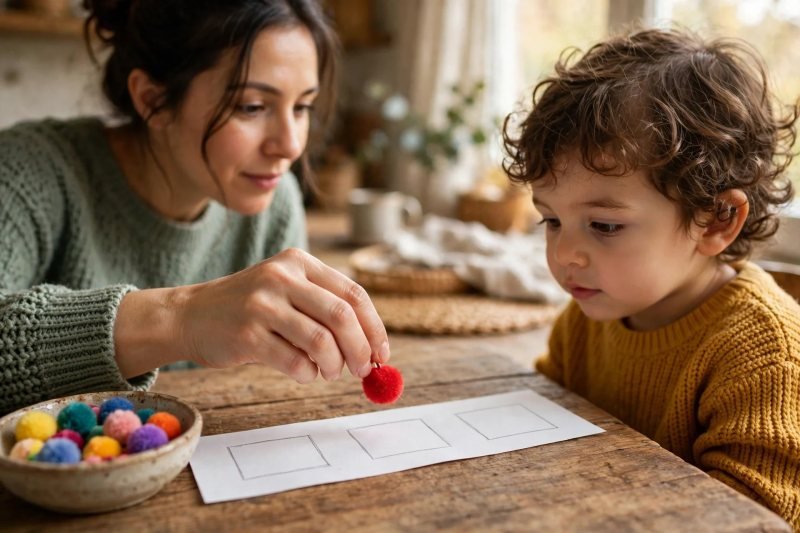
Draw the three boxes. One box per sound — not per letter. Sit side by side with the strip between you and trace each box, stating the rule: "One box for each sound we hear." Your child traces too, learning the left-to-right path. From here the routine is always the same: push one token per sound, left to right, then sweep a finger underneath and blend them into the word — and run it in reverse for spelling.

-
Say the word slowly together. Pick sun — all three sounds stretch. Say it together like taffy: "ssss-uuu-nnn." Then count the sounds on fingers: three.

-
Model the slide yourself. Demonstrate while your child watches: "/s/" fills box one, "/u/" box two, "/n/" box three — one sound, one push, one box. Then sweep under the row: "sun!"
-
Slide it together, hand over hand. Their hand over yours: you say each sound while you both push. Then guide their finger in the sweep: "Now whoosh — sun!" Two shared rounds teaches the rhythm.

-
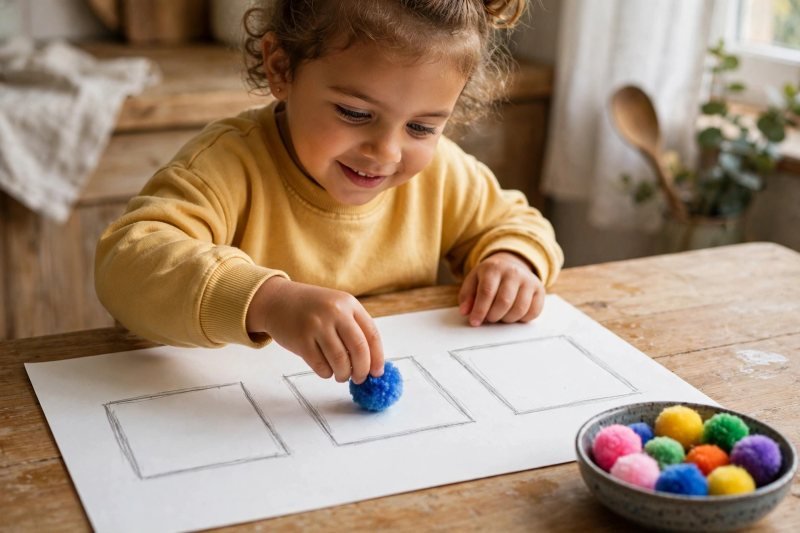
Their turn with the tokens. Hand the word over: "Your turn — you be the teacher." They push one token per sound while saying the sounds. Celebrate: "Three sounds, three boxes, three tokens."
-
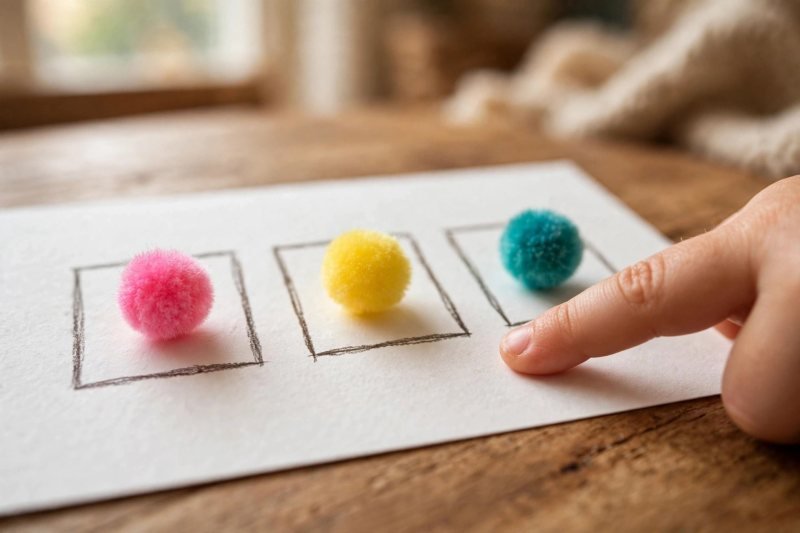
Sweep and blend into the word. Your child slides one finger under the row — left to right, one smooth motion — saying the word fast: "sun!" Choppy? Model it once more, faster and sillier.
-
Play the mystery word game. Push tokens for a secret word, saying only the sounds: "/h/ ... /a/ ... /t/." Sweep and ask, "What word did I make?" When they shout "hat!", swap roles.

-
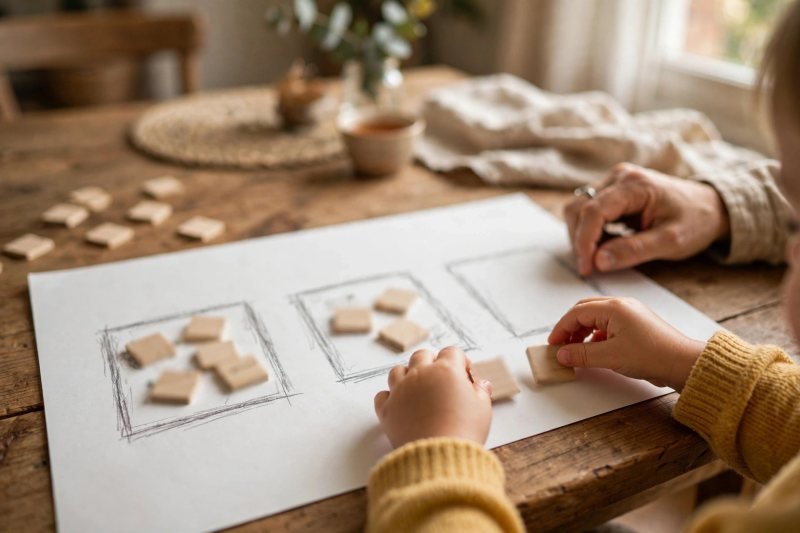
Stretch it into spelling. Keep the three boxes. Your child segments the word; for each sound name its letter together: "/s/ — that's s!" Write each letter in its box. Try cat, dog, pig. And remember why the boxes count sounds, not letters: ship has four letters but only three sounds — /sh/ /i/ /p/ — so it gets three boxes, because s and h are holding hands and make one sound together.
-
Play box puzzles. Say a word — no picture, no stretched sounds. Your child pushes one token per sound into empty boxes, then covers them and repeats from memory.

-
Celebrate and set tomorrow's word. End with sun again — fast and confident, a victory lap. Then your child picks tomorrow's word and draws its boxes. Fridge the paper.



Make it easier
Start with two-sound words (up, at, me) on a two-box strip. They push tokens while YOU say the sounds. Use stretchy sounds only (s, m, f, l, n): sun, man. Draw boxes four inches wide for little fingers.
Make it harder
Four-sound words: frog, tent, clap, milk. Try ship, chat, fish: three boxes for four letters. Segment without tokens — tap each box with a fingertip. Dictation: you say a word, they box the sounds, then write the letters.
Other ways to play it
- Floor boxes: Tape big boxes on the rug; your child hops one box per sound.
- Token swap: A different token per sound — red pom-pom, blue button, yellow bean.
- Build without the picture: Drop the picture cards. You say the word; your child segments and blends it back — pure ears.
- Backwards build: Start with full boxes; pull one token out per sound while saying them.
How it changes by age
- Ages 3–4: Oral-only: you say the sounds and push the tokens; they push while you say them, then sweep and shout the word.
- Ages 4–5 (the sweet spot): The full routine — segment, sweep and blend, then the spelling stretch.
- Ages 6–7: A spelling tool: dictate a word, they box the sounds, then write it.
What they're learning
Phonemic awareness: hearing and ordering speech sounds. Segmenting: splitting a word into sounds, left to right, one per box. Blending: gluing sounds back into a word with the finger sweep. Sound-letter connection: mapping each sound to a letter in order. Digraph awareness: sh shares one box — some sounds take two letters. Left-to-right tracking: eyes and hands moving the way print moves.
Clearing up
Rinse tokens after the session and air-dry them. Save the box strips — tomorrow starts where today ended. Bag the letter tiles and scan the floor for escapee beans.
Questions parents ask
What are Elkonin boxes?
How do Elkonin boxes work for CVC words?
Why is there one box per sound and not one per letter?
What age should you start Elkonin boxes?
What if my child can't hear the separate sounds yet?
Named for D.B. Elkonin, the psychologist who developed it — to your child, just "the sliding game." Ten minutes three times a week beats one long session. No strips? Use three plates, three cushions, or chalk squares on the driveway. The boxes are the idea, not the paper. Keep building: blending sounds activities pair segmenting with blending; CVC words for kids is the parent-led reading routine that follows; digraphs for kids activities extend the "sh shares a box" discovery; CVC word games add playful practice; CVC words list gives you fresh words to box; and word families for kindergarten show how boxed words group into patterns.

save it for later
Pin this for the next rainy afternoon
Keep it on a board so it is there when you need it, rather than when you happened to find it.
Save to Pinterest


