


Teaching Kids Skin Care Habits: Gentle Routines for Ages 5–6
Teaching kids skincare habits is less about products and more about coaching: model the wash, hand over one job at a time, anchor it to toothbrushing, and keep everything gentle. A complete guide for ages 5–6.
Teach kids skincare habits by coaching, not lecturing: explain the why ("skin is a coat we wash and keep soft"), model the gentle wash side by side for a week, anchor the routine to toothbrushing, then hand over one job at a time — patting dry, then dispensing moisturizer, then the full wash. Keep products minimal: water or a gentle cleanser, moisturizer for dryness, sunscreen outdoors.

The short version
- Young kids need only three things: gentle washing, moisturizer when skin is dry, and sunscreen for outdoor play — no anti-aging, exfoliating, or fragranced products.
- Model side by side first; children copy bodies better than instructions. Then hand jobs over one rung at a time.
- Technique mantra: lukewarm water, fingertips in tiny circles, pat — never rub — dry.
- Anchor the routine to toothbrushing (same sink, same order, under five minutes) and use a picture card for pre-readers.
- House rules: gentle hands (no scrubbing or picking), products are personal and parent-approved.
- Praise the habit ("you ran your routine all week"), never the appearance of their skin.
- Age
- Ages 5–6
- Prep
- 5 min
- Play time
- 5 min
- Mess
- Low
- Difficulty
- Easy
- Where
- Indoor
Why kids love this
Five- and six-year-olds are wired for "I can do it myself." A skincare routine they own — their stool, their washcloth, their three jobs in order — feels like a grown-up privilege, not a chore. Kids also love the sensory parts: warm water, soft foam, patting dry like a "skin superhero," and checking the mirror for a job well done.
What you'll need
- A gentle cleanser made for children (optional — many young kids need only water most days)
- A soft washcloth or muslin cloth, plus a small dry towel for patting
- A gentle, fragrance-free moisturizer (for after washing and dry patches)
- Sunscreen made for children, for daytime outdoor play
- A step stool and a mirror at child height
- A simple picture routine card (draw three icons: wash, moisturize, brush — no reading required)
Before you start
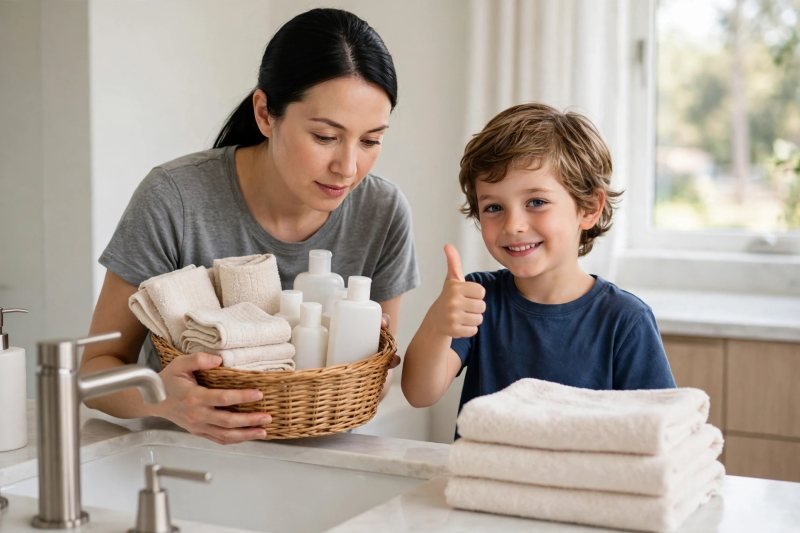
1. Set up a self-serve station: stool at the sink, washcloth folded within reach, products in one small basket. If they can't reach it, they can't own it. 2. Choose products by criteria, not marketing: made for children; short ingredient lists; fragrance-free if your child is sensitive; nothing marketed as anti-aging, brightening, or exfoliating — young skin needs none of it. 3. Patch-test any new product on the inner forearm and wait 24 hours before routine use. 4. Draw the three-icon routine card together and stick it at mirror height — drawing it is the first buy-in.
How to do it
-
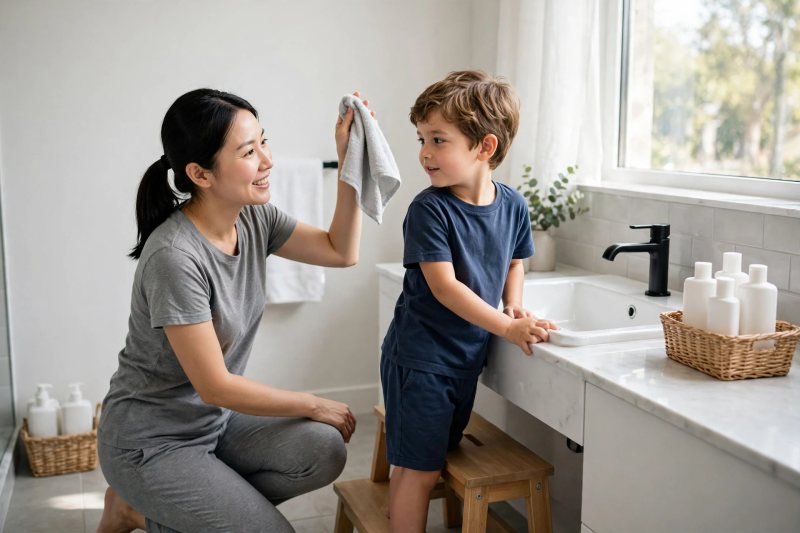
Start with the why, in kid language. Before any technique, sit at the sink and say: "Our skin is a coat we wear every day. It collects dirt, sweat, and germs, so we wash it gently and keep it soft — like taking care of a favorite jacket." Teaching kids skincare habits works when the habit has a reason a six-year-old can repeat back. Keep it positive and practical: skin care is washing, moisturizing dry spots, and sun protection — nothing about looking different or fixing flaws, because young children's skin needs care, not correction. If they can teach the reason back to you, they understand it. Reason installed, it's time to show rather than tell.
-
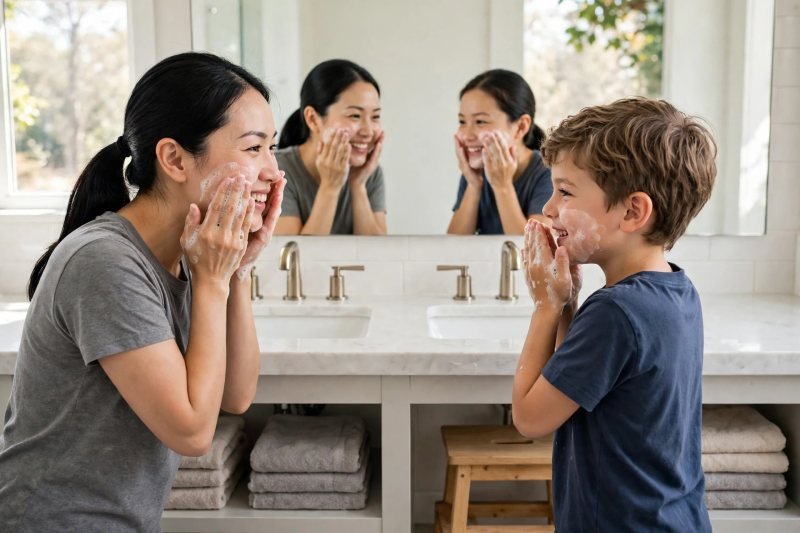
Model the whole routine side by side. For the first week, do your own (grown-up, simple) version next to them at the same sink: you wash your face while they wash theirs, you pat dry while they pat dry. Say each step out loud as you do it: "Warm water… tiny circles… pat, don't rub." Children copy bodies far better than they follow lectures, and side-by-side turns the routine into shared time instead of inspection time. Resist correcting mid-wash unless something's headed for an eye; reteach that one point tomorrow. By week's end, let them lead while you follow their narration. Modeling done, zoom in on the skill everything hangs on: the gentle wash itself.
-
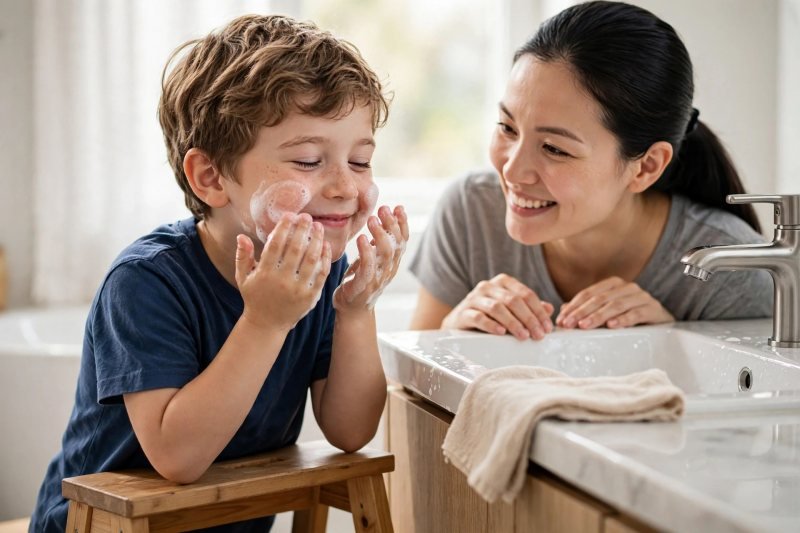
Teach the gentle face wash, fingertips only. Run the water lukewarm — test it on your inner wrist — and show the technique: wet the whole face with cupped hands or a soft cloth; if using cleanser, a pea-sized amount worked into a light lather in the palms first; fingertips in tiny, slow circles for about twenty seconds (cheeks, forehead, nose, chin); rinse with several handfuls of water; then pat — never rub — dry with the small towel. Say the house rule once and repeat it forever: "Fingertips are softer than any cloth, and patting is kinder than rubbing." Many young kids need only water on most mornings; cleanser earns its place after sunscreen days, sweaty play, or face paint. If water stings eyes or washing sparks battles, a damp washcloth "press and lift" wash is a perfectly good adaptation. Face washed and patted: one sealing step remains.
-
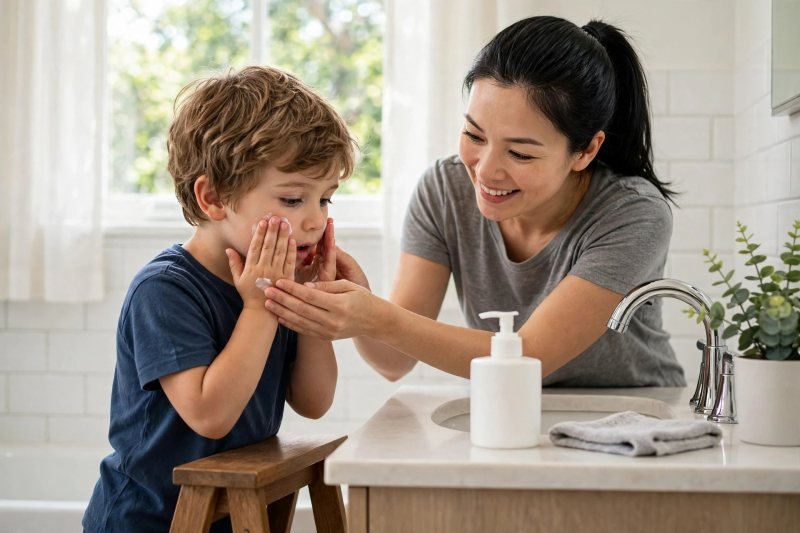
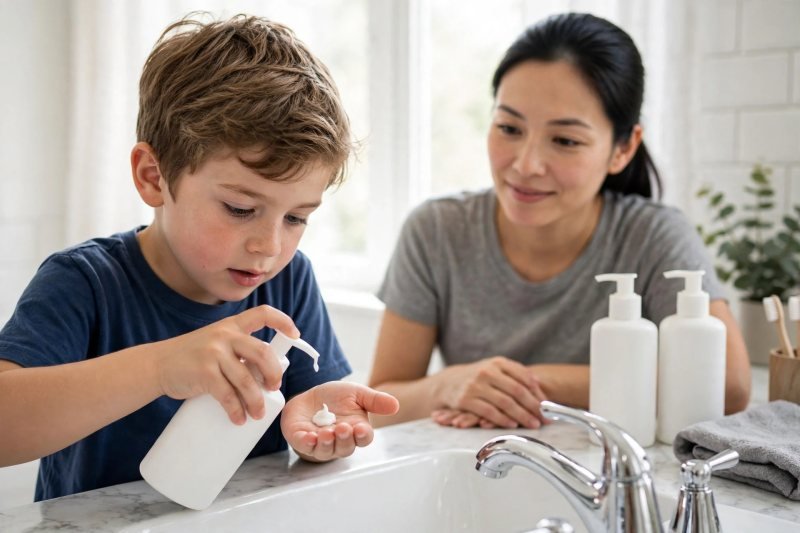
Make moisturizer the "seal it in" step. Right after patting dry, while skin is still very slightly damp, teach the moisturizer move: a pea-to-fingertip-sized amount warmed between the palms, pressed and smoothed over cheeks, forehead, and any dry patches. Say: "Washing cleans the coat; this keeps it soft." That tiny amount is deliberate — more invites greasy complaints and product in eyes. Fragrance-free suits most young skin — this best moisturizer for kids' dry skin covers how to pick one — and elbows, knees, and shins often want the leftovers more than the face does. If your child's skin is happy with water-only washing and no moisturizer, that is also fine — moisturizer is for dryness and comfort, not a compulsory daily layer on skin that doesn't need it. Skip anything that stings; a product that hurts is the wrong product, full stop. Sealed and soft: the daytime habit comes next.
-
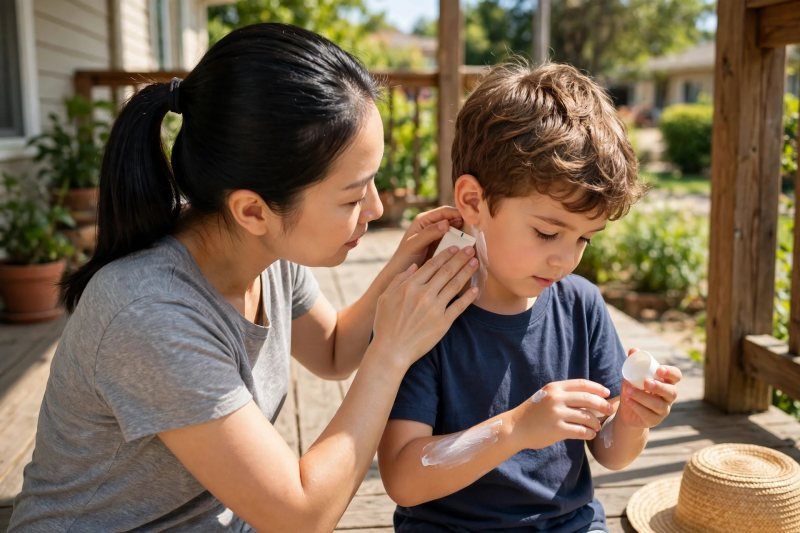
Add sunscreen as the leaving-the-house uniform. Teach sunscreen as clothing, not cosmetics: "We don't go outside without shoes; in sunny weather we don't go out without sunscreen on the skin that's showing." Practice the application together on a Saturday morning, not in a rushed school-day doorway: smooth it over face, ears, neck, and the backs of hands, and let your child do their own arms while you cover the tricky spots. Reapply after swimming, heavy sweating, and every couple of hours outdoors, and pair it with shade and a hat rather than treating it as a force field. Choose a sunscreen made for children and patch-test it like any product. Morning practice makes weekday application a two-minute non-event. Habits now exist for morning and night separately — the next job is stitching them into one rhythm.
-
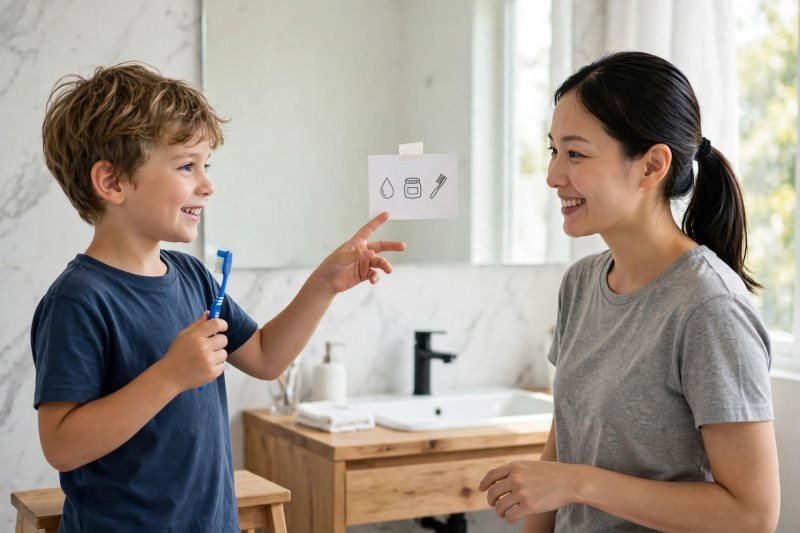
Stitch the routine to toothbrushing. Habits survive when they hitchhike on existing ones, and toothbrushing is the perfect host: wash face, moisturize if needed, brush teeth — morning and night, same order, same sink. Say: "Sink jobs stick together." Put the picture card at the mirror in that exact order — the same wash, moisturize, brush order in this kids skincare routine — and let your child flip or point to each icon as it's completed. Keep the whole sequence under five minutes; a routine that feels long gets negotiated, and negotiated routines dissolve. On chaotic evenings, the minimum viable version — water wash and teeth — still counts as keeping the chain unbroken. Rhythm set: now start the real teaching project, which is handing the jobs over.
-
Hand over one job at a time. Independence lands best as a ladder, not a handover: week one, they own patting dry; week two, they dispense their own pea of moisturizer (you check the amount); week three, they run the full wash while you watch silently; then you graduate to "bathroom door open, parent nearby." Say at each step: "This job is yours now — show me how it goes." Expect messier splashes and slower circles during each transfer, and budget your patience accordingly — sloppy independence this month is smooth independence next month. Self-care routines like this one sit on every kindergarten readiness checklist, so the independence you're building is classroom gold too. If a step collapses (soap in eyes, skipped rinsing), drop back one rung for a few days without framing it as failure. Ladder climbed, the final teaching content is the set of kindness rules that protect skin from the child themselves.
-
Teach gentle hands: no scrubbing, no picking, no sharing. Three rules cover nearly everything: hands are gentle on skin (no scrubbing, scratching, or picking at spots, scabs, or dry flakes — tell a grown-up instead); products are personal (no sharing washcloths, lip balms, or creams with friends or siblings); and new products are grown-up decisions (nothing goes on their face that a parent hasn't approved — including friends' products and anything found in a bathroom cabinet). Rehearse the scripts, not just the rules: "My skin rule is gentle hands," and "I have to ask my mom first." Itchy, sore, or spreading skin is a tell-a-grown-up moment, never a fix-it-yourself project — and for itchy or eczema-prone skin, these eczema care tips for toddlers explain what helps at home and when to call the pediatrician. Rules in place, the last step is yours, not theirs: keeping the whole thing alive with the right kind of attention.

-
Review weekly, and praise the habit — never the skin. Once a week, do a quick two-minute review at the sink: Is the washcloth fresh? Is the moisturizer running low? Did any product sting this week? If moisturizer is still the daily wrestling match, these tips for applying moisturizer to a squirmy toddler make the two-minute job easier. Then praise process, not appearance: "You did all three sink jobs every night this week — that's real responsibility," never "your skin looks so pretty." Tying praise to appearance teaches kids to judge their skin; tying it to consistency teaches them to keep habits — which is the actual goal of teaching kids skincare habits in the first place. Celebrate a full week of self-run routines with something small and experience-based. And keep a low threshold for outside help: persistent rashes, spreading redness, painful dry patches, or anything that worries you are pediatrician territory, not product-swap territory. That's the complete coaching arc — reason, model, technique, rhythm, ladder, rules, review.


Make it easier
Water-only washing most days, cleanser only after sunscreen or very dirty play. Just two jobs at first (wash + pat dry) — add moisturizer once the wash is automatic, following the kids skincare routine for the product order. A two-minute sand timer by the sink turns "wash properly" into a game with an end point.
Make it harder
Let your child teach the routine to a younger sibling or a stuffed animal — teaching is the deepest level of learning. Add a weekly "skin check" job: they report dry patches, bug bites, or scrapes to you like a health reporter. Connect the independence to school life: self-care routines are part of the self-management skills on every kindergarten readiness checklist — washing hands and face unaided is classroom gold.
Other ways to play it
- Sensitive or eczema-prone skin: fewer products, shorter washes, lukewarm water only, moisturizer as the star — and your pediatrician's guidance outranks any general routine, including this one.
- The reluctant washer: move the wash into the bath or shower (face washed last, with the cloth), or offer the choice of two washcloths — control over trivia dissolves most resistance.
- Sibling pairs: run the routine side by side with staggered jobs so the older child models for the younger — coaching built into the family for free.
How it changes by age
- Ages 4–5: full modeling, two jobs maximum, water-only most days, and expect the routine to need a parent standing there the whole time. The picture card does the heavy lifting.
- Ages 5–6: the guide as written — ladder handovers across a month, three sink jobs, sunscreen practice on weekends, first self-run evenings by the end.
- Ages 7–8: children can own the full routine with weekly reviews only. Conversations shift to advertising literacy: products promise a lot in videos; your family's rule is gentle basics chosen by parents.
- Red flags at any age: persistent or spreading redness, weeping or crusted patches, painful cracks, or sudden widespread rash — skip products, see your pediatrician, and let medical advice replace general guidance.
What they're learning
Self-care independence: owning a daily routine is foundational self-management — the same skill family routines build across the day. Sequencing and memory: three jobs in a fixed order, recalled via a picture card, is early executive function in action. Body awareness and communication: noticing dryness, itching, or stings — and reporting them — teaches kids to read and voice body signals. Gentle self-treatment: "fingertips, patting, no picking" is a physical habit of treating their own body kindly.
Clearing up
Build cleanup into the routine itself: washcloth goes in the laundry basket (a fresh one every day or two), towel hangs on its hook, products go back in the basket, splashes get one wipe with the hand towel. Thirty seconds, done by the child, every time — a routine that cleans up after itself is a routine that survives busy parents.
Questions parents ask
At what age should kids start learning skincare habits?
What skincare does a 5- or 6-year-old actually need?
How do I teach my child to wash their face gently?
Should kids use moisturizer every day?
What if my child refuses the skincare routine?

save it for later
Pin this for the next rainy afternoon
Keep it on a board so it is there when you need it, rather than when you happened to find it.
Save to Pinterest


