


Toddler Afraid of the Bath: How to Help
Gentle help for a toddler scared of bath time: a child-led path from dry play beside the tub to sink play, doll washing, an empty-tub sit, toe dips and finally short, cheerful baths — never forced, always at your toddler's pace.
Help a toddler who is afraid of the bath by going slowly and letting her lead: play beside the empty tub, splash at the sink, wash a doll, sit in the dry tub fully clothed, dip toes in shallow water, then try short, cheerful baths. Never force her in, stay within arm's reach, and end every bath while it is still fun.

The short version
- Never force a frightened toddler into water — the whole path is gradual, playful and child-led, and her 'all done' is always honored.
- Follow the order: dry play near the tub, water play outside the tub, washing a doll, sitting in an empty tub fully clothed, toe dips, then short shallow baths.
- Keep first baths brief — a few inches of warm water, bubbles and favorite toys, a parent within arm's reach the whole time, and no hair washing at first.
- End every bath on time and on a happy note, with the same routine, song and towel waiting, so bath time becomes predictable.
- Never leave a toddler alone in or near water, even briefly, and empty basins and pools straight after play.
- If the fear is sudden, extreme, followed a frightening incident, or is getting worse, check in with your child's pediatrician.
- Age
- Ages 2–3
- Prep
- 5 min
- Mess
- Low
- Difficulty
- Easy
- Where
- Indoor
Why kids love this
This gentle approach works because it never asks a frightened toddler to be brave all at once — it asks her to play, and lets the bathtub slowly become part of the play. A two- or three-year-old who is scared of the bath is not being difficult; the tub has simply started to feel big, slippery, loud or unpredictable, and small children feel safest when they can predict what happens next and stop it when they have had enough. Every step here gives your toddler that control: she plays near the tub while it is dry, she splashes at the sink where she can walk away, she washes a doll before anyone suggests washing her, and she sits in the empty tub wearing her clothes long before water is involved. Because nothing is ever forced, each small success builds on the last — a toe dipped today becomes two feet tomorrow, and a two-minute bath that ends with laughter is worth far more than a long bath that ends in tears. Toddlers also copy what they see, so watching a beloved doll get a gentle, cheerful wash — and getting to be the grown-up in charge of that wash — turns a scary routine into a story she directs. By the end, bath time is not a test she passed; it is a familiar game with her favorite person, warm water and her duck.
What you'll need
- Plastic stacking cups, pouring cups and a rubber duck or other simple bath toys — washable, with no small parts that come loose
- A favorite doll or washable stuffed toy that can get wet, plus a small plastic basin or washing-up bowl for doll baths
- Soft washcloths — at least two, so one can be your toddler's to hold and squeeze
- A sturdy step stool for sink play, set on a dry, steady floor where it cannot tip
- A soft mat or folded towel for dry play on the bathroom floor, and a non-slip mat for inside the tub later on
- A large, fluffy towel — a hooded towel is a lovely finish, but any big soft towel works — warmed if you like, and clean pajamas ready nearby
- A gentle, tear-free child wash for later steps, used in small amounts, plus a small unbreakable cup for trickling water
- Bubbles for the in-tub steps, if your toddler enjoys them — a deep layer of foam is comforting cover and a toy in itself
- A small timer or a favorite short song, used later to give baths a friendly, predictable length
- Your time and your calmest voice — the most important item on this list, needed at every single step
Before you start
1. Pick a calm part of the day for practice play — not the tired, hungry end of the day when real baths usually happen, and never right before a bath she actually needs. 2. Decide in advance that practice is not a bath in disguise: no surprise washing, no lifting her into water, and the session ends the moment she wants it to end, every time. 3. Set up the bathroom so it feels soft and unhurried — towels down, toys in a basket beside the tub, the step stool steady at the sink, and anything breakable or unsafe moved out of reach. 4. Keep water warm, never hot, whenever water appears: test it with the inside of your wrist or elbow, and fill basins and tubs only after the water is mixed and checked, never with your toddler already in it. 5. Choose one or two favorite toys to live in the bathroom for this project — a duck and some cups are plenty — so the room starts to promise play instead of washing. 6. Plan to repeat each step on several different days. Move on only when the current step looks boring in the best way — relaxed, familiar and easy — and be ready to drop back a step on a hard day without treating it as failure.
How to do it
-
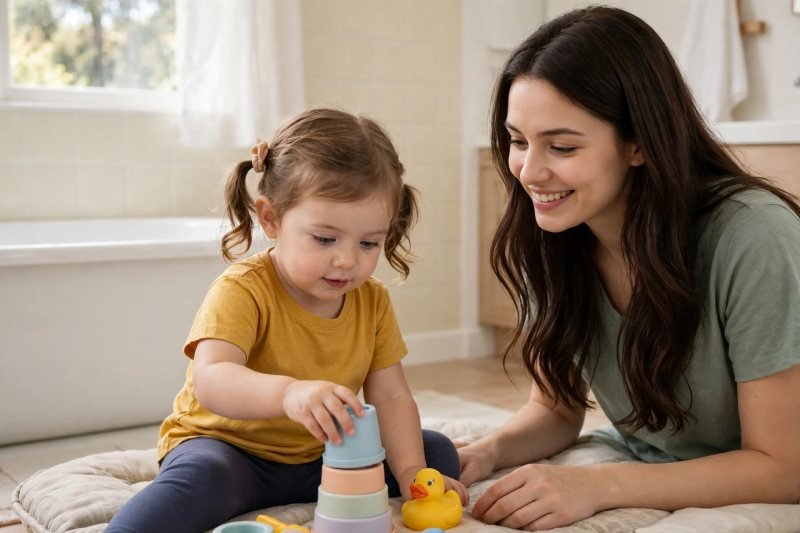
Start with dry play. Begin nowhere near water, because the first job is simply helping your toddler feel relaxed in the bathroom again: spread a soft mat or folded towel on the bathroom floor beside the empty, dry bathtub, bring in a basket of favorite playthings — stacking cups, a rubber duck, blocks or a beloved doll — and play together on the floor exactly as you would in any other room, with the tub simply part of the scenery. Keep these sessions short and ordinary, a few minutes of stacking, sorting and pretend play while the empty tub sits quietly behind you; if she glances at it, pats its side or drops a toy in and fishes it out, smile and follow her lead, and if she ignores it completely, that is fine too, because ignoring it peacefully is itself real progress. Never use this playtime as a trick to get her into the water, and end the session while she is still happy, tidying the toys into their basket together. A toddler scared of bath time often relaxes first around a tub that asks nothing of her, and that calm, no-strings play is the foundation every later step is built on. Say, "We are just playing in here today — no bath, no water, just you, me and your duck on the mat."
-
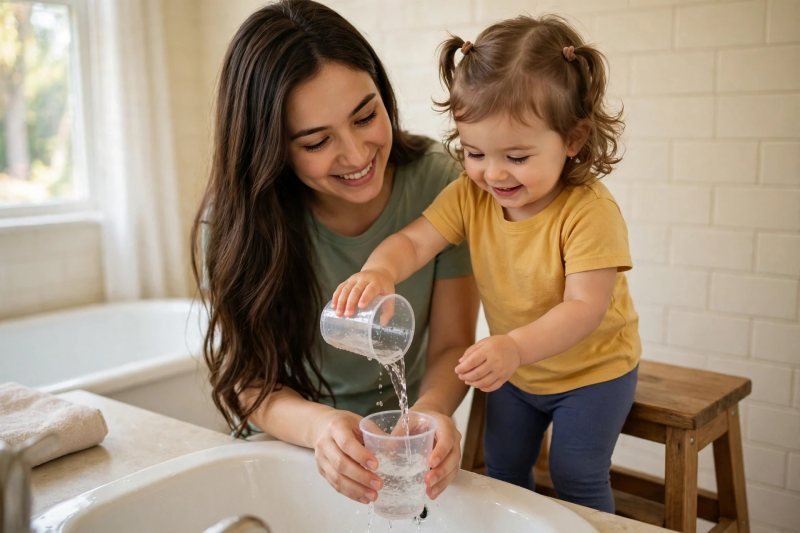
Play with water outside the tub. Once floor play feels easy, let water join the fun in a place your toddler can control completely — the bathroom sink, a small basin on a towel, or a water table if you have one: set her on a sturdy step stool at the sink with you right beside her, fill the basin shallow with warm water, and hand over the stacking cups for pouring, filling, emptying and splashing with her hands, all while her clothes stay on and her feet stay dry and free to step down the moment she has had enough. This kind of open-ended pouring play is the same joyful learning explored in these toddler learning activities at home, and it teaches a quietly powerful lesson here — water is something she can start, stop, spill and play with, rather than something that happens to her. Let her get her hands wet, then her arms; offer the washcloth to squeeze and drip; and mop up cheerfully without fuss, because a relaxed attitude to splashes keeps the mood light. If she wants to leave after two minutes, she leaves after two minutes, praised for the pouring she did. A few simple best bath toys for toddlers — cups, a duck, a pouring toy — are all the props this step needs. Say, "This is your water to play with — pour it, splash it, and tell me 'all done' whenever you want to stop."
-
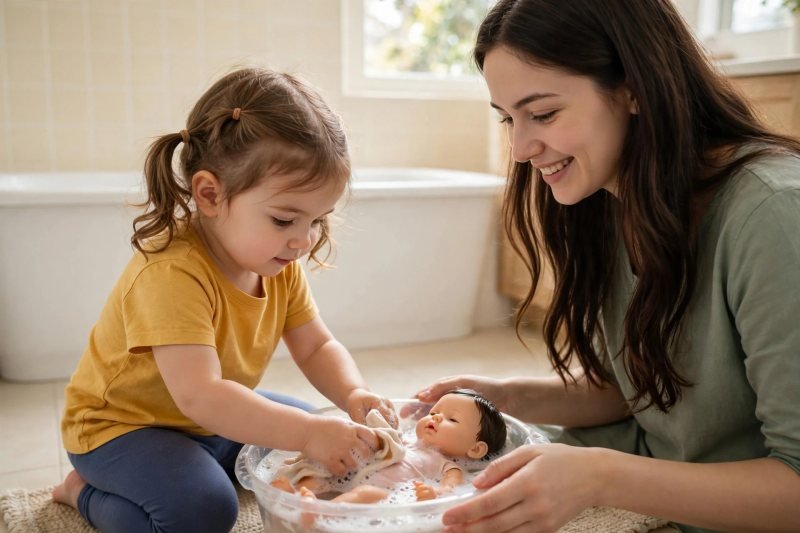
Wash a favorite toy together. Now give your toddler the powerful job of being the washer instead of the washed: fill the small basin with warm water and a little foam, set it on a towel on the bathroom floor, and invite her to give her doll or washable toy a bath, with you narrating the gentle routine exactly as you will one day use it for her — first the toy's feet, then its tummy with the soft washcloth, a trickle of water from the small cup, and a big snuggly towel at the end. Let her do as much as she wants to do — squeezing the cloth, pouring tiny cups, patting the toy dry — and follow her script if she invents one, because directing the doll's bath lets her rehearse every sensation at a safe distance: the foam, the warm water, the washing and the drying all happen to the toy while she stays in charge. Talk through the toy's feelings in a light, reassuring way and keep the whole thing playful rather than instructional; if she decides the doll is done after one dip, the doll is done. Repeat this game on other days until it is an old favorite. Say, "You are the bath helper today — wash your doll gently, trickle, trickle, and then wrap her up all cozy."
-
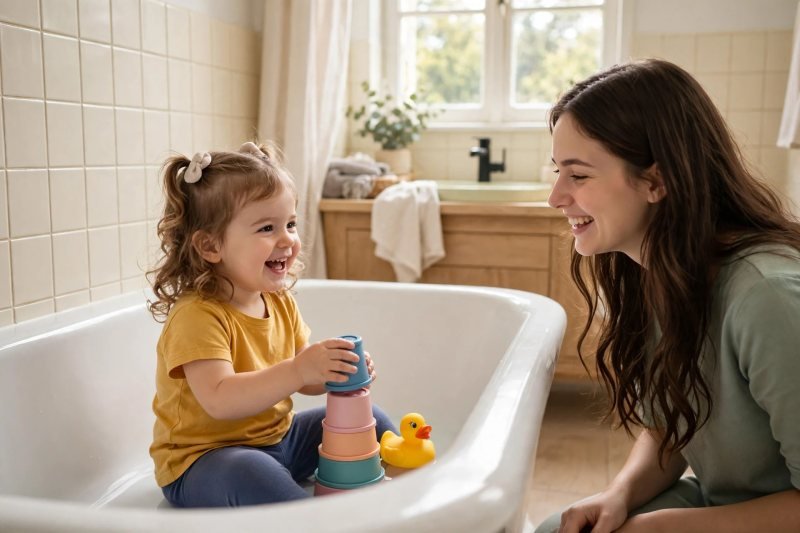
Sit in the empty tub, fully clothed. When the bathroom, the water play and the doll baths all feel familiar, invite — never lift, place or persuade — your toddler to climb into the completely empty, dry bathtub wearing all her clothes, with you kneeling beside the tub the whole time: line the tub with a soft towel or non-slip mat so it feels warm and grippy rather than cold and hard, bring the stacking cups and the duck in with her, and treat the tub as a funny little play den for a few minutes of stacking, posting toys through cups and peekaboo over the side. Getting in and out is part of the game, and she should do it her way, with your steady hand offered and the step stool nearby; if she only wants to sit on the edge today, the edge counts. Keep water entirely out of this step — taps stay off, the plug stays out, and the promise that this is dry play is kept absolutely, because her trust in your promises is the real curriculum here. A few happy, clothed, dry sits turn the tub's shape, height and echoes into something known and safe. Say, "Clothes on, tub dry, toys in — this is our special play boat, and you can climb out whenever you like."
-
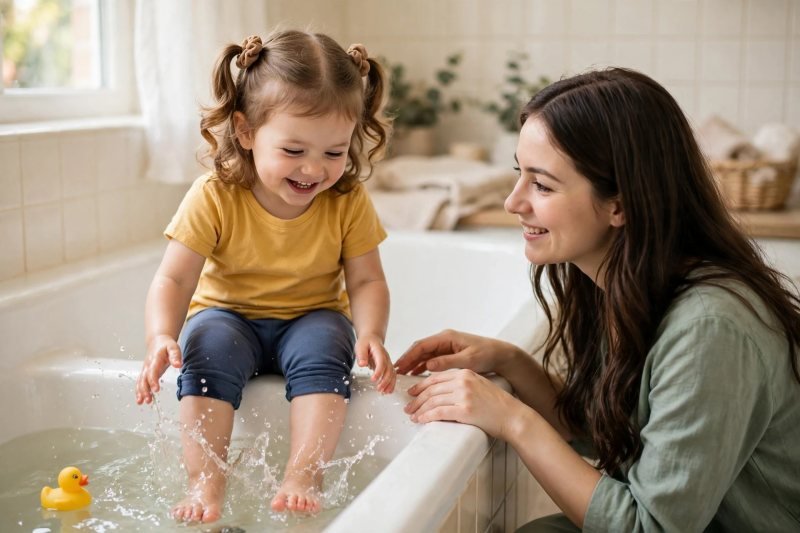
Dip toes in shallow water. The first water in the tub arrives at the lowest-stakes address possible — her feet, while she stays clothed and seated on the edge: roll her leggings up to her knees, run just a few inches of warm water into the tub with her watching from a safe spot, check the temperature with your wrist, and then sit her on the tub's edge with you kneeling right beside her, one supportive hand close, so she can dip her toes, kick gently and splash her feet while the rest of her stays dry and dressed. The duck floats in the shallow water, cups can be filled and poured over her feet, and the whole event lasts minutes; some toddlers want their hands in too, splashing from the edge, and some want out after a single dip, and both are complete successes to celebrate warmly. Let her see the water drain away at the end, because watching it disappear under her control is reassuring, and dry her feet with the big towel and plenty of praise. Repeat toe dips on different days until kicking in the shallows is pure fun. The wrist test is the reliable check — this bath water temperature for kids guide explains the safe range and how to mix the water first. Say, "Just your toes are going swimming today — kick, splash, and I am right here holding on with you."
-
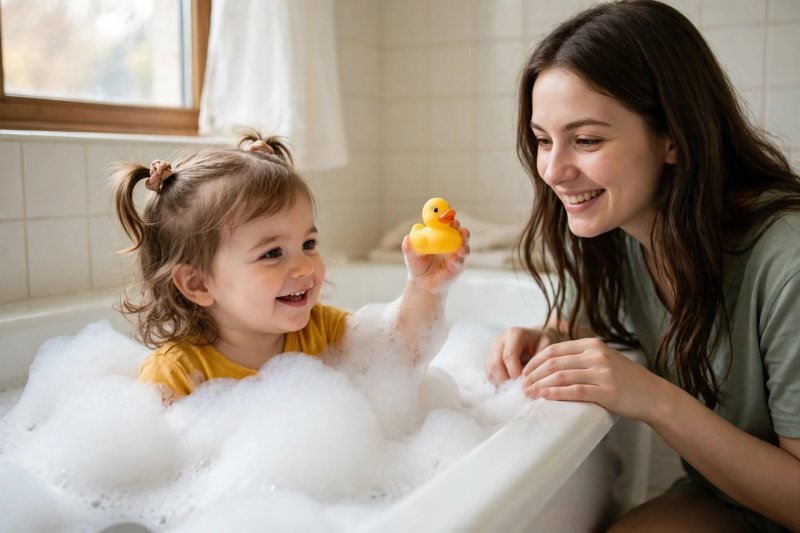
Try a first short, shallow bath. Only when toe dips are genuinely fun is it time for a real bath — and the first one is deliberately tiny: a few inches of warm, checked water, a deep layer of bubbles if she likes foam, her best toys already floating, and you kneeling beside the tub within arm's reach for the entire bath, staying off your phone and fully present. Lower her in gently only when she is willing, talk her through each small thing before it happens, and keep the washing to the minimum — a gentle cloth over her body, no hair washing today, no water poured anywhere near her face — because this bath exists to prove that baths can be brief, warm and pleasant, not to get every inch clean. Two or three happy minutes is a triumph; use the song or timer so the end is predictable, then lift her out into the big towel while she is still cheerful, even if that feels surprisingly soon. If she cries to get out at any point, she gets out at that point, kindly and without disappointment in your voice, and you simply try a smaller step another day. Keep the first bath playful with the ideas in this how to make bath time fun guide, so the new experience reads as a game, not a test. Say, "A short, splashy bath today — I will stay right here the whole time, and we will finish while it is still fun."
-
Make washing gentle and playful. Once short baths are accepted, washing can slowly join the play, one gentle piece at a time: let her hold her own washcloth and wash her tummy and arms while you wash what she cannot reach, trickle water from the small cup over her shoulders and arms — always warning her first, always keeping water and foam well away from her face — and turn each part into a tiny game of washing the duck, washing the cup, washing knees that pop up through the bubbles. The calm, predictable order used in a simple kids skincare routine is a good model here: the same steps, in the same sequence, in the same words, so nothing about washing ever arrives as a surprise. Hair washing, when it eventually comes, starts the same small way — a trickle from a cup while she tips her head back and looks at a toy held up high, stopped the instant she asks. If a particular part upsets her, skip it without a battle; a missed wash is forgotten by morning, while a forced one is remembered for weeks. Say, "Your turn to wash your tummy, my turn to trickle your shoulders — tell me 'stop' and I will stop straight away."

-
End while it is still going well. The end of the bath is a step in its own right, because baths that finish happily teach her that getting out is easy and nothing scary happens at the end: agree the finish before she gets in — when the song ends, when the timer dings, or when the duck has had his ride — give one friendly warning that the end is close, and then honor it promptly, lifting her into the big warm towel even if she is mid-game and would happily stay longer. A bath that ends too early leaves her wanting more next time, which is exactly the feeling you are growing; a bath that drags on until the water cools and she gets overtired ends the story on the wrong page. Wrap her fully, dry her with unhurried pats, dress her in the waiting pajamas right there in the warm bathroom, and keep your voice at the same cheerful pitch you used in the water, so the whole routine — in, wash, play, out, cozy — feels like one continuous, predictable pleasure. If she asks to get out early on any day, early it is, with the same warm routine. Say, "The song is finished, so bath is finished — out into your big towel for a cozy cuddle, just like we planned."

-
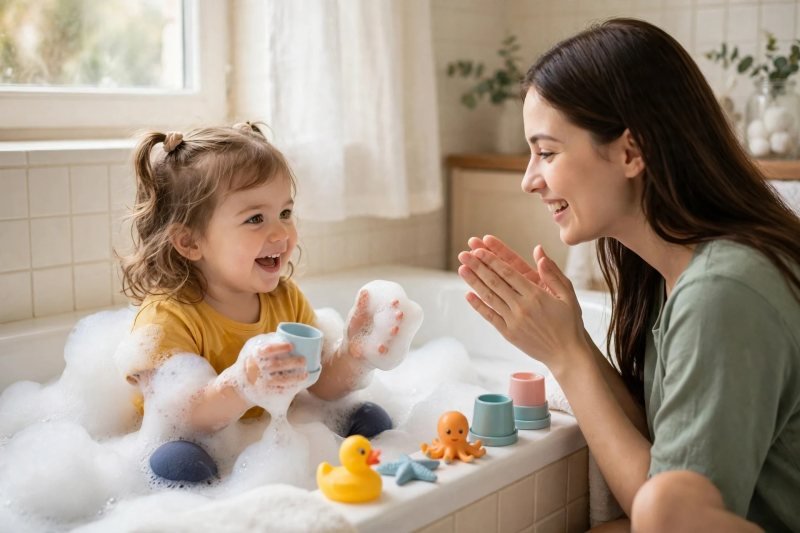
Build the same cheerful routine. Repetition is what turns a brave experiment into an ordinary bath, so once a short bath works, keep everything about it the same for a good long while: the same time of day, the same order of events, the same toys, the same song to finish, the same towel and pajamas waiting in the same place, and the same words from you at the same moments, because a two-year-old relaxes into what she can predict the way she relaxes into a favorite bedtime story. Keep baths short and cheerful rather than stretching them — a happy few minutes several times a week builds far more confidence than one long weekend soak — and add new elements one at a time, days apart: a new toy this week, a slightly deeper fill next week, hair washing only when the rest is thoroughly boring. Expect wobbly days after illness, travel, a slip, or a splash in the face, and answer them by dropping back to whichever earlier step still feels easy — toe dips, doll baths or dry play — for as many days as she needs, without sighs or comparisons. The routine bends; it never breaks, and it never becomes a contest. Short baths several times a week are enough — this guide to how often toddlers should bathe explains the rhythm that keeps skin calm and confidence growing. Say, "Same bath, same song, same duck — you know exactly what happens next, because it is your bath routine."
-
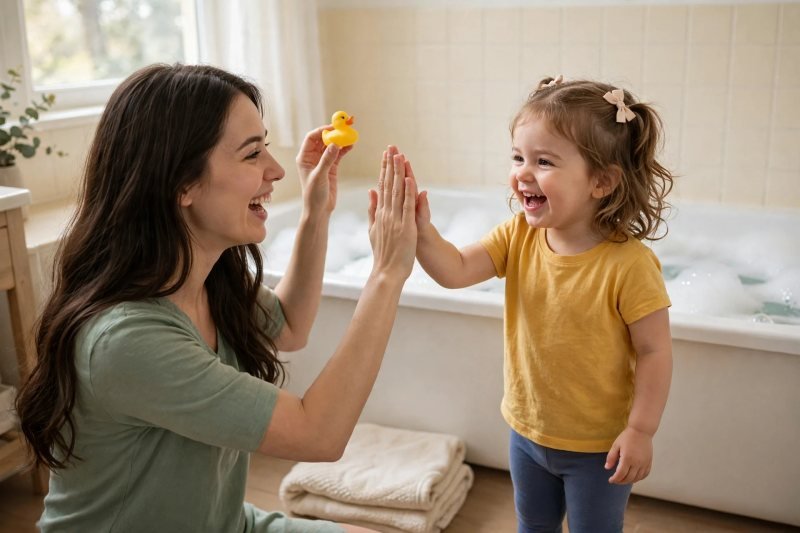
Celebrate progress and keep baths short. Finish the journey by treating every small win as the big deal it genuinely is: praise the specific thing she did — the toes she kicked, the doll she washed, the two minutes she stayed, the hair trickle she allowed — with a high-five, a happy retelling to the other parent or a grandparent within her hearing, and the rubber duck presented like a trophy, because toddlers work hard for the delight in your face and it tells her she is a child who can do bath time. Keep the pattern that got you here permanently in place: baths stay short, cheerful and predictable, she is never forced, held in, or surprised with water, her 'all done' is always honored, and you stay close and attentive for every single bath. Progress is rarely a straight line, and a step backward after a good run is normal toddler weather, not failure — return to the last easy step, play there happily, and climb again at her pace. The goal was never a child who tolerates long baths; it is a child who trusts the water, trusts the routine and, most of all, trusts that you will listen. Say, "You did it — toes, bubbles, washing and all — I am so proud of you, and bath time is ours again."


Make it easier
Stay on the earliest steps for as long as she needs: dry floor play, sink pouring and doll baths are complete, valuable activities in themselves, and there is no schedule to keep. Wash her without the tub on hard days — a warm washcloth wash at the sink, a basin wash on a towel, or a quick shower with a parent holding her if she prefers that to the tub — so hygiene never becomes the reason a bath gets forced. Shrink any step that feels too big: toes instead of feet, feet instead of a bath, thirty seconds instead of two minutes, or the doll doing it first while she watches.
Make it harder
Add gentle hair washing as its own mini-step: a single trickle from a cup while she tips her head back to look at a toy held high, building up over several baths, always stopping when she asks. Let her help run the bath: carrying the duck in, choosing which cup to bring, testing the water on her own wrist beside yours, and pulling the plug to watch it drain at the end. Stretch play before washing: a few extra minutes of pouring, foam patting and duck races in the shallow water before the cloth comes out, keeping the cheerful finish exactly on time.
Other ways to play it
- Shower swap: if the tub itself is the sticking point, try standing in a shallow shower with a parent holding her, feet on a non-slip mat, playing with cups under a gentle spray — some toddlers find moving water less daunting than sitting in it.
- Paddling-pool practice: in warm weather, a shallow paddling pool outdoors offers the same sitting-in-water practice with a holiday feeling, swim clothing on, and a parent right beside her at all times.
- Sibling or parent in first: a calm older sibling playing happily in the bath, or a parent bathing first while she plays on the mat beside the tub, gives her a cheerful live demonstration — joining in must always be her idea, never a lift-in.
How it changes by age
- Age 2: Keep every step at its smallest and most playful: dry play, sink pouring and doll washing may be the whole program for weeks, and that is perfectly fine. Sessions last minutes, words stay few and warm, and her 'all done' — said, signed or shown by walking away — ends things instantly. In-tub steps, when they come, are two or three minutes of shallow water and bubbles with a parent within arm's reach at all times.
- Age 3: Three-year-olds can often talk about the plan, choose the order of steps and take pride in being the doll-washer and bath helper, so involve them: let her pick the finishing song, carry the toys in, and say what happens next. Explanations can be a little fuller, but the rules stay identical — child-led, never forced, short baths, and a step back on hard days without any fuss.
What they're learning
Trust and emotional safety: every kept promise — the tub stayed dry, the bath ended on time, 'stop' worked — teaches her that her feelings are heard and that grown-ups keep their word. Control and confidence: choosing when to dip, pour, climb in and get out builds a genuine sense of mastery over something that once felt overwhelming. Cause and effect and early water sense: pouring, filling, floating the duck and watching water drain away are hands-on lessons in how water behaves, learned at her own pace. Language and routines: the same words, songs and sequences at every bath build vocabulary, memory and the comfort of knowing what comes next. Self-care skills: washing her doll, then her own tummy and arms, and helping with the towel are the first playful steps toward washing herself.
Clearing up
While your toddler is warm, dressed and settled, drain the tub and rinse it free of foam, empty basins and the paddling pool if you used one, and squeeze bath toys dry and stand them to air so they stay fresh for next time. Washcloths and towels go into the wash, wet mats are hung up to dry rather than left in a heap, and the bathroom floor gets a quick mop or towel-dry so no one slips on puddles later. Put the cups, duck and doll back in their bathroom basket together — letting her help with this small tidy-up is a calm, happy final scene for bath time, and it sets up the room to feel welcoming next time you walk in.
Questions parents ask
What should I do if my toddler is suddenly scared of the bath?
How long does it take for a toddler to stop fearing the bath?
Should I ever make my toddler get in the bath if she is crying?
What if my toddler will play with water but still will not get in the tub?
How deep and warm should a first bath be for a scared toddler?
When should I talk to a pediatrician about bath fear?
Internal links embedded in body (6, all /activities/): toddler-learning-activities-at-home; best-bath-toys-for-toddlers; bath-water-temperature-for-kids; how-to-make-bath-time-fun; kids-skincare-routine-simple-steps; how-often-should-toddlers-bathe. All six are embedded inline in the Instructions above. Framing discipline: the whole arc is gradual and child-led — dry play near the tub, water play outside the tub, washing a doll, sitting in an empty tub fully clothed, toe dips in shallow water with a parent close, then short, cheerful baths. A frightened child is never forced into water at any point, and 'all done' is honored in every step.

save it for later
Pin this for the next rainy afternoon
Keep it on a board so it is there when you need it, rather than when you happened to find it.
Save to Pinterest


