


How Often Should Toddlers Bathe?
Pediatric guidance commonly suggests toddlers bathe 2-3 times a week unless dirtier. A gentle guide to when daily baths are fine, washing, moisturizing and safety for ages 2-3.
Pediatric guidance commonly suggests most toddlers need a bath only two to three times a week, with a quick cloth wash of the face, hands, and diaper area on other days. Bathe more often whenever your toddler is muddy, sweaty, or covered in sunscreen — and daily baths are fine when the water is lukewarm, washing is gentle, and you moisturize afterward.

The short version
- Two to three baths a week is enough for most toddlers aged 2–3; cloth-wash face, hands, and diaper area on the days between.
- Add a bath whenever the day demands it: sunscreen, sweat, sand, paint, or a diaper leak all make tonight a bath night.
- Daily bathing is fine if baths stay short and lukewarm, cleansing stays gentle, and moisturizer follows every time.
- Wash gently head to toe with a fragrance-free cleanser, rinse well, pat dry, and moisturize while skin is still damp.
- Safety never relaxes: an adult within arm's reach for the whole bath, warm — never hot — water, and a non-slip mat.
- Age
- Ages 2–3
- Mess
- Low
- Where
- Indoor
Why kids love this
Toddlers love bath time because it is warm, splashy, unhurried play with their favorite person close by — and because the same gentle routine happens in the same order every time, which makes them feel safe and clever for knowing what comes next. They get to pour, stir bubbles, wash a toy, and hear the same silly rinse song, all while getting clean without a fuss. Parents love it for the opposite reason: once you know that pediatric guidance commonly suggests two to three baths a week is enough for most toddlers, the pressure disappears. A quick wash of hands, face, and diaper area on the in-between days keeps a toddler fresh, bath nights become a treat rather than a chore, and a child who is muddy, sweaty, or covered in sunscreen simply gets an extra bath — no guilt, no schedule to defend, just clean, moisturized skin and a sleepy, contented toddler.
What you'll need
- A clean bathtub or a large toddler bath tub — rinsed out before you run the water
- Warm water — comfortably warm to the inside of your wrist or elbow, never hot
- A gentle, fragrance-free cleanser made for young children — a small amount is plenty, and many baths need it only on the dirty spots
- A soft washcloth and a soft hooded towel — one for washing, one waiting for the warm wrap-up
- A mild, fragrance-free moisturizer — for smoothing on within a few minutes of the bath ending
- A cup for rinsing — unbreakable, easy to grip, and kept for bath use
- A few bath toys — cups, a rubber duck, or stacking boats; washed and dried regularly so they stay clean
- Clean pajamas, a fresh diaper or underwear, and any bedtime items — laid out before the water runs so you never leave the room
- A non-slip bath mat in the tub and one on the floor — for steady footing getting in and out
- Blank, unlabeled bottles only in any photograph — and in real life, cleansers stored out of reach between baths
Before you start
1. Choose the bath nights for your week — two or three evenings that suit your family — and treat extra baths as simple add-ons after muddy, sweaty, or sunscreen-heavy days. 2. Lay out the towel, pajamas, fresh diaper or underwear, and moisturizer within arm's reach of the tub before any water runs, so your toddler is never left alone while you fetch something. 3. Check the bathroom once: non-slip mat in place, cleansers and razors and medicines out of reach, toilet lid down, and the floor clear for a wet, wriggly exit.
How to do it
-
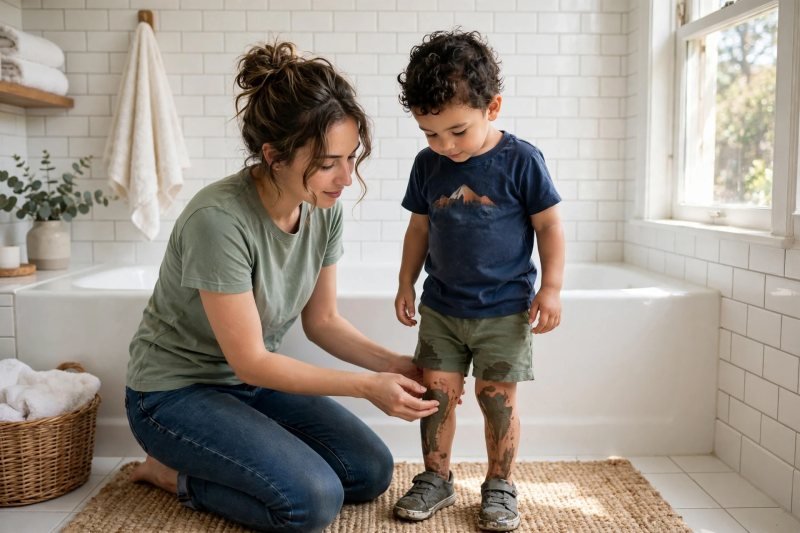
Decide if tonight is a bath night. Start here, because this is the whole answer in one step: pediatric guidance commonly suggests most toddlers only need a bath two to three times a week, and on the other days a quick wash of the face, hands, neck folds, and diaper area with a warm cloth is enough. Tonight counts as a bath night if the day left its mark — sunscreen smoothed on at the park; sweat from a hot afternoon; dirt, sand, or paint from real play; food in the hair; or a diaper leak that a cloth cannot fix — and a calm, ordinary day at home usually does not. Daily bathing is fine too when your toddler loves it, the water is not hot, washing stays gentle, and you moisturize afterward, so treat two to three as a reassuring floor, not a strict rule. A steady bath routine for toddlers helps the pattern stick without a nightly debate. Say, "Let's check the day — muddy knees and sunscreen mean bath night tonight."
-
Gather everything before the water. Lay out the whole routine within arm's reach before a single tap turns: the soft towel opened on its hook; the washcloth over the tub edge; the rinsing cup and two or three bath toys in the dry tub; pajamas and a fresh diaper or underwear folded on the closed toilet lid; and the moisturizer standing by for the end. This gathering is a safety step disguised as tidiness, because a toddler in water is never left alone — not for a towel, not for a phone, not for a doorbell — so anything forgotten simply waits until the bath is over. Invite your toddler to carry one safe item, like the towel or a toy, so gathering feels like the first game of the routine. Say, "Everything ready first — then we never have to leave our bath."

-
Run a shallow, warm bath. Run the water with your toddler nearby but not yet in the tub, fill it only to about your child's waist when sitting — a few inches is plenty at this age — and swirl it with your hand so there are no hot pockets hiding under the surface. Test it the old-fashioned way, with the inside of your wrist or your elbow, where skin is sensitive: it should feel comfortably warm, like a hug, never hot, and if it feels hot to you it is too hot for a toddler. Add bubbles only if your child wears a swimsuit or sits deep in them for photographs, keep bubble play occasional because frequent bubble baths can irritate delicate skin, and skip bath oils that make the tub slippery. For the wash itself, choosing the best body wash for toddlers matters more than a fancy bottle — gentle and fragrance-free wins. Say, "Warm like a hug, not hot — we test it together every time."

-
Settle in safely and play first. Lift your toddler in slowly, one hand under an arm and one steadying, let small feet find the non-slip mat, and stay right there — kneeling beside the tub, within arm's reach, for the entire bath, because a toddler is never left unattended in water, not even for a few seconds, and never placed under a sibling's watch. Give the first minutes to play before any washing starts: pouring from the cup; stirring the bubbles into mountains; washing a toy duck with great seriousness; and splashing in rhythm while you sing. Play first is not wasted time — it warms cold toes, relaxes a child who arrived grumpy, and makes the washing that follows feel like part of the game rather than an interruption of it. Say, "Splash and play first — washing comes after the duck is clean."

-
Wash the body gently, top to bottom. Work in one calm order so nothing is missed and nothing is scrubbed twice: face first with plain warm water on the cloth and no cleanser at all; then neck and behind the ears, where milk and sweat collect; then arms, tummy, and back with a pea-sized amount of gentle cleanser on the cloth; then legs and feet, with a gentle look between the toes; and the diaper area last, front to back, with the cloth rinsed well before it touches skin again. Gentle is the technique — soft strokes, no scrubbing, no adult soaps, no strongly scented products — because toddler skin loses moisture quickly and a light touch cleans a two-year-old perfectly well. A simple routine like this sits comfortably alongside a broader kids skincare routine as your child grows. Say, "Soft strokes, top to bottom — face, tummy, toes, done."

-
Wash the hair without the tears. Hair needs washing only once or twice a week for most toddlers, and on other bath nights plain water is enough, so check whether tonight is a hair night before anyone gets wet. Lean your toddler back against your supporting hand or arm, shield small eyes with your fingers or the dry edge of the cloth, and pour warm water slowly from the rinsing cup, working from the hairline backward so water runs away from the face. Use a tiny amount of gentle, tear-free cleanser, massage with fingertips — never nails — and keep the whole thing unhurried and narrated, because a child who hears each pour coming rarely startles. If hair washing is a new skill in your house, the calm, trust-first approach in this guide to a toddler first haircut helps with salon visits later too. Say, "Head back like a star-gazer — here comes the warm rain."

-
Rinse every trace of cleanser away. Rinse in the same top-to-bottom order you washed, pouring clean water from the cup or scooping it fresh from the tap end of the tub, until skin feels clean rather than slippery and hair runs free of suds. Leftover cleanser left to dry on toddler skin is a common, quiet cause of itchiness, so this step earns its full minute: one pass over the shoulders and back; one over the tummy and arms; a careful rinse of the diaper area; and a final pour over the hair if tonight was a hair night. Turn rinsing into the finale of the play — count the pours together, catch the water in the toys, and let your toddler do the last small pour with both hands on the cup and yours guiding. If the hair rinse ever brings tears, the slow-pour tricks in washing toddler hair without tears help here too. Say, "One, two, three pours — all the bubbles sail away."

-
Lift out and pat dry, never rub. Baths for this age stay short — about ten to fifteen minutes is plenty, and once fingertips wrinkle or the water cools, it is time to come out even if the game is good. Pull the plug while your toddler is still in the tub if the sound is familiar, lift out with two steady hands onto the floor mat, and wrap the hooded towel straight around small shoulders so warmth arrives before any chill can. Pat dry gently rather than rubbing, and take a moment over the places moisture hides: behind the ears; in the neck and elbow creases; between the toes; and in the diaper area, where skin should be fully dry before a fresh diaper goes on. Say, "Wrap up warm, pat pat pat — dry toes, dry ears, all dry."

-
Moisturize while skin is still damp. Smooth moisturizer on within a few minutes of the bath ending, while skin is still slightly damp, because that timing helps lock the bath's moisture in rather than letting it evaporate. Use a plain, fragrance-free cream, warm a little between your own palms first so the first touch is never cold, and work in the same gentle order: cheeks if they tend to dry; arms and legs with long, soft strokes; tummy and back; and a little extra on any knees, elbows, or cheeks that often feel rough. Keep it light and quick — this is a comforting massage as much as skincare, and most toddlers melt into it — then dress your child straight into the waiting pajamas so the warmth and moisture stay sealed in. If her skin runs dry, our notes on the best moisturizer for kids' dry skin cover what to look for in a plain, fragrance-free cream. Say, "Smooth and cozy, head to toe — now pajamas hug it in."

-
Finish with the same calm wrap-up. End every bath the same way so the routine itself becomes the sleepy signal: pajamas on; hair given a gentle pat or a soft brush; the damp towel hung up together; toys scooped from the tub, rinsed, and left to dry; and the bathroom given one quick check that cleansers are back out of reach. Then move straight into the bedtime runway — a drink of water, teeth, a short book, and lights low — because a warm bath followed by a predictable wind-down is one of the kindest ways to tell a toddler body that sleep is coming. If you notice skin that looks persistently red, cracked, or sore tonight, make a mental note rather than a worry: mention it at your next pediatric visit, and sooner if it spreads or your child seems uncomfortable. Say, "Bath done, book next — our sleepy story starts now."



Make it easier
Keep a one-minute wash for non-bath days: warm cloth, face, hands, neck folds, and diaper area, then moisturizer on any dry patches — fresh in five minutes with no tub at all. Bath with a swimsuit or deep bubbles for photo days, and keep the whole routine to the same nights each week — a predictable pattern is easier for toddlers and parents alike. Use a two-in-one gentle cleanser and skip separate hair products; most toddler hair needs only a tiny amount once or twice a week.
Make it harder
Let your toddler run more of the routine: choosing the bath toys, washing their own tummy and legs with the cloth, and counting the rinse pours aloud — early independence and counting in one step. Add a simple body-words game: name each part as you wash it — elbow, ankle, shoulder blade — building vocabulary and body awareness inside a routine they already love. Introduce a first shower adventure on a warm day: hand-held shower on its gentlest setting, you in or beside the tub, same order and same safety rules, for a child who is outgrowing the bath.
Other ways to play it
- Sensitive-skin version: shorter baths in plain warm water, cleanser used only on hands, feet, and the diaper area, moisturizer smoothed on twice a day, and any new product tried on one small patch of skin first.
- Eczema-aware version: lukewarm rather than warm water, baths kept to about ten minutes, no bubble bath or scented products, moisturizer applied generously straight after patting dry — and your pediatrician's own plan always outranks general guidance like this.
- Reluctant-bather version: start with feet-only paddling in a shallow tub with toys, sit fully dressed beside the tub playing for the first sessions, keep baths playful and brief, and let confidence grow before expecting a full sit-down wash.
How it changes by age
- Age 2: Two-year-olds need the routine held almost entirely by you: baths two to three times a week with cloth washes between, water only waist-deep when sitting, constant arm's-reach supervision, and washing done gently by your hands while they play. Hair washing once a week is usually plenty, moisturizer goes on as part of the cuddle afterward, and the whole bath is over in about ten minutes — before the water cools or patience runs out.
- Age 3: Three-year-olds can start joining in: holding the cup for rinsing, washing their own tummy and legs, naming body parts, and remembering the order of the routine with pride. The frequency guidance is the same — two to three baths a week unless the day was dirtier — but daily baths are fine at this age too when they stay short, lukewarm, gentle, and followed by moisturizer. Supervision stays absolute: an adult within arm's reach, every minute, no exceptions.
What they're learning
Body awareness and vocabulary: naming ears, elbows, ankles, and toes while washing them, in the same order every time — early anatomy learned through warm water and repetition. Independence and self-care: carrying the towel, choosing toys, washing their own tummy, and helping hang up the towel — the first real steps toward washing themselves one day. Sequencing and routine: first play, then wash, then rinse, then dry, then moisturize — a predictable chain a toddler can anticipate, recite, and feel proud of completing. Sensory comfort and trust: warm water, gentle touch, and a calm voice in a steamy bathroom — learning that being cared for feels safe, which makes every future routine easier.
Clearing up
Pull the plug as your toddler leaves the tub, scoop toys out, rinse them, and set them somewhere they can dry fully before the next bath — damp toys left in a closed box grow musty quickly. Fish out any cloths, hang the towel and washcloth to dry, wipe the rim and the floor mat, and put cleanser and moisturizer back in their out-of-reach spot while the bathroom is still steamy and you are still in it. Pajama-day clothes go straight into the laundry basket, the floor gets one quick dry pass so no one slips later, and the whole reset takes under three minutes — a tidy bathroom tonight makes the next bath night feel easy.
Questions parents ask
How often should toddlers bathe each week?
Is it okay for a toddler to bathe every day?
When does a toddler need an extra bath?
How long should a toddler's bath last, and how warm should the water be?
What should I do if my toddler has dry skin or signs of eczema?
How can I keep my toddler safe in the bath?

save it for later
Pin this for the next rainy afternoon
Keep it on a board so it is there when you need it, rather than when you happened to find it.
Save to Pinterest


