


Toddler Learning Activities at Home: 30 Ways to Teach Your 2-Year-Old
Simple toddler learning activities at home that teach your 2-year-old language, counting, colours and fine-motor skills through play — 30 ideas from things you already own, five to fifteen minutes each.
The best toddler learning activities at home are short, playful and woven into daily life: naming games and rhymes for language, counting stairs and snacks for early maths, colour hunts and shape posting for colours and shapes, playdough and pouring for fine motor skills, sensory bins for exploration, and freeze dance and rhythm games for listening and coordination. Five to fifteen minutes, with things you already own.

The short version
- At two, learning happens through play, talk and repetition — not lessons or flashcards.
- Each activity takes 5–15 minutes with ordinary household items; most need no preparation.
- Six skill areas: language, counting, colours and shapes, fine motor, sensory play, music and movement.
- Narrating what your child does teaches as much as any structured activity.
- Stop when interest fades — a short happy session beats a long forced one.
- Supervise closely around small items, water and paint.
- Age
- Ages 2–3
- Play time
- 5 min
- Mess
- Some
- Difficulty
- Easy
- Where
- Both
Why kids love this
Play-based learning for twos — no flashcards, no pressure, just everyday fun that teaches. To your toddler this isn't "learning" — it's chatting with a sock puppet, drumming on pots and rescuing toys from ice. These toddler learning activities at home work because they match what twos already love: copying you, making noise, filling and emptying things. No sitting still required, and wandering off halfway is perfectly normal.
What you'll need
- Socks
- Wooden spoons
- Pots
- Plastic jugs and cups
- Dried pasta
- Rice or lentils
- Ice cubes
- Pom-poms or scrunched tissue
- Clothes pegs
- Crayons
- Washable paint
- Paper
- Stickers
- Masking tape
- A picture book
- A laundry basket
- Cushions
- A scarf or tea towel
- A sealed rice bottle for a shaker
- Optional: playdough
Before you start
Nearly everything needs zero prep. For the rest, five minutes does it: fill a tray while the kettle boils, freeze toys in ice the night before, or cut card shapes during naptime. Keep pegs, pom-poms, pasta and stickers in one grab-and-go box.
How to do it
-
What can a 2-year-old actually learn at home? A great deal — through talk, touch and repetition. Language grows when you name their world; early maths grows by counting real things; hand control grows through pouring and pinching. Thirty ideas below, grouped by skill, each sized for a toddler's attention span.
-
LANGUAGE (How do I teach my 2-year-old words through play?):
-
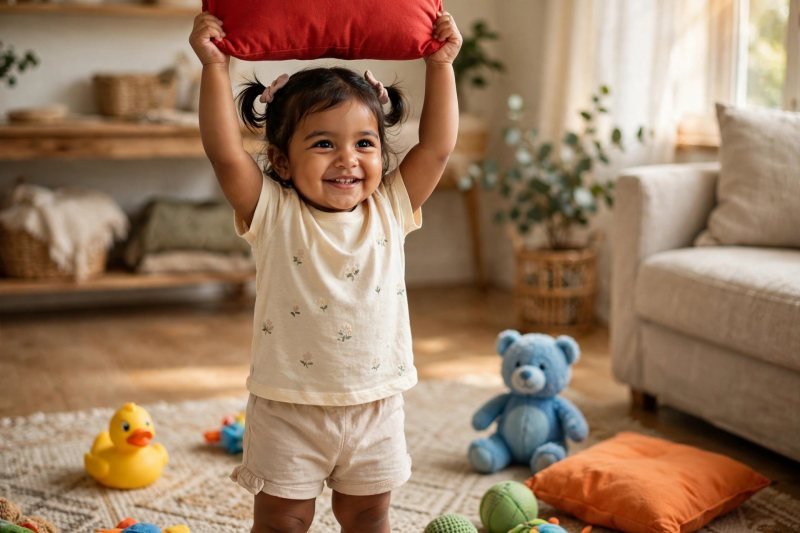
1. Name-the-basket. Pull familiar objects from a basket, naming each with delight.
-
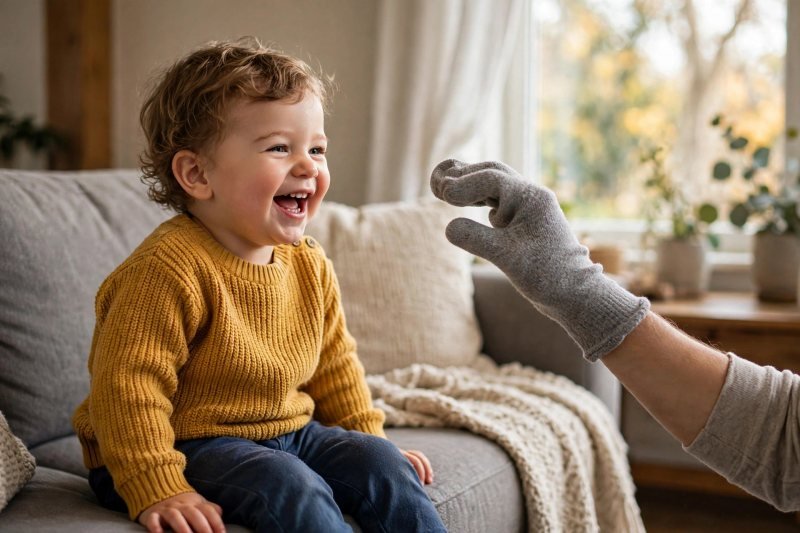
2. Sock-puppet chat. A sock on your hand asks, "Where's your nose?"
-
3. Book treasure hunt. "Can you find the dog? Where's the moon?"
-
4. Rhyme and clap. Sing nursery rhymes, clapping along; pause before the last word so they fill it in.
-
5. Two-word building. They say "ball"; you stretch it: "Yes — red ball! Big red ball."
-
COUNTING (What are the best counting activities for a 2-year-old?):
-
6. Counting the stairs. Count each step as you climb, touching it as you go.
-
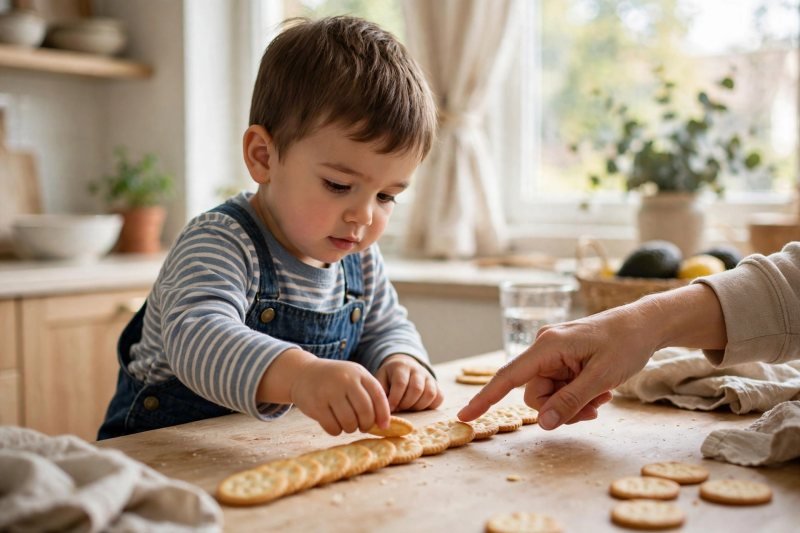
7. Snack maths. Count raisins onto a plate together.
-
8. Button jar drop. Drop large buttons into a jar one by one, counting aloud.
-
9. Clap-count copy. You clap three times; they echo.
-
10. Peg the line. Clip three pegs onto a cushion edge, counting as you go.
-
COLOURS AND SHAPES (How can I teach my toddler colours and shapes without flashcards?):
-
11. Colour hunt. "Let's find everything RED!"
-
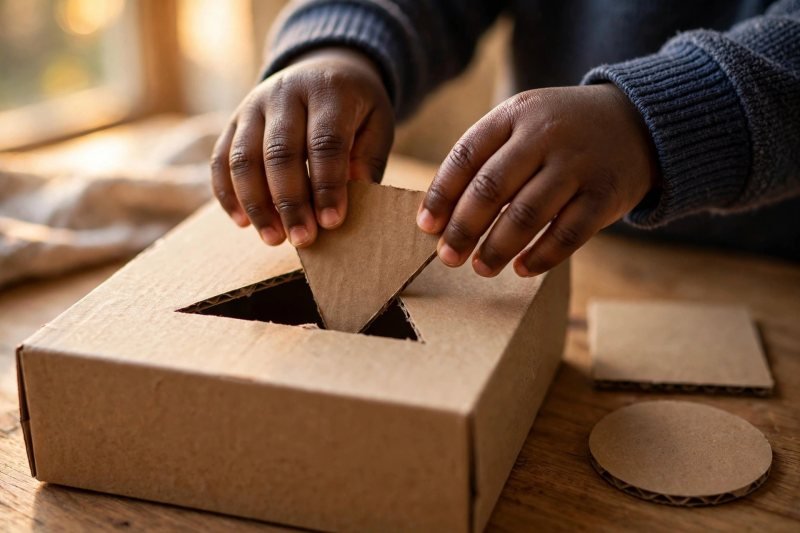
12. Homemade shape sorter. Post big card circles, squares and triangles through slots in a shoebox lid.
-
13. Sponge-print painting. Stamp sponge shapes in washable paint, naming colours and shapes.
-
14. Laundry sorting. "Find all the blue socks!"
-
15. Sticker night sky. Stick star and circle stickers on dark paper.
-
FINE MOTOR (What fine-motor activities work for 2-year-olds?):
-
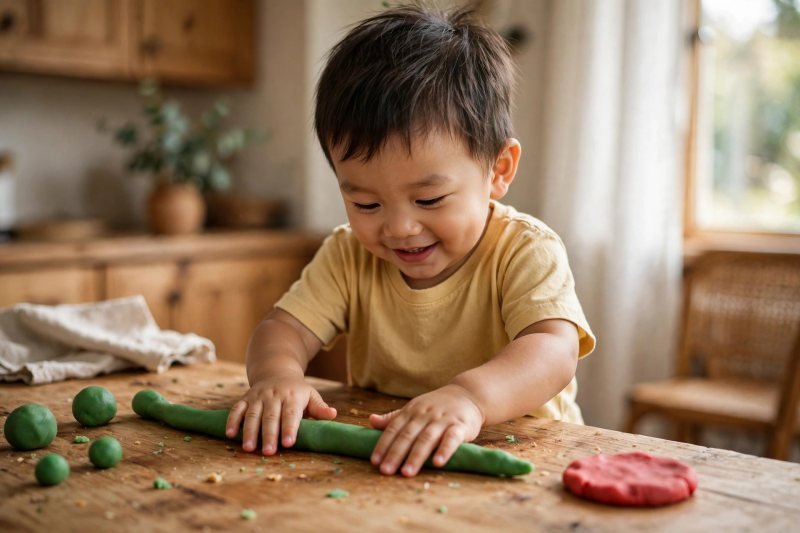
16. Playdough pinch and roll. Roll snakes, pinch bits off, squash flat.
-
17. Pasta threading. Thread penne onto a knotted shoelace.
-
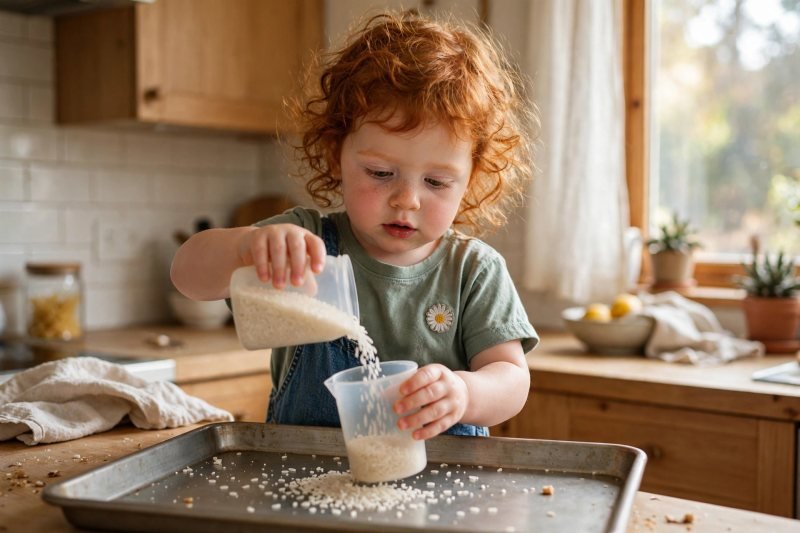
18. Pouring practice. Two jugs, dry rice, a tray — pour back and forth.
-
19. Sticker line-up. Draw a wiggly line; they stick stickers along it.
-
20. Pom-pom tongs. Move pom-poms between bowls with toddler tongs.
-
SENSORY (Do sensory activities help toddlers learn?):
-
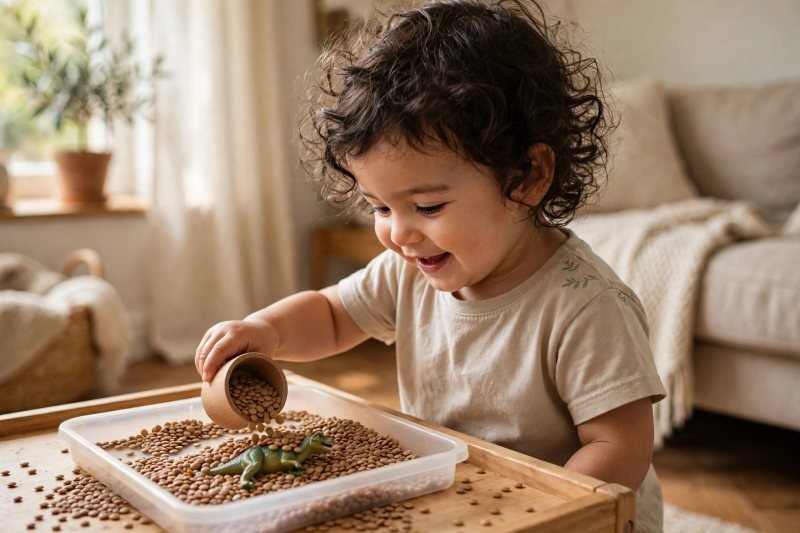
21. Lentil scoop bin. A tray of dry lentils, scoops and hidden toys.
-
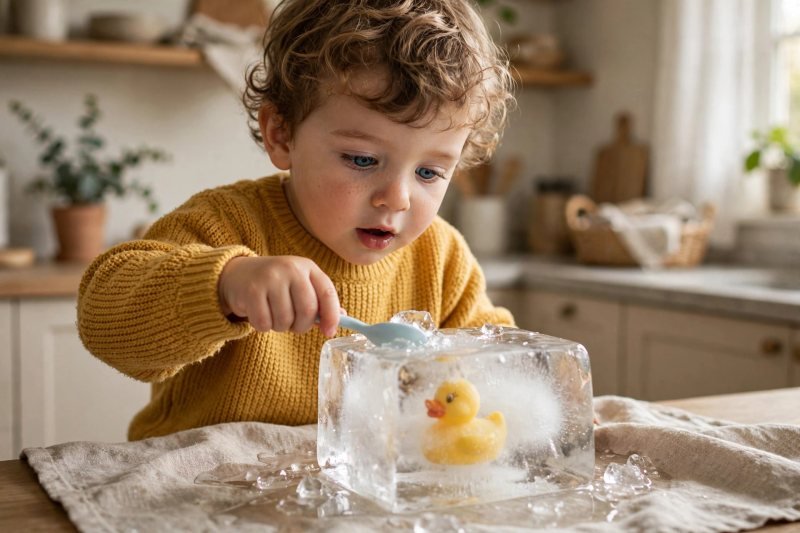
22. Ice rescue. Freeze small toys overnight; they free them with a spoon and warm water.
-
23. Yoghurt finger painting. Plain yoghurt swirled on a tray.
-
24. Texture walk. Barefoot across a cushion, towel, baking tray and tea towel.
-
25. Smell jars. Lemon, cinnamon and mint in lidded pots.
-
MUSIC AND MOVEMENT (How do music and movement support a 2-year-old's learning?):
-
26. Freeze dance. Dance wildly, pause the music — everybody freezes!
-
27. Shaker march. March around shaking sealed rice bottles.
-
28. Animal parade. Stomp like elephants, hop like bunnies, waddle like penguins.
-
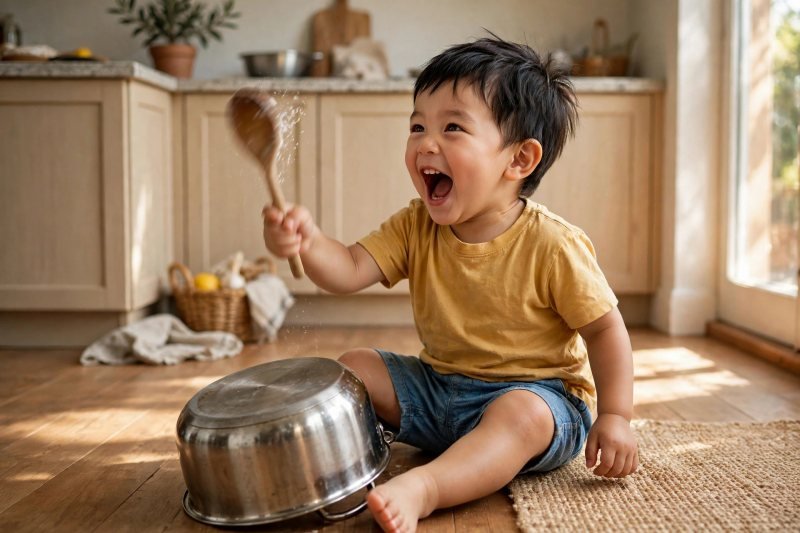
29. Pot drum echo. You tap a rhythm on an upturned pot; they echo it.
-
30. Scarf dancing. Wave a scarf to music — fast, slow, high, low.


Make it easier
Forget the "teaching" goal; just play alongside them and narrate ("You're pouring! Splash!"). Offer choices — "Red paint or blue?" — and treat three repetitions as a full session.
Make it harder
Sort by colour, then sort the red pile by size. Add turn-taking: "My roll, then your roll." Ask "what happens if…" during sensory play to stretch thinking.
Other ways to play it
- Move colour hunts, texture walks and animal parades into the garden.
- Swap lentils for chickpeas in the sensory bin.
- Turn any activity into "teaching teddy" — toddlers love being the expert.
How it changes by age
- Tuned for ages 2–3.
- At 2: younger twos will mostly watch, copy and explore with their senses — exactly right.
- At 2.5–3: older twos may count to five, name colours and follow two-step instructions.
- The normal range at two is enormous.
What they're learning
Language (vocabulary in context, listening, early two-word phrases, rhyme and rhythm) Early maths (one-to-one counting, sorting by colour, shape and size, spotting patterns) Fine motor (pinching, pouring, threading, peeling, squeezing) Thinking (cause and effect, describing textures and smells, focus and persistence) Social-emotional (turn-taking, coping with "stop", pride in doing it themselves)
Clearing up
Keep a damp cloth handy — most activities tidy in five minutes. Lay a sheet under sensory bins. Make tidying a game: "Can you find all the red pom-poms?"
Questions parents ask
What are the best learning activities for a 2-year-old at home?
How can I teach my 2-year-old at home without buying toys?
How long should a learning activity last for a 2-year-old?
What should a 2-year-old know academically?
How do I teach my toddler colours?
Are sensory activities good for toddlers?

save it for later
Pin this for the next rainy afternoon
Keep it on a board so it is there when you need it, rather than when you happened to find it.
Save to Pinterest