


Pigtail Hairstyles for Toddlers: 10 Cute Variations
Gentle pigtails for toddlers in 10 cute variations — classic low, high, half-up, bubble, braided, twisted, buns, crisscross, side and bow-finish styles, all low-tension and sleep-safe to remove.
Gentle pigtails for toddlers use soft, snag-free elastics and loose tension — never tight pulling, heat or tiny beads. Try classic low, high, half-up, bubble, braided, twisted, buns, crisscross, side and bow-finish styles, and always take every style out before naps and sleep.

The short version
- Use snag-free soft elastics only, keep every bunch loose enough to slide a fingertip underneath, and loosen or remove any style a toddler pats or pulls at.
- All 10 variations — classic low, high, half-up mini, bubble, braided, twisted, buns, crisscross, side and bow finish — use no heat tools at any point.
- No tiny beads or small accessories are used, because they are a choking hazard for under-3s; large soft bows appear only in variation (10), with an adult present.
- Every style comes out before naps and before nighttime sleep; brush hair loose and let the scalp rest overnight.
- Brush gently from the ends upward, mist with plain water only, and skip styling if the scalp looks red, sore or bumpy.
- Age
- Ages 2–3
- Prep
- 5 min
- Play time
- 10 min
- Mess
- None
- Difficulty
- Easy
- Where
- Indoor
Why kids love this
Toddlers love pigtails because the change is instant and easy to see — two bouncy bunches appear, hair stays out of eyes and off a sticky neck, and every style in this guide feels a little different without ever feeling tight or fussy. For a two- or three-year-old, sitting for hair is also a small, cozy ritual: a familiar stool, a favorite song, a mirror to peek into and a grown-up narrating each gentle step in a calm voice. These pigtails for toddlers are built for real toddler hair — fine, wispy, uneven in length and quick to tangle — so each variation uses soft, snag-free elastics, loose tension and short styling time, and each one comes out in seconds before naps and sleep. Children get to make one simple choice, like high or low today, which gives them a sense of control, while parents get ten reliable options that work for playdates, photos, preschool mornings and ordinary Tuesdays alike. There is no heat, no pulling and no tiny beads to worry about — just soft hair, soft hands and a finished style a toddler can shake, bounce and forget about while she plays.
What you'll need
- A soft-bristle brush and a wide-tooth comb for gentle detangling, plus a fine comb or your fingers for making a soft part
- Snag-free soft elastics made for toddler hair — small, stretchy and fabric-covered or seamless, with no metal joins and no tight rubber bands
- A small spray bottle filled with plain water for lightly dampening flyaways — water only, no styling products needed
- A low, steady stool or a seat on your lap in front of a mirror, in bright, natural light so you can see the part clearly
- A small basket or dish to hold elastics so you are not hunting for them mid-style, and a soft cloth for wiping hands
- Large, soft fabric bows on clips or tied onto elastics for the final variation only — large enough that they are never a choking hazard, used only while an adult is present and always removed before naps and sleep
- A favorite small book, song or stuffed toy to hold during styling, to keep little hands busy and the mood calm
- A soft pillow or folded towel for the stool if your toddler prefers extra comfort while she sits
Before you start
1. Choose a calm moment — after breakfast or after a nap, not when your toddler is hungry, tired or rushing out the door — and keep styling to once a day so hair and scalp get plenty of rest. 2. Wash hands, gather the brush, comb, soft elastics and spray bottle into one basket, and set up the stool or lap seat in front of a mirror with good light. 3. Brush hair gently from the ends upward in small sections to remove tangles without pulling, and lightly mist with water only if hair is very flyaway. 4. Check the scalp as you brush — if you see redness, soreness, bumps or a spot your toddler flinches away from, skip styling that day and let the scalp rest. 5. Count out the elastics you need for the style you have chosen, keep spares in the basket, and put away any tiny beads, small clips or small accessories entirely — none are used in this guide. 6. Invite your toddler to choose between two styles by pointing at your fingers or at the mirror, agree on one, and start a favorite song so she knows styling lasts about one song.
How to do it
-
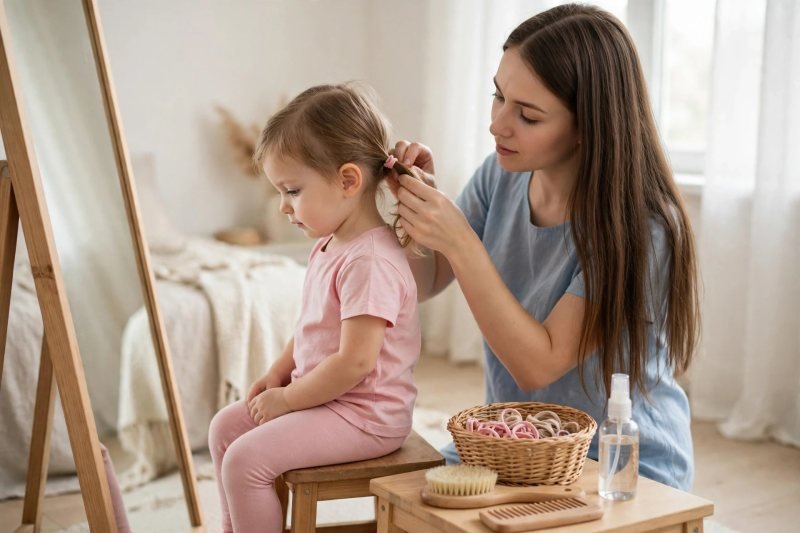
Gather your gentle tools and try Classic Low Pigtails. Begin every session the same calm way, because a predictable start lets a toddler relax: set the basket of soft elastics, the soft brush, the wide-tooth comb and the water spray bottle within reach; seat your toddler on the low stool or on your lap facing the mirror; start her favorite song; and brush gently from the ends upward in small sections — never dragging from the top — misting lightly with plain water only if wispy ends will not settle. Once hair is smooth, you have everything for Classic Low Pigtails, the kindest first pigtail of all: make a soft center part from forehead to nape with your fingers or the fine comb; gather the left side low, just behind and below the ear, holding it loosely in your palm so you can feel there is no pulling; smooth it once with your fingers; and secure it with one snag-free soft elastic wrapped only as many times as it needs to hold — you should be able to slide a fingertip easily under the bunch. Repeat on the right side, check in the mirror that both bunches sit at the same height, and loosen either side if your toddler wrinkles her nose or reaches to pull at it. This low, loose version teaches your hands the right tension for every other variation. If scissors make her nervous, the same calm approach in these haircut anxiety tips for kids works for trims too. Say, "We brush soft, we hold soft, and your low pigtails bounce — can you see them in the mirror."
-
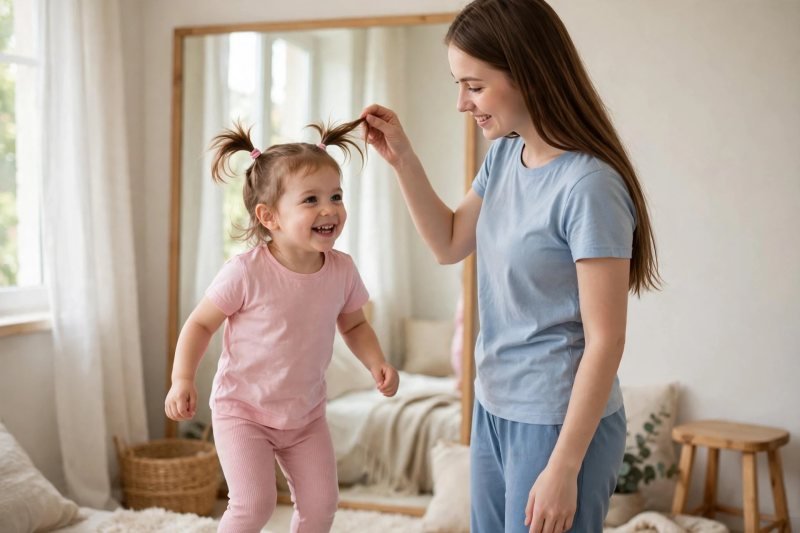
Try High Pigtails for a cheerful lift. Choose this bouncy favorite when your toddler wakes up full of energy and wants hair completely up for active play: brush hair smooth as in step 1, keep the soft center part, and gather the left side higher — up on the side of the head, above the ear — holding the bunch loosely upward without pulling the hairline at the forehead or above the ears, where tight styles hurt most. Secure it with a soft elastic with the same fingertip test — loose enough to slide a fingertip underneath, snug enough to stay while she runs — then gather and secure the right side to match, comparing heights in the mirror rather than tugging one side tighter; if one side sits lower, undo it fully and regather it instead of pulling it up by the bunch. High pigtails frame the face, keep fine hair off the neck on warm days and photograph beautifully, but they show tension sooner than low styles, so loosen straight away if the skin looks stretched or your toddler pats at it. Families who have read a toddler first haircut guide will recognize the same advice here — short, calm, child-led sessions build trust — and a toddler who trusts hair time will soon ask for this cheerful style herself. Say, "Up, up, up — your high pigtails are bouncy, and nothing pulls, nothing pinches."
-
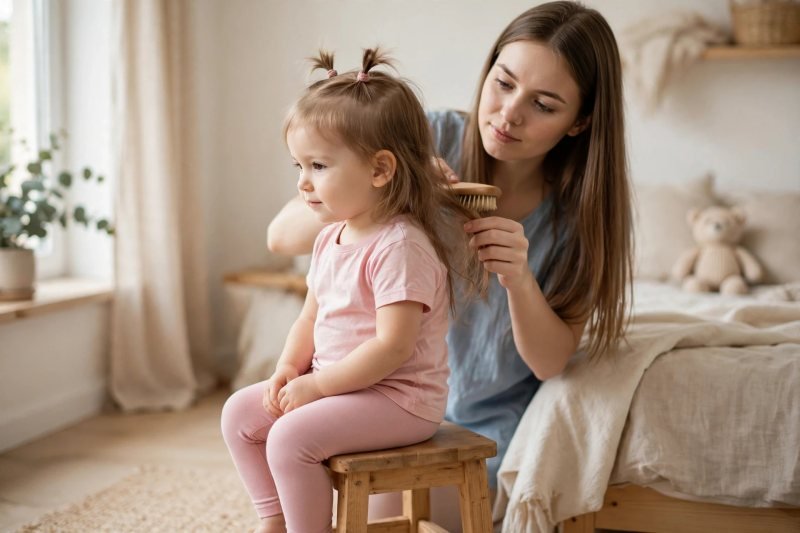
Try Half-Up Mini Pigtails for shorter hair. Reach for this sweet in-between style when hair is still growing — long on top, shorter and wispier at the back — because it only asks the top section to cooperate: brush all hair gently, then use your thumbs to sweep a soft section from above one ear, across the top of the head, to above the other ear, leaving the back hair loose and free; divide that top section at the center part into two small bunches, one on each side of the top of the head; and secure each mini bunch with a soft elastic, keeping both small, light and very loose so their weight never drags on fine roots. Tidy the loose back hair with one gentle brush pass and a light water mist, check that no stray strands are trapped in the elastics, and enjoy how the style keeps hair out of eyes for eating, painting and playground time while still showing off those toddler wisps at the back. This is often the first pigtail style that truly works at age 2, it needs only two small handfuls of hair, and it is the easiest of all ten to take out — two gentle elastic rolls and it is gone — which makes it perfect for short practice sessions. Say, "Two tiny pigtails on top, soft hair left down at the back — best of both."
-
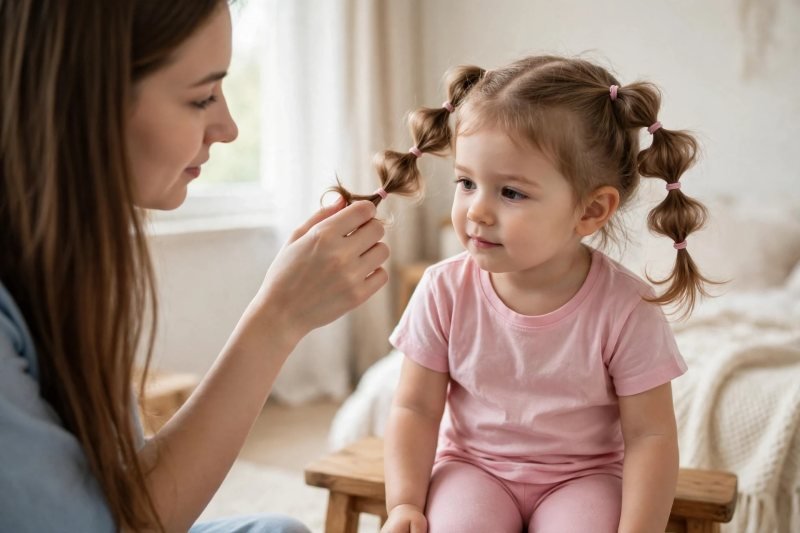
Try Bubble Pigtails with soft spaced elastics. Save this playful, rounded style for a day when you have an extra minute and your toddler is in a patient, mirror-watching mood, because it uses more elastics than any other variation here: start with Classic Low Pigtails secured loosely as before, then work down the length of each bunch adding one soft elastic at a time — place the next elastic a short distance below the first, secure it just as loosely, and use your fingers to gently puff the hair between the two elastics outward into a soft, rounded bubble shape; add a second bubble the same way if the bunch is long enough, and a third only on longer hair, always stopping while every segment still feels loose and puffy rather than squeezed. Repeat down the other bunch, matching bubble sizes by eye in the mirror instead of pulling segments to match, and keep every elastic at the same gentle tension — bubble pigtails should look plump, never pinched. The segmented shape holds fine hair surprisingly well through active play and delights toddlers who love to pat each bubble in the mirror and count them with you. At removal time, slide each elastic gently down and off in reverse order, bottom bubble first, brushing softly between sections so fine hair does not knot around an elastic — never snip anything near the hair. Fine hair slips out of styles easily, so this thin fine toddler hair care guide is worth a read if her wispy bunches tangle between styles. Say, "One bubble, two bubbles — soft and round, with no squeezing at all."
-
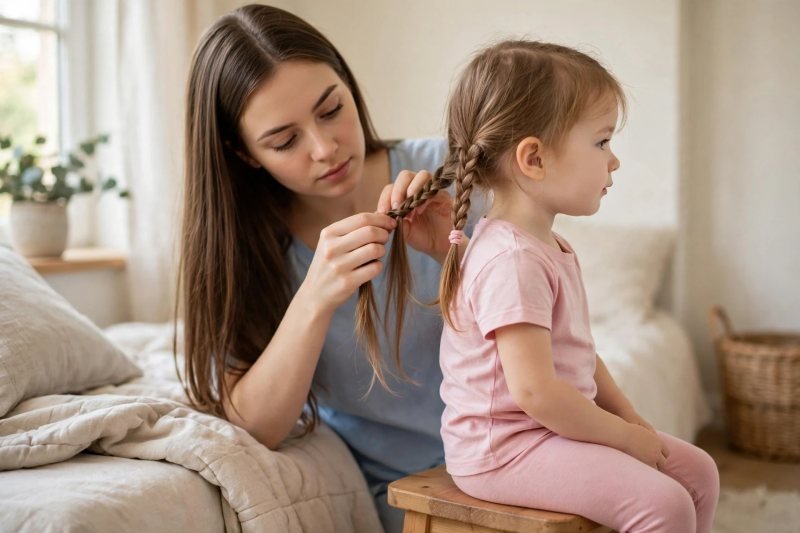
Try Loose Braided Pigtails for a tidy finish. Pick braids on a busy morning when you want a style that stays neat for hours — at preschool, on a long car ride or under a sun hat — and braid looser than you think, because a toddler braid should drape, not swing stiffly: begin with low pigtails gathered but not yet secured, divide the left bunch into three soft sections, and cross them over one another slowly — right over center, left over center — keeping your hands relaxed and the tension even and light, so the finished braid shows soft looseness between each cross. Secure the end with a soft elastic, leaving a small tail below it, then braid the right side to match, and gently soften the edges of each braid outward a fraction so no section sits tight against the scalp or pulls at the nape. If hair is short, do only two or three crosses and finish there. The crossing and smoothing here uses the same small-hand control celebrated in fine motor activities for preschoolers — your toddler practices it too when she holds the brush or passes you an elastic. Check both braids in the mirror, confirm the hairline looks relaxed everywhere, and remember braids come out before naps like every style here. Say, "Over, over, over — soft braids that swing, with no pulling at all."
-
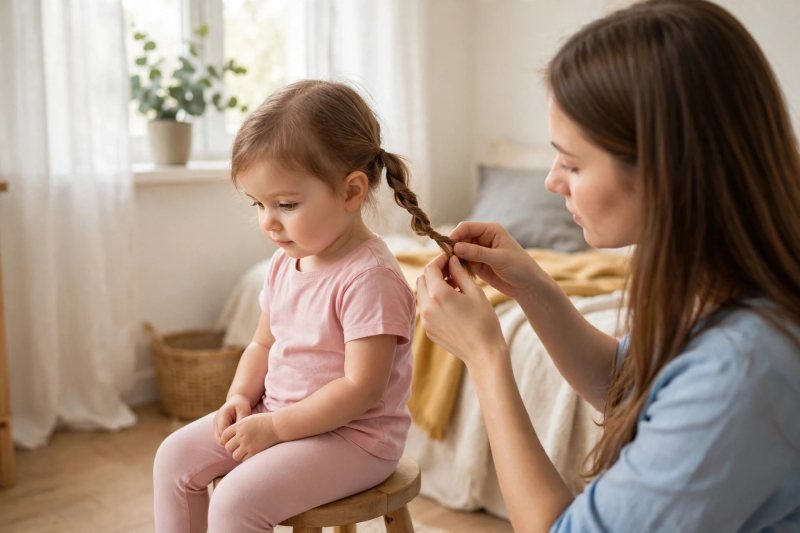
Try Twisted Pigtails for a swirly change. Offer twists when your toddler wants something new but you want the fastest hands-on time of any dressed-up style, because a twist is only two sections turning around each other: gather a low bunch on the left as before, divide it into two equal sections, and twist the sections around one another from top to bottom — passing one over the other again and again with loose, relaxed hands — letting the natural twist form without winding it tight or pulling it straight as you go. Secure the end with a soft elastic, give the twist one gentle outward soften with your fingertips so it sits full and rope-like rather than thin and tight, then repeat on the right side, twisting in the same direction so the pair matches in the mirror. Twists suit fine hair that slips out of braids, they take under a minute per side once your hands know the motion, and they unravel gracefully at removal time — the sections simply unwind as you slide the elastic off and brush through. Watch the very top of each twist, where enthusiasm can wind hair too firmly against the scalp; if the skin at the part or nape looks pulled, unwind and restart that side looser, which costs only seconds. Say, "Twist and turn, twist and turn — swirly pigtails that feel soft all day."
-
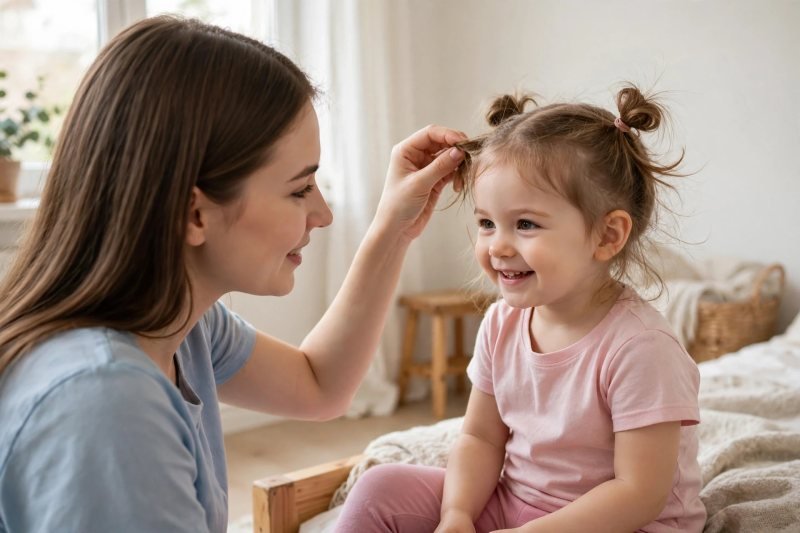
Try Pigtail Buns for a double-bun day. Make buns for photos, parties or any day your toddler asks for circles on her head, and build them softly — a toddler bun is a loose loop, never a tight knot: start with high pigtails gathered loosely above each ear as in step 2, then, on the left side, twist the bunch once very loosely and wrap it gently around its own elastic to form a small, soft bun shape, and secure it by stretching a second soft elastic over the whole loose bun just enough to hold its shape — never winding until it feels firm. Repeat on the right side, compare the pair in the mirror, and adjust by loosening and rewrapping rather than by adding more elastics or pulling stray hair in tight; a few soft wisps escaping at the edges are part of the charm and a sign the tension is right. Buns keep every strand off the face and neck, hold their shape through dancing and playground time. Because buns use two elastics per side, do the fingertip test twice — underneath the bunch and around the bun — and take buns out as soon as the outing ends if your toddler starts patting or pulling at them, since a heavy-feeling bun was wrapped too snugly. No pins, grips or small accessories are used at any point — soft elastics do all the holding. Buns are one of the gentlest protective hairstyles for toddlers when they sit loose, because they keep every strand off her face without pulling. Say, "Two soft buns, round and loose — give them a little pat in the mirror."
-
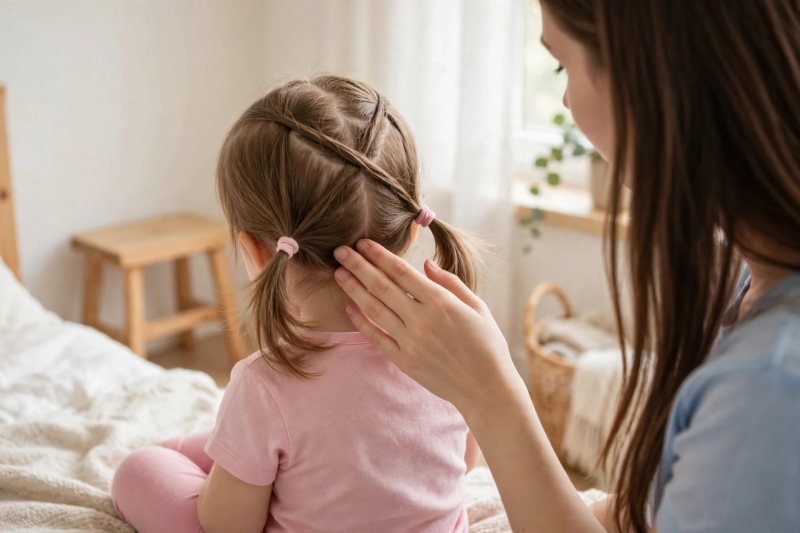
Try Crisscross Pigtails for a clever part. Try this eye-catching variation when the basic styles feel easy and you want one new skill — a diagonal part — to make the whole head look freshly designed: instead of a straight center part, use the fine comb or your fingertip to draw a soft diagonal from the front of the head on one side down to the nape on the opposite side, then a second soft diagonal crossing it, so the top hair divides into two crossed sections; gather the hair from the upper-left section and secure it loosely as a low bunch on the lower-right side, then gather the upper-right section and secure it as a low bunch on the lower-left side, so the sections visibly cross at the back of the head. Smooth each crossed section flat with your palm and a light water mist as you go, keep both elastics at the usual gentle tension with the fingertip test, and check from behind — turning together toward a second mirror if you have one — that the cross sits centered and neither bunch pulls the section above it tight. Crisscross pigtails distribute hair a little differently, so the usual part line gets a rest day. The diagonals do not need to be ruler-straight; soft, slightly wavy crosses read as intentional and pretty, and chasing perfection only lengthens the session. Say, "Cross over, cross over — your pigtails swapped sides and look so clever."
-
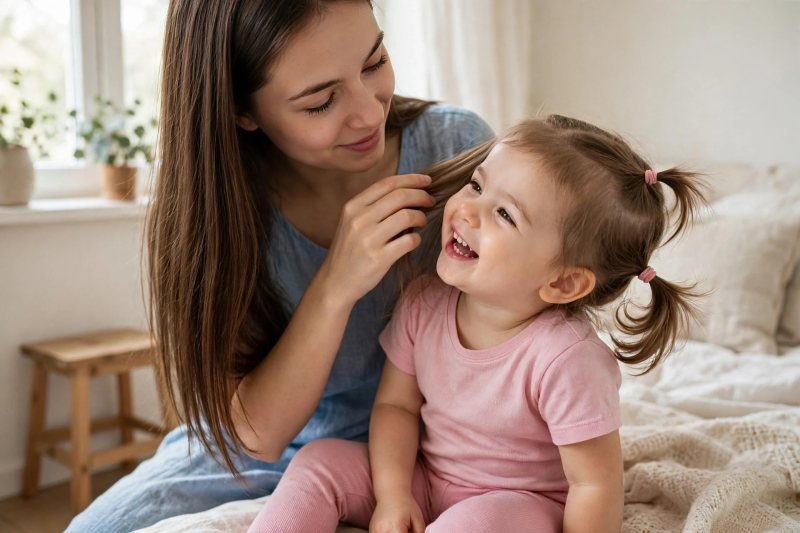
Try Side Pigtails for an asymmetric twist. Choose side pigtails for a playful, slightly cheeky look with the least hair-splitting of all — literally, because both bunches live on one side: sweep all the brushed hair gently toward one side with your hands, letting it fall naturally rather than forcing a strict part; gather a bunch low on that side, just behind the ear, and secure it loosely with a soft elastic; then gather a second, smaller bunch just above or in front of it on the same side and secure that one loosely too, so the pair sits together like a big bunch and a little bunch in a row. Leave the other side smooth and free, tidy it with one brush pass and a fingertip smooth at the hairline, and turn to the mirror together so your toddler can enjoy how different this looks — tilting her head makes both bunches swing at once, which reliably produces giggles. Side pigtails suit days when one side of the hair is having a wild morning, they keep hair off one shoulder for eating and painting, and they are the quickest full style here because there is no center part to balance and no pair to match across the head. Keep both elastics gentle, watch that the lower bunch does not drag on the upper one's roots, and switch sides next time so the same patch is not gathered day after day. Say, "Both pigtails on one side today — swing them and show me your smile."
-
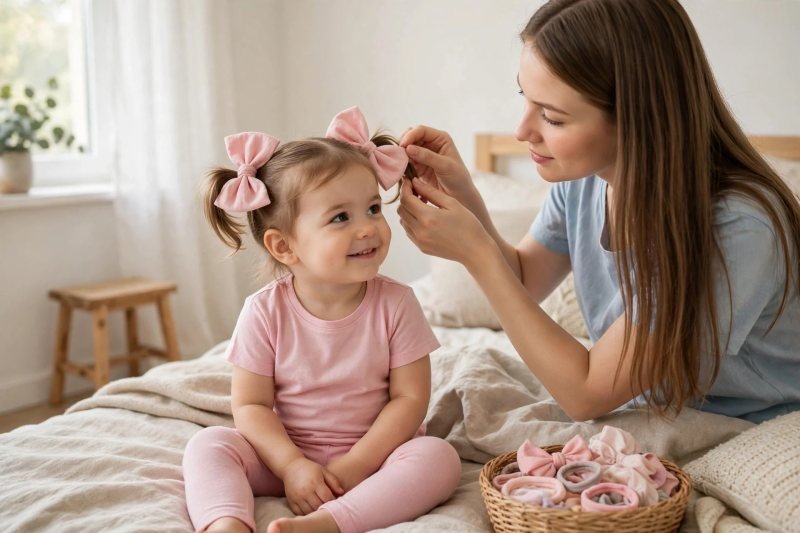
Finish with Double Pigtails with Soft Bow Finish and gentle care. End with the dressed-up version of the classic, plus the care routine every style here shares, because how pigtails come out matters as much as how they go in: make Classic Low Pigtails exactly as in step 1 — soft center part, two low loose bunches, fingertip test on both sides — then add the finish with large, soft fabric bows already tied onto elastics or large clips meant for adult handling; slide one bow elastic gently over each bunch just above the first elastic, keeping it large, soft and fully visible, with no tiny beads, no small detachable parts and no tight extra wrapping. Use bows only while you are with your toddler, and always take them off before naps, sleep, reclined car rides and unsupervised play. Then practice the care steps that close every styling day: when the style's moment is over — and always before naps and bedtime — slide or gently roll each soft elastic down and off without dragging it through tangles; brush hair softly from the ends upward until it falls loose and smooth; run your fingers gently over the scalp where elastics sat; and leave hair fully loose for sleep so the scalp and fine strands rest overnight. If an elastic ever snags, hold the hair above the snag, work the elastic free in tiny movements, and snip the elastic itself — never the hair — with small scissors held by an adult well away from skin only if it will not slide free. If you ever wonder whether a styling product would help, this kids hair styling products safe guide explains what is safe for toddler hair — water alone does the job here. Say, "Bows on for our outing, bows off before sleep — and your hair rests loose all night."


Make it easier
Start with (1) Classic Low Pigtails or (3) Half-Up Mini Pigtails only, and add one new variation a week as your hands and your toddler's patience grow together. Style hair while your toddler watches a favorite song or holds a beloved stuffed toy, and stop after one side if needed — one pigtail and one loose side is a fine practice day. Keep a second basket of soft elastics in your bag so a lost elastic never turns into a tight substitute borrowed from somewhere else.
Make it harder
Let your toddler choose the day's variation from two options, hold the basket and pass you each elastic — early independence inside the same gentle routine. Combine ideas softly: bubble sections on braided pigtails, or the crisscross part finished as low buns, keeping every elastic at the same loose tension. Practice the diagonal part for (8) Crisscross Pigtails on a doll or on your own hair first, so the toddler session itself stays short and confident.
Other ways to play it
- Photo-day finish: use (10) Double Pigtails with Soft Bow Finish with matching large soft bows, styled just before photos so bows are on for the shortest, happiest time.
- Warm-day lift: use (2) High Pigtails or (7) Pigtail Buns to keep fine hair off the neck, with a light water mist to smooth flyaways in the morning.
- Short-hair win: use (3) Half-Up Mini Pigtails or (9) Side Pigtails when length is uneven — both look complete with only small handfuls of hair.
How it changes by age
- Age 2: Keep sessions shortest at this age — one song, one style, and favor (1) Classic Low Pigtails, (3) Half-Up Mini Pigtails and (9) Side Pigtails, which need the least hair and the least sitting. Hair is often still fine and uneven, so gather very loosely, expect wisps, and treat any completed style as a success. Always remove styles before naps, which are still a big part of the day at 2.
- Age 3: Three-year-olds can usually enjoy the full set, including (4) Bubble Pigtails, (5) Loose Braided Pigtails, (7) Pigtail Buns and (8) Crisscross Pigtails, especially when they get to choose between two options and watch in the mirror. Sitting stamina varies by day — follow your child's signals, loosen anything she pats or pulls at, and keep the same out-before-sleep rule without exception.
What they're learning
Patience and routine: a short, predictable styling routine with a start song and a mirror finish teaches waiting, turn-taking and what comes next. Body awareness and language: naming left, right, high, low, top and back during styling builds early spatial words and awareness of her own head and hair. Choice and confidence: picking between two gentle styles gives a toddler real control over how she looks, which supports independence and self-expression. Fine motor practice: holding the brush, passing elastics and patting bubbles or buns strengthens the small hand muscles used for dressing and drawing. Gentle touch and trust: experiencing hair care with no pulling builds trust in grooming routines that carry into haircuts, washing and brushing every day.
Clearing up
Styling leaves almost nothing to clear: gather every used elastic as it comes out and return it to the basket out of your toddler's reach, discard any elastic that has stretched out, cracked or snapped, and put bows back in the basket with elastics. Give the brush a quick clean by removing loose hairs, wipe the stool or mirror if water mist spotted it, and check the floor, the seat and your toddler's clothes for any dropped elastic before she plays — a stray elastic on the floor is a choking hazard for a crawling sibling or for your toddler herself. Hair that was brushed out can go straight into the trash. The whole tidy takes under a minute, and ending with the basket put away keeps tomorrow's calm start exactly where you left it.
Questions parents ask
What are the best pigtail styles for a 2-year-old toddler?
How tight should toddler pigtails be?
Are bubble pigtails and braided pigtails safe for toddlers?
Can toddlers sleep in pigtails or wear small beads and clips?
What should I do if an elastic snags in my toddler's hair?
Internal links embedded in body (6, all /activities/): haircut-anxiety-kids-tips; toddler-first-haircut-guide; thin-fine-toddler-hair-care; fine-motor-activities-for-preschoolers; protective-hairstyles-for-toddlers; kids-hair-styling-products-safe. All six are embedded inline in the Instructions above. Safety discipline: gentle low-tension styling only — snag-free soft elastics, no tight pulling, no heat tools, no tiny beads or small accessories (choking hazard for under-3s), and every style comes out before naps and sleep.

save it for later
Pin this for the next rainy afternoon
Keep it on a board so it is there when you need it, rather than when you happened to find it.
Save to Pinterest

