


Bath Water Temperature for Kids: What's Safe?
Bath water temperature for kids explained for ages 2-3: aim for comfortably warm water, test with your wrist and a thermometer, keep the bath shallow, and never leave your child alone near water.
Pediatric safety guidance commonly recommends bath water of about 100°F (37–38°C), comfortably warm, for young kids. Swirl away hot spots first, test with your inner wrist or elbow, confirm with a thermometer, keep the water shallow, and never leave your child alone in the bath.

The short version
- Gather towel, clothes, washcloth, and thermometer before any water runs, so you never leave your child alone in or near water.
- Set the home water heater to about 120°F (49°C), run cold water first then add warm, and keep your child away from the faucet end.
- Swirl away hot spots, test with your inner wrist or elbow, and confirm with a thermometer: about 100°F (37–38°C), comfortably warm, never hot.
- Keep the bath shallow at about 2–3 inches (5–8 cm), never above your seated toddler's waist, and keep testing while the bath runs.
- Watch for flushing pink skin (too warm) or shivering (too cool), never run the tap near a child in the tub, and empty the tub straight away.
- Age
- Ages 2–3
- Prep
- 10 min
- Mess
- Low
- Difficulty
- Easy
- Where
- Indoor
Why kids love this
Getting the bath water temperature for kids right is what turns bath time from a negotiation into a pleasure. Water that is comfortably warm lets a two- or three-year-old relax, splash, pour, and play without flinching when they first sit down or shivering before the fun has even started. Toddlers notice temperature with their whole bodies, so a bath that feels just right right away teaches them that bath time is a cozy, predictable place to be. The testing steps themselves become part of the game, too: swirling the water with a hand, watching a little floating thermometer bob beside a rubber duck, and hearing the same friendly words each night all feel like a ritual rather than a safety lecture. When the water, the depth, and the routine stay the same, your child can give their full attention to the good stuff — stacking cups, bubble beards, and pouring practice — while you quietly hold the safety side of things steady in the background.
What you'll need
- A soft bath towel — for the big warm wrap straight out of the tub
- Clean clothes or pajamas and a clean diaper or underwear — laid out before any water runs
- A soft washcloth — for gentle washing
- A simple bath thermometer — a plain floating style is fine; it supports your hand test, it does not replace it
- A non-slip bath mat — inside the tub, plus a mat or towel on the floor for stepping out
- A plain rubber duck or a few simple bath toys — only what fits easily in a shallow bath
- A gentle, generic cleanser — in a plain, unlabeled bottle, kept within adult reach only
Before you start
Make temperature checking a habit, not a guess: decide in advance that every bath gets the same three checks — swirl the water, test with your inner wrist or elbow, and confirm with a thermometer when you use one — in the same order, every single time. Gather everything before any water runs: towel, clothes, washcloth, thermometer, mat, and toys all within arm's reach of where you will kneel, so there is never a reason to step away once your child is in or near the water. Know your home's starting point: pediatric safety guidance commonly recommends setting home water heaters to about 120°F (49°C), so take a moment this week to check yours — or ask your landlord if you rent — before bath time is the moment you think of it.
How to do it
-
Gather everything first. Before a single drop of water runs, lay out everything the bath will need within arm's reach of where you will kneel — the towel; the clean clothes or pajamas; the washcloth; the bath thermometer; and the rubber duck — and put your phone in another room or face-down and out of reach. This gathering step is the foundation the whole guide rests on, because a toddler is never left alone in or near water, not even for a few seconds: not for a towel, not for pajamas, not for the doorbell. If something is missing, the bath simply waits until it is in the room, and if something urgent truly pulls you away later, you lift your child out, wrap them, and take them with you. Working through the pile out loud turns preparation into a little game your toddler can join, counting items and placing the duck in the dry tub. Say, "Towel, clothes, washcloth, thermometer, duck — everything is here, so I stay right here with you."

-
Check the water heater. Take two minutes before bath time — ideally once this week, and then whenever you move or the hot water starts feeling different — to check the setting on your home water heater, because the safest bath starts long before the tap turns on. Pediatric safety guidance commonly recommends keeping home water heaters set to about 120°F (49°C), a setting that greatly reduces scald risk while still giving your household comfortably hot water for dishes and laundry. If you own your home, the dial is usually on the heater itself; turn it down gradually if it is set higher, then let the water run at the tap for a minute the next day and notice how the hottest setting feels on your inner wrist. If you rent, you can simply ask your landlord to confirm or adjust the setting — it is a normal, reasonable request, and most landlords are glad to help. Say, "Grown-ups set the heater first, so the water can never get too hot for you." This one quiet check protects every bath, every hand wash, and every splash that follows.

-
Run the water in the right order. With everything gathered and your toddler waiting safely with you beside the tub — never in water that has not been tested yet — run the bath in this order every time: cold water first, then warm water added gradually until the bath feels right. The order matters for a simple, practical reason: if a curious toddler climbs in early, leans over the edge, or reaches through the stream while you are filling the tub, the first water they meet is cold rather than hot, and cold water surprises without scalding. Keep your child at the opposite end of the tub from the faucet throughout the bath, because taps and the metal around them can stay hot even after the water stops running. Fill slowly, keep one hand in the stream as you adjust, and stop adding warm water before you start testing — you can always fine-tune in the next steps, and it is far easier to warm a cool bath than to cool an overheated one. Say, "Cold water first, then warm — that is our safe order, every time."

-
Swirl away the hot spots. Before you trust any test, swirl the whole tub thoroughly with your hand — big, slow circles from one end to the other, top to bottom — because water straight from the tap does not arrive at one even temperature. It layers, with hotter water often sitting near the top and around the faucet end, and cooler water settling underneath, so a single dip of a fingertip in one spot can tell you a comforting story that is not true for the spot where your toddler will actually sit. Swirling mixes those layers into one honest temperature you can genuinely test, and it takes only a few seconds. Make it a visible, cheerful part of the ritual: your toddler can watch the bubbles travel and the duck ride the little whirlpool from a safe spot beside you, still out of the water. Swirl once more after any adjustment, too — every time water is added, the layers form again. Say, "Big swirls, round and round — now the water is the same everywhere."

-
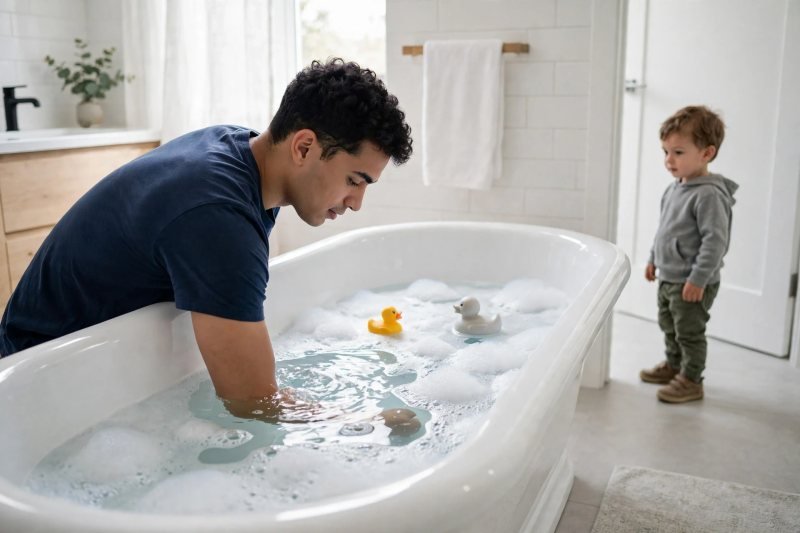
Test with wrist or elbow. Now test the swirled water the way caregivers have been taught for generations: with your inner wrist or your inner elbow, not the palm of your hand. The skin on your inner wrist and inner elbow is thinner and more sensitive than the tougher skin of your hands, which handle hot mugs and warm pans all day and can easily judge water as fine when it would feel far too hot on a toddler's whole body. Hold your inner wrist just under the surface for a few seconds, or dip your inner elbow in, and pay real attention: the water should feel comfortably warm, the way a cozy hug feels warm — never hot, never with a sting or a flinch, and never leaving your skin pink. If it feels hot on that sensitive skin, it is too hot for your child: add cold water, swirl again, wait a moment, and test again. If it feels barely warm or cool, add a little warm water, swirl, and re-test. Say, "My wrist is the tester — comfortably warm, never hot, just right for you." Only when this test passes do you move on to confirming the number.
-
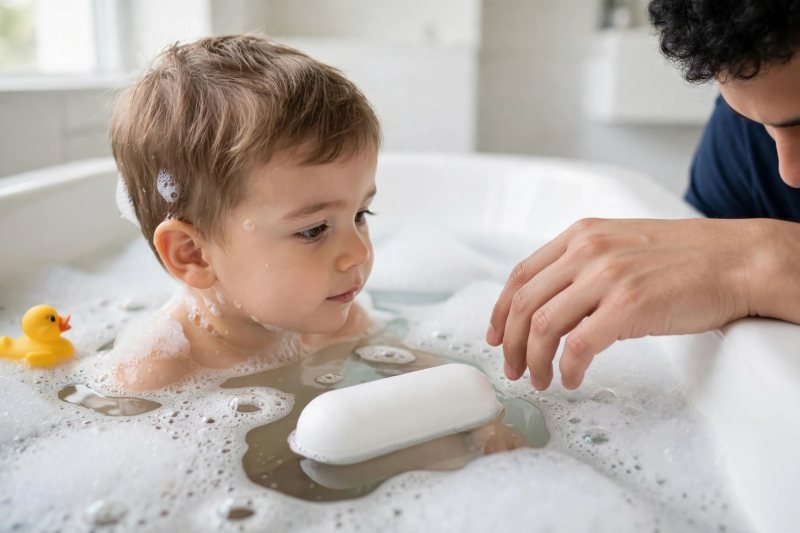
Confirm with a thermometer. For extra confidence — especially while you are still learning how your taps behave — confirm the bath with a simple bath thermometer, floated in the swirled water away from the faucet end. Pediatric safety guidance commonly recommends bath water of about 100°F (37–38°C), comfortably warm, and that is the range to aim for: close to body temperature, warm enough for happy play, and well below anything that could scald. Give the thermometer a moment to settle, check it at toddler-sitting depth rather than right at the surface, and treat it as a partner to your wrist test, not a replacement for it — if the number looks fine but the water feels hot on your inner wrist, trust your skin, add cold water, swirl, and check both ways again. A thermometer is also a lovely teaching tool: older toddlers enjoy watching it bob beside the duck while you narrate. For the gentle washing and care that pairs with the right temperature once your child is in, this kids' skincare routine lays out simple steps you can borrow. Say, "The little thermometer agrees with my wrist — warm and just right, in we go."
-
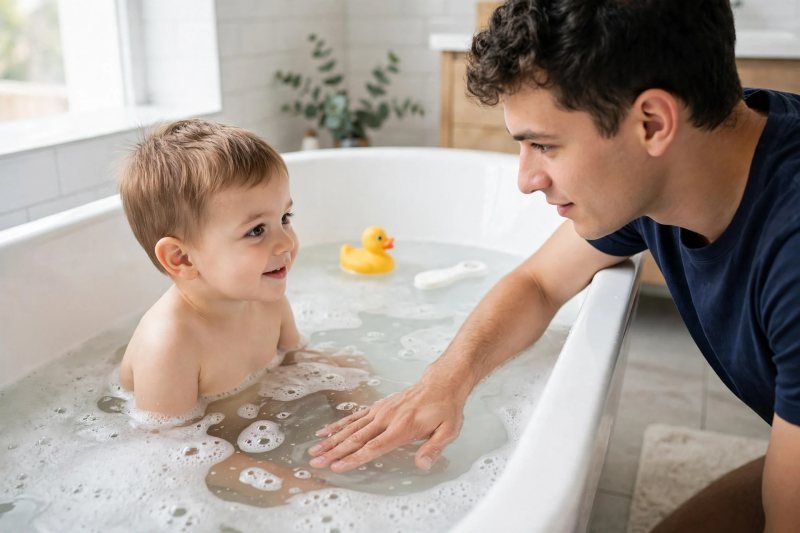
Check the depth. Temperature is only half the comfort picture; depth is the other half, so check it before your toddler gets in. Pediatric safety guidance commonly describes about 2–3 inches (5–8 cm) of water as plenty for a toddler bath at this age: enough to sit in warmly, splash, pour, and wash, without the water creeping high up the body. As a simple visual rule, the water should never sit above the waist of your seated toddler — if it does, let some out before the bath begins. Shallow water is also easier to keep evenly warm, easier for a small child to sit steadily in on the non-slip mat, and quicker to fill and empty, which keeps the whole routine calm. Let your toddler watch you check with a flat hand held sideways in the water if they like; making the check visible helps it become an expected, unhurried part of bath time rather than a delay to argue with. Say, "Just a shallow puddle to sit in — warm, splashy, and not too deep."
-
Keep testing during the bath. A bath does not stay one temperature from start to finish, so keep quietly testing as you go: trail your inner wrist through the water every few minutes, notice how it feels on your forearm as you wash and play, and watch your toddler's comfort as the best ongoing thermometer of all. Baths cool gradually, and most toddlers will happily keep playing in water that has gone tepid, so when the warmth fades, the kind choice is usually to wrap up the bath warmly rather than to stretch it. If you ever do top the water up, follow this rule without exception: top up only with your child OUT of the tub, or lifted and moved well aside with you holding them securely — never run the hot tap, or any tap, over or near a child sitting in the tub, because a stream can surge hot in a second and a wriggling toddler can move into it. In practice, most families find that ending a cooled bath and starting fresh and warm tomorrow is simpler and safer than topping up at all. While the temperature stays safe and cozy, bath time doubles beautifully as play and learning time — these toddler learning activities at home include plenty of pouring, sorting, and counting ideas that adapt happily to the tub, and the best bath toys for toddlers roundup lists more simple toys that suit a shallow bath. Say, "I keep checking while we play — still warm, still cozy, still just right."

-
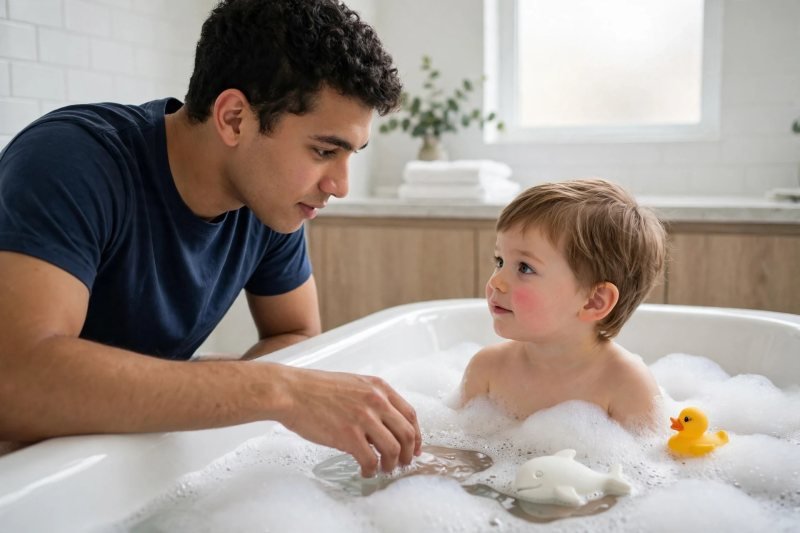
Read the warning signs. Your toddler's skin and behavior give you clear, honest signals, so learn to read them and act early. If your child's skin is flushing pink or red in the water, the bath is too warm: lift them out or add cool water with your child moved safely aside, swirl, re-test with your wrist and the thermometer, and only continue when the water feels comfortably warm again and the flushing fades. If your child is shivering, has goosebumps, or their lips look chilly, the bath has gone too cool: end it warmly and early, wrap them straight into the big towel, and dress them somewhere cozy — there is no prize for finishing a cold bath. Separately, know the general first-aid basics for a scald, shared here as general first-aid guidance and not as medical advice: cool the area under cool — not cold — running water, remove anything tight nearby if it comes away easily, and seek medical care promptly for any blistering, broken skin, or a scald bigger than the size of your child's palm, or sooner if you are worried at all. For the bubble side of bath time, our bubble bath safety for kids guide covers how much bubble bath is enough and when to skip it. Say, "Pink skin means too warm, shivers mean too cool — I watch, and I act straight away."
-
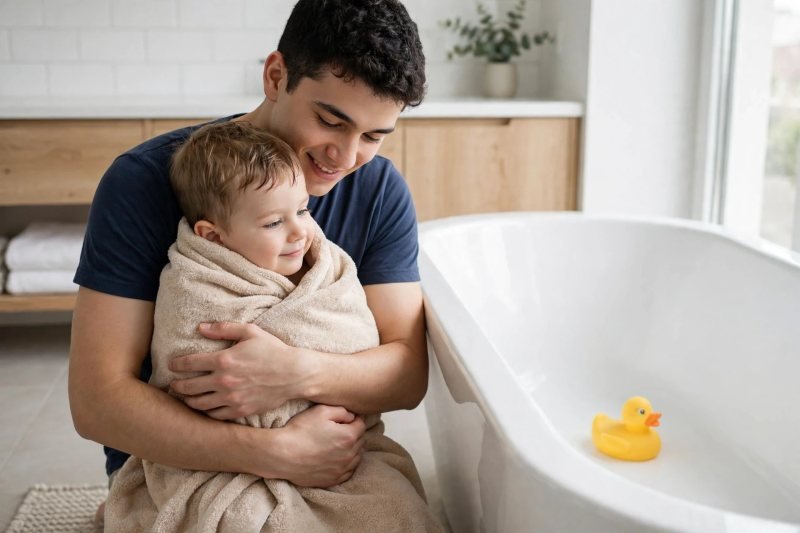
Finish and empty straight away. End the bath while it is still warm and happy, with the same cheerful closing line each night so the finish feels expected rather than abrupt. Lift your toddler out with both hands — wet toddlers are slippery — set them straight onto the floor mat, and wrap them immediately in the big towel for a warm squeeze before patting dry and dressing them right there in the warm bathroom. Then, as the final safety step of every single bath, empty the tub straight away: pull the plug as your child comes out or immediately after they are safely dressed and out of the room, drain the toys or scoop them into a basket to drip, and never leave a filled or partly filled tub sitting unattended. An empty tub is a safe tub — standing water left behind is a risk to any small child who wanders back in, and draining takes seconds. A steady order every night — gather, test, play, wrap, drain — is what turns all of this into a calm bath routine for toddlers your child can count on. The same goes for buckets and basins used nearby: tip them out the moment you are done. Say, "Out, wrapped, dressed — and the water goes away. An empty tub is a safe tub."


Make it easier
Keep the thermometer living in the tub or on the tub edge, so confirming the temperature never requires a search while water is waiting. Learn your own taps: after a week of checking, you will know roughly which handle positions give you comfortably warm water in your home — but keep doing the wrist test anyway, because water pressure and heater behavior change. Bath at the same point in the evening routine each night, when you are unhurried; temperature checks skipped in a rush are the ones that matter, so build in the extra two minutes.
Make it harder
Let your toddler help with the safe parts of testing: they can hold the duck while you swirl, watch the thermometer float, and tell you whether the water feels warm or cool on their own feet once you have already confirmed it is safe. Add temperature words and comparisons to play: warm cup, cool cup, which one does the duck like — early science language built on a bath you have already made safe. Give your three-year-old the job of temperature reporter: after your checks pass, they announce the verdict — just right — before getting in, turning careful steps into a proud responsibility.
Other ways to play it
- Shower version: if your toddler prefers a shower, keep every principle: gather everything first, run cold water first then add warm, test the stream on your inner wrist before your child steps under it, keep the water comfortably warm rather than hot, and stay within arm's reach the whole time.
- Travel and grandparents' houses version: unfamiliar taps and heaters are exactly when to slow down — run the water longer, swirl and test more than once, confirm with a thermometer if you packed one, and ask your hosts about their water heater setting without embarrassment; new houses get extra checks, always.
- Sibling version: if siblings share the bath, test for the youngest child in the tub, keep the depth right for the smallest seated child, keep both children away from the faucet end, and keep the never-alone rule absolute — an older sibling is company, never supervision.
How it changes by age
- Age 2: Two-year-olds need the full frame held for them: shallow water at about 2–3 inches (5–8 cm), comfortably warm at about 100°F (37–38°C), short and cheerful baths, and you kneeling beside the tub for every second. Narrate the checks in simple words — swirl, wrist, just right — so the language of safety becomes familiar long before your child can help with it.
- Age 3: Three-year-olds can join in more: watching the thermometer, reporting warm or cool, and helping swirl with a hand alongside yours once you have confirmed the water is not hot. Baths can run a little longer if the water stays comfortably warm and you keep re-testing — and supervision stays constant at three, too, because confidence around water grows much faster than judgment does.
What they're learning
Early science: warm versus hot versus cool, mixing and swirling, and watching a thermometer respond are a toddler's first real experiments — cause, effect, and careful observation in warm water. Safety habits: Good toddler bath safety is a habit, not a lecture: hearing the same checks in the same order every night — gather, run cold first, swirl, test, confirm — teaches that some steps always come before the fun, and that careful is normal. Body awareness: noticing how water feels on skin, naming too warm and too cool, and learning to speak up about comfort builds a practical, confident sense of their own body. Independence: holding the duck during checks, helping swirl, and announcing the just-right verdict are real jobs inside a frame an adult holds safe — the beginning of doing things properly by themselves.
Clearing up
Clearing up starts with the most important job: the tub is emptied straight away, during the lift-out or immediately after, every time. Scoop toys into a draining basket or leave them in the empty tub to drip, stand the thermometer somewhere it can dry, and put the rinse cup upside down on the tub edge. Hang the towel and washcloth to dry, wipe the worst splashes off the floor so nobody slips later, drop any soaked clothes straight into the laundry, and put the cleanser back in its out-of-reach spot with the lid on. If you like, lay out tomorrow's towel and pajamas while the bathroom is still warm and tidy — two quiet minutes now make tomorrow's gather-everything-first step almost effortless.
Questions parents ask
What is a safe bath water temperature for kids?
Why test bath water with your wrist or elbow instead of your hand?
What temperature should a home water heater be set to for kids?
How deep should bath water be for a 2- or 3-year-old?
What should I do if the bath water feels too hot or my child is scalded?
Can I leave my toddler in the bath for a few seconds to grab something?
Internal link targets for publisher: kids-skincare-routine-simple-steps; toddler-learning-activities-at-home; best-bath-toys-for-toddlers; bubble-bath-safety-for-kids; bath-routine-for-toddlers. All five are live URLs. Enter the link anchors as plain text only (kids' skincare routine / toddler learning activities at home / best bath toys for toddlers / bubble bath safety for kids / bath routine for toddlers) — NO markdown syntax, NO bare URLs.

save it for later
Pin this for the next rainy afternoon
Keep it on a board so it is there when you need it, rather than when you happened to find it.
Save to Pinterest


