


Bath Toys for Toddlers: How to Choose Safe, Mold-Free Ones
How to choose bath toys for toddlers that stay clean: solid one-piece toys with no holes, easy-clean silicone and hard plastic, a simple rinse-and-dry routine, clear replace signs, and bath safety rules for ages 2-3.
The safest bath toys for toddlers are solid, one-piece toys with no holes, made from smooth silicone or hard plastic that rinses clean and dries fully. Skip squeeze toys that trap water inside, rinse every toy after the bath, dry it completely, store it dry, and replace anything that smells musty or will not clean.

The short version
- Solid and hole-free wins: one-piece toys with no holes give water nowhere to hide, so mold has nowhere to grow.
- Squeeze toys fail the test: a toy that still drips on a second squeeze a minute later holds damp inside for days.
- Materials matter: smooth silicone and smooth hard plastic rinse clean and dry fully; foam is a short-play, retire-early extra.
- Rinse, dry, store dry: shake every toy at bath's end, rack it with airflow outside the tub, and never store toys soaking or sealed damp.
- Retire on sight: musty smell, dark specks, cracks, peeling, stickiness or a slosh inside all mean the toy leaves the bath set.
- Age
- Ages 2–3
- Mess
- Low
- Where
- Indoor
Why kids love this
Toddlers do not need a mountain of bath toys — they need a few good ones that pour, stack, float and splash in ways they can control. A solid cup that fills and empties on command, a boat that stays upright, a smooth one-piece animal that can be carried, dunked and lined up on the tub edge: these are the toys two- and three-year-olds reach for night after night. Toddlers also love being in charge of the routine — handing you each toy to rinse, shaking the water off, dropping it into the drying basket — and a small set makes that job doable for little hands. When every toy is smooth, sturdy and easy to grab with wet fingers, bath time stays play time: no sharp seams, no broken bits, no toy that squirts yesterday's bath water into today's bath. Fewer, better toys also means a calmer tub and a faster tidy-up. This guide names no brands — instead it gives you the five toy types worth owning and the ten-second checks that judge any toy on the shelf.
What you'll need
- Solid one-piece bath toys — single-piece figures, boats and animals molded from one piece of material, with no seams that open and no holes anywhere
- Stacking and nesting cups in plain colors — smooth, open cups that rinse clean in seconds and dry completely between baths
- A simple pouring jug or scoop — one open, easy-grip piece for filling, pouring and rinsing games
- Silicone bath toys — soft, smooth, one-piece silicone shapes that can be washed thoroughly and left to dry fully
- Hard plastic bath toys with a fully sealed, smooth surface — no cracks, no peeling paint, no rough or flaking edges
- A mesh-free drying spot — a small rack, tray or basket with drainage and airflow outside the tub, so toys dry between baths instead of sitting in water
- A soft cloth or old towel for wiping toys dry and for the weekly toy sort
- A small basket or caddy for the weekly rotation — a handful of toys in the bath, the rest stored clean and dry
Before you start
1. Before the bath, gather everything you need — towels, washcloth, soap, shampoo for a tear-free toddler hair wash, a change of clothes and the chosen toys — and place it all within arm's reach of the tub, so you never need to leave or turn away once your toddler is in the water. 2. Sort the current toy pile on a dry towel: keep solid, hole-free toys that rinse clean, and set aside any squeeze toy with a hole, anything cracked or peeling, and anything that smells musty after washing. 3. Run the hole test on every toy you are unsure about — squeeze it firmly over a sink; if air or water escapes from any opening, water is getting inside too, and that toy leaves the bath set. 4. Choose tonight's small set — three to five toys is plenty — rinse them under the tap before they go in, and put the rest away clean and dry for the weekly rotation.
How to do it
-
Understand why bath toys grow mold. Start with the simple problem this whole guide solves: a bath toy that lets water inside but never dries inside becomes a hidden, damp pocket — warm, dark and wet long after bath time ends — and that is exactly where mold likes to grow, out of sight, inside the toy your toddler then squeezes, chews and splashes with tomorrow night. You cannot scrub the inside of a sealed toy, and you cannot dry what you cannot reach — so the honest fix is not better cleaning of bad designs; it is choosing toys that never trap water in the first place. Think of it as a doorway rule — if water can get in and cannot get straight back out and dry, the toy does not belong in the tub; solid, open or fully sealed-and-smooth designs pass that rule, while squeeze toys with little holes fail it every time. This is a general hygiene habit, not a scare story — toddlers mouth bath toys as a normal part of play, so what is inside the toy matters as much as what is on it. Say, "We pick toys that can dry all the way through — no hidden wet middles." A toddler who hears the rule out loud starts handing you the right toys herself.

-
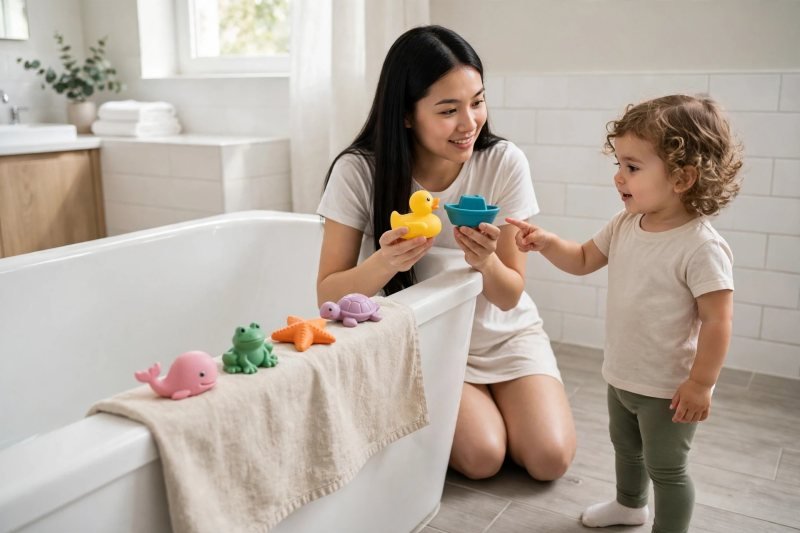
Choose solid, hole-free toys first. Build the whole bath set on one buying and keeping rule — solid, one-piece toys with no holes — and let everything else be a bonus. A one-piece toy is made from a single piece of material — a solid duck shape with no squeaker hole in the base, a chunky boat with no gaps along the seam, a smooth animal figure with nothing that unscrews, pops open or peels apart — so there is simply nowhere for water to hide. Run three checks on anything you keep or bring home — the look check, running your eyes over every surface for holes, seams that gape, cracks or flaking paint; the squeeze check, pressing it hard to feel for any opening that puffs air; and the shake check, holding it to your ear after a bath — a toy that sloshes has water inside and fails. Open designs pass easily too — cups, jugs and scoops are one open shape, so every surface meets air and dries — which is why this guide leans on open and solid toys and skips the squeeze-and-squirt category entirely. Say, "Solid and smooth — that is our kind of bath toy." Given the choice between a clever toy with moving, trapping parts and a plain solid one, the plain one wins every bath night of the year.
-
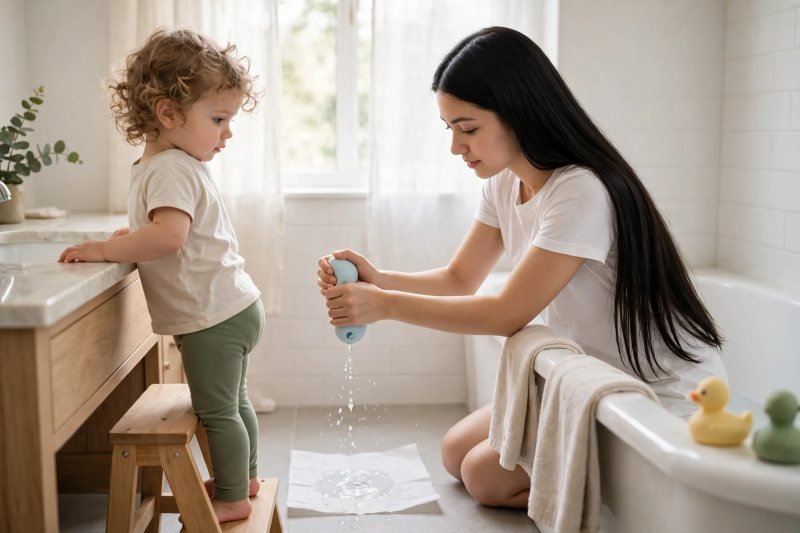
Test squeeze toys with the hole check. Squeeze toys deserve their own step because they are the most common bath toy and the most common mold trap — a soft, squeezy body with one small hole in the base or beak that sucks bath water in every time your toddler squeezes it underwater, then keeps most of that water inside when the squeezing stops. Do the test properly — fill the toy, squeeze it hard over the sink, then squeeze it again a full minute later over a dry tissue; if the tissue gets wet spots on that second squeeze, water was still hiding inside — and a toy that holds water for a minute after one squeeze holds damp for days on the shelf. Also check older squeeze toys for the other giveaway — dark specks visible through the hole or around it, and a musty smell when you squeeze it near your nose; either sign means the inside is no longer clean, and no amount of surface scrubbing fixes an inside you cannot reach. The kind choice is retirement, not repair — these toys move to dry-land play, where they can be squeezed to a toddler's heart's content without ever sitting in bath water again. Say, "This one drinks water and keeps it inside — it can live with the dry toys instead." Toddlers accept the swap happily when a solid toy of the same shape takes its place in the tub.
-
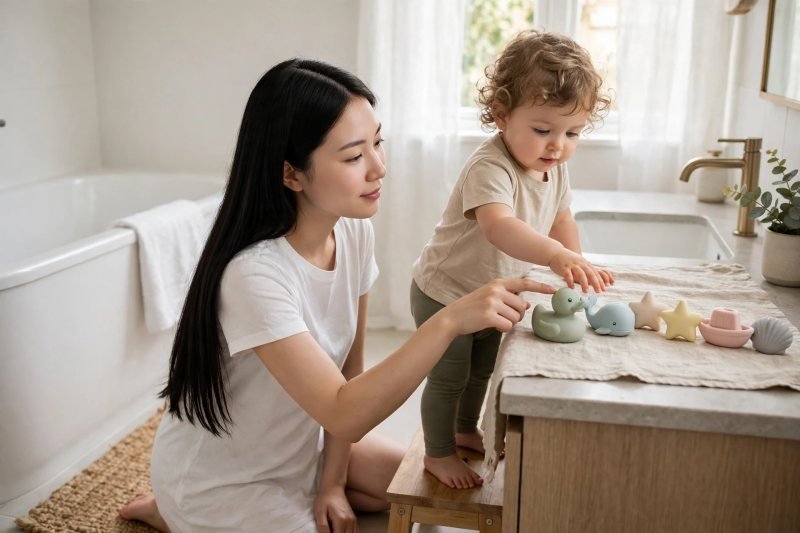
Pick materials that clean and dry well. Once holes are ruled out, material decides how easy a toy is to keep clean — and the two toddler-proof choices are smooth silicone and smooth hard plastic, because both have a non-porous, wipe-clean surface with nowhere for grime to lodge. Silicone is the forgiving favorite — soft enough to be kind when a toy is dropped or thrown, smooth enough to rinse clean under the tap, and sturdy enough to be washed thoroughly with warm soapy water and even scrubbed without the surface roughening; hard plastic is the sturdy classic — light, floatable and easy to rinse, as long as the surface stays smooth and uncracked. Judge any material with the fingertip test — run a wet fingertip over the toy; it should glide, because rough, pitted, sticky or flaking surfaces hold onto bath scum and are on their way out. Be pickier with foam — foam shapes are light and fun, but the material is full of tiny pockets, tears easily under toddler teeth, and dries slowly, so foam belongs to short, supervised play and early retirement rather than the everyday set. Whatever the material, the after-bath rule is identical — rinse it, shake it, dry it — because even the best material stays fresh only when water is not left sitting on it. Say, "Smooth toys wash clean — feel how slippery-smooth this one is." Letting your toddler do the fingertip test turns material sense into a game she will repeat on every new toy.
-
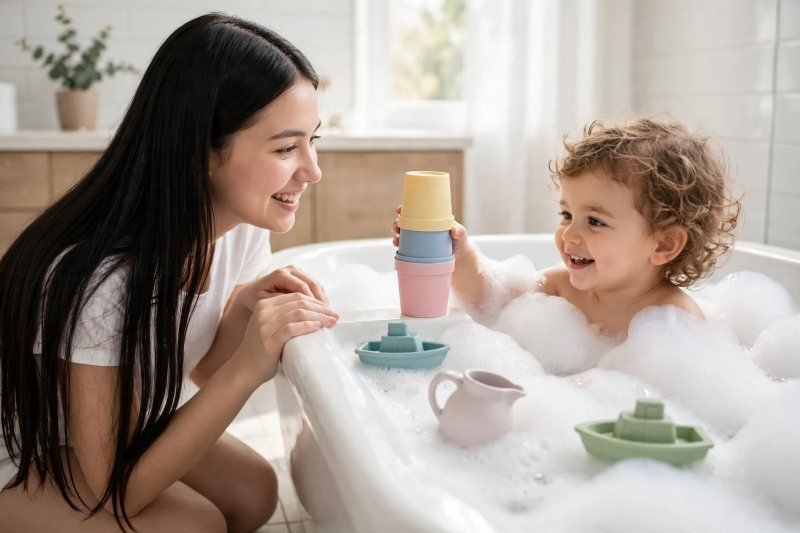
Pour, stack and count with open toys. With safe shapes and materials settled, here are the play picks that earn their place — the open and solid toys that give toddlers the most bath games per toy: (1) a set of smooth stacking cups in graduated sizes — for nesting, stacking towers on the tub edge, hiding a small solid figure underneath, and the fill-and-empty game every toddler masters first; (2) a chunky one-piece pouring jug with an easy-grip handle — for watering games, rinsing games and the deep satisfaction of a big, controlled pour; (3) solid one-piece boats that sit upright in the water — for pushing, racing along the tub and loading with tiny cargo; (4) smooth one-piece animal figures with no holes — for stories, lining up along the rim and dunking games; and (5) a plain scoop or ladle — for fishing games, transferring water between cups, and helping with the end-of-bath toy roundup. Open toys like these turn bath time into a first counting game too — count the cups as they stack, count the boats as they line up — the same early number play you will recognize from counting activities for toddlers. The boats double as a first sink or float game for toddlers — guess which toys stay up and which go under before you let them go. Keep the in-bath set to about five pieces — enough for rich play, few enough that rinsing and drying every single one stays a two-minute job. Say, "Five toys tonight — cups to stack, a jug to pour, boats to sail." A named, small set also ends the nightly negotiations about which toys come to the bath.
-
Use foam and wind-up toys with care. Two popular categories can stay in a toddler's life with honest limits rather than a place in the everyday bath set — foam shapes and letters, and wind-up swimming toys. Foam is soft, light and sticks to wet tiles in a way toddlers adore, but it tears into small pieces under busy teeth, its tiny pockets dry slowly, and a torn edge is a mouthing hazard — so foam pieces come out for short, closely watched play, get rinsed and dried flat afterward, and retire the moment a corner tears or a bite mark appears. Wind-up toys hide the opposite problem — a sealed body with a winding key and moving joints gives water tiny ways in around the mechanism while the body cannot be opened to dry, so treat them as occasional guests too: wind, watch, enjoy, then rinse, shake hard, and dry them on the rack — and retire them when rust specks, stiffness or a sloshing sound appear. Neither category needs banning — they just do not earn a permanent, soak-every-night place beside the solid set. Say, "These are visiting toys — they play, then they dry on the rack like everyone else." Framing them as visitors keeps the fun and quietly retires them before they become a problem.

-
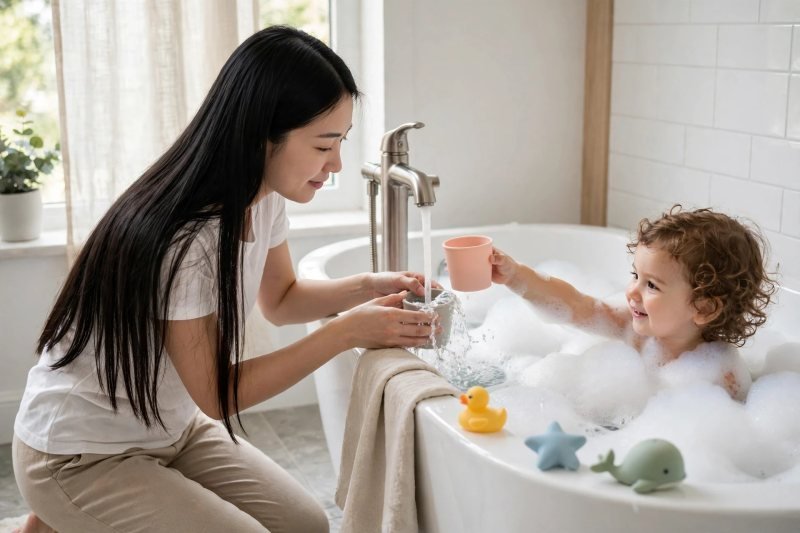
Rinse every toy as the bath ends. Cleaning starts while the water is still warm — make the rinse the last game of every single bath, not a chore saved for someday. As your toddler plays in the last minutes, take each toy in turn — swish it through the clean end of the bath water or hold it under the tap, rub it over quickly with your hand or the washcloth to lift off soap scum and bath residue, give it a firm shake over the tub, and hand it back to your toddler to shake again, because the double shake is the part they will fight to do themselves. Cups get tipped and shaken mouth-down; boats get tipped bow-down and stern-down so no pooled water rides home in a corner; solid figures just need the swish, the rub and the shake. This two-minute habit is what keeps good toys good — residue left on a toy dries into a film, film holds moisture, and moisture is the whole problem this guide exists to prevent. The rinse also flows naturally into what happens after the bath — warm towel, dry skin, pajamas and a gentle body wash for toddlers — the wind-down you build on in a simple kids' skincare routine, where clean, dry toys waiting on the rack are simply part of the room being ready. Say, "Every toy gets a rinse and a shake — you do the shaking." A toddler with a job at the end of the bath climbs out far more willingly than one who is simply lifted away from the fun.
-
Dry and store toys outside the tub. The rinse only works if drying finishes the job — a rinsed toy dropped back into a wet tub corner or a sealed box stays damp all night, undoing everything. Build a drying routine with three fixed parts — the shake, already done at rinse time; the rack, a slatted tray, small rack or open basket with drainage and airflow that lives on the side of the tub or a nearby shelf, never inside the tub itself; and the spacing, toys set apart mouth-down or on their sides so air reaches every surface, not heaped in a damp pile. Suction-cup mesh bags hanging inside a wet shower and lidded boxes both fail the airflow test — they hold yesterday's humidity against the toys all day — so if storage must live in the bathroom, open and airy beats closed and tidy every time. Before the next bath, a ten-second check — pick up two or three toys; they should feel bone dry and smell like nothing at all — and anything still damp gets an extra day on the rack instead of a place in the water. Say, "Toys sleep on the rack, dry and airy — not in the tub." Giving the rack a home and a name turns storage into part of the routine your toddler polices for you.

-
Replace toys at the clear warning signs. Even the best-chosen toys wear out, and replacing on time is a safety habit, not a shopping habit — retire any bath toy the moment you spot the clear signs: a musty or sour smell that survives a proper wash; dark spots or specks you can see through a hole, along a seam or under a flaking surface; cracks, splits or tears anywhere, because a crack is a doorway for water and a home for grime; peeling paint or a surface that has turned rough, sticky or chalky; a sloshing sound when you shake a supposedly solid or sealed toy; and any small part — an eye, a wheel, a key — that has loosened, because loose parts are a mouthing risk as well as a water trap. Retirement is not waste — a retired toy can often live on as a dry-land toy, a sandbox toy or a play-kitchen prop, as long as it never returns to bath water once its surface or seal has failed. When you do replace a favorite, replace like with like — the same solid, hole-free shape in the same material family — so the safe set your toddler knows stays the safe set. Say, "This one is tired and cracked — it retires, and a fresh solid one takes its job." Toddlers handle retirements well when the replacement keeps the same shape and color.

-
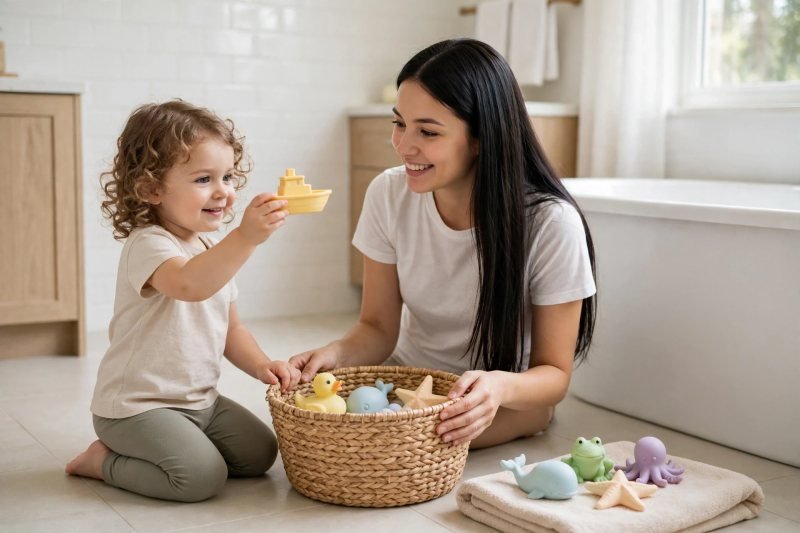
Rotate a small set every week. Finish with the habit that keeps every other habit easy — a simple weekly rotation. Keep the bath set small — around five toys in play — and store the rest clean and dry in a basket outside the bathroom; once a week, on the same day, swap the set: this week's cups and boats go to the basket, and a fresh handful comes out, which toddlers experience as brand-new toys arriving on a schedule. Rotation does three quiet jobs at once — every toy gets long, full drying time between tours of duty; wear spreads across more toys, so favorites last longer; and the weekly sort is your built-in inspection, the moment you run the hole test again, spot the crack, catch the musty smell and retire what needs retiring. The swap also doubles as gentle learning play — sorting by color, counting the new set in, choosing which boat sails this week — the same sorting-and-choosing spirit behind good toddler learning activities at home. Say, "New crew for the tub this week — which boat should sail first?" A toddler who chooses the week's crew owns the routine, and an owned routine is one that actually happens every night.


Make it easier
Start with the sort, not the shopping: one dry-towel sort and the ten-second hole test on the toys you already own usually produces a safe starter set today, with nothing new to buy. Shrink the set to three toys — cups, a jug and one solid figure — so rinsing, drying and inspecting take almost no time while the habit forms. Put the drying rack where your hand already goes — on the tub edge or the nearest shelf — because a routine that needs no extra steps is the one that survives tired evenings.
Make it harder
Run a full weekly toy audit: every rotation day, do the look, squeeze and shake checks on the whole collection, wipe each toy with warm soapy water, and note retirements so replacements stay like-for-like. Build themed rotation sets — pouring week, boat week, animal-story week — and let your three-year-old plan the next set by choosing from the clean basket the night before. Teach the full routine as a toddler job: rinse, shake, rack, and count the set in — four steps your three-year-old can own end to end with you watching.
Other ways to play it
- Small bathroom, no shelf space: dry toys on a slatted tray across the tub for an hour after the bath, then move them to an open basket on top of a cabinet or in the hallway — the air matters more than the location.
- Shared or sibling baths: give each child their own small set in their own color family and their own corner of the rack; the rotation and inspection stay identical, and arguments about whose boat is whose disappear.
- Travel and grandparents' houses: pack the solid travel trio — cups, jug, one figure — in an open mesh-free pouch, use it there, and dry everything fully on a towel before it goes back in the bag for the trip home.
How it changes by age
- Age 2: Two-year-olds mouth bath toys constantly and squeeze everything, so the solid, hole-free rule matters most at this age: keep the set to three or four large, one-piece toys that cannot be bitten apart, with no foam and no detachable parts. Do the rinsing and drying yourself while your toddler does the ceremonial shaking, keep every bath fully supervised with everything within reach, and expect toys to be chewed, thrown and dunked — sturdy silicone and hard plastic survive this age best.
- Age 3: Three-year-olds can run real parts of the routine: the fingertip smoothness test, shaking and racking their own toys, counting the set in and out, and choosing the weekly rotation from the clean basket. Offer the pour-and-stack games with more pieces, let them help with the weekly inspection as a spot-the-crack game, and keep the same rules — solid toys only, everything rinsed and dried, an adult within arm's reach throughout.
What they're learning
Cause and effect through water play: filling, pouring, tipping and stacking teaches how volume, weight and floating work — a cup that sinks when full and a boat that tips when loaded are first physics lessons. Early counting and sorting: counting cups as they stack, lining boats up in a row, and sorting the weekly rotation by color and type build early number and classification skills. Hygiene habits and routine: rinsing, shaking, drying and racking every toy, every night, makes cleanliness a normal sequence toddlers can perform themselves. Care and responsibility: spotting a crack, reporting a musty smell and retiring a worn toy teaches toddlers that looking after their things is part of playing with them.
Clearing up
Clearing up is the routine itself: rinse and shake every toy as the bath ends, set them spaced out on the rack mouth-down or on their sides, and tip the cups out so no puddle hides inside one. Wipe the rack and tub edge once a week at the rotation sort, wash the storage basket whenever it feels scummy, and leave the bathroom door open after bath time so humidity leaves instead of settling on the toys. Retired toys leave the bathroom the day they retire — into dry-land play, the sandbox or the recycling — so nothing worn quietly migrates back into the tub.
Questions parents ask
What are the safest bath toys for toddlers?
Why do bath toys get mold inside them?
Are squeeze toys with holes okay for the bath?
How do you clean and dry toddler bath toys properly?
How often should you replace toddler bath toys?
What materials are best for toddler bath toys?
H1 reframe: the queue title was "Best Bath Toys for Toddlers: Safe and Fun Picks" (#782), a best-picks product roundup framing. This article deliberately reframes the H1 to the honest how-to-choose format — "Bath Toys for Toddlers: How to Choose Safe, Mold-Free Ones" — because the guide recommends zero brands and zero prices and teaches selection criteria instead. Internal link targets: wash-toddler-hair-without-tears (Preparation, anchor "toddler hair wash"); kids-skincare-routine-simple-steps (step 7, anchor "kids' skincare routine"); best-body-wash-for-toddlers (step 7, anchor "body wash for toddlers"); counting-activities-for-toddlers (step 5, anchor "counting activities for toddlers"); sink-or-float-toddlers (step 5, anchor "sink or float game for toddlers"); toddler-learning-activities-at-home (step 10, anchor "toddler learning activities at home").


