


15 Easy Toddler Hairstyles for Girls (5 Minutes or Less)
Easy toddler hairstyles for busy mornings: 15 gentle styles for girls ages 2 to 3, each done in 5 minutes or less — soft snag-free bands only, low tension, no pulling tight, clips used safely, and a happy, loose finish every single time.
The easiest toddler hairstyles for girls ages 2 to 3 are low pigtails, a soft high ponytail, mini space buns, a half-up ponytail, loose braided pigtails, soft puffs, and a fabric-headband finish — each takes 5 minutes or less on detangled hair, uses soft snag-free bands only, stays loose, and stops the moment she resists.

The short version
- Detangle first, gently: a light water mist, fingers first, then a wide-tooth comb from the ends upward — every style depends on it.
- Soft snag-free bands only, wrapped just enough to hold, with two fingers of room at the scalp; never tight, never rubber, never metal clasps.
- All 15 styles take 5 minutes or less, sit loose at the hairline, and come out the moment she says no.
- Small clips are adult-placed, supervision-only accessories — always removed before naps, car seats, and sleep.
- Bands are cut out at removal, never dragged off; no heat styling and no chemical products, just water and soft hands.
- Age
- Ages 2–3
- Prep
- 2 min
- Play time
- 5 min
- Mess
- Low
- Difficulty
- Easy
- Where
- Indoor
Why kids love this
The best easy toddler hairstyles never feel like a chore, because they are finished before a two-year-old has time to get bored: she sits in her special styling spot, picks between two styles like a very small boss, watches herself in the mirror, and is done in five minutes or less. These 15 styles are built for toddler hair and toddler patience — soft, fine strands that slip out of anything fussy, a tender scalp that should never feel a pull, and an attention span measured in songs, not minutes. Every style here uses soft snag-free bands, low tension, and loose finishes, and every style comes out the moment she says no, so hair time stays something she trusts. Pigtails swing when she runs, space buns bounce when she dances, puffs feel like clouds she can pat, and a headband day means her hair stays loose and swishy exactly the way she likes it. She gets real jobs along the way — holding the mirror, passing the bands, counting the ties — and a mirror check at the end where the finished style is admired properly. Fast, gentle, and chosen together: that is the whole secret.
What you'll need
- - Wide-tooth comb — wide spacing glides through toddler hair without snagging; it works on misted hair only, never dry
- - Spray bottle filled with plain water — the only styling product in this guide; no heat styling and no chemical products are used anywhere
- - Soft snag-free bands — smooth, seamless, fabric-covered or silicone, with no metal clasps and no tight rubber; they hold by wrapping, never by squeezing
- - A few small clips — one soft bow clip, one flat barrette, and one mini claw clip, used by an adult, only under supervision, and always removed before naps, car seats, and sleep
- - One wide, soft fabric headband — stretchy and loose, never a hard or tight band
- - A small hand mirror she can hold, a round cushion or booster seat, and a small basket that keeps bands and clips together
- - A favorite small toy or a few bites of snack — the busy-hands kit that makes sitting still possible
- - Small scissors, kept by the adult and stored out of reach — used only by a grown-up to snip a band out at removal time, never dragged through hair and never handed to the child
Before you start
1. Choose the style together before you start — offer two from the 15 in this guide and let her final pick win; a style she chose is a style she will sit for. 2. Pick a rested, fed, unhurried moment; five-minute styles still need a calm two minutes of detangling first, and a tired or hungry toddler cannot give you either. 3. Set out the basket, comb, spray bottle, mirror, and her toy at the styling spot, and check every band before it goes near her head — stretched out, rough, or cracked bands go in the bin, not in her hair.
How to do it
-
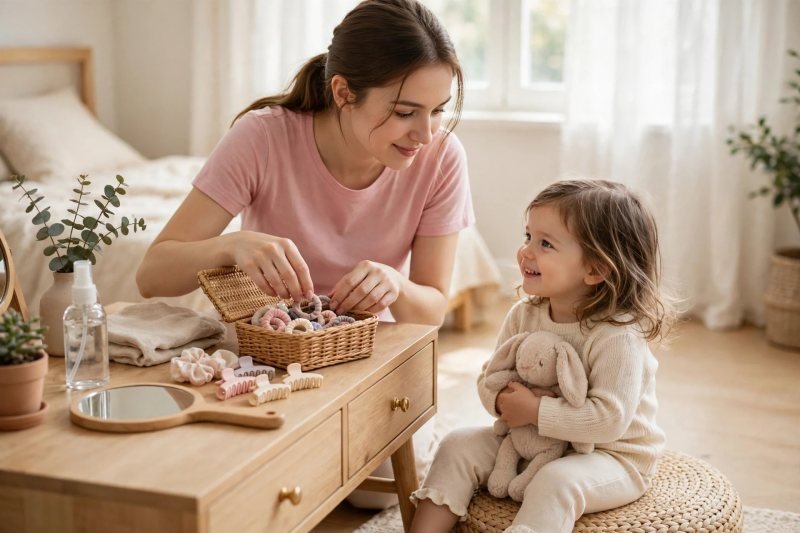
Set up the styling spot. Make one small corner the hair place every time — a round cushion at your knees or a booster seat at a low table or vanity, her basket of soft bands and clips within your reach and out of her mouth's reach, a hand mirror she can hold, and a favorite toy or a few bites of snack for busy hands. Hair is always styled sitting in this spot, never chased around the room, because a moving head turns even a soft band into a tug and a two-minute style into a wrestling match neither of you enjoys. Show her every tool before it touches her head — the mist bottle, the wide-tooth comb, the bands stretched gently between your fingers so she can see how soft they are — and agree the house rule out loud before the first spray: styling is always gentle, bands are always loose, and the moment she says stop, everything stops. The hair-health basics behind that rule — a tender scalp, delicate edges, and patience over perfection — are the same ones covered in this toddler first haircut guide, and they run through every style in this list. Say, "This is our hair chair — you sit, I style soft and slow, and if you say stop, we stop right away."
-
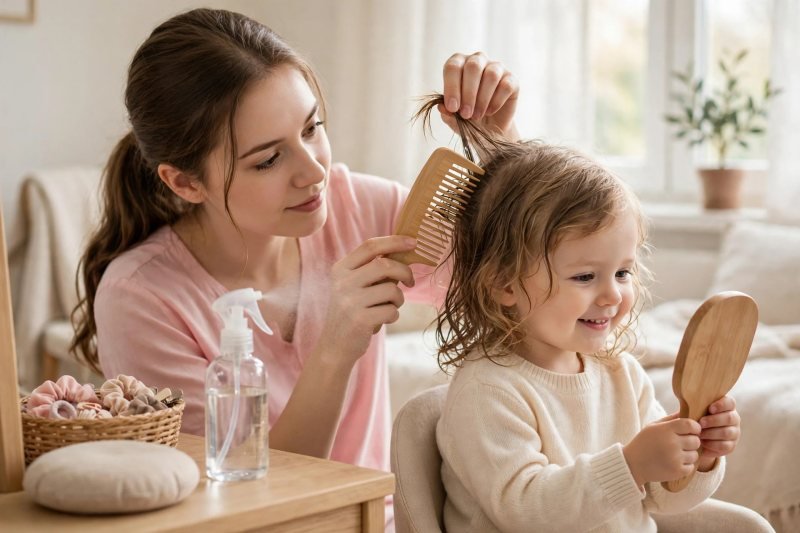
Detangle the gentle way. Every style in this guide starts here, and skipping this step is the only way these five-minute styles turn into ten-minute tears. Mist her hair lightly with plain water until it is evenly damp and soft — not dripping, never bone dry — then detangle with your fingers first, teasing apart any knots and sleep tangles gently by hand. Follow with the wide-tooth comb in small sections, starting at the very ends and working upward in short, patient steps, holding the hair above the comb with your other hand so no pull ever reaches her scalp. Add another mist whenever a section resists, because slip is what makes detangling painless, not force, and never rip through a tangle to save time — the thirty seconds saved cost you her trust in the whole routine. Work around her head section by section until the comb glides, keep her mirror and toy in rotation, and treat these two calm minutes as part of the style rather than a chore before it. If her fine hair tangles easily, a soft brush chosen with this best hair brush for toddlers guide makes the whole detangle kinder. Say, "We start at the ends and sneak up on the tangles — soft hair first, pretty hair second." When the hair is smooth, damp, and separated, every style that follows takes minutes.
-
Tie the two everyday classics. These are the two styles most toddler mornings actually run on, and both begin from the same soft middle part made with your fingers or the wide end of the comb, following her natural part where she has one. First, two classic low pigtails: gather one side loosely low behind her ear with your hand, smooth it with your palm rather than a brush, and wrap a soft snag-free band just enough times to hold — then stop, even if one more wrap feels tidier, and slide two fingers between the band and her head to prove there is room. Repeat on the other side, match them roughly in the mirror together, and let charmingly uneven pigtails be the correct toddler finish. Second, one high ponytail with a soft band: gather all her hair loosely on top with both hands, let it sit soft rather than slicked, secure it with the same gentle band at the same two-finger looseness, and let the tail flop and swing freely. Both styles should move when she shakes her head, and she should be able to smile, frown, and wiggle her eyebrows without feeling a thing. Say, "Two pigtails or one pony on top — soft bands, wiggly hair, and you picked which one."

-
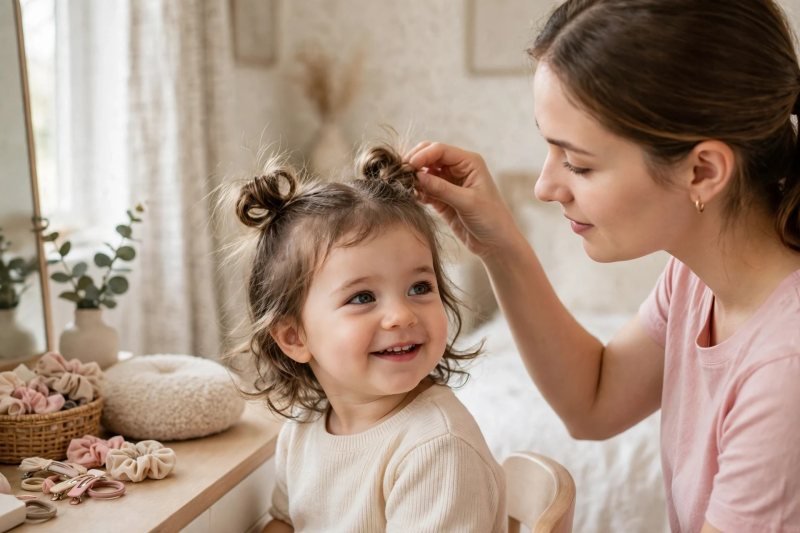
Bun it two ways. Buns sound fancy and take about a minute each once the hair is detangled, because toddler buns are small, soft, and proudly imperfect. First, two mini space buns: make the gentle middle part, gather one top side loosely as if starting a high pigtail, twist the little tail softly around its own base into a small round bun, and wrap a soft band around the base just enough to hold it — the bun should feel squishy, never wound tight, with wispy ends poking out wherever they like. Repeat on the other side and admire them together, because matching exactly is neither possible nor the point. Second, one top top-knot bun: gather the hair loosely on the very top of her head, twist it once into a soft rope, coil that rope around itself a single time into a tiny knot, and secure it with one soft band at the base, leaving the ends free and floppy. Run the wriggle test on both styles — she shakes her head, the buns bounce, nothing pulls, nobody winces. If a bun feels tight to your fingers, it feels tighter to her: unwrap it and coil it looser. Say, "Two space buns or one little top knot — soft and squishy, like tiny pillows for your head."
-
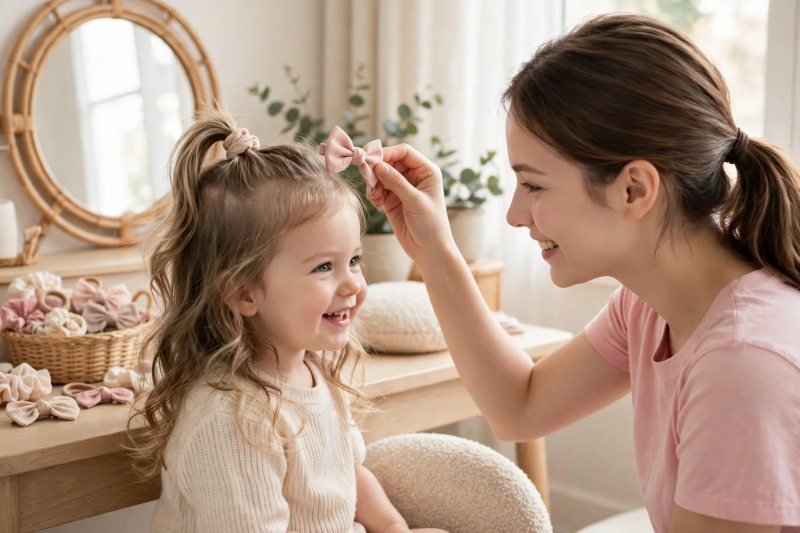
Do the half-up pair. Half-up styles are the kindest cut for toddlers whose hair is still growing in, because only the top layer is gathered and the rest flows free, so there is barely anything to pull and nothing heavy hanging from a band. First, half-up ponytail: use your thumbs to lift just the top section of hair, sweeping from her temples upward and leaving everything below her ears completely loose, gather that top section softly at her crown, and wrap a soft snag-free band at the usual two-finger looseness so the little tail stands up and bounces while the rest swishes around her shoulders. Smooth the loose hair down with damp palms and let the front wisps and baby hairs stay exactly where they fall. Second, half-up finished with a soft bow clip: build the same gentle half-up gather, then clip one soft bow just above the band — placed by your hands, pressed flat so no edge digs in, and checked with a fingertip so it sits smooth against her head. The bow is decoration only; the soft band does the holding, and the clip comes out before naps, car seats, and sleep, every time. Say, "Half up, half swishy — and the bow is just visiting until nap time."
-
Part and braid gently. A clean part and a loose braid are the whole technique here, and loose is not a flaw in toddler braiding — it is the safety rule wearing a pretty disguise. First, side part smoothed with one flat barrette: make a soft side part with your fingers or the wide end of the comb a little to one side of the middle, smooth the heavier side down and across with a damp palm, and clip one flat barrette along that side so it lies flat against her head, placed by you and checked with a fingertip for any digging edge. The rest of her hair stays loose and free, and the barrette is a supervised accessory only — out before naps, car seats, and sleep. Second, two loose three-strand braided pigtails: start from the low pigtail gathers, divide one side into three sections, and cross the outer sections over the middle in turn, keeping your grip deliberately soft at the root so the braid starts loose and only firms up down its length; finish each braid with a soft band at the end, well away from her scalp. A braid that pulls at the root is a braid to undo and redo looser, full stop. If the front wisps keep falling into her eyes, a careful trim following this trim toddler bangs at home guide keeps them out of the way without a salon trip. Say, "Over, over, over — soft at the top, swishy at the bottom, just the way braids should be."

-
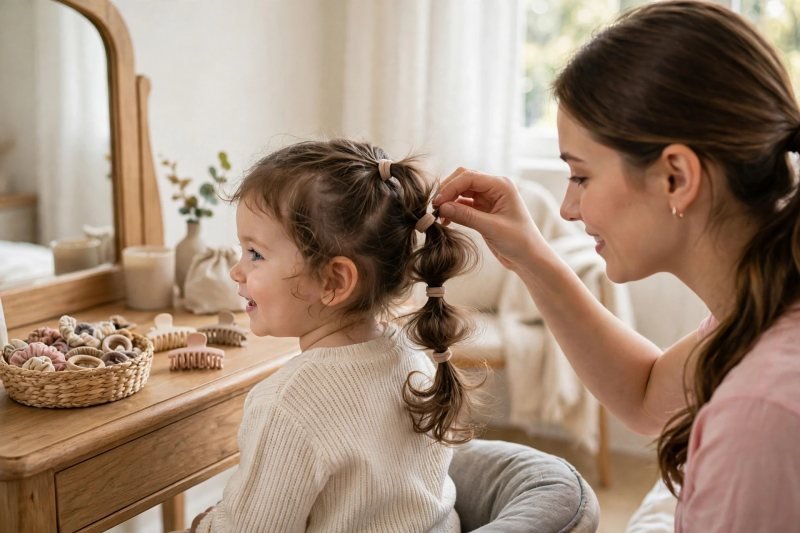
Cascade and twist. These two look like party hair and take the same five gentle minutes, because both are built from loose gathers and soft bands rather than tension. First, three-tie cascade ponytail down the back: gather just the top third of her hair at her crown and wrap a soft band at the usual looseness, then sweep the middle section of hair up into that tail and add a second soft band a little lower, then gather the remaining hair in and finish with a third soft band low down her back, so the ponytail steps down her back in three soft stages. Gently puff each section between the bands outward with your fingertips to make the little bubbles, stopping the moment anything starts to pull. Second, two front twists swept back and clipped: take one small front section on each side of her part, twist each one loosely away from her face with relaxed fingers — two or three soft turns is plenty — sweep each twist back above her ear, and secure it with one small clip that you place and check flat. The twists lie on the hair; they never drag on the hairline, and the clips come out before naps, car seats, and sleep. Say, "One cascade down your back, or two little twists like curtains — pretty, and nothing pulling anywhere."
-
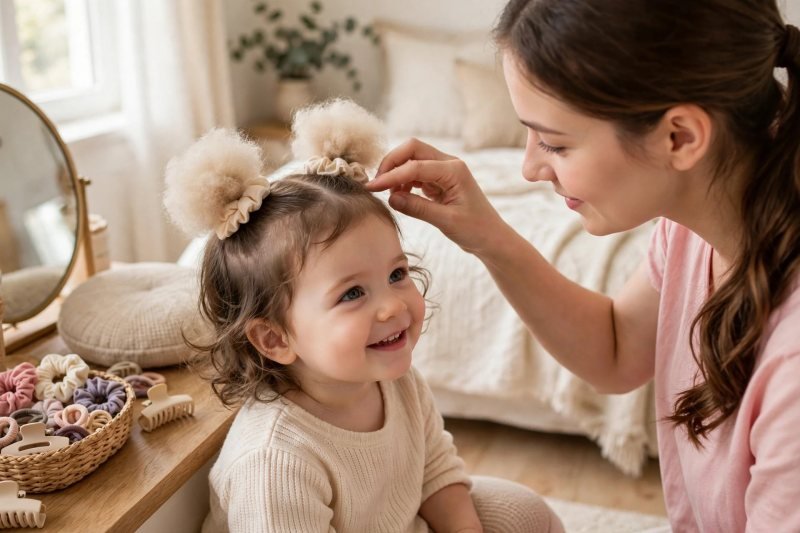
Puff and sweep. Puffs are the fastest full style in this guide and the one most toddlers ask for by name, and the side ponytail is its laid-back cousin for days when even puffs feel like a project. First, two soft puffs on top: make the gentle middle part, gather one top side softly with your hands, and secure it with a soft snag-free band doubled over the hair rather than tightened down onto it — the band wraps just enough times to hold, and then you stop. Run the two-finger check every single time, two of your fingers sliding comfortably between the band and her scalp, then fluff the puff open with your fingertips so the hair stands in a soft cloud instead of pulling toward the band. Repeat on the other side. Second, one low side ponytail: gather all her detangled hair loosely low behind one ear, wrap the soft band at the same checked looseness, and let the tail fall over her shoulder. Letting her help is built into this step — holding the next band, passing you a clip, and counting the puffs are exactly the kind of grip-and-pinch practice found in these fine motor activities for preschoolers, because clips and bands are fine-motor practice when toddlers help. Choose bands and clips with this toddler hair accessories guide so every piece you use is soft, snag-free and sized for a toddler. Say, "Two puffs, soft and round — we always leave room for two fingers, because puffs bounce, they never pull."
-
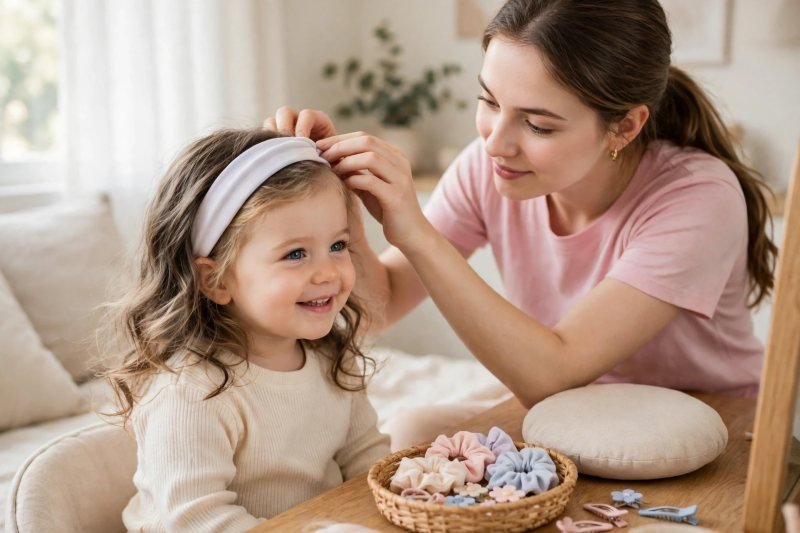
Finish loose or clipped up. Some days the kindest style is barely a style at all, and these last two finishes are for mornings when her hair — or her mood — wants freedom with just a finishing touch. First, loose hair smoothed under a soft fabric headband: leave her detangled hair completely loose, smooth it down with damp palms, and slide one wide, soft fabric headband on gently from front to back, sitting it just behind her hairline with no squeezing at the sides. There is no band tension anywhere in this style, nothing to remove at nap time except the headband itself, and the loose hair underneath stays swishy and free. Second, mini claw-clip twist-up at the back: gather her hair loosely at the back, twist it upward once with relaxed fingers so the ends point up and flop over softly, and clip the twist in place with one mini claw clip that you position and press gently, checking with a fingertip that no tooth digs into her scalp. It is a supervised, awake-time style only — the clip always comes out before car seats, naps, and sleep, without exception. Say, "Loose and swishy under your headband, or twisted up like a big girl — both soft, both quick, both your choice."
-
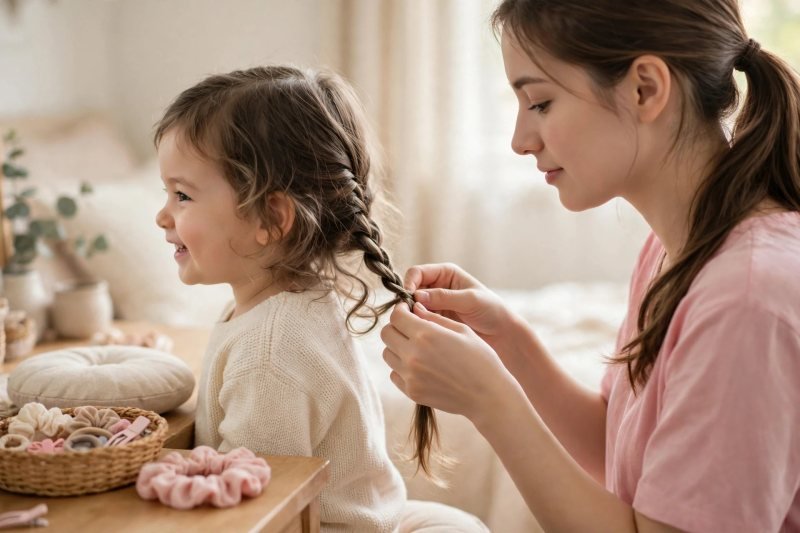
Braid for tomorrow + the fixing rules. The last style works overnight while she sleeps: one loose overnight braid for morning waves. At bedtime, on detangled, dry-ish hair, divide her hair down the back into three sections and braid one single three-strand braid as loosely as your fingers can manage — so loose it looks a little lazy — and finish it with one soft snag-free band at the very end, far from her scalp. In the morning, snip that band out, unwind the braid with your fingers, and shake out the soft waves she wears loose for the day. If she dislikes sleeping in it, take it out and let her sleep with loose hair instead; the braid is a bonus, never a battle. The rest of this step is the fixing rules that protect all 15 styles: redo a style looser rather than ever redoing it tighter; swap a slipping band once for a fresh soft one, then switch to a simpler style instead of wrapping tighter; cut every band out with the grown-up scissors at removal time rather than dragging it off down the hair; and stop the moment she says no, mid-style, every time. A loose overnight braid is one of the gentlest protective hairstyles for toddlers, because it keeps the hair tidy while she sleeps without any tension at the roots. Say, "One sleepy braid tonight, waves tomorrow — and remember, a happy loose style beats a perfect tight one, always."


Make it easier
- Start with the two everyday classics in step 3 — low pigtails and the high ponytail need no parting skill, no clips, and no mirror-checking, and they carry most toddler weeks on their own.
- Style in two sittings on wriggly days: detangle and rest, then tie — her patience, not your plan, sets the schedule, and a half-finished style plus a break is a success.
- Keep the styling basket packed and stationed — comb, spray bottle, bands, clips, headband, mirror — so hair time starts in one minute instead of a scavenger hunt.
Make it harder
- Let her direct the menu: choosing between two named styles, counting the bands as they go in, and checking the mirror between steps builds planning, counting, and very serious creative direction.
- Add the cascade ponytail from step 7 as her special-occasion upgrade once your hands are quick — three soft ties, same looseness rules, just more stages.
- Teach the morning refresh as her job: headband on by herself, a fingertip fluff for yesterday's puffs, and carrying the basket to the styling spot — small, real responsibilities in her own routine.
Other ways to play it
- - Pigtails into mini buns: the low pigtails from step 3, each twisted softly and coiled once at the base with the same soft bands — a two-minute change that feels like a brand-new style.
- - Headband over puffs: yesterday's two soft puffs, refreshed with a mist and fingertip fluff, worn under the soft fabric headband for a dressed-up finish with zero restyling.
- - Bow-clip swap: any half-up or side style finished with the soft bow clip instead of a visible band wrap — adult-placed, flat-checked, and still out before naps, car seats, and sleep.
How it changes by age
- Age 2: Twos get the simplest versions and the shortest sittings: low pigtails, the high ponytail, two soft puffs, the half-up ponytail, and loose headband days. Expect to detangle in stages with a toy rotation, keep clips to the bow and barrette used briefly and always supervised, and let the overnight braid wait if bedtime is already a negotiation. Her jobs are real but tiny: holding the mirror, holding the basket, and choosing between two styles you offer.
- Age 3: Threes can sit for the full menu, including braided pigtails, the cascade ponytail, front twists, and the claw-clip twist-up, and they love running the routine — counting the three cascade ties, naming the style she wants tomorrow, and doing the two-finger looseness check with you. Clips are still adult-placed and still come out before naps, car seats, and sleep, and the stop rule still belongs to her completely.
What they're learning
- Body autonomy and consent: the stop rule that always works, styles she chooses herself, and "too tight" believed on the spot — her body, her say, practiced every morning. - Counting and sequencing: three cascade ties, two pigtails, one braid for tomorrow — numbers and order woven into a routine she can recite and predict. - Fine motor practice: passing bands, holding sections, gripping the mirror, and helping with the spray bottle — pinch, grip, and two-handed coordination in real life. - Patience and pride: sitting for a short, calm routine and checking the finished style in the mirror — hair care as care, never as a battle.
Clearing up
Bands come out one at a time and are snipped into the bin, never saved for a second use once stretched; clips are collected and counted back into the basket — a missing clip is usually hiding in the cushion, and finding it matters because small clips are choking hazards for toddlers. The comb is rinsed and dried, the spray bottle is topped up with fresh water, the fabric headband goes in the wash basket when it needs it, and the styling basket goes back to its spot stocked and ready, so tomorrow's five minutes starts calm.
Questions parents ask
What are the easiest hairstyles for a toddler girl?
How do you style a toddler's hair without hurting her?
How long should toddler hairstyles take?
What hair bands are safest for toddlers?
Are clips safe for toddlers?
What if your toddler will not sit still for hairstyling?
All 15 styles, re-enumerated: (1) two classic low pigtails, (2) one high ponytail with a soft band, (3) two mini space buns, (4) one top top-knot bun, (5) half-up ponytail, (6) half-up finished with a soft bow clip, (7) side part smoothed with one flat barrette, (8) two loose three-strand braided pigtails, (9) three-tie cascade ponytail down the back, (10) two front twists swept back and clipped, (11) two soft puffs on top, (12) one low side ponytail, (13) loose hair smoothed under a soft fabric headband, (14) mini claw-clip twist-up at the back, (15) one loose overnight braid for morning waves.

save it for later
Pin this for the next rainy afternoon
Keep it on a board so it is there when you need it, rather than when you happened to find it.
Save to Pinterest

