


How to Make Bath Time Fun for Toddlers
How to make bath time fun for toddlers ages 2-3: ten safe, simple water games — pouring, bubbles, foam shapes, songs and a calm wind-down — with everything gathered within arm's reach first and an adult beside the tub the whole time.
Learning how to make bath time fun starts before the water runs: gather everything within arm's reach, stay beside the tub the whole time, and keep the water warm, shallow and supervised. Then simple play does the rest — pouring cups, bubbles, foam shapes, songs and a calm wind-down turn washing into happy, safe play.

The short version
- Setup is the safety system: everything within arm's reach before your toddler gets in, so you never leave — not even briefly.
- Bath seats are not safety devices; your eyes and your arm's reach are the safety plan for the whole bath.
- Test water with your wrist or elbow: warm, not hot, shallow, and swished even before anyone gets in.
- Play in an arc: pouring and bubbles first, songs and games in the middle, slow floating play to wind down.
- Plain household things are the toys: cups, a sieve, a soft cloth and generic blank toys.
- Age
- Ages 2–3
- Prep
- 5 min
- Mess
- Some
- Where
- Indoor
Why kids love this
Toddlers love bath time when the water becomes a playground they are allowed to control — a cup they can fill and tip themselves, bubbles they can scoop into a wobbly hat, a boat that only moves when they push it, and a song that tells their hands exactly when to splash and when to freeze. Every game here is built from that toddler logic: the fun is in the doing, not in special toys, and the same plain cups and foam shapes work night after night because a two-year-old's favorite game is the one he already knows how to win. Toddlers also love a bath that starts calm and ends calm — no scramble for a forgotten towel, no adult popping out mid-game — and that is what the setup-first routine in step one gives them. When everything is within reach and you stay right there at the side of the tub, the whole bath feels like undivided-attention time, and that feeling is what makes a toddler ask for bath time instead of resisting it. The games also run in the right order — lively first, slow last — so the bath itself winds your toddler down toward pajamas and bed.
What you'll need
- Two or three plain plastic cups in different sizes — unbreakable and smooth-edged; your pourers, fillers and measuring tools
- One small kitchen sieve — your fishing net and rain-maker; check it has no sharp edges or loose parts
- A handful of generic blank bath toys — plain boats, floating cups, a simple ball; no letters, numbers, logos or small detachable parts
- Plain foam shapes in simple forms — circles, stars, hearts and squares in bright colors; shapes only, no letters or words
- One soft washcloth and one soft sponge — for the toy car wash and gentle washing between games
- A large towel laid open beside the tub, plus clean pajamas and a diaper waiting within arm's reach for the out-and-dry finish
- A non-slip bath mat inside the tub and a towel or mat on the floor beside it
- A small basket that lives in the bathroom — so every toy is rinsed and stored in the same place after every bath
Before you start
1. Gather everything first, before any water runs: cups, sieve, toys, foam shapes, washcloth, sponge, the open towel, pajamas and diaper all go within arm's reach of where you will kneel — once your toddler is in the water you do not leave, not even briefly, so anything forgotten waits until the next bath. 2. Put the non-slip mat in the tub, close the bathroom door, and move anything that does not belong in a toddler bath — razors, glass bottles, medicines and cleaning products — up high or out of the room. 3. Run a shallow bath of warm water — warm, not hot; test it with the inside of your wrist or your elbow and swish it so there are no hot patches before your toddler gets in. 4. Decide on tonight's short game list — pouring first, one middle game, then the calm-down — and tell your toddler what is coming while you undress him beside the tub; a toddler who knows the plan cooperates with it. 5. Put your phone away, roll your sleeves up, and settle in: for the next fifteen to twenty minutes your only job is to be beside the tub, within arm's reach, watching and playing.
How to do it
-
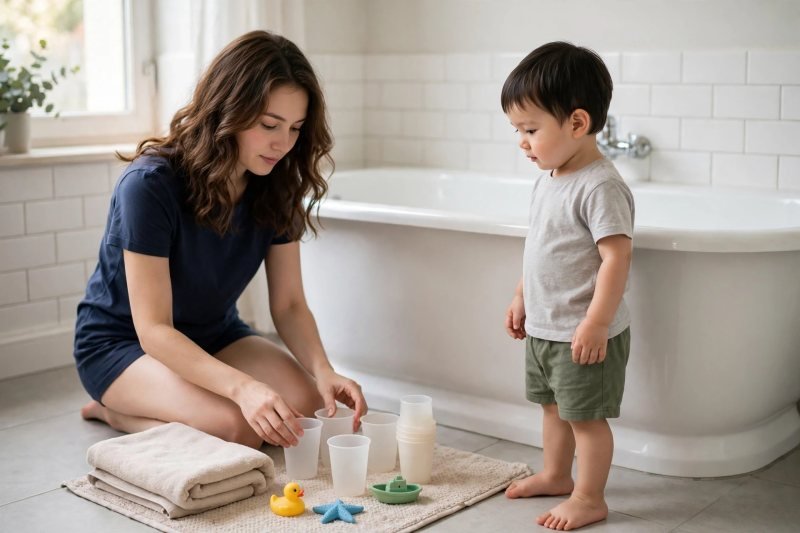
Set up everything first, then in we go. Before a single drop of water runs, build your station — the open towel on the floor mat beside the tub; the pajamas and diaper folded on top of it; the cups, sieve, boats and foam shapes in a small pile at the end of the tub you will sit beside; and the washcloth and sponge on the tub edge — because the golden rule of toddler baths is that once your child is in the water, you never leave him unattended, not even briefly, not even for a towel in the next room. Then run the shallow water, test it with your wrist or elbow until it feels warm and even — warm, never hot — swish away any hot patches, and only then lift your toddler in, supporting him under the arms, and settle him sitting on the non-slip mat with your hand staying close until he is steady. If you use a bath seat, treat it as a sitting helper only — bath seats are not safety devices, they can tip and they never replace your eyes or your arm's reach, so your attention stays exactly where it would be without one. Say, "Everything is ready, and I stay right here — let's play." A bath that starts this organized stays relaxed, because nothing later in the routine will ever pull you away from the tub.
-
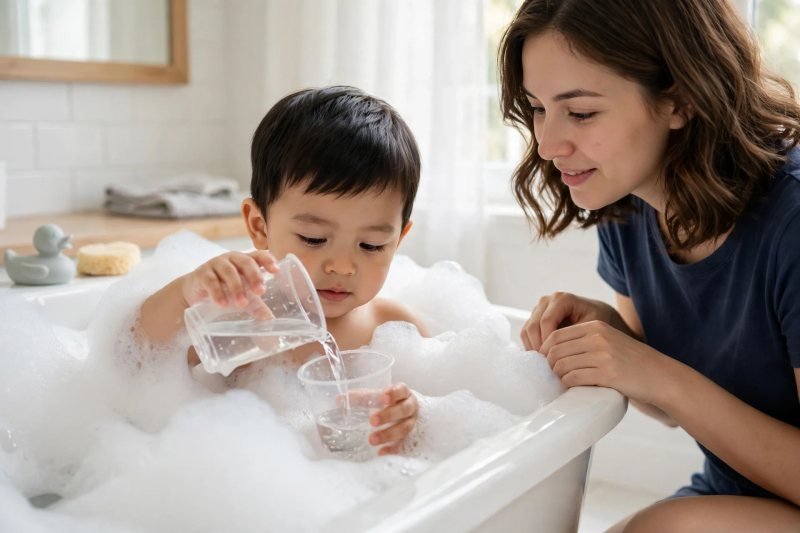
Pour, fill and tip it all out. Hand your toddler the biggest cup and show him the simplest, most satisfying game in the whole bath — fill it under the water; lift it slowly; tip it into the smaller cup and watch the water find the new home — then swap, so the small cup fills the big one and he discovers it takes two small pours to do what one big pour does. Build the rhythm together — fill together; count the pour out loud, one, two, three; cheer the splash as it lands — because this counting-while-pouring is the same early math hiding inside counting activities for toddlers, only wetter. Add the sieve for rain: fill it, lift it high, and let it shower down over a boat, over the foam shapes, over his own hands held out flat — never over his face unless he tips his chin up and asks for rain himself. Keep your free hand resting near him on the tub edge the whole time, and if a cup drifts out of his reach, fetch it yourself rather than letting him lunge or stand for it — standing in a slippery tub is never part of any game in this guide. Say, "Fill it up, tip it out — again, again!" Pouring gives toddlers total cause-and-effect control, and it will happily fill ten full minutes if you let the cups keep changing jobs.
-
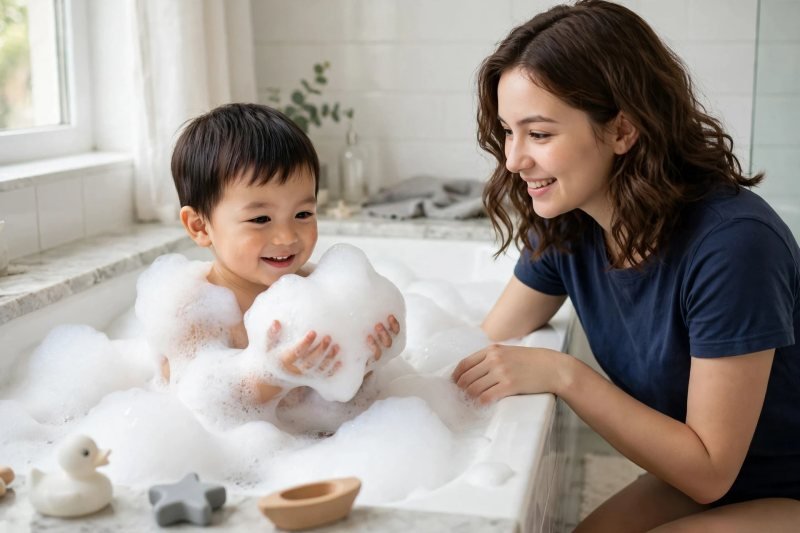
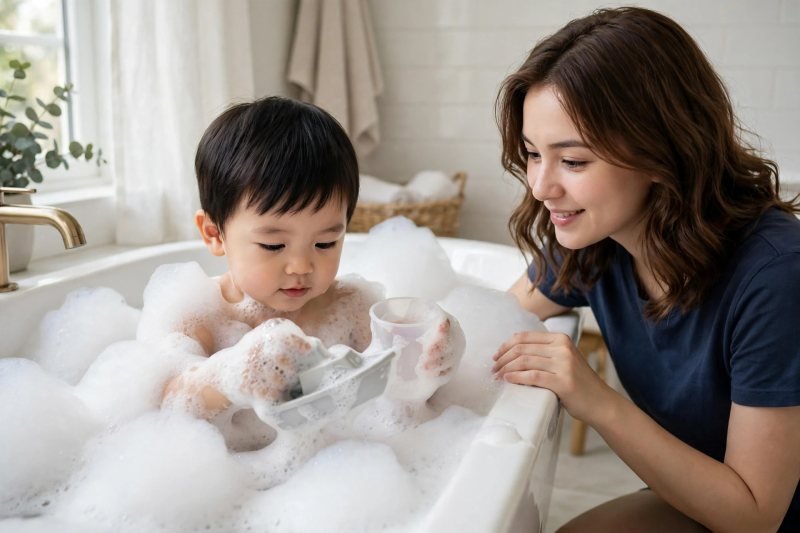
Scoop, pile and wear the bubbles. If tonight's bath has bubbles, they become building material — scoop a two-handed mound together; pile it into a wobbly tower on the back of his hand; smooth it into a bubble hat balanced on his head for exactly as long as it lasts; and blow gently across a palmful to send a few bubbles drifting — while you stay close enough that blowing never becomes leaning, reaching or standing. Play the hiding version too: drop a plain boat under the bubbles and let him pat the surface flat until the boat bumps his fingers — found it — then hide the cup, then hide the ball, because searching by touch under foam is wonderful slow detective work for two-year-old hands. Keep the bubble play honest and safe — the bubble bath safety for kids guide covers the same watch-outs: bubbles belong on hands, arms and boats, not rubbed into eyes, and if a handful heads for his mouth, redirect it onto a toy — "the boat wants a bubble beard" — rather than making it a battle. Watch the water level of the fun, too: bubbles flatten after a while, and that natural fade is your cue to move on rather than topping anything up. Say, "Bubble hat, bubble beard — who is that bubbly sailor?" Bubble play is pure sensory joy, and it teaches gentle hand control, because a tower only survives hands that learn to move slowly.
-
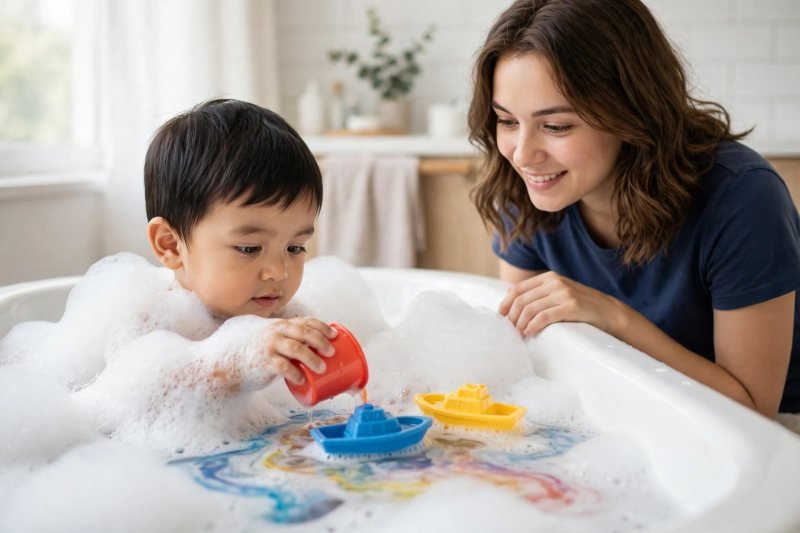
Spot the colors floating by. Tonight's color game needs nothing added to the water at all — just the bright, plain water-safe things you already have: the red cup; the blue boat; the yellow foam star; the green cup — floated, bobbed and lined up along the tub edge while your toddler learns to find a color on demand. Start easy: hold up the red cup and ask him to sail the boat that matches the cup in his hand — no, simpler still for a young two — name what he is already holding, out loud and with delight, "you found the BLUE boat," so the word lands on the thing itself. Then grow it into a fetching game that keeps him seated: you call a color from your spot beside the tub, he hunts among the floating toys and holds the winner up high — and because every toy started within reach inside the tub, the hunting never becomes climbing, stretching or standing. This naming, matching and hunting is the same skill thread that runs through toddler learning activities at home, moved into warm water where mistakes just float away. Say, "I spy something red floating — can your hands find it?" Color play in the bath works because the set is tiny and the water slows everything down, giving a toddler's eyes and hands time to actually succeed.
-
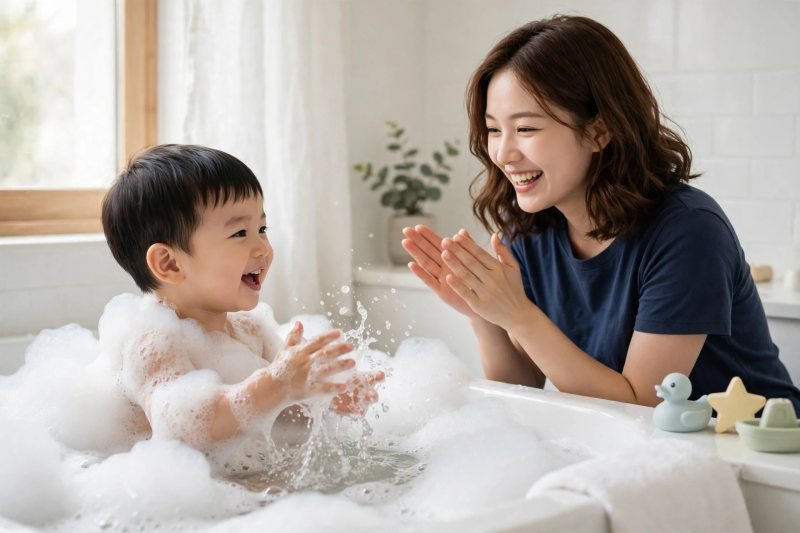
Sing it, splash it, freeze. Turn the middle of the bath into music: pick any simple song your toddler already knows — nursery rhymes for toddlers has plenty that work with hand actions — and give his hands a job in every line — palms patting the water flat on the slow lines; fingers drumming the tub edge on the fast ones; both hands lifting a gentle splash up — never at faces — on the biggest word of the chorus — and then the magic part, the freeze: when the song stops, hands stop, water settles, and the stillness itself becomes the funniest moment of the bath. You conduct from your kneeling spot, singing and watching at the same time, and your toddler stays seated through all of it because the game lives entirely in his hands and the water right in front of him. Repeat the same song three times rather than introducing three songs — toddlers adore knowing exactly when the splash is coming, and the anticipation giggle before the big word is the best sound in the whole routine. If the energy climbs too high and the splashing heads for the bathroom walls, slow the song down instead of stopping the game; tempo is your volume knob. Say, "Sing with your hands — splash on the big word, freeze when I stop!" Song-and-freeze play builds listening, rhythm and self-control, all while the water does the entertaining.
-
Run a car wash for very small customers. Announce that the boats and cups are dirty from a long day of sailing and the bath's own car wash is now open — dunk the first boat; soap it gently all over with the soft sponge or washcloth; pass it to your toddler for the inspection pat; then rinse it clean by pouring cup after cup of bath water over it together — and drive it proudly to the drying spot on the tub edge. Work the queue one customer at a time — the boat; the big cup; the ball; the foam shapes get a wipe and a rinse each — because a line of customers waiting gives this game a beginning, a middle and a natural end, and toddlers who wash things are practicing the exact sequence real washing follows: wet it, scrub it, rinse it, done. Your role is quality control officer, kneeling in arm's reach, narrating every stage; his role is chief washer, and he will take it extremely seriously. Fold real washing in quietly once the game is rolling — arms and tummy get their own turn through the car wash while he is happily distracted by the customers. Say, "Next customer, please — scrub, scrub, rinse, all clean!" The car wash turns the necessary part of the bath into the game itself, so getting clean stops being an interruption of play and becomes the play.
-
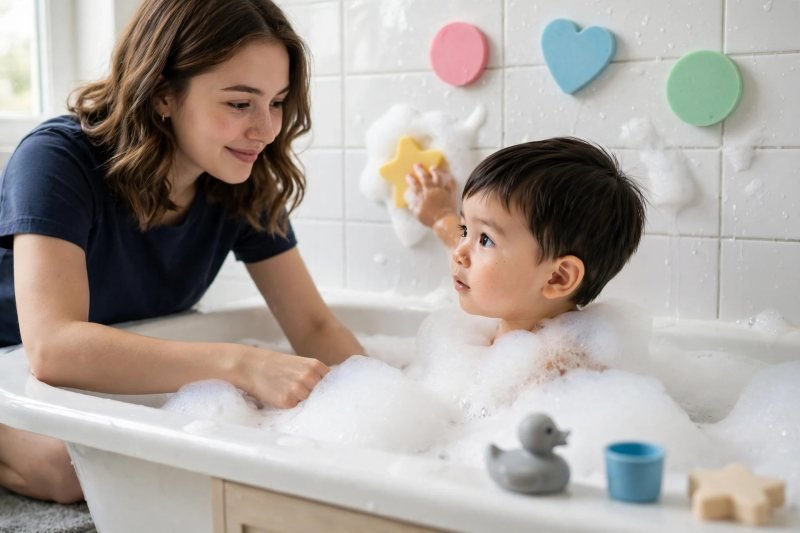
Stick foam shapes on the tiles. Wet a plain foam shape, press it flat against the wet wall tiles just above the water, and it stays — a small miracle your toddler will want to repeat twenty times: the circle high; the star beside it; the heart upside down because he insists — a whole gallery built one press at a time, using shapes only, plain forms with no letters or words, so the lesson stays purely about shapes, colors and sticking power. Sit him facing the wall end of the tub so the gallery is directly in front of him and every reach is a short, seated reach — you pass each shape from your pile, he decides where it lives, and nothing about this game ever requires standing, climbing or turning his back on you. Grow it gently: ask for the star next; ask which shape is biggest; peel one off together and count how long it floats before it sinks — most float, which is its own surprise. When the gallery is complete, admire it properly, out loud, naming every shape he placed, because finishing something and having it witnessed is deep toddler satisfaction. Say, "Press it flat — it sticks! Where does the star live?" Foam-shape galleries teach shape recognition, planning and pressing-with-control, and the peel-off ending is built-in tidying he will volunteer for.
-
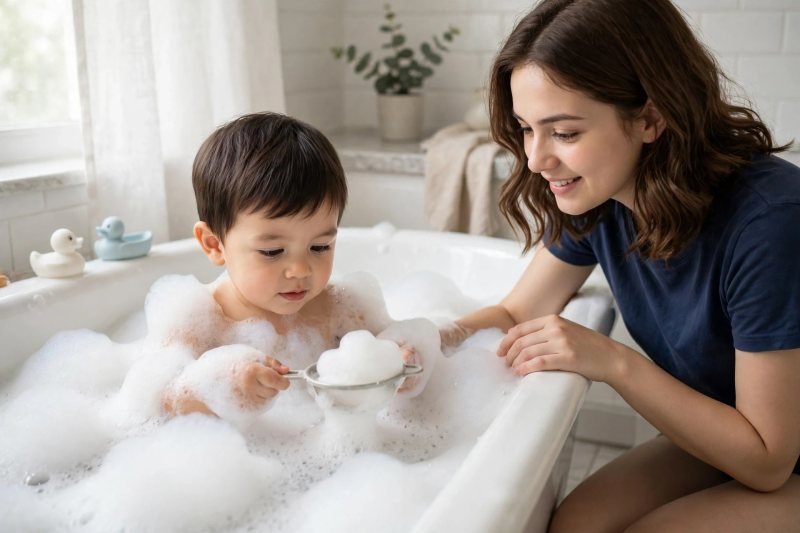
Go fishing with a cup sieve. Scatter the small floating things — the foam shapes; the ball; the smallest cup turned upside down like a bobbing boat — and hand over the sieve: the fishing game is to scoop under one floating prize, lift it slowly while the water drains away in satisfying streams, and deliver the catch to the landing zone, a big cup held steady by you at the tub edge. Cheer every catch by name and keep a running count together — one fish, two fish — because "fish" that are really foam hearts are funnier to a two-year-old than any sensible version of this game, and the counting rides along for free. Set the challenge at his exact level: prizes floating close and still for a young two; prizes nudged gently away by your fingertip current for a confident three — and always fished for from a seated position, with you retrieving anything that drifts behind him so he never twists, lunges or stands to chase it. If the sieve proves tricky, fish with a cup instead, scooping water and prize together; the game is the hunting and the lifting, not the tool. Say, "Slow scoop, lift it high — you caught the runaway star!" Fishing builds patience and hand-eye coordination better than almost any bath game, because the water keeps moving the target and success still comes every few tries.
-
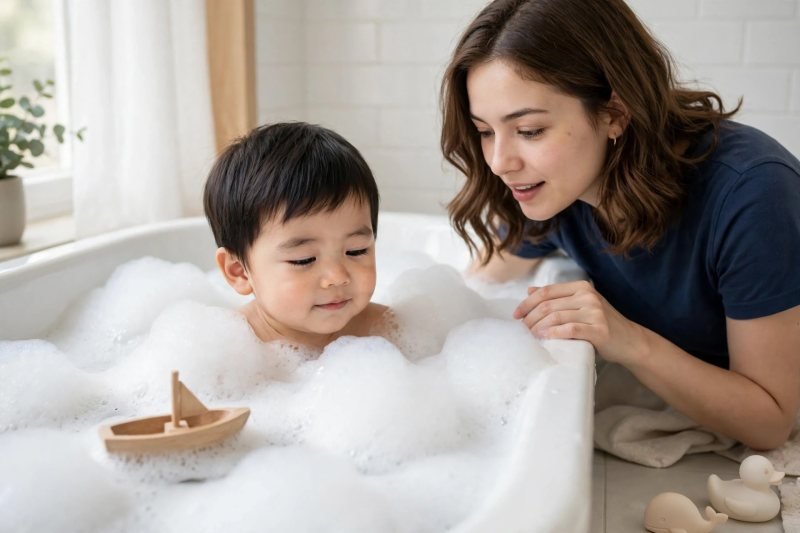
Slow everything down to floating speed. The last game of the bath is deliberately the quietest: clear the water of everything except one plain boat, dim your voice to match, and sail it together — one slow push from his hands; a long, gentle glide; a soft catch against your palm at the other end — while the water settles, the bubbles thin and his breathing finds the slower rhythm the bedtime routine needs. Drift into quiet talk: name the best moment of today's bath; name what the boat is carrying to sleep; let him trail one hand flat in the water and feel it go still. This is also your moment for the final checks that end every bath in this guide — water still warm enough or cooling toward done; hands and feet wrinkly; the game energy spent — because a toddler lifted out mid-excitement protests, and a toddler lifted out at floating speed mostly yawns. Keep him seated for the whole wind-down, and if he revs back up, slow the boat further rather than adding anything new; calm is contagious at this range, and you are right there at the tub edge being it. Say, "Slow boat, quiet water — nearly time to get cozy." Ending at floating speed turns the transition out of the bath from a battle into a landing, and it is the step that makes the whole routine repeatable tomorrow night.
-
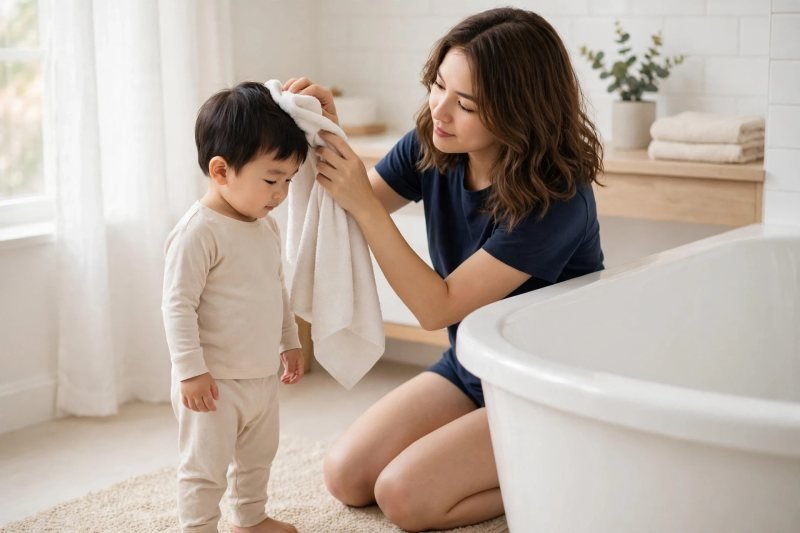
Out, wrapped and dried like a pro. The ending was prepared before the bath began — that ready ending is the heart of a calm bath routine for toddlers — which is why it works: the big towel is already open on the floor mat beside you — announce the last boat ride; lift your toddler straight up and out, supporting him under the arms, and set him standing on the non-slip floor mat inside the circle of your arms — never carry a wet, slippery toddler across the room, and never leave him standing in the emptying tub while you reach for anything, because everything you need was placed within arm's reach in step one. Wrap the towel around him whole, pat him dry together — arms; legs; between the toes — dress him into the waiting pajamas right there on the mat, and keep the post-bath skin care just as simple and gentle as the kids' skincare routine: pat rather than rub, and let the skin be. Only once he is dressed and the bathroom door is open do you pull the plug and do the quick toy rinse together — he can hand you each toy from the mat, fully clothed and nowhere near the draining water. Say, "Out we come, wrap up warm — all dry, all cozy, bath all done." A rehearsed, ready-for-him ending teaches a toddler that baths end predictably and pleasantly, which is half of why he will climb willingly into tomorrow's.


Make it easier
Run three games only — pouring, bubbles and the slow boat; a short, calm bath your toddler loves beats a full program that ends in tears. Move the whole thing earlier in the evening, before the tired-and-wriggly hour, and keep the water play seated and slow from the very first cup. Let your toddler choose tonight's two toys at the door — one choice made happily outside the tub removes most stalling at getting in.
Make it harder
Add a pouring challenge ladder: fill the big cup using only the smallest cup, then pour a full cup without spilling over the boat — real control practice for a confident three-year-old. Turn fishing into a sorting game: catches get landed by color or shape into two different cups, called by you from the tub side. Give your three-year-old the announcer's job at the car wash — he calls each customer, orders the wash steps himself, and declares each one clean before it may park.
Other ways to play it
- No-bubble baths: every game works in plain water — bubbles become "clouds" made by swishing the washcloth, and foam shapes, pouring and fishing carry the fun unchanged.
- Small-tub homes: shrink the set to two cups, the sieve and three foam shapes, and run the same order — pour, stick, fish, float.
- Sibling baths: each child gets their own cup and boat, the car wash takes both sets of customers in turn, and the freeze song keeps four hands busy — the setup-first and never-leave rules do not change at all.
How it changes by age
- Age 2: Young twos need the shortest, calmest version: pouring, bubble patting and one floating toy, with the sieve swapped for an easier cup scoop. Expect to do most of the lifting and pouring hand-over-hand at first, keep the bath nearer fifteen minutes, and end at the first sign of tiredness — a two-year-old who leaves the water happy comes back happily tomorrow.
- Age 3: Threes can run the full ten-step arc and hold small jobs: chief washer, gallery planner, and caller of the freeze in the song game. Offer the sorting version of fishing, let them choose the order of the middle games, and narrate the safety routine out loud with them — "we get everything ready first, and you stay sitting" — because a three-year-old who can say the rules is starting to own them.
What they're learning
Early math in the water: filling, emptying, full and empty, more and less, and counting pours and catches out loud — volume and number learned with both hands, long before any worksheet. Hand-eye coordination and control: pouring without flooding, scooping a moving target with a sieve, pressing a foam shape flat and sailing a boat slowly — graded, splashy fine-motor practice. Shapes, colors and naming: finding the red cup, placing the star, landing catches by color — recognition games where the answer can be held up and cheered. Listening and self-regulation: splashing on the big word, freezing when the music stops, then slowing down to floating speed — energy raised and lowered on purpose, in one bath. Sequencing and independence: setup, play, wash, wind down, out and dry — a fixed routine a toddler can predict, join and eventually help lead.
Clearing up
Pull the plug only after your toddler is out, dressed and out of the tub area, then make the reset a two-minute routine: every toy gets a rinse under the tap, a squeeze-out for anything hollow, and a shake before it goes into the bathroom basket to air-dry — standing water inside toys is what makes them slimy, so the dry-out matters more than the wash. Cups and sieve nest in the same basket, foam shapes dry flat on the tiles overnight, and the washcloth and sponge are wrung out and hung up. Wipe the tub edge and floor mat dry and drape the towel over the rail. Because the basket holds the whole kit, tomorrow's step-one setup takes under a minute — the tiny, ready-again finish that keeps this routine going night after night.
Questions parents ask
How do I make bath time fun for a toddler who hates baths?
How long should a toddler's bath last?
Can I leave a toddler alone in the bath just for a second?
What temperature should toddler bath water be?
Are bath seats safe for toddlers?
What are the best bath toys for toddlers?
Safety is woven through the whole article, not parked in one section: the never-leave and gather-first rules anchor step 1 and return in Preparation, Safety notes and FAQ; the bath-seat warning appears in step 1 and Safety notes; warm-not-hot wrist/elbow testing appears in Preparation, step 1 and Safety notes; seated-only play recurs in steps 2, 4, 7 and 8. No brands, no prices and no product presented as necessary anywhere: every game runs on plain cups, a kitchen sieve, a soft cloth and generic blank toys; skin notes are general only, with no medical claims. Foam shapes in step 7 and its image are plain forms only — circles, stars, hearts and squares — with no letters or words, verified in the step-7 image.


