


Washing Your Toddler's Hair Without Tears
Learning how to wash toddler hair without tears is possible with warm water from the back, lather made in your hands, an eye shield for rinsing, and simple games — plus the golden rule: never leave a toddler unattended in or near water.
Wash toddler hair without tears by wetting from the back, lathering shampoo in your hands first, shielding the eyes, and rinsing cup by cup while your toddler looks up — and never leave a toddler unattended in or near water, not even for a second.

The short version
- Set up everything within arm's reach first, and never leave a toddler unattended in or near water — not for a towel, a phone, or the doorbell.
- Wet the hair from the back and sides first so the face stays dry, using comfortably warm water you tested with your wrist or elbow.
- Lather a pea-sized amount of gentle shampoo in your own hands first, massage with fingertips only for one short silly song.
- Shield the eyes with a visor or your hand, teach chin-up, and rinse cup by cup down the back during the look-at-the-ceiling game.
- If a splash lands, stay calm: wipe, blink together, praise, and continue — and see a doctor promptly for persistent redness, pain, discharge, or light sensitivity.
- Age
- Ages 2–3
- Prep
- 1 min
- Play time
- 10 min
- Mess
- Low
- Difficulty
- Easy
- Where
- Indoor
Why kids love this
Most toddlers do not actually hate having clean hair — they hate the surprise of water over the face, suds near the eyes, and feeling tipped backward with no warning and no job to do. This routine fixes all three. Water arrives at the back of the head first, where it feels like warm rain rather than a splash in the face. Your toddler gets real choices — which toy to hold, which cup is theirs — and a silly song sets a clear, short finish line for the massage part. The look-at-the-ceiling game turns the hardest moment, rinsing, into a challenge they can win: chin up, eyes on the star, cup after cup running safely down the back. Because every wash follows the same ten steps in the same order, your toddler quickly learns what comes next, and predictability is deeply calming at two and three. The towel-turban game at the end gives the whole thing a prize finish, so hair-wash night stops being the bath they dread and becomes the bath with the funny hat at the end.
What you'll need
- - A plain plastic rinse cup — plus a second, smaller cup for your toddler to hold and pour with
- - A pea-sized amount of gentle toddler shampoo — in a plain, unlabelled bottle; a tiny amount of gentle conditioner too, only if hair is longer
- - A soft rinse visor or a clean soft cloth — for shielding eyes, with your hand as a backup shield at the hairline
- - A plain rubber duck or another simple bath toy — chosen by your toddler at the start
- - A washable doll with hair — for washing alongside, if you have one
- - A plain star or duck shape — stuck high on the wall above the tub for the look-at-the-ceiling game; plain shapes only, no letters or words
- - A large soft towel — for the towel-turban game and a warm wrap straight after rinsing
- - A wide-tooth comb or just your fingers — for gentle detangling while hair is damp
- - A non-slip mat inside the tub — and a mat or towel on the floor beside it
Before you start
1. Lay out everything within arm's reach of where you will kneel before any water runs: both cups, the shampoo, the visor or cloth, the toy, the doll, and the towel. This is not tidiness — it is what makes the never-unattended rule easy to keep, because you will never need to turn away or step out mid-wash. 2. Stick the plain star or duck shape high on the wall above the tub, well above your toddler's eye level when seated, so looking at it naturally lifts the chin. Check it is firmly stuck before bath time, not during. 3. Run shallow, comfortably warm water and test it yourself first with your inner wrist or elbow — warm and comfortable, never hot — and decide before your toddler gets in whether tonight is a full wash night or a plain-water rinse night, so the plan never changes mid-bath.
How to do it
-
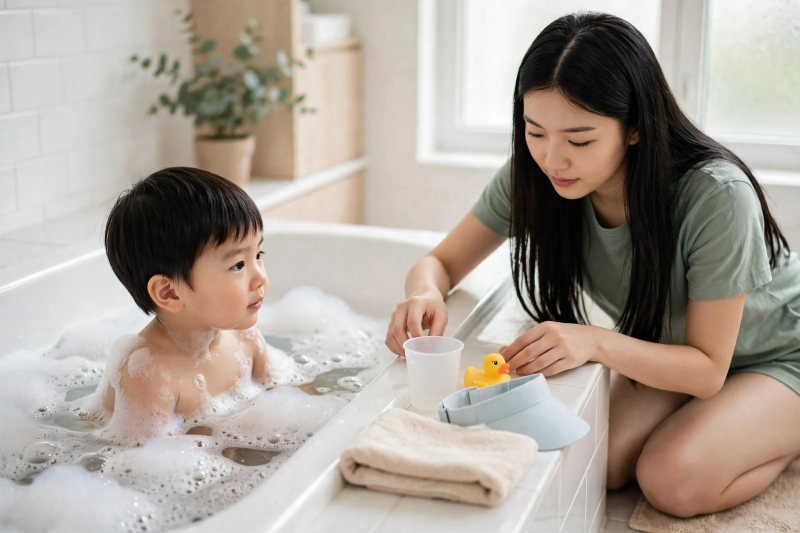
Set up within arm's reach. Before your toddler gets anywhere near the water, lay out everything this wash needs within arm's reach of where you will kneel: the rinse cup and the spare cup, the shampoo, the visor or soft cloth, the chosen toy, the doll, and the big towel, all ready before a single drop runs. This first step carries the most important rule of the whole article, stated plainly: never leave a toddler unattended in or near water — not for a second, not for a towel, not for your phone, not for the doorbell. Toddlers can slip silently, so your eyes and your hands stay with your child for the entire wash, and if something urgent truly pulls you away, you lift your toddler out, wrap them in the towel, and take them with you. Setting up first is what makes that promise effortless, because there is never a reason to leave. Keeping wash day as one calm part of a wider, predictable hair routine helps too — this toddler first haircut guide shows how gentle, familiar hair care moments build on each other. Say, "Everything is ready, so I stay right here with you the whole time."
-
Hand over some control. Toddlers who feel steamrolled by hair washing fight it; toddlers who get a job and a choice mostly play along, so start by handing over the small powers that are safe to share. Let your toddler choose tonight's bath toy from two options you offer — simple, washable best bath toys for toddlers like a duck and a few pouring cups are all you need — hand them the spare cup to hold, pour with, and guard, and let them pick whether the duck or the doll gets washed first. These choices are tiny, but to a two-year-old they transform the wash from something done to them into a game they are partly running. Keep the choices closed and quick — this toy or that one, your cup or the blue cup — so deciding takes seconds and the warm water does not cool while you negotiate. If your toddler wants to pour a cup over the duck's head in practice, cheer it on: rehearsing the scary part on a toy makes the real thing feel familiar. Say, "You pick the toy and hold your own cup — helpers get to choose."

-
Wet the hair from the back. The single biggest no-tears trick is also the simplest: water touches the back and sides of the head first, and the face stays completely dry. Fill the rinse cup with comfortably warm bath water — the water you tested before your toddler got in — and pour it slowly over the back of the head, letting it run down the hair and away from the face, then do the same at each side, working your way around while the front hairline stays dry until the very end. Pour low and close to the head rather than from a height, so there is no splashing, and pause between cupfuls so each warm pour feels calm instead of relentless. Most toddlers who "hate hair washing" are really protesting that first shocking cascade over the eyes; pour from the back and that moment simply never happens. Choosing gentle products with short, simple ingredient lists follows the same kind logic as a kids' skincare routine — mild, minimal, and rinsed away well. Say, "Warm rain on the back first — your face stays nice and dry."

-
Lather in your hands first. Never squeeze shampoo straight onto your toddler's head: a cold, concentrated blob landing on the scalp is unpleasant, hard to spread evenly, and far too easy to overdo, which then means endless rinsing. Instead, squeeze a pea-sized amount of gentle toddler shampoo into your own wet palms, rub your hands together until you have a soft, even lather, and only then bring your lathered hands to your toddler's hair. A pea-sized amount is genuinely enough for fine toddler hair — more product does not mean cleaner hair, it just means more suds to rinse away and more chances for drips to wander toward the eyes. Working the lather up in your hands first also warms it, so nothing cold touches the scalp, and it gives you a natural pause to check the amount before it goes anywhere near your child. If the hair is very thick or longer, add a second pea-sized amount the same way rather than starting with a big squeeze. Say, "First the bubbles grow in my hands — nice and warm, then onto your hair."

-
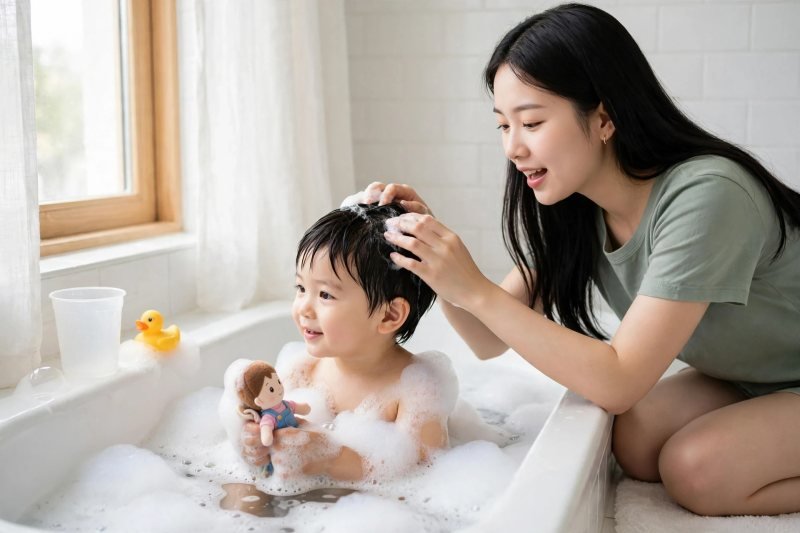
Massage with a silly song. With lathered hands, massage the shampoo through your toddler's hair using your fingertips only — never your nails — in small, gentle circles, working from the back and sides toward the top and saving the front hairline for last so suds stay as far from the face as possible for as long as possible. Give the massage a built-in finish line your toddler can hear: one short, silly song, sung at a cheerful pace, and when the song ends, the scrubbing ends, every single time. A song does three jobs at once — it times the wash so it never drags, it distracts with something funny, and it proves to your toddler that this part is short, because they can hear exactly how much is left. Meanwhile, hand over the doll and invite your toddler to wash its hair alongside you, copying your circles; a busy toddler with soapy hands of their own is rarely a toddler swatting yours away. Say, "Fingertips only, round and round — when our song finishes, the scrubbing finishes too."
-
Shield the eyes for rinsing. Rinsing is where tears usually start, so set up the shield before the first rinse cup is poured. Fit a soft rinse visor gently at the hairline if your toddler will wear one, or use your own hand as the shield: fingers spread, palm angled at the hairline like a little roof, so water running down meets your hand and diverts around the sides instead of over the face. Teach the chin-up cue now, before any water moves — chin up means head tipped gently back, eyes looking up, so gravity becomes your helper and every rinse runs down the back of the head. Practice the cue once on dry land, so to speak: say the words, watch the chin lift, praise it hugely, and only then pick up the cup. If your toddler drops their chin mid-rinse, pause, reset the shield and the cue, and carry on calmly — pausing is always allowed and never costs you the wash. Say, "Chin up, eyes up — my hand is your little roof, and the water runs down your back."

-
Play look-at-the-ceiling. Now give that chin-up pose a job to do: the plain star or duck shape you stuck high on the wall before the bath. Ask your toddler to find it and keep looking at it — what color is it, is the duck smiling, can they stare at the star until it wobbles — while you rinse cup by cup, pouring slowly at the back of the head and letting each cupful run down the back, checking with your free hand that the shield at the hairline is holding. The shape works because it holds the head in exactly the right position without you ever having to hold your toddler's head yourself, and it turns the longest part of the wash into a staring game they are trying to win. Rinse more than you think you need to: keep going until the water runs clear and the hair feels squeaky-clean rather than slippery, because leftover shampoo is a common cause of itchy scalps and next-day complaints. Keep the game going with questions between cupfuls so looking up never feels like a long, silent wait. Say, "Keep your eyes on the star — I can see it smiling. One more cup down your back, nearly done."

-
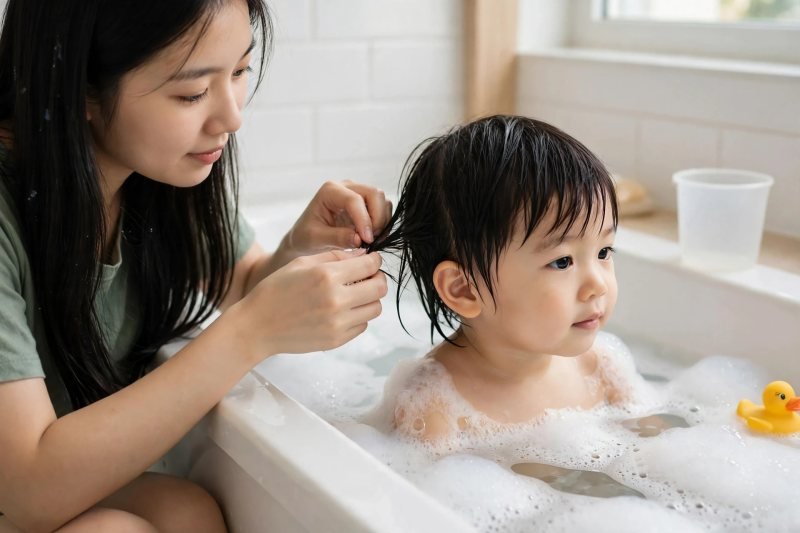
Smooth the ends only. If your toddler's hair is longer and tends to tangle, finish the wash with a tiny amount of conditioner — but only on the ends. Smooth a pea-sized amount between your palms and work it through the last few inches of hair, keeping it well away from the scalp, where conditioner is not needed on a toddler and can leave fine hair looking flat and feeling coated. Give it just a few seconds, then rinse the ends thoroughly with the cup, again pouring down the back with the chin-up cue and your hand shielding the hairline, until the hair feels smooth but not slippery. Short hair can skip this step entirely — fine, short toddler hair rarely tangles enough to need conditioner, and a shorter wash is a happier wash. On nights when even the ends feel tangle-free after a plain-water day, skipping is fine too; conditioner is a helper for knotty ends, not a daily requirement at this age. Say, "Just the ends get the smooth cream — the top stays light, and we rinse it all away."
-
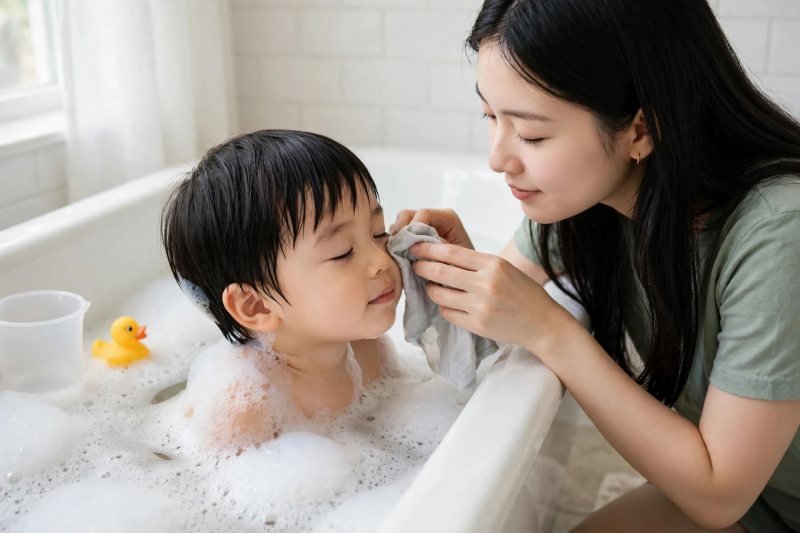
If water gets in the eyes. Even with perfect shielding, one splash will eventually land wrong — and how you react in the next ten seconds decides whether it becomes a funny story or a lasting fear of hair washing. Stay completely calm, pause the rinsing, and wipe the eyes gently with the soft cloth, then blink together, big exaggerated blinks side by side, until your toddler copies you and giggles instead of crying. Praise the brave blinking like an achievement, name what happened in simple words — a splash, it is already gone — and then continue the wash at the next step, a little more slowly, rather than abandoning it in a panic or, worse, pushing through while your toddler is upset. A wash that pauses, recovers, and finishes kindly teaches your toddler that splashes are small and survivable; that lesson is worth more than any single clean head of hair. If eyes ever look more than briefly bothered afterwards — persistent redness, pain, discharge, or sensitivity to light — stop and see a doctor promptly rather than waiting it out; those red flags are covered fully in the Safety notes below. Say, "A splash! Wipe, blink, blink — all gone. You were so brave, and we are nearly finished."
-
Finish with the towel-turban game. End every wash the same cheerful way, while the win is still warm: lift your toddler out safely with both hands, wrap the big towel around them, and twist the top into a towel turban, then admire the result together in the mirror with suitable amazement — who is that fancy person, where did their hair go — because a wash that ends in laughter is a wash your toddler will agree to again next time. Follow the game with cuddles while the hair is still damp, and detangle gently right then, when hair is at its most forgiving: work through it with your fingers or a wide comb, starting at the ends and easing upward, never dragging through a knot. Keep the mood unhurried and warm; pajamas, a story, or whatever your evening routine holds can follow once the detangling is done. You have now done the whole thing — wet, lathered, massaged, rinsed, and dried — with the face dry, the eyes shielded, and your toddler supervised every second. A steady bath routine for toddlers makes wash night predictable, so the same calm steps in the same order become the routine she expects. Say, "Look at that turban — what a fancy finish. Cuddle time, then gentle combing while it is damp."



Make it easier
- Wash hair less often: for most toddlers, two or three proper washes a week is plenty, with plain warm water play on other nights — fewer washes means fewer battles while the routine beds in; this how often to wash toddler hair guide explains the rhythm in detail.
- Practice the pieces dry: rehearse chin-up, the visor, and the staring game during daytime play with no water at all, so bath night only assembles skills your toddler already has.
- Keep everything in one bathroom caddy — cups, shampoo, visor, cloth, towel — so the within-arm's-reach setup takes thirty seconds and never tempts you to leave the tub to fetch a forgotten item.
Make it harder
- Let your toddler pour the rinse cups over the back of the doll's head themselves, counting each cupful out loud — pouring control and early counting inside the same safe routine.
- Hand over the massage: with lather already in your hands, guide your toddler's fingertips to copy your circles on their own sides and back of the head, with you finishing the top.
- Add a memory layer to the ceiling game: after each rinse cup, your toddler names the shape's color or whether the duck is smiling, building recall while the chin stays up.
Other ways to play it
- - Fully-clothed sink or basin lean-back: on nights when the tub itself is the problem, skip the bath entirely — keep your toddler fully clothed, lay a folded towel on the counter, and lean them back at a kitchen sink or over a basin of comfortably warm water so the head rests back and the hair hangs into the water, face pointing up and staying dry while you wet, lather, and cup-rinse from the back. An adult supports your toddler securely the whole time, a second adult helping if needed, and the golden rule holds exactly as in the tub: never leave a toddler unattended in or near water — stay hands-on for every second, and empty the basin straight afterwards.
- - Shower-wand-with-parent option: if your toddler prefers showers, a parent showers with them and uses a gentle handheld shower wand on its softest setting, held low and close at the back of the head, with the same lather-in-hands, eye-shield, and chin-up steps as the tub version. The adult tests the water temperature first, keeps a non-slip mat underfoot, holds the wand rather than letting it swing, and stays within arm's reach throughout — never leave a toddler unattended in or near water in the shower either, not for a second.
- - Plain-water night: between wash nights, run the identical routine with water only — back-first wetting, a fingertip massage with no shampoo, shielded rinsing, and the towel-turban finish — so hair-wash night never feels like a different, scarier bath.
How it changes by age
- Age 2: Two-year-olds need the shortest, most game-led version: expect the wash itself to take just a few minutes, keep the silly song genuinely short, and do most of the work yourself while your toddler holds the cup and the toy. Chin-up is a brand-new skill at two, so praise every wobbly attempt and let the visor or your hand do the heavy lifting. Hold the safety frame exactly as written — everything within arm's reach, warm water tested first, and never leave a toddler unattended in or near water, whatever their mood that night.
- Age 3: Three-year-olds can take real ownership: pouring practice cups over the doll, copying the fingertip massage on their own hair, calling out the ceiling game, and holding the shield cloth with you. Washes can run a touch longer and the song can gain a second verse, but confidence is not the same as safety sense — the never-unattended rule, the wrist temperature test, and emptying the tub or basin straight after stay absolute at three, too.
What they're learning
- Cause and effect: pouring at the back keeps the face dry, chin up sends water down the back, blinking clears a splash — your toddler is learning that their own actions control what happens next. - Independence: choosing the toy, holding the spare cup, washing the doll, and copying the massage are real jobs done by themselves inside a frame an adult holds safe. - Body awareness: back, sides, ends of the hair, chin up, eyes up — washing names and maps the body in a calm, practical way. - Trust and resilience: a splash that gets wiped, blinked away, and praised teaches that small upsets end quickly — the emotional foundation that makes the next wash easier.
Clearing up
Clearing up takes two minutes and closes the routine safely: the tub is drained as your toddler comes out — or the basin emptied straight after a sink wash — the cups go upside down on the tub edge, and the duck and doll are left in the empty tub or squeezed out to drip. Hang the big towel and the soft cloth to dry, drop any soaked items straight into the laundry, wipe the worst splashes off the floor so nobody slips later, and put the shampoo and conditioner back in their out-of-reach spot with lids on. Pop the visor where it can dry, and leave the bathroom door in its usual safe state. Nothing with standing water is ever left behind for a wandering toddler to find.
Questions parents ask
How do I wash my toddler's hair without tears?
How often should I wash my toddler's hair?
What should I do if shampoo or water gets in my toddler's eyes?
Can I wash my toddler's hair outside the bath?
How do I keep my toddler safe during hair washing?
Does my toddler need conditioner?
Internal link targets for publisher (6, all curl-verified 200): toddler-first-haircut-guide (step 1); kids-skincare-routine-simple-steps (step 3); best-bath-toys-for-toddlers (step 2); bath-routine-for-toddlers (step 10); how-often-wash-toddler-hair (Make it easier); bubble-bath-safety-for-kids (Safety notes). Content discipline: zero brands and zero prices anywhere; shampoo and conditioner described generically with no ingredient, dosing, or medical claims. The only health guidance is the general red-flag advice in step 9 and Safety notes: persistent redness, pain, discharge, or light sensitivity means see a doctor promptly. Safety discipline: never leave a toddler unattended in or near water is stated in step 1, step 9 context, both water-based variations, Age guidance, the FAQ, and first in Safety notes, with the basin and shower explicitly included.

save it for later
Pin this for the next rainy afternoon
Keep it on a board so it is there when you need it, rather than when you happened to find it.
Save to Pinterest


