


Sorting Coins by Value: A Hands-On Money Game
Sorting coins by value turns a pile of mixed US coins into a game for ages 5–6: kids sort pennies, nickels, dimes, and quarters into 1¢, 5¢, 10¢, and 25¢ groups, dodge the tricky "dime trap," and race the timer like a bank teller.
Sorting coins by value is a hands-on money game for ages 5–6. Kids dump out a mixed pile of pennies, nickels, dimes, and quarters, then sort each coin into one of four groups: 1¢, 5¢, 10¢, or 25¢. Along the way they discover the "dime trap" — the tiny dime is worth more than the bigger nickel — and finish by ordering the groups from least to greatest.

The short version
- Sorting coins by value means grouping coins by what they're worth (1¢, 5¢, 10¢, 25¢) — not by size or color.
- The dime trap: the dime is the smallest US coin but worth 10¢, double the nickel's 5¢.
- Timed races, mystery-bag pulls, and bank teller role play turn sorting practice into a game kids ask to replay.
- Ordering the finished groups from least to greatest builds early magnitude sense.
- Supervise with real coins and keep them away from children under 3.
- Age
- Ages 5–6
- Prep
- 5 min
- Mess
- None
- Difficulty
- Easy
- Where
- Indoor
Why kids love this
Sorting coins by value feels like grown-up work. Real money clinks — it has weight, ridges, and a secret code to crack: the smallest coin is worth more than the bigger one, and nothing about that is obvious until you play. Five- and six-year-olds also love the drama. The timer turns an ordinary sort into a race. The cloth bag turns it into a mystery. And the bank teller round turns it into a job — your child behind the "counter," stamping each deposit with a confident "Dime! Ten cents!" It is money math disguised as play, and kids ask to play it again.
What you'll need
- 8–10 pennies
- 5–6 nickels
- 5–6 dimes
- 5–6 quarters (clean, about 25 coins total)
- 4 small bowls, cups, or muffin-tin cups — one per value group
- 4 slips of paper and a pen for labels (1¢, 5¢, 10¢, 25¢)
- A small cloth bag or drawstring pouch
- A kitchen timer or phone timer
- (Optional) a toy cash register or cardboard box as the "bank" for the teller round
Before you start
1. Rinse the coins and dry them — clean coins are easier for small hands to handle. 2. Write the four value labels — 1¢, 5¢, 10¢, 25¢ — on the paper slips. 3. Set the four bowls in a row on a low table with one label by each. 4. Put all the coins in the cloth bag, mixed together. The bowls start empty.
How to do it
-
Pour out the treasure. Dump the mixed coins from the bag onto the table. Let your child dig through the pile for a minute — this is the hook. "These are real coins. Your job is to sort every coin by what it's worth."

-
Meet the four values. Pick up one coin of each type. Say the name and the worth together: "Penny — one cent. Nickel — five cents. Dime — ten cents. Quarter — twenty-five cents." Lay the four coins in a row in front of their bowls as a reference line.

-
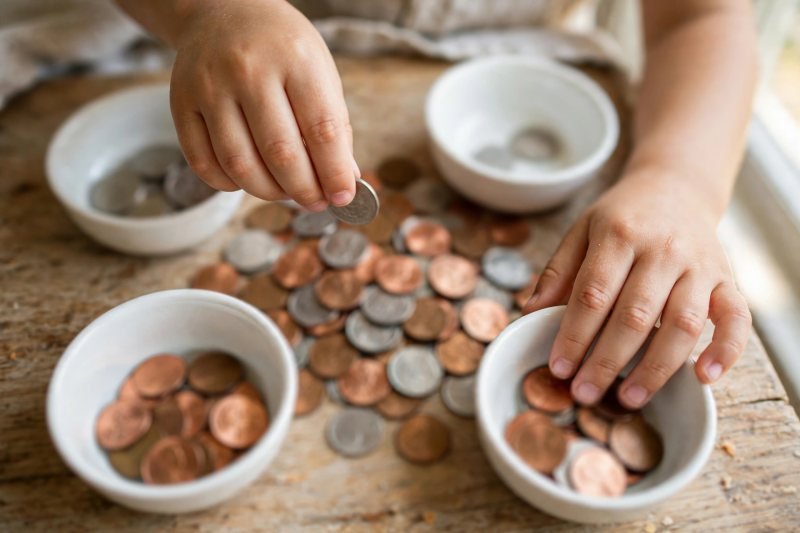
Sort the first round slowly. No timer yet. Your child picks up one coin at a time, says its value out loud, and drops it in the matching bowl — "Dime! Ten cents!" Cheer the moment they stop hesitating between the nickel and the dime.
-
Spring the dime trap. This is the lesson the whole game is built around. Lay a nickel next to a dime and ask: "Which one is worth more?" Most kids point to the nickel — it's bigger. The tiny dime is worth 10¢, double the nickel's 5¢. "When we sort by value, size can trick us. We sort by worth, not by size."

-
Mix it all back together. Sweep every coin back into the pile. The second sort goes faster — your child already knows where everything lives. Time it casually and tell them the number; kids love beating their own record.

-
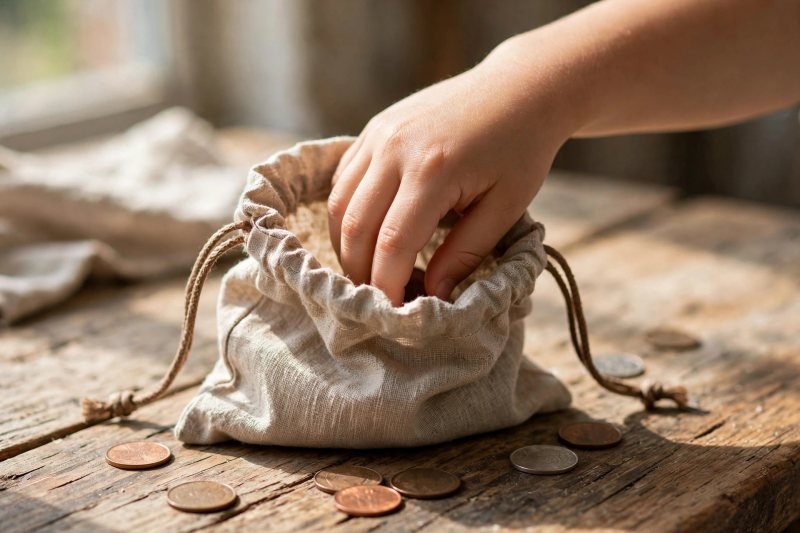
Play the mystery bag pull. Coins go into the cloth bag. Your child reaches in without looking, feels one coin, and names its value group before pulling it out — "Nickel! Five cents!" — then drops it in the right bowl to check.
-
Run the timed teller race. Mix everything up and set a one-minute timer. How many coins can your child sort before the bell? The rule that matters: they race their own last time, never a sibling's.

-
Open the bank. Your child is the bank teller behind the table; you are the customer making deposits. Hand over one coin at a time: "I'd like to deposit this, please." The teller examines it, announces the value, and drops it in the right bowl. Swap roles halfway through.

-
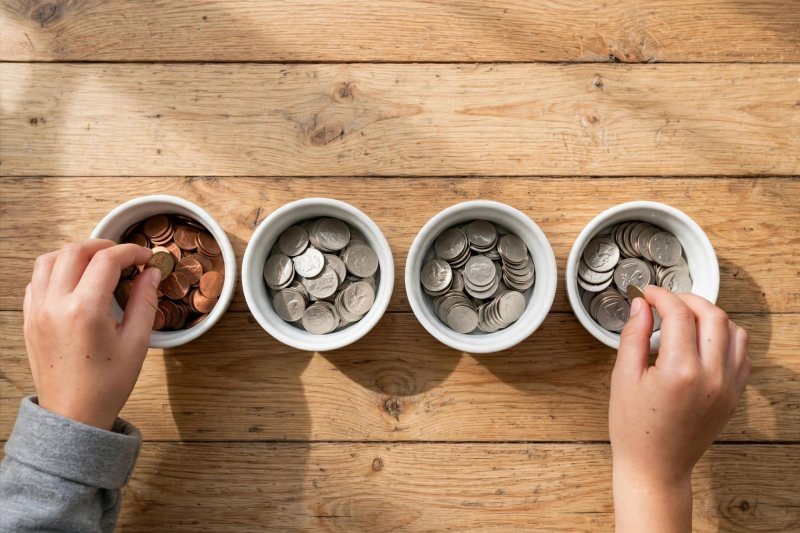
Order the groups least to greatest. Line the four full bowls up in order: penny (1¢), nickel (5¢), dime (10¢), quarter (25¢). Run a finger down the line together: "Least… to… greatest." The order looks nothing like a size lineup — the dime leaps ahead of the bigger nickel. That mismatch is the whole point, learned by doing.
-
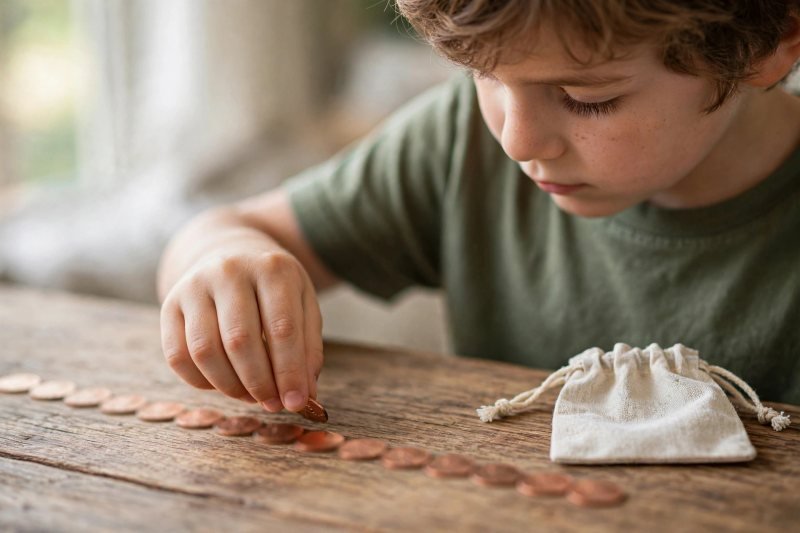
Count one tray and pack up. Pick the penny bowl and count its coins by ones together: "One cent, two cents, three cents…" Sorting made the counting easy — that connection lands here. Pour all four bowls back into the bag, stack the bowls, and save the labels for next time.


Make it easier
Start with pennies and quarters only — brown and small versus big and silver — then add nickels and dimes. Skip the timer for the first few plays; speed is a bonus, not the lesson. Leave the four reference coins lined up by the bowls as a cheat sheet.
Make it harder
Sort the whole pile from the bag by touch alone — no peeking. After sorting, count each bowl's total together: pennies by ones, nickels by fives, dimes by tens, quarters by twenty-fives. Add a second mixed handful so the pile — and the race — gets longer. Once sorting is fast, count the sorted groups toward a dollar with our counting money to one dollar guide.
Other ways to play it
- Store day: Once sorting is solid, open a tiny shop with price tags in cents and let your child pay with sorted coins — a natural bridge to our counting coins activities.
How it changes by age
- This game is built for ages 5–6, when most kids can name the four coins and count to 30 or so. If your child can't name the coins yet, play our coin recognition activities first — naming is the foundation sorting stands on. A sharp 4-year-old can join in with just pennies and quarters; an older 6 or 7 can run the whole thing solo. If the dime and nickel keep getting mixed up after several plays, that's normal — that pair is genuinely the hardest.
What they're learning
That money has value independent of size — the dime trap, learned by doing; One-to-one correspondence: one coin, one value group, every time; Ordering by magnitude: least to greatest with real objects; Early skip counting: by ones, fives, tens, and twenty-fives — our skip counting by 2s, 5s and 10s games make the fives and tens stick; Attention to detail: checking color and size before deciding; Real-world money sense: the foundation for counting money and paying for things
Clearing up
Pour all four bowls back into the cloth bag — the coins live there between plays. Stack the bowls and tuck the labels inside the top one so setup takes thirty seconds next time.
Questions parents ask
At what age can kids sort coins by value?
Why does my child think the nickel is worth more than the dime?
Should we use real coins or play money?
How many coins should I start with?
What's the difference between sorting coins and counting coins?
This game works best as a weekly 10-minute ritual rather than a one-time lesson — a regular "bank day" cements the values far better than a single long session. If the penny-bowl count in step 10 is still wobbly, our counting worksheets for kindergarten build one-to-one counting on paper first. For more money play once sorting feels easy, try our money games for kids collection.


