


Coin Recognition Activities: Meet the Penny, Nickel, Dime and Quarter
Before kids can count money, they must know the coins. These coin recognition activities teach ages 4–5 to spot the penny, nickel, dime, and quarter by sight and touch — sorting games, a size lineup, and a feel-in-the-bag challenge.
The best coin recognition activities let preschoolers handle real coins and learn their names. Ages 4–5: sort pennies, nickels, dimes, and quarters into bowls; line one of each up smallest to biggest; play a "name that coin" race; try a touch test in a pouch. Names first, counting later.

The short version
- Names first, values later.
- Color and size are the cues: brown penny, tiny silver dime, chunky nickel, big quarter.
- Sorting into bowls is the easiest recognition game.
- The dime is the classic confusion — teach it explicitly.
- A pouch touch-test locks in recognition by feel.
- Real coins, adult supervision, every coin counted back.
- Age
- Ages 4–5
- Prep
- 5 min
- Play time
- 25 min
- Mess
- None
- Difficulty
- Easy
- Where
- Indoor
Why kids love this
Real coins are grown-up treasure. Four-year-olds love the seriousness of it: holding actual money and saying the real names like an adult. Each coin feels like a character — the tiny shiny dime, the big chunky quarter — and kids line them up like prizes.
What you'll need
- Real US coins: 8–10 pennies, 4–5 each of nickels, dimes, quarters (clean)
- 4 small bowls or cups
- A drawstring pouch or cloth bag
- One white sheet of paper and crayons (optional, for the rubbing)
Before you start
1. Pull clean coins — pennies, nickels, dimes, quarters — about twenty in total. 2. Set the four bowls in a row on a low table. 3. Put the pouch nearby, empty for now. 4. Keep the paper and crayons off to the side for later.
How to do it
-
**Step 1 — Dump the treasure.** Pour all the coins into a big bowl. Let your child dig through them, feeling how different each one is: "These are real coins. Today we learn their names."

-
**Step 2 — Meet the penny.** Pick out all the brown coins: "The brown ones are called pennies. Can you find every penny?" Your child hunts for copper-colored coins and drops them in the first bowl, counting each as it lands — just counting, no values yet. This one-by-one counting builds the same careful skill as our [counting activities for toddlers](/activities/counting-activities-for-toddlers/).

-
**Step 3 — Meet the nickel.** Hold up a nickel beside a penny: "Bigger, silver — this is the nickel." Let your child compare them in their palm, then drop the nickels in the second bowl, naming each one.

-
**Step 4 — Meet the dime.** This is the tricky one. Hold a dime next to a nickel: "The dime is the smallest coin of all — tiny and silver." Let your child look closely. Point out that small does not mean worthless — small is just its look. Add the dimes to the third bowl.

-
**Step 5 — Meet the quarter.** Hold up the quarter: "The biggest coin — the quarter." Let your child stack two or three and feel the weight. All remaining coins should be quarters; drop them in the fourth bowl with a proud "Quarter!"

-
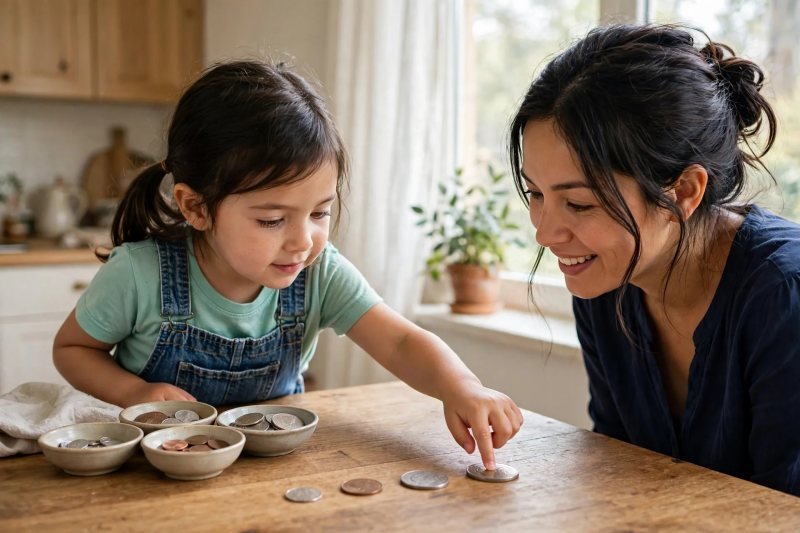
**Step 6 — Build the size lineup.** Take one coin of each type and lay them on the table from smallest to biggest: dime, penny, nickel, quarter. Have your child run a finger down the line and name each one. Do it again backwards. The careful line-up and touch work doubles as [fine motor practice](/activities/fine-motor-activities-for-preschoolers/) for little fingers.
-
**Step 7 — Play the coin race.** Mix the coins back into a pile. Call out a name — "Find the dime!" — and your child drops the right coin into its bowl as fast as they can. Keep score if they like, or just giggle at near misses.

-
**Step 8 — Try the touch test.** Drop all the coins into the pouch. Your child reaches in, feels one coin, and names it without looking — "Quarter!" — then pulls it out to check. The dime-quarter size gap makes this surprisingly easy.

-
**Step 9 — Sing the coin song.** Make up a chant together, pointing at each coin: "Penny's brown, dime is small, nickel's bigger, quarter's tall." Sing it twice, faster the second time.

-
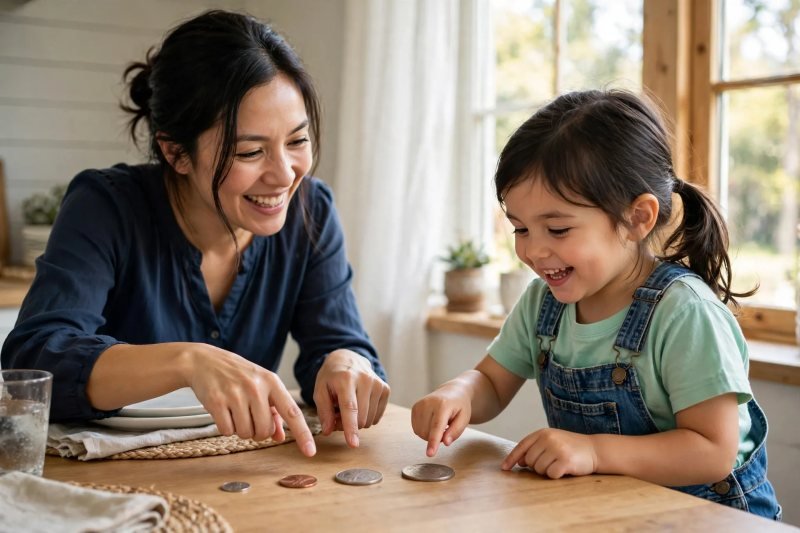
**Step 10 — Name them all back.** Line up the four coins one last time and point to each in random order. Most four-year-olds name three or four correctly by now. End with a proud round of applause — your child can name real coins.


Make it easier
Start with pennies and quarters only — the easiest pair, brown versus big and silver. Let your child keep each coin after its round; holding one makes the name stick. Slow the coin race down — speed is fun, not the point.
Make it harder
Mix two sets of coins and ask which is which. Ask your child to order all four by size without the lineup to copy. Introduce "one cent, five cents, ten cents, twenty-five cents" — names first, numbers later.
Other ways to play it
- **Memory tray:** lay four coins out, cover them, remove one — "Which coin disappeared?"
- **Pocket check:** send your child to fetch "two nickels" from the bowl while you time them.
How it changes by age
- Built for ages 4–5, when children love naming the differences they notice. Threes can join in by finding the brown pennies; six-year-olds can use it as a warm-up before coin values.
What they're learning
**Coin recognition:** telling pennies, nickels, dimes, and quarters apart by color, size, and feel. **Vocabulary:** the real names — penny, nickel, dime, quarter — and words like "copper" and "silver." **Size ordering:** sequencing four objects smallest to largest. **Sorting and classifying:** putting like with like, a foundation for later math. **Touch discrimination:** telling coins apart by feel alone.
Clearing up
Zero mess — just put the coins away. Store the pouch high enough that toddlers cannot reach it.
Questions parents ask
How do you teach a child to recognize coins?
What are the four US coins kids should learn first?
Why do kids confuse the dime and the nickel?
At what age can children name coins?
Should I use real coins or play money for recognition practice?
Keep it to twenty minutes — naming takes real concentration at four. Two or three short rounds on different days make recognition stick. Say "check again" instead of "no."

