


Counting Coins Activities: Pennies, Nickels, Dimes and Quarters
These counting coins activities turn spare change into real math practice. Kids 6–8 count pennies by ones, skip-count nickels and dimes, add mixed coins, and pay exact amounts — ten hands-on activities building real money sense.
The best counting coins activities for ages 6–8 start with skip counting: pennies by ones, nickels by fives, dimes by tens, quarters by twenty-fives. Then mix the coins, sort by type, and count from the biggest value down. A handful of 2 quarters, 3 dimes, 4 nickels, and 6 pennies totals 106¢. Exact-payment games and a monthly jar count build real money sense.

The short version
- - Give each coin its own skip-counting rhythm before mixing types.
- - Teach the dime surprise early: smallest coin, twice the bigger nickel.
- - Count mixed coins biggest first — quarters, dimes, nickels, pennies.
- - Exact-payment games turn counting into a useful skill.
- - A monthly jar count shows visible progress.
- - Supervise: coins are a choking hazard under 3.
- Age
- Ages 6–8
- Prep
- 10 min
- Play time
- 30 min
- Mess
- None
- Difficulty
- Easy
- Where
- Indoor
Why kids love this
Real coins feel important — the first "grown-up" math. These counting coins activities work because every total means something your child can hold: line up nickels, add a mixed handful, crack the number like a code. The skip-counting rhythm makes tens fly by.
What you'll need
- - Real US coins: 15 pennies, 8 nickels, 8 dimes, 4 quarters per child
- - A clear jar for the coin bank; 4 small bowls for sorting
- - 4 blank index cards, a thick marker, and a pencil (value card)
- - Snack plate: apple slices, a banana, crackers, a granola bar
- - A muffin tin (optional, for the grab challenge)
Before you start
1. Count out each child's coin kit (15 pennies, 8 nickels, 8 dimes, 4 quarters). Drop the rest of your change in the jar for the finale. 2. Set four small bowls on a clear table — one per coin type. 3. Lay out four blank index cards, the marker, and the pencil. 4. Put the snack plate aside for Step 8.
How to do it
-
**Step 1 — Pour out the coin kit.** Hand your child the coin kit; let them pour it across the table. Then: "How many coins is that?" Count all 35, touching each one. No values yet — just getting used to real money.

-
**Step 2 — Build the value reminder card.** Trace one of each coin onto the four index cards; you write the value — penny 1¢, nickel 5¢, dime 10¢, quarter 25¢. Now the trap: hold a dime and a nickel up. "Which is worth more?" The dime is smaller but worth twice as much.

-
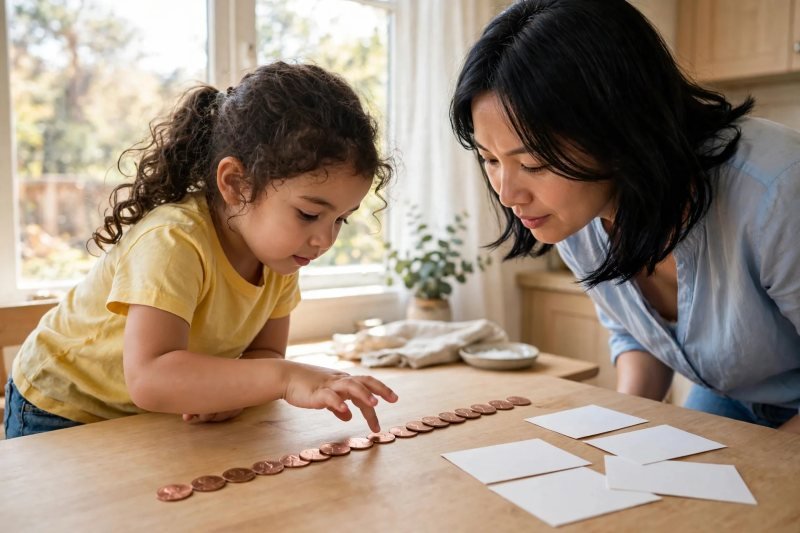
**Step 3 — Count a penny row by ones.** Line up 12 pennies. Your child points at each and counts: one, two… twelve. Total: 12¢. Scatter a few; let them count 10 alone, recounting to check. Touch each coin once, count it once.
-
**Step 4 — Skip-count nickels by fives.** Line up 7 nickels. Tap each one: "five, ten, fifteen, twenty, twenty-five, thirty, thirty-five." Clap on each tap — the beat locks the sequence in. Total: 35¢.

-
**Step 5 — Skip-count dimes by tens.** Now 6 dimes, same rhythm, bigger jumps: "ten, twenty… sixty." Total: 60¢. Counting dimes is the tens column doing a lap.

-
**Step 6 — Count quarters by twenty-fives.** Line up 4 quarters: "twenty-five, fifty, seventy-five, one hundred." The payoff: "One hundred cents — a whole dollar." Stack the quarters — four make a dollar, and no other coin does.

-
**Step 7 — Sort a mixed handful, count biggest to smallest.** The core skill. Hand your child a mixed scoop: 2 quarters, 3 dimes, 4 nickels, 6 pennies. Sort into the four bowls, then count biggest to smallest: 25, 50; 60, 70, 80; 85, 90, 95, 100; 101… 106. Total: 106¢.

-
**Step 8 — Pay exact amounts at the snack bar.** Price the snacks: apple slices 15¢, banana 25¢, crackers 32¢, granola bar 47¢. Your child is the customer; you're the cashier. Apple: dime + nickel. Banana: quarter. Crackers: quarter + nickel + 2 pennies. Granola bar: quarter + 2 dimes + 2 pennies.

-
**Step 9 — The mystery-grab challenge.** Call a total; your child builds it — any combination. 63¢: two quarters, a dime, three pennies. 81¢: three quarters, a nickel, a penny. 39¢: a quarter, a dime, four pennies. Compare methods out loud.

-
**Step 10 — Count the whole jar.** The finale. Pour out the jar: 3 quarters, 4 dimes, 5 nickels, 12 pennies. Sort, then count down: 25, 50, 75; 85, 95, 105, 115; 120… 140; 141… 152. Total: 152¢ = $1.52.



Make it easier
- Spend a whole session on pennies before adding nickels. - Keep the value card on the table — checking it is strategy, not cheating. - Pre-sort the mixed handful; let them focus on counting.
Make it harder
- Set totals with two answers, like 58¢: two quarters + nickel + 3 pennies, or five dimes + nickel + 3 pennies. - Play "short-changed": you pay for a snack with cents missing — they spot what's short. - Time the jar count: how fast with zero mistakes? - Build the adding fluency these totals need with our [addition games for kindergarten](/activities/addition-games-for-kindergarten/).
Other ways to play it
- - **Coin grab race:** scatter the kit; call "Dimes!" — fastest correct grab wins a point.
- - **Estimate first:** everyone guesses the jar total before Step 10; closest wins.
- - **Real-store mission:** let your child count exact coins into the cashier's hand. Younger siblings can warm up with our [counting activities for toddlers](/activities/counting-activities-for-toddlers/) first.
How it changes by age
- Built for ages 6–8, when most children add small numbers and skip-count by fives and tens. Five-year-olds can do Steps 1–6 with pennies and nickels only; mixed counting clicks best around seven.
What they're learning
- **Coin values:** penny 1¢, nickel 5¢, dime 10¢, quarter 25¢. - **Skip counting:** by fives, tens, and twenty-fives. - **Adding mixed values:** sort by type, count biggest to smallest. - **Exact payment:** matching coin combinations to a price. - **Dollars and cents:** 100¢ = $1.00, found through four quarters.
Clearing up
Real coins beat play money — kids focus harder when the money is real. Short on quarters? Four dimes stand in — say so out loud so values stay honest.
Questions parents ask
How do you teach a child to count coins?
What is the value of each US coin?
How can kids practice counting mixed coins?
What is the easiest way for kids to add coins?
Keep sessions to 25–30 minutes — coin math is concentrated work. End on a win: make the last activity one they can already do. Revisit the jar count monthly — watching the total grow motivates.


