


Counting Money to $1: Add Coins Up to a Dollar
Kids ages 6–8 climb a paper ladder from 0¢ to $1.00 with real coins, stopping at 25¢, 50¢, and 75¢ camps before planting the dollar flag — adding pennies, nickels, dimes, and quarters all the way up.
The best way to teach counting money to $1 is a milestone climb: build a paper ladder with camps at 25¢, 50¢, and 75¢, and climb each one with real coins. Reach 25¢ with 5 nickels, add 2 dimes and 5 pennies to hit 50¢, add a quarter to 75¢, and finish with 2 dimes and a nickel. Recount from zero at every camp.

The short version
- Make the dollar a mountain: camps at 25¢, 50¢, 75¢, and a $1.00 flag on top.
- Climb with cumulative coin piles, recounting biggest value first at every camp.
- Teach the dime trap early: smallest coin, twice the bigger nickel.
- Trade-ups prove bigger coins carry the same value in fewer coins.
- Dollar recipes show the same $1.00 can be built many ways.
- Keep real coins away from children under 3.
- Age
- Ages 6–8
- Prep
- 15 min
- Mess
- None
- Difficulty
- Easy
- Where
- Indoor
Why kids love this
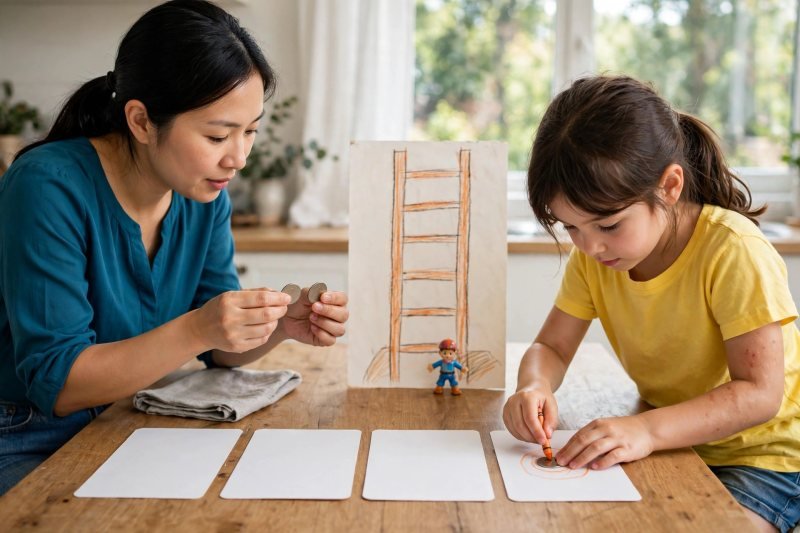
The dollar becomes a mountain to climb. Your child starts at base camp with real coins, and every camp reached — 25¢, 50¢, 75¢ — moves their little toy climber up a ladder they drew themselves. No worksheet, no screen: just real coins and a flag to plant. The goal is physical — grow the pile, count it, climb — which is exactly why math-shy kids lean into it.
What you'll need
- Real US coins per child: 20 nickels, 14 dimes, 3 quarters, 25 pennies
- One large sheet of paper or poster board, plus markers or crayons
- A small toy figure or sticker to be the climber
- 4 small bowls for sorting
- 4 blank index cards and a pencil
- A paper strip for the summit flag
Before you start
Count out one coin kit per child (20 nickels, 14 dimes, 3 quarters, 25 pennies) and sort them into the four bowls. Tape the big paper down. Draw a tall ladder and mark four camps along it: circles labeled 25¢, 50¢, 75¢, and a $1.00 flag at the top. Place the climber at the bottom and set the index cards and pencil nearby.
How to do it
-
**Build the 100-cent mountain together.** Let your child decorate the poster — rungs, camp circles, the flag at the top. Tell the story: "This mountain is one dollar tall. It takes 100 cents to reach the top." Set the climber at the bottom.

-
**Make the four climber cards.** Trace one of each coin onto an index card; you write the value: penny 1¢, nickel 5¢, dime 10¢, quarter 25¢. Now the classic trap: hold a dime and a nickel side by side. "Which is worth more?" Almost every child picks the bigger nickel — and is wrong. The small dime is 10¢, twice the nickel's 5¢. Line the cards up from smallest value to biggest.
-
**Climb to Camp 25¢ with five nickels.** Line up 5 nickels and skip-count together, tapping each: "5, 10, 15, 20, 25." Move the climber to the 25¢ camp. Ask: "How many coins?" (Five.) "How many cents?" (Twenty-five.) First camp conquered — with nickels only.

-
**Push on to Camp 50¢.** The next push needs 25 more cents: 2 dimes and 5 pennies. Add them, then recount from zero, biggest first: nickels 5, 10, 15, 20, 25; dimes 35, 45; pennies 46–50. Total: 50¢. Move the climber up: "Halfway to a dollar."

-
**Climb to Camp 75¢ with one quarter.** One quarter jumps the whole gap from 50¢ to 75¢. Drop it on the pile and recount from zero: quarter 25; nickels 30, 35, 40, 45, 50; dimes 60, 70; pennies 71–75. Move the climber up: "Three quarters of the mountain — one camp left."

-
**Summit the dollar.** The final push: add 2 dimes and 1 nickel (20 + 5 = 25¢ more). Recount the whole pile, biggest first: quarter 25; four dimes 35, 45, 55, 65; six nickels 70, 75, 80, 85, 90, 95; five pennies 96–100. "One hundred cents — one whole dollar." Plant the flag and move the climber to the top.

-
**Run the trade-up bank.** The summit pile is huge — let's shrink it without losing a cent. Set aside 10 pennies, 4 nickels, and 2 dimes (50¢ total). Trade 1: swap the 10 pennies for 1 dime — count both sides, 10¢ each. Trade 2: swap the 4 nickels for 2 dimes — 20¢ each. Sixteen coins became 5 dimes, still exactly 50¢. Bigger coins carry the same value — that's the secret of the mountain.

-
**Cook three dollar recipes.** Prove there's more than one trail up. Recipe A: 10 dimes, counted by tens to 100. Recipe B: 20 nickels, counted by fives to 100. Recipe C: 2 quarters, 2 dimes, and 6 nickels — 25, 50; 60, 70; 75, 80, 85, 90, 95, 100. Your child builds each one and counts it out.

-
**Attempt the blind climb.** You call a camp; your child climbs it from scratch with any coins. 50¢: two quarters works, and so does 3 dimes plus 4 nickels (30 + 20 = 50). 75¢: three quarters works, and so does 7 dimes plus 1 nickel (70 + 5 = 75). They count aloud; you count along to check. Two different trails to the same camp — that's the whole lesson.

-
**Hold the summit ceremony.** One last climb with fresh coins: 1 quarter, 5 dimes, 2 nickels, 15 pennies. Count from zero to 100 out loud: 25; 35, 45, 55, 65, 75; 80, 85; 86 through 100. Plant the flag, march the climber to the top, take a photo. They just added mixed coins all the way to a dollar — real money math.



Make it easier
Climb with quarters only first: 25, 50, 75, 100 — the simplest trail. Keep the value cards on the table — checking is strategy, not cheating. Stop at Camp 50¢ and summit tomorrow. If coin names are shaky, start with these coin recognition activities.
Make it harder
Climb each camp with a totally different coin mix than the first time. Add detour stops at 35¢ (quarter + dime), 65¢ (2 quarters + dime + nickel), and 90¢ (3 quarters + dime + nickel). Time the Step 10 count — reach 100 with zero mistakes.
Other ways to play it
- **Sidewalk climb:** chalk the ladder on the driveway and hop a toy figure up the rungs.
- **Climbing race:** two kits, two climbers — first to plant the flag wins, but miscounts drop you back a camp.
- **Real-price climb:** climb to a real snack price, like an 89¢ juice box (3 quarters + dime + 4 pennies). More money play: these money games.
How it changes by age
- Built for ages 6–8, when most children add small numbers and skip-count by fives and tens. Six-year-olds do best with quarters and dimes and may stop at Camp 50¢; mixed counting usually clicks around seven. Eight-year-olds can run the trade-ups and recipes alone. For a slower warm-up, try these counting coins activities.
What they're learning
Skip counting by 5s, 10s, and 25s to reach target totals. Adding mixed coin values cumulatively to 100¢. The dime-nickel size trick: a coin's worth is not its size. Coin equivalence: different mixes, same total. Breaking a big goal into reachable milestones.
Clearing up
Short on quarters? The climb still works — Recipes A and B need none, and dimes and nickels can reach every camp. Trade-ups only stick if you count before AND after each swap. And leave the poster up: most kids revisit their mountain within a day or two.
Questions parents ask
How do you teach a child to count money to $1?
Why does the dime confuse kids?
How many quarters make a dollar?
What are some ways to make exactly $1.00?
What is the easiest way for kids to add mixed coins?
Keep climbing sessions to 25–30 minutes — coin math is concentrated work. End on a win: make the final climb one your child can already do. If a camp keeps collapsing, drop back one camp and climb it twice.

save it for later
Pin this for the next rainy afternoon
Keep it on a board so it is there when you need it, rather than when you happened to find it.
Save to Pinterest


