


Pretend Play Shop: Money Math Through Imaginative Play
Turn your living room into a little store. Your 4–5-year-old names the shop, prices goods with real coins, rings up sales, and makes change.
A pretend play shop teaches money math by giving coins a job to do. Your four- or five-year-old names the shop, prices goods with real coins on the tags, rings up each sale, and makes change by counting up. Start with pennies and nickels under ten cents; add dimes and change-making as counting grows.

The short version
- Tape real coins to price tags so prices can be counted, not just read.
- The shopkeeper role makes children count carefully.
- Start with pennies and nickels; prices at ten cents or under.
- Teach change by counting up from price to payment.
- Let your child play customer too — paying exact coins builds the same skills.
- Age
- Ages 4–5
- Prep
- 15 min
- Play time
- 50 min
- Mess
- None
- Difficulty
- Easy
- Where
- Indoor
Why kids love this
Because they are the boss. In a pretend play shop, your child is not practicing math — they run a real business. They name the shop, set the prices, ring the opening bell, and count the till at closing time. Shopkeeper is the perfect grown-up role for a four-year-old: an apron, a title, customers who need them. The money math sneaks in because every sale demands it.
What you'll need
- Real US coins: plenty of pennies, plus nickels, dimes, 2 quarters
- A shoebox till (muffin liners make compartments)
- 8–12 toys, books, or play food items as stock
- Folded index cards and tape for price tags; crayons for the sign
- A paper bag per customer; paper slips for receipts; optional apron and bell
Before you start
Count out the float: 20 pennies, 6 nickels, 4 dimes, 2 quarters. Choose 8–12 items of stock together. Set up the counter: a low table with the shoebox till beside it. Fold index cards into tent price tags; keep tape handy. Clear a customer waiting spot — a rug or cushions.
How to do it
-
Name the shop and make the sign — Ask what the store will be called — "Sam's Toy Store," "The Cookie Corner," anything they invent — and draw the sign together while they dictate. Tape it behind the counter. A name flips the switch from "activity" to "my business."

-
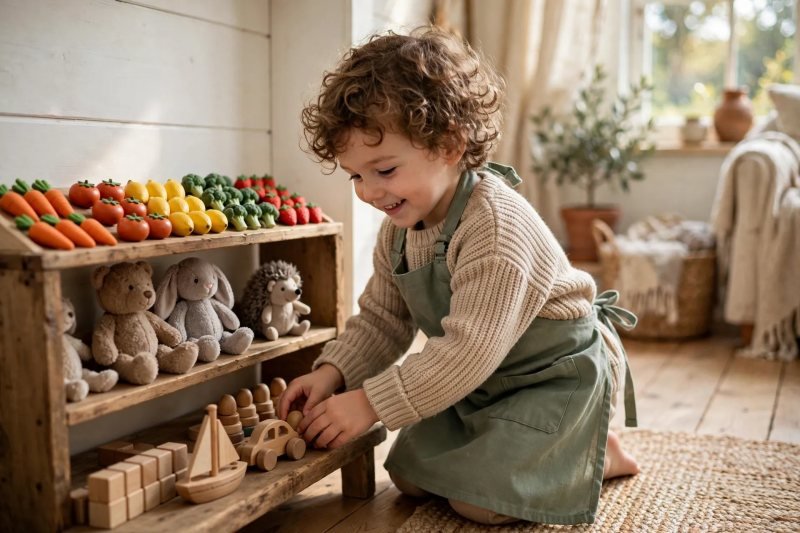
Stock the shelves — Your child groups the goods: play food together, stuffed animals in a row, cars parked neatly. Narrate like a shopkeeper: "Where should the teddy bears live? Customers need to see them!" Sorting stock is early classification work.
-
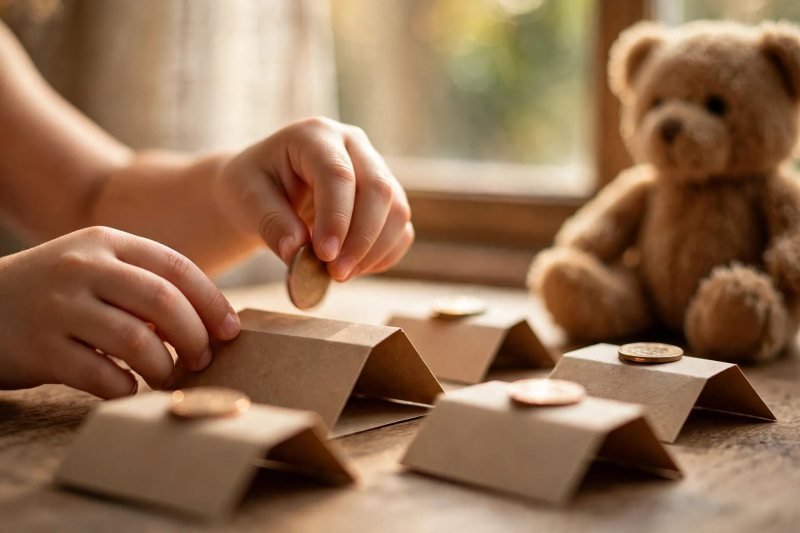
Price everything with real coins — The heart of the money math: tape the actual coins to each tag instead of writing numbers — a nickel and two pennies means seven cents. Do the first few together: "Five for the nickel… six, seven!" Keep every price at ten cents or under.
-
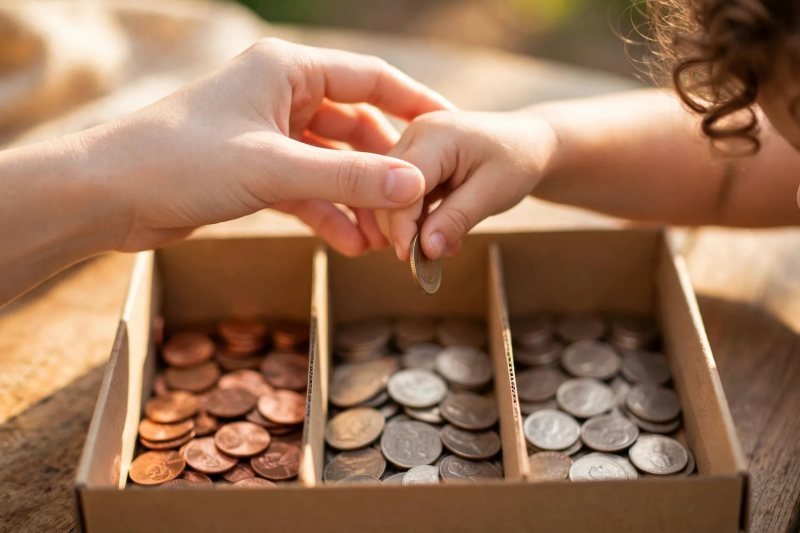
Fill the till — Sort the float into the shoebox: pennies, nickels, dimes, each in their own section. This is the shopkeeper's change money, and sorting teaches the coin families by look and feel. Let your child drop each coin in.
-
Ring the opening bell and greet the first customer — Grand opening! You are Customer Number One. Walk up with your paper bag, coach the greeting once — "Welcome to my shop!" — then let them take it. Buy the three-penny apple: they count the coins on the tag and drop each penny in the till.

-
Ring up a bigger sale — Buy the seven-cent toy, tagged with a nickel and two pennies. Now the counting jumps: "Five… six, seven!" Let your child do the whole ring-up: find the tag, count the coins, take your payment, till it.

-
Let the customer overpay — on purpose — Buy the seven-cent toy again, but pay with a dime. "Oh no — I only have a dime!" Count up from the price to the payment, touching one penny per number: eight, nine, ten. Three pennies go back to the customer. "Three cents change!"

-
Swap roles — Hand over the apron: your child is the customer with a little purse of coins, and you are the shopkeeper. They pick an item, read the price from the coins on the tag, and count out exact payment. Change often clicks once they are the one receiving it.

-
Write receipts for the big sales — For anything costing a nickel or more, the shopkeeper "writes" a receipt — proud crayon scribbles on a paper slip, handed over with ceremony. Keep the receipts in a pile to count up together tomorrow.

-
Closing time — count the day's takings — Ring the bell: the shop is closed! Empty the till and count the earnings — pennies by ones, nickels by fives if ready. Announce it like a newsflash: "We made thirty-two cents today!" Then crown a bestseller: which item sold the most?



Make it easier
Pennies-only shop: everything costs one to nine cents — pure counting, no change — the same counting skill as counting games for preschoolers. Tape one of each coin to a cheat card for matching and checking. Let your child be the customer first; paying exact coins is easier than giving change.
Make it harder
Prices past ten cents: a fifteen-cent car priced with a dime and a nickel. Two items in one visit: a twelve-cent apple plus a five-cent book is seventeen cents — addition games for kindergarten practice the same two-number adding. A fifteen-cent item paid with a quarter: count up twenty, twenty-five for ten cents change.
Other ways to play it
- Grocery store: a penny per piece of play fruit — counting plus one-to-one matching.
- Bakery: "bake" playdough cookies; run a "two for five cents" deal.
- Clearance sale: take one coin off every tag and recount the new prices.
How it changes by age
- Built for ages 4–5, when children grasp that coins hold different values and can count to 20. Three-year-olds can run the shop with play coins and a grown-up reading prices. Confident five-year-olds can jump to harder prices and two-item sales.
What they're learning
Coin values: penny 1¢, nickel 5¢, dime 10¢, quarter 25¢ — learned because the shop needs them. If coin names are still new, coin recognition activities come first. Counting on: from five (five… six, seven) instead of always from one — counting money to one dollar builds the same counting-on. Addition: two prices combined into one bill. Change as counting up: the most concrete first subtraction — subtraction activities for kindergarten build the same idea. Social scripts: greeting, offering help, thanking customers.
Clearing up
Taping actual coins to the tags is what makes this work — a written "7¢" means little to most four-year-olds, but a nickel and two pennies can be counted on the spot. Keep the till full of pennies for change. End while it is still fun; a shop that closes happy reopens tomorrow.
Questions parents ask
How does a pretend play shop teach money math?
What coins should a 4-year-old start with?
How do you price items in a pretend play shop?
How can a pretend shop teach making change?
What if making change is too hard for my child?
At what age can kids play shop with money?
This game stretches across days — leave the shop set up and "reopen" each afternoon with new stock or prices. Follow up at a real store: let your child hand the cashier coins for a small item. If they invent their own rules — a loyalty card, a second branch in the bedroom — say yes. A sturdier shopfront helps too — build the counter from a cardboard box shop if you have a big box spare.

save it for later
Pin this for the next rainy afternoon
Keep it on a board so it is there when you need it, rather than when you happened to find it.
Save to Pinterest


