


Kids Halloween Costumes 2026: Every Trending Theme
Twenty kids Halloween costumes for 2026 for ages 4–5 — friendly classics, helpers, food costumes, and trending generic themes like a blocky builder and a pop-star performer — all mask-free, built over clothes you own, and checked in a home fitting before the night.
The best kids Halloween costumes for 2026 for ages 4–5 are generic versions of trending themes built over clothes you own: a friendly ghost, a smiling pumpkin, helpers like a firefighter and doctor, an original superhero, a blocky builder, and a pop-star performer — mask-free, above the ankles, and rehearsed at a home fitting.

The short version
- Twenty ideas, one filter: face visible, nothing at the neck, costume over ordinary clothes, hem above the ankles.
- Trending themes go generic: blocky builder, pop-star performer, and an original superhero with no logos or copied characters.
- Pajama costumes — skeleton and cozy pajama animal — are the warm, easy, bedtime-ready champions.
- DIY pieces carry the learning: felt seeds, bone shapes, and square builder patches build fine motor skill and ownership.
- The home fitting a few days early — vision, neck, hem, light, shoes — is the step that makes the night calm.
- Age
- Ages 4–5
- Prep
- 15 min
- Play time
- 15 min
- Mess
- Low
- Where
- Indoor
Why kids love this
Searching kids halloween costumes 2026 usually leads to licensed outfits that cost a fortune, fit over nothing warm, and fall apart by the second house. This guide does the opposite: it translates every trending theme into a generic version a four- or five-year-old can actually wear, move in, and recognize as their own idea. Children this age choose with their whole hearts — the dinosaur phase, the helper phase, the performer phase — so the twenty ideas here are grouped by the enthusiasms children already have, from gentle spookies to food costumes to this year's blocky builder and pop-star themes, all named in general terms and built from plain, unbranded pieces. Every costume goes over ordinary clothes, keeps the face fully visible, and ends above the ankles, so sitting on a porch step, climbing into a car seat, and dancing in the living room all stay easy. A short home fitting turns Halloween night into the second, confident wearing — familiar, comfortable, and already theirs before the first doorbell rings.
What you'll need
- Plain t-shirts in white, black, orange, red, green, and brown — the blank base for most of the twenty ideas; everything unbranded, with no logos or printed words
- Plain leggings, soft pants, and a warm long-sleeve layer in costume colors — costumes are worn over clothes, never instead of them
- Plain cardboard sheets and boxes — for a pirate hat brim, a cardboard steering wheel, flower pots, a builder's blocky tool, and other simple props; all surfaces blank
- Face paint in basic colors, described generically — water-based, for whiskers, noses, and bone lines; patch test on a small patch of skin a day ahead
- Soft hats and hoods — a soft pointed witch hat, a firefighter-style helmet hat, an astronaut-style soft cap, and ear headbands; all crushable and easy for a child to lift off
- Felt, fabric scraps, and child-safe glue — for pumpkin smiles, strawberry seeds, scarecrow patches, and skeleton bone shapes
- A plain cape with breakaway fastening at the shoulders — attaches with hook-and-loop tabs at the shoulders, never tied at the neck
- Reflective tape or a clip-on light, plus a tote or bucket with a handle your child can carry comfortably
- Real, broken-in shoes — the shoes your child walks in every day, whatever the costume
- A mirror and fifteen unhurried minutes for the home fitting in the final step
Before you start
1. Shortlist together a few days ahead: read the twenty ideas aloud, let your child react, and narrow to two or three finalists that match their current obsessions and temperament. 2. Assemble the winner from the closet first, then make only the one or two props it truly needs — a cardboard piece, a felt detail, a face-paint plan — and lay everything out the night before. 3. Check the forecast and stage the warm or light layers to match, then schedule the home fitting for a calm afternoon, never for the evening itself.
How to do it
-
Start by choosing together, using two worked examples. Spread the plain costume pieces on the couch and treat choosing as the first game, because a costume a child picks is a costume a child keeps on. Work through the twenty ideas in small groups rather than all at once, watching for the full-body yes — the bounce, the roar, the twirl — and use the counting and sorting games from preschool learning activities to compare finalists, twenty ideas becoming three becoming one. Two gentle classics show how every idea in this guide works. The (1) friendly ghost is the sheet-free version: a white tee and a soft white hood over ordinary clothes, with a smiling face drawn in felt on the belly, so vision, breathing, and sitting are never in question. The (2) smiling pumpkin is a padded orange tunic or an orange tee over a soft layer, a green stem hat, and a felt smile your child places herself. Say, "You choose who you will be — I will help you build it." Shy children often bloom inside these two soft classics, while bold children race ahead to the performers and heroes in the steps that follow, and both instincts are the right compass.

-
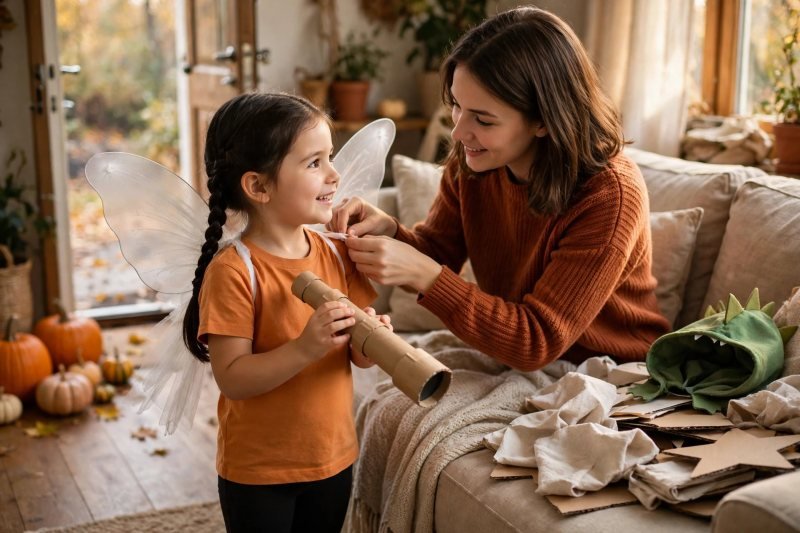
Build the storybook favorites — fairy, pirate, and dinosaur. These three run on imagination children already practice at preschool. The (3) storybook fairy is soft wings on a shoulder harness over a dress or tee and leggings, a flower crown that sits loose and lifts straight off, and a ribbon wand with a soft tip. The (4) pirate captain is a striped tee, a plain vest, and a soft tricorn-style hat or bandana, with a cardboard telescope as the one prop and any eye patch worn up on the forehead so both eyes keep full vision for steps and curbs. The (5) roaring dinosaur is a green hooded top with soft stuffed spikes down the back and a short tail attached high at the waistband, short enough to sit on a chair and climb a porch step without catching. Test every tail and wing by sitting, spinning, and climbing two steps at the fitting. Say, "Show me how your character walks, sits, and roars." If a piece cannot survive those three verbs, it is decoration for the photo, not part of the walking costume. Wings, tails, and hats in this step are simple enough to build with Halloween crafts for kids, so the making afternoon becomes part of choosing the character.
-
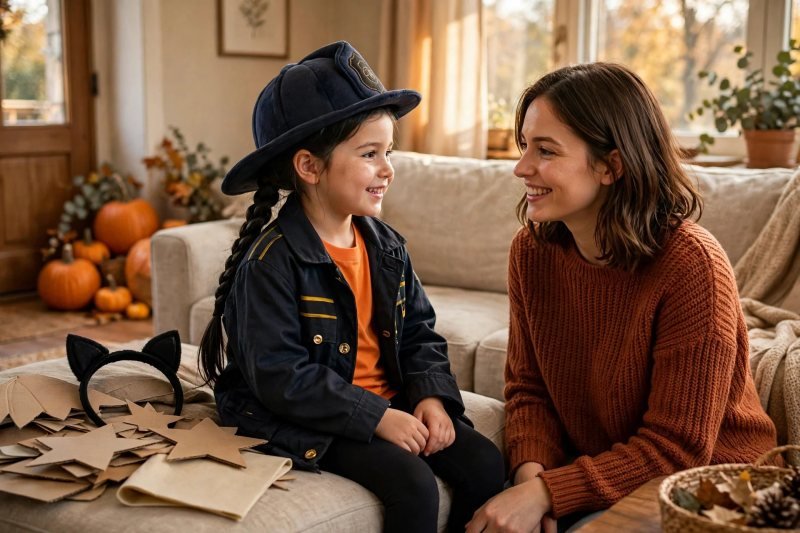
Dress the animal and the helpers — cat, firefighter, and doctor. Helper costumes are this age's great love, because four- and five-year-olds spend their days practicing being capable. The (6) black cat is black leggings and a black tee, an ear headband, a soft tail pinned high, and face-paint whiskers drawn in three strokes per cheek while your child watches in the mirror. The (7) firefighter is a dark jacket with reflective tape stripes added by an adult, a soft helmet hat, and rain boots or real shoes, with a cardboard hose nozzle as an optional soft prop. The (8) doctor is a white tee or an adult white shirt worn as a coat over clothes, a plain head mirror disc made from cardboard and foil-free gray paper, and a toy-free checkup kit of cardboard cards for listening and looking. Keep every prop soft, large, and optional, and rehearse the greeting each helper will use at the door. Say, "Helpers knock, smile, and say who they are." A child who can announce the character needs no licensed badge to be believed.
-
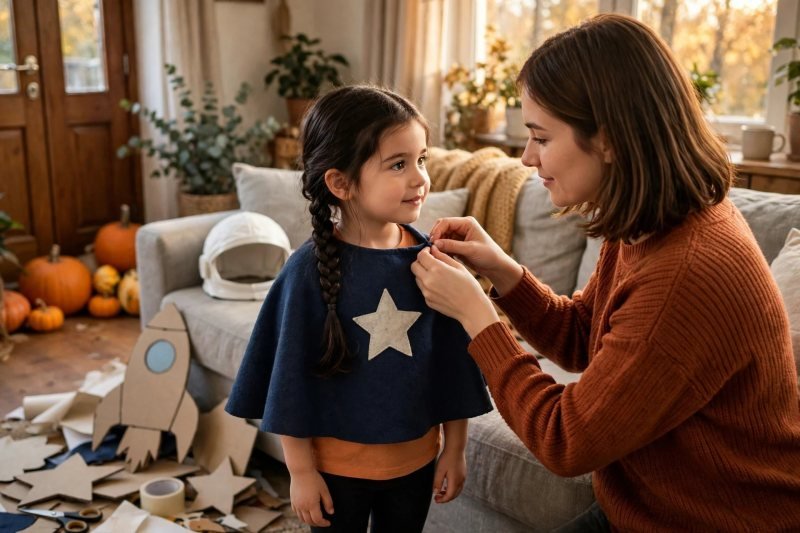
Reach for the sky — astronaut and an original superhero. Space and superheroes trend every year, and both translate cleanly into generic pieces with no logos and no emblems copied from anywhere. The (9) astronaut is white or light gray layers, a soft open-face cap, and plain felt patches in bright shapes that your child designs and places herself, with moon boots that are simply her real shoes covered by nothing at all. The (10) caped superhero is entirely original: colored leggings and a tee in your child's chosen colors, a plain cape fastened with breakaway tabs at the shoulders and cut short above the waist, and a blank felt shape on the chest that she invents — a star, a bolt, a heart — with no letters and no copied symbols. The cape rule is absolute: it must release instantly if it catches, and it comes off for car rides and playground equipment. Say, "Your hero, your colors, your symbol — nobody else has this one." Original heroes photograph beautifully precisely because they belong to one child only.
-
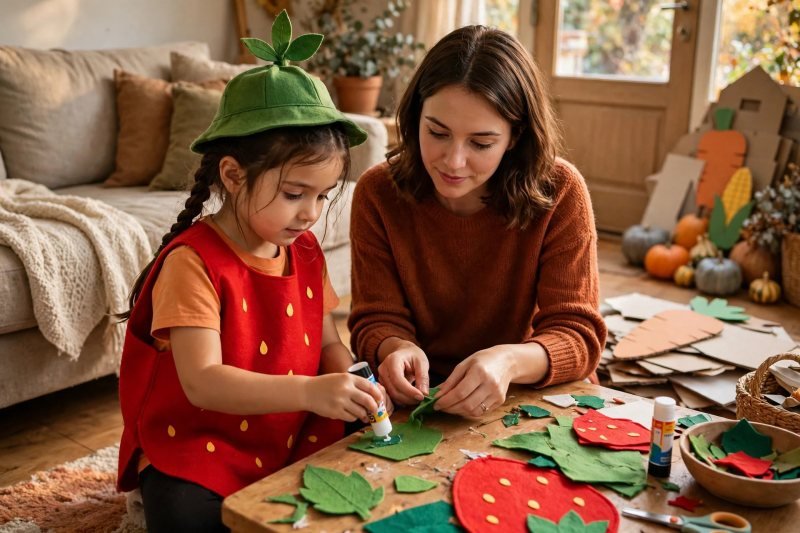
Join the food and farm favorites — strawberry and scarecrow. Sweet and harvest themes suit children who prefer cute over spooky, and both of these build in one sitting. The (11) strawberry is a red padded tunic or red tee with felt seed dots your child glues on, green leggings, and a green stem hat, with the padding light enough to compress for sitting. The (12) friendly scarecrow is a plaid or plain shirt, soft pants with felt patches, a soft floppy hat, and strands of yellow yarn tucked into cuffs and hat brim as straw, kept away from the face and never tied around anything. Making the seeds and patches is exactly the gluing, placing, and pressing practice celebrated in fine motor activities, so let small hands do the imperfect, wonderful work. Say, "A little wobbly is how we know you made it yourself." Photograph food and farm costumes before the first treat of the night, while the felt is still where its maker placed it.
-
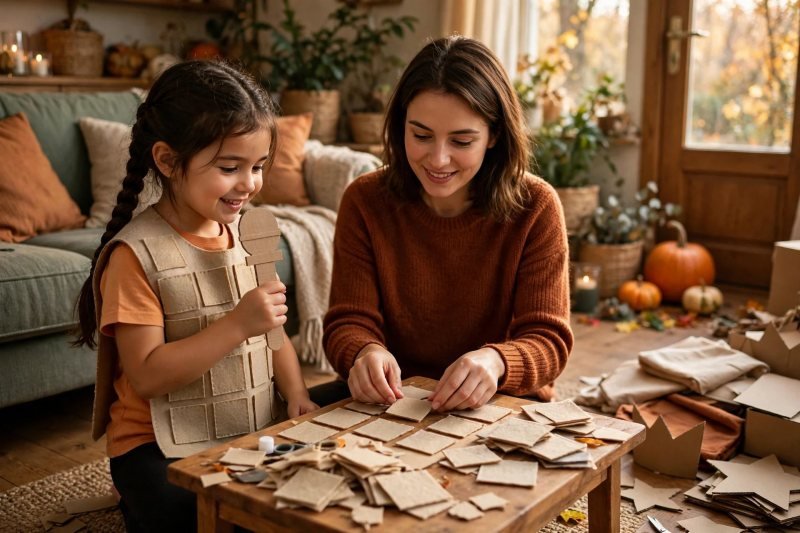
Translate the trending screens — blocky builder and pop-star performer. Two of this year's most popular themes arrive here in fully generic form, named in general terms only, with no character likenesses, no game or movie art, and no trademarked designs anywhere. The (13) blocky builder adventurer is a plain teal or green tee and brown pants, a cardboard pick-style tool with soft edges, and square felt patches in earthy colors arranged in a simple grid on a plain vest — the blocky idea reads through shape and color, never through copied artwork. The (14) pop-star performer is a sparkly skirt or bright leggings over a plain tee, a soft headband, and a cardboard microphone with a foam-ball top, rehearsed with one favorite song performed for the couch. The crossover crafting here — cutting squares, arranging grids, building a microphone — is the same joyful making found in halloween crafts for toddlers scaled up for preschool hands. Say, "We build our own version — that is the whole fun." If a child asks for an exact copied character, offer the colors and the job, not the copy, and watch invention take over.
-
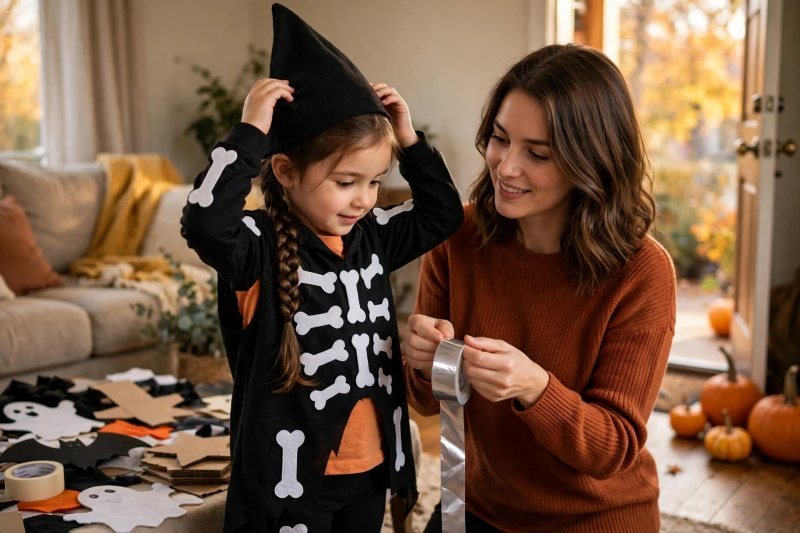
Keep the spooky gentle — witch and skeleton. Classic Halloween flavor works at this age when every scare is smiling. The (15) witch with a soft pointed hat wears a black or purple dress or tee and leggings, a soft pointed hat that crushes flat and lifts off freely, and a small soft broom carried only for photos, never swung on the route. The (16) skeleton is the efficiency champion of the twenty: black pajama-style layers with white bone shapes drawn in fabric paint or sewn as felt by an adult — bone-print pajama style, drawn not branded — warm underneath, straight to bed afterward. Dark costumes earn a visibility upgrade without negotiation: reflective tape on the back, light-colored tote, clip-on light at the chest. Say, "Spooky-soft and easy to see — that is our kind of scary." Any child who hides from their own mirror image retires that idea instantly, and the shortlist simply offers the next favorite. A gentler monster afternoon helps too: monster footprint painting lets a cautious child meet monsters as paint and paper first, before wearing one.
-
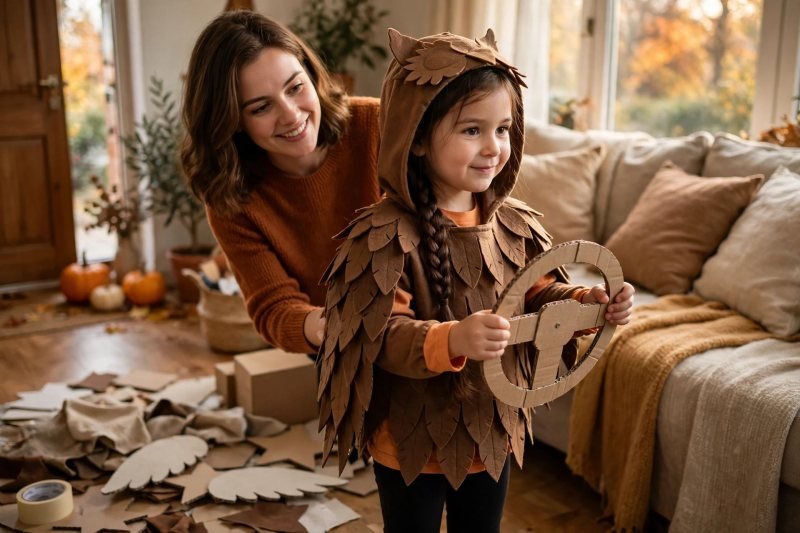
Move fast and watch the night — owl and race-car driver. For children whose Halloween is mostly motion, these two keep up. The (17) owl is a hooded top in brown or gray with layered felt feather shapes on a soft cape that attaches at the shoulders, big soft eyes placed on top of the hood and never over your child's eyes, and a head that turns freely for curbs and cars. The (18) race-car driver is a plain jumpsuit or matching tee and pants in one bright color, a soft cap, and a cardboard steering wheel carried for photos and porch moments, then handed to the grown-up for the walking stretches so both hands stay free. Check that feather capes and hoods never cover ears completely, because hearing traffic and a parent's voice matters more than silhouette. Say, "Fast costumes still stop, look, and listen." Build in one practice lap of the living room at full character speed, ending in a full stop on your word, before either costume is declared ready.
-
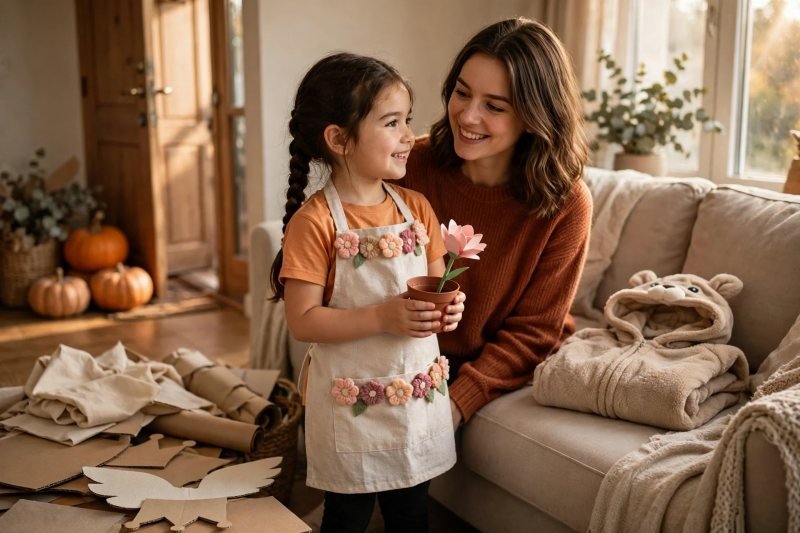
Finish sweet and cozy — gardener and pajama animal. The last two ideas are for children who want Halloween gentle, warm, and close to home. The (19) gardener with flower pots wears a plain apron over clothes, a soft sun hat, and carries one small empty flower pot with a paper flower, plus felt flowers pinned to the apron — pockets hold treasures, the pot holds the first treats, and everything is soft if it drops. The (20) cozy pajama animal is a onesie-style hooded pajama costume with simple ears on the hood — bear, bunny, or fox by color alone — worn over a warm layer on cold nights or alone on mild ones, with real shoes instead of the suit's soft feet outdoors. These two are also the easiest photographs for grandparents, because the child's whole face, smile, and personality stay completely unobstructed. Say, "Cozy counts as a costume — especially a happy one." If the evening ends early in a pajama animal costume, bedtime is already half accomplished, which every parent of a five-year-old will recognize as genius.
-
Do the final fitting, safety check, and photo plan. A few days before the night, run the full ceremony in costume over the planned layers: shoes on, tote in hand, a march to the mirror, a sit test, a stair test, a spin, and the parent's checklist spoken aloud — face fully visible with no mask and nothing blocking vision; nothing tied at the neck, with any cape releasing from its shoulder tabs in one tug; hem above the ankles with no dragging fabric; reflective tape or light in place for dusk; and every prop soft, large, and easy to hand to a grown-up. Take the planned photographs now, in daylight, in the living room or by the pumpkins at the door, so the dark-night pictures become a bonus rather than a burden. Adjust or swap pieces in this calm moment, never at the front door. Say, "Tonight we practice — on Halloween, we just go be it." A rehearsed child in a simple generic costume outshines an unrehearsed child in an expensive copied one every single year. When the fitting is done, the Bright Play Days learning hub gathers the play and learning ideas that keep these generic costumes in use all year.


Make it easier
Choose the pajama champions: the skeleton and the cozy pajama animal are complete costumes that are already bedtime clothes — warm layers underneath, no change needed afterward. Use the closet builds: the black cat, the doctor, and the gardener assemble from clothes you own plus one headband, cardboard disc, or apron each. Make only one prop: a single cardboard steering wheel, microphone, or telescope carries a theme further than five fussy accessories, and it is the piece your child will actually remember making.
Make it harder
Let your child design the superhero symbol and the astronaut patches from scratch — drawing, cutting, and placing an original emblem turns a costume into an art project with a story. Build the blocky builder vest together as a grid challenge: arrange the square felt patches in rows and columns, count them together, and let your child direct the pattern. Add a porch performance: the pop-star performs one song, the pirate tells one joke, and the dinosaur roars on cue for the family photo — a tiny rehearsed show gives confident five-year-olds a stage.
Other ways to play it
- Sibling groups: pick a set that reads together without matching purchases — the food pair of strawberry and gardener, the helper trio of firefighter, doctor, and astronaut, or the gentle spookies of friendly ghost, witch, and skeleton in light and dark.
- Warm-climate version: run the vest, hat, and tee ideas light — pirate, gardener, race-car driver, and pop-star performer over a single tee, no padding, hoods swapped for headbands, and the photo taken before anyone overheats.
- Cold-climate layering: treat the costume as the middle layer — warm base layer first, costume over it, plain jacket on top where the cut allows, with pajama costumes and the padded pumpkin forgiving the most layers; check fingers and cheeks every few doors.
- When a child changes their mind: if the chosen theme is refused at the fitting, do not rebuild from scratch — keep the base clothes, swap only the hat or prop, and let the child rename the character; a renamed costume the child chose again beats a perfect one they will not wear.
How it changes by age
- Age 4: Fours do best with the simplest architectures — the friendly ghost, smiling pumpkin, black cat, and cozy pajama animal — with two finalists offered rather than the full twenty, a short route of familiar doors, and a grown-up hand available at every curb. Keep their fitting playful and brief, let them veto any piece without debate, and expect the costume to shed a prop or two as the evening goes on; that is the plan working, not failing.
- Age 5: Fives can carry the fuller builds — the blocky builder vest, the pop-star performance, the pirate with a prop — choose between finalists with real reasoning, walk a longer route with breaks, and take small jobs like holding the tote and announcing the character at each door. Give them the checklist language from the fitting so they can check their own cape tabs and hems; responsibility at five feels like being trusted, and trusted children take care.
What they're learning
Imaginative play: becoming a helper, a performer, a builder, or a gentle ghost for an evening — trying on jobs, feelings, and courage inside a story they control. Decision-making: narrowing twenty ideas to three to one, weighing cute against spooky and cozy against fast — real choosing, with their reasons listened to and honored. Fine motor from DIY pieces: gluing felt seeds and bone shapes, arranging square patches in a grid, placing a pumpkin smile, and building cardboard props — hand strength and precision dressed as costume making. Confidence: rehearsing at the fitting, announcing their character at the door, and performing a roar, a song, or a smile on cue — being seen, kindly, exactly as they chose to be.
Clearing up
Costumes come off into the dress-up basket for their second career, cardboard props are flattened and recycled once they are truly finished, felt pieces are saved in a labeled bag for next year's builds, and face paint washes off in the regular bath. Shake out and air every piece before storing, retire any glow lights and stretched-out elastic, and photograph the winning costume flat before it goes away — next October's shortlist starts with honest evidence of what was actually worn happily all evening.
Questions parents ask
What are the best kids Halloween costumes for 2026 for a 4- or 5-year-old?
How do I choose a Halloween costume that suits my child's temperament?
How can I make a trending costume without buying a licensed outfit?
How do I keep a 4- or 5-year-old warm and comfortable in a Halloween costume?
What should I check in a home costume fitting before Halloween?

save it for later
Pin this for the next rainy afternoon
Keep it on a board so it is there when you need it, rather than when you happened to find it.
Save to Pinterest

