


Addition Games for Kindergarten: 15 Hands-On Ways to Add to 10
Fifteen hands-on addition games for kindergarten that turn adding to 10 into play. Dice games, snack maths, hopping games and card battles — minutes to set up with things you own, building real number sense, not memorised answers. Play your way to adding to 10: fifteen simple, giggle-filled addition games for 5- and 6-year-olds — no worksheets, no pressure, just real number sense.
The best addition games for kindergarten are hands-on: roll dice and add the pips, stack blocks and count them together, deal cards and race to make 10. Play short 10–15 minute rounds, keep totals at 10 or below to start, and let your child touch and move every object they count.

The short version
- Start with physical objects before written numbers.
- Dice games are the easiest win.
- 10–15 minute sessions beat 40-minute drills.
- Let your child count slowly.
- Move from adding to 5, then 10, then past 10 only when easy.
- Praise the strategy, not just the answer.
- Age
- Ages 4–6
- Prep
- 5 min
- Mess
- Low
- Difficulty
- Medium
- Where
- Both
Why kids love this
Because nothing here looks like school. Dice rattle, towers get knocked down, socks fly across the floor, and somebody gets to shout "ten!" at the top of their voice. Every game has a winner, a giggle, or a snack — often all three.
What you'll need
- Two ordinary dice
- A deck of playing cards (face cards set aside)
- Building bricks or wooden blocks
- Buttons, dried pasta shapes, or pom-poms
- Paper, crayons, and sticky notes
- Two small bowls and a snack (raisins, cereal, blueberries)
- Unpaired socks and two baskets
- Beanbags or rolled-up socks
- Pavement chalk
- Coins or buttons as bingo markers
Before you start
Almost nothing: gather dice and cards, pour counters into a bowl, clear table space. Garden games: chalk two circles. Most games set up in under five minutes.
How to do it
-
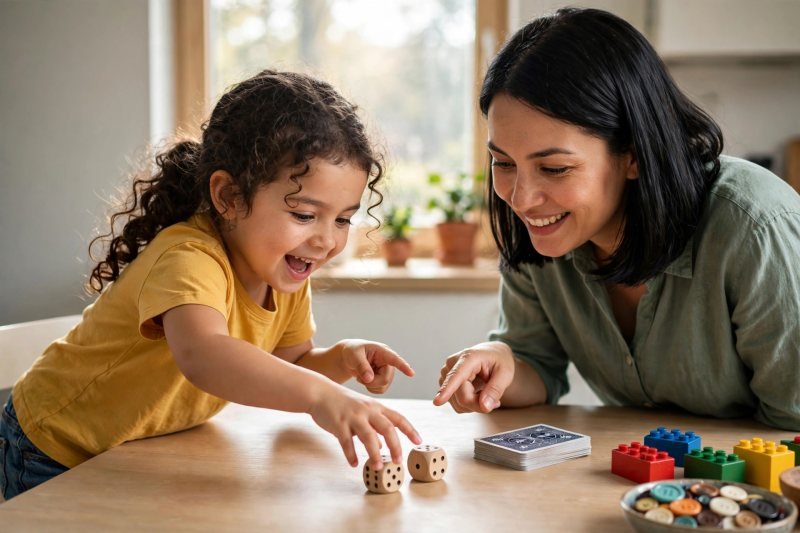
1. Pick one game to start — dice games are the easiest first step.
-
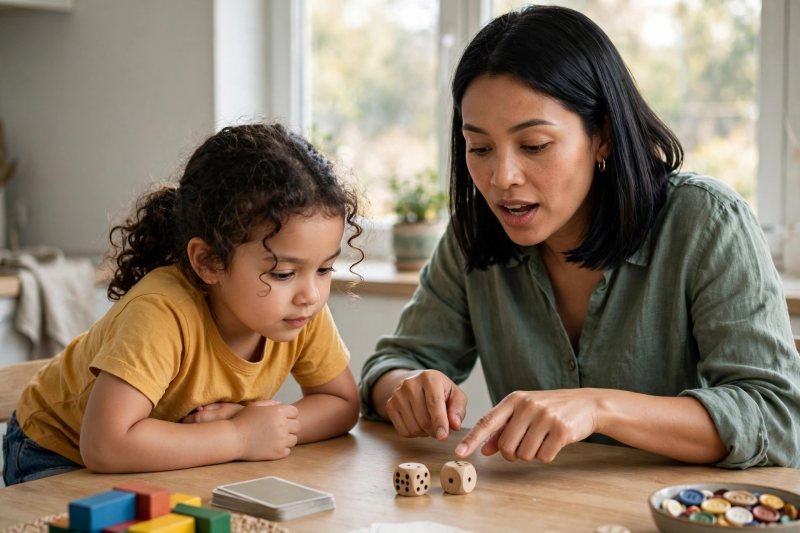
2. Play a quick demonstration round yourself, counting out loud, so your child sees how it works.
-
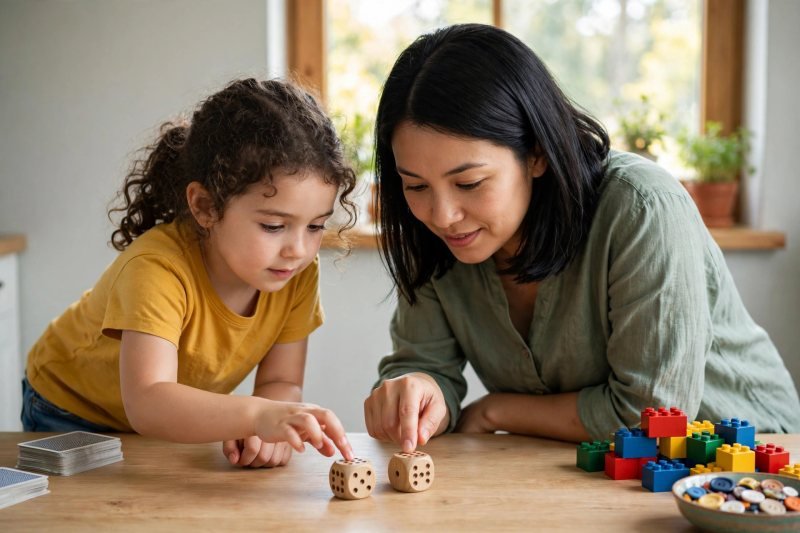
3. Let your child take the first real turn. Count along with them, touching each object.
-
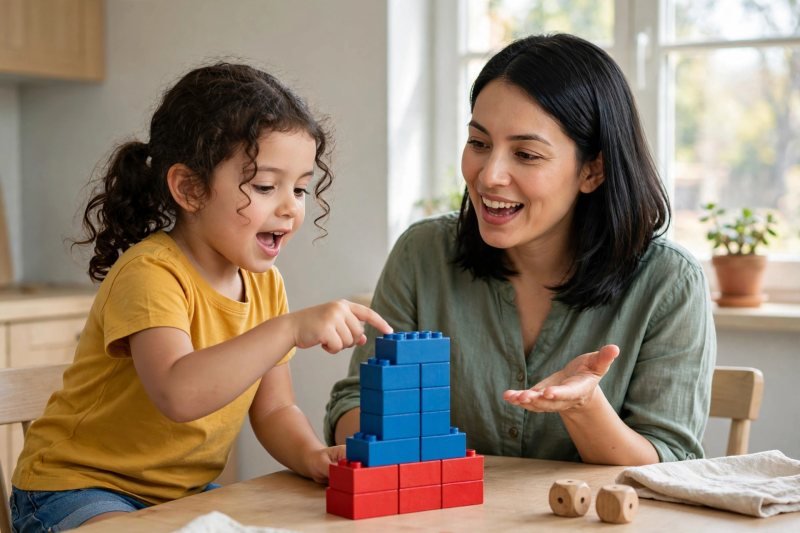
4. Say the whole addition sentence together: "3 plus 4 makes 7."
-
5. Play for 10–15 minutes, then stop while it's still fun — even mid-winning-streak.
-
6. Come back tomorrow with the same game or a new one from the list.
-
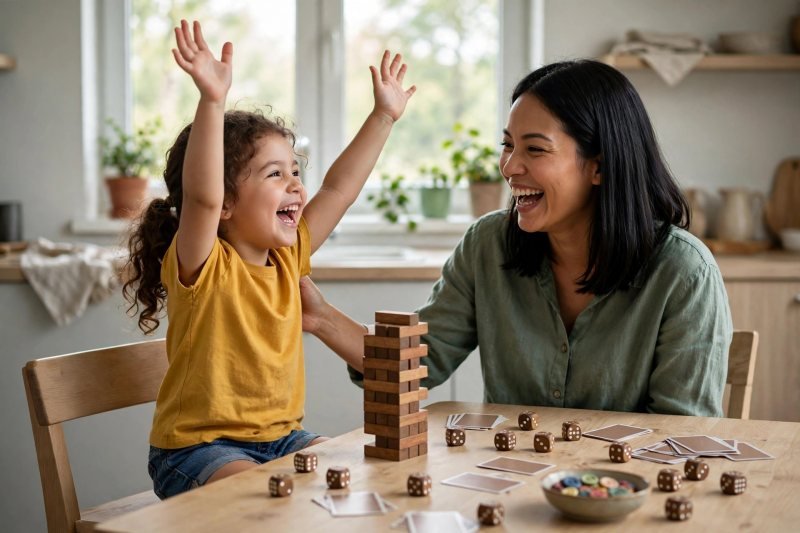
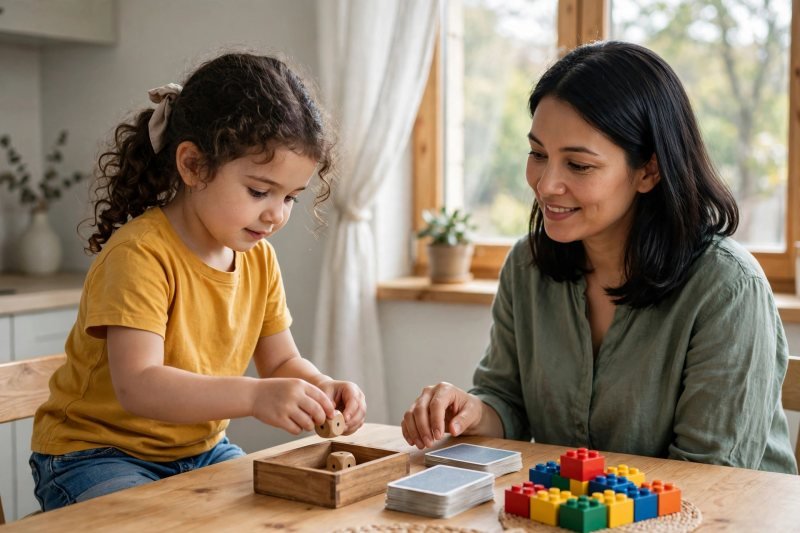
Addition games for kindergarten work best when children can see and touch the numbers. A 5-year-old doesn't learn "3 + 4 = 7" by staring at it — they learn it by stacking 3 blocks next to 4 blocks and counting all 7. These fifteen games keep every total at 10 or below. Pick any two or three, play each for about 10 minutes, and stop while it's still fun.
-
DICE GAMES
-
1. Dice Duel: roll two dice, count pips together, highest total wins the round; first to five rounds wins.
-
2. Target 10: roll two dice; if they add to 10, score a point; say every total out loud.
-
3. Roll and Build: roll a die, click on that many bricks; roll again, add more; count the tower and say "3 plus 4 makes 7."
-
4. Big Number Small Number: roll two dice, say which is bigger/smaller, then add.
-
SNACK MATHS
-
5. Snack Attack: count out snacks into two bowls and add.
-
6. Cereal Necklace: thread 10 pieces, count in groups.
-
MOVEMENT
-
7. Hop and Add: chalk two circles, hop the total.
-
8. Sock Toss: toss paired socks into baskets, count each basket, add.
-
CARDS
-
9. Card War Addition: flip two cards each, add, highest total takes the cards.
-
10. Make 10 Snap: flip cards looking for pairs that make 10.
-
EVERYDAY
-
11. Staircase Stacking: line up cups with pom-poms (2+3, 3+4, 4+5), ask for totals.
-
12. Button Sorting: sort buttons by colour, count each pile, add.
-
13. Shopping List: "we need 3 apples and 4 bananas — how many altogether?"
-
14. Toy Parking: park 4 cars then 3 more, count the lot.
-
15. Card War Addition (team): play alongside as a team.
-
This one fits beautifully into a regular kindergarten maths block because the progression is built in.


Make it easier
Keep totals at 5 or below. Let your child count every object from 1 each time. Play as a team against a stuffed toy. Use bigger objects.
Make it harder
Move totals to 15 or 20. Roll three dice and add all three. Play Target 12, then Target 15. Ask "how many more to reach 10?" Time two minutes of addition sentences.
Other ways to play it
- Number bond pairs (pairs that make 10).
- Seasonal swap (conkers, baubles, shells).
- Sibling version (older add three numbers).
- Quiet version (stacking cups, button sorting).
How it changes by age
- Ages 4–6. Fours keep totals to 5 with one die. Fives (sweet spot) handle totals to 10 with two dice. Sixes push past 10. Follow your child's ease, not their birthday.
What they're learning
Adding to 10. Number bonds (pairs that make 10). One-to-one correspondence. Comparing bigger/smaller. Counting on. Problem-solving ("how many more to reach 10?"). Fine-motor practice — our [fine motor activities for preschoolers](https://brightplaydays.com/activities/fine-motor-activities-for-preschoolers/) has more.
Clearing up
Two minutes: counters in the jar, cards rubber-banded, dice back in the box. Let your child sort — counting buttons back is one last round of maths.
Questions parents ask
When should my child learn addition?
Worksheets or games?
My child keeps counting from 1. Is that OK?
What if my child gets the wrong answer?
How long should a session last?
When ready to add past 10?
No worksheets were harmed. If your child asks to play again tomorrow, the maths is working. Zero pressure, zero guilt: play first, maths follows.


