


Days of the Week Activities: Order, Sing and Sequence
Days of the week activities for 4–5-year-olds: chanting, an original song, and hands-on sequencing games that teach the days in order — Sunday to Saturday, one joyful step at a time.
Most 4–5-year-olds learn the days of the week in order by chanting them daily, singing a simple days song, and putting seven objects in sequence again and again. Start with Sunday, always the same order, and attach each day to something real — pizza Friday, library Tuesday.

The short version
- Always teach the days in the same order — Sunday to Saturday in the US — because the sequence IS the skill.
- Saying, singing, and physically ordering the days each help differently; use all three.
- Yesterday/today/tomorrow is harder than the order — chant first, timeline second.
- Ten minutes a day for a couple of weeks beats one long lesson.
- Age
- Ages 4–5
- Prep
- 10 min
- Play time
- 20 min
- Mess
- None
- Difficulty
- Easy
- Where
- Indoor
Why kids love this
A song, silly moves, and toys to scramble and rebuild. The missing-day game feels like detective work, the pillow walk like an obstacle course — ending in applause.
What you'll need
- 7 chunky objects: blocks, soft toys, or beanbags (one per day)
- 3 large cushions and 7 pillows
- Nothing to buy — raid the toy box and the sofa
Before you start
Count out seven objects and keep them in one bag between sessions so the "week" is always ready. Clear a straight stretch of floor for the pillow walk. Five minutes, tops.
How to do it
-
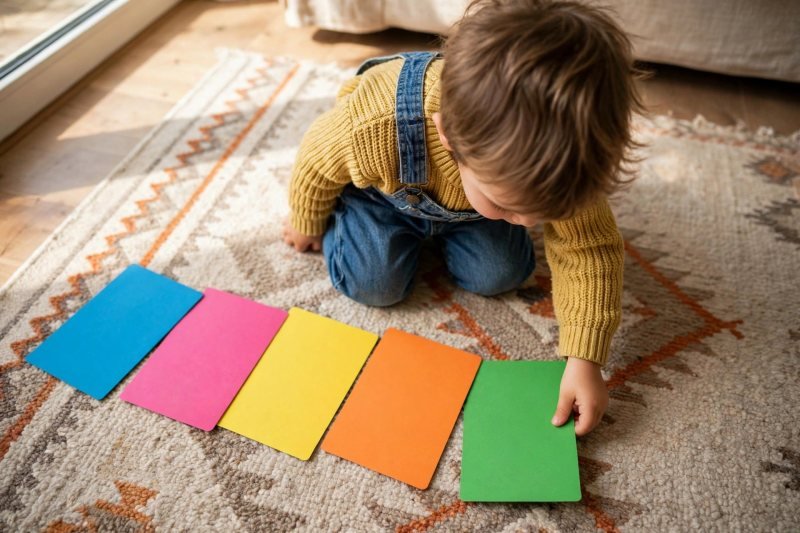
Line up seven of anything. Seven blocks or soft toys in a row. Name the days slowly, touching one object each: "Sunday… Monday… Tuesday…" This row is your week.

-
Chant together, tapping each one. One tap per object, slow and even, three times through — then your child tries solo. Seven taps, seven days.

-
Sing the days song. To any tune: "Sunday, Monday, Tuesday too, Wednesday, Thursday, just for you, Friday, Saturday, hooray, that's the week — hip, hip, hooray!" Clap on "hooray."

-
Give each day a move. March Monday, spin Tuesday, jump Wednesday, tiptoe Thursday, stomp Friday, twirl Saturday, flop down Sunday. Bodies remember what words forget.

-
Put the week back in order. Jumble the objects; your child lays the week out left to right, chanting as they go. Chant along — you're proving the order survives scrambling.
-
Play "which day is missing?" Line up the seven, eyes closed, whisk one away. They chant the row to find the gap — detective work, not a quiz.

-
Stand in yesterday, today, tomorrow. Three cushions. Middle: "This is today — say the day!" Step left: "Yesterday was…" Step right: "Tomorrow will be…"

-
Walk the week. Seven pillows in a line; walk it naming each day, then your child walks it alone, faster each time, ending at Saturday with a jump.

-
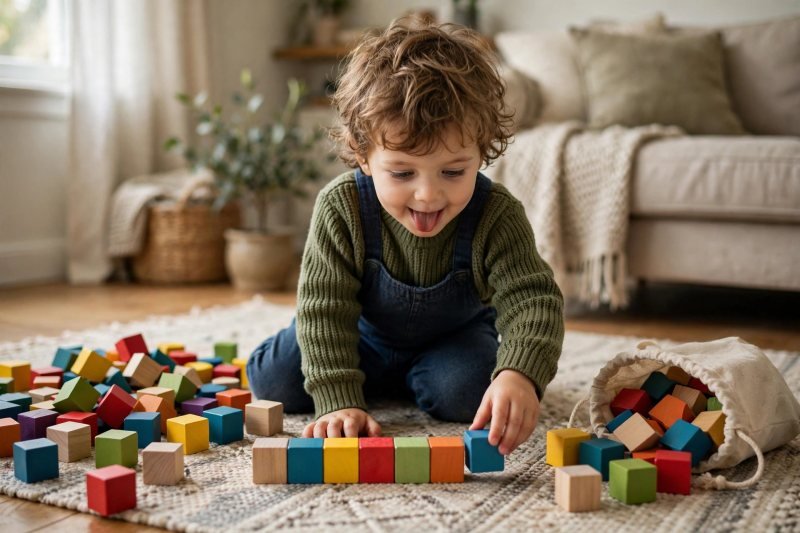
Rebuild from a full scramble. Tip the objects from a bag; your child builds the week from scratch, chanting under their breath. Solo success is the milestone.
-
Tell the week to someone. Recite or sing the days for a grandparent, stuffed animals, or the family at dinner. Applause teaches them this knowledge is worth pride. Repeat tomorrow; sequences are kept by repetition.



Make it easier
Stay on steps 1–3 as long as you like; chanting and singing to seven objects is plenty for a young 4-year-old. You name the days; your child taps along and joins in when ready.
Make it harder
Ask "what day comes after Tuesday?" without chanting from Sunday — the real fluency test. Try yesterday/today/tomorrow for any day, or a Monday-start week once the Sunday chain is solid. More ordering play: sequencing activities for preschoolers. Our counting to 20 activities keep the number side of the week strong.
Other ways to play it
- Days train: seven chairs in a row, one per day — ride and announce each stop.
- Laundry days: peg seven socks on a line, one per day, chanting as you peg.
- Bedtime countdown: "Three more sleeps until Saturday!" For more musical memory tricks, our nursery rhymes for toddlers collection has plenty.
How it changes by age
- Ages 4–5. Most 4-year-olds manage steps 1–6 within a week or two; the solo rebuild and "what comes after?" click closer to 5. Under-4s can join the singing. Once the week is solid, our guide on how to teach a child to tell time is the natural next step. Our letter of the week activities build the same weekly rhythm with letters.
What they're learning
Sequencing: the days as a fixed chain — first, next, last. Rote memory with rhythm: song and chant holding a sequence. One-to-one matching: one day per object, no skipping. Time vocabulary: day, week, yesterday, today, tomorrow.
Clearing up
Objects back in the bag, pillows back on the sofa — tidied in under five minutes.
Questions parents ask
What order should I teach the days of the week in?
How long does it take a 4-year-old to learn the days of the week?
My child keeps saying the days in the wrong order. Should I correct them?
How do I teach yesterday, today, and tomorrow?
The rhyme "Monday's child is fair of face" is centuries old and in the public domain — a lovely next layer once the order is solid. Keep your chant Sunday-start. Once the week is solid, our day and night explanation helps children place the days inside a bigger picture of time.

save it for later
Pin this for the next rainy afternoon
Keep it on a board so it is there when you need it, rather than when you happened to find it.
Save to Pinterest


