


Kids and Sunglasses: Protecting Little Eyes
Choosing sunglasses for kids made simple for ages 4–5: how to read the UV label, fit a pair that stays on, build the wearing habit, and spot the signs that mean it is time to see a doctor.
For ages 4–5, choose children's sunglasses whose printed label states they block both UVA and UVB rays, with flexible frames, shatter-resistant lenses, and a close, comfortable fit your child helps pick. Pair them with shade and a wide-brim hat, store them in a hard case by the door, and see a doctor for persistent squinting, light sensitivity, eye pain, or any change in vision.

The short version
- Label first: only pairs whose printed label states UVA and UVB blocking count as protection — no label means it is a toy.
- Fit decides everything: close coverage including at the sides, no sliding, no pinching — test with a gentle shake and a jump.
- Built for childhood: flexible frames and shatter-resistant lenses, never glass, plus a breakaway retainer for active play.
- Team of three: shade first, hat second, glasses third — and adults modeling their own pair every sunny day.
- Know the red flags: persistent squinting, light sensitivity, eye pain or redness, headaches in bright light, or vision changes mean see a doctor.
- Age
- Ages 4–5
- Prep
- 10 min
- Play time
- 10 min
- Mess
- None
- Difficulty
- Easy
- Where
- Both
Why kids love this
Good sunglasses for kids succeed or fail on one simple test: will your child keep them on? Children wear what fits, what looks cool to them, and what does not pinch, slide, or squeeze — and they remove, chew, or quietly abandon everything else within minutes. That is why this guide treats comfort as protection: a pair that sits close without pressing, stays put when your child runs, and comes in a color your child chose is a pair that is still on their face at the park, at the beach, and on the walk home. There is also real delight in it for a four- or five-year-old. Sunglasses feel grown-up. They match what you are wearing, they live in their own special case, and putting them on becomes part of the adventure of going out — like a hat, but with a little more swagger. Choose for comfort and ownership first, and the eye protection quietly happens all day long.
What you'll need
- A pair of children's sunglasses whose printed label states they block both UVA and UVB rays — if there is no such label, treat the pair as a toy, not protection
- Flexible frames that bend a little without snapping, sized for a young child's face
- Shatter-resistant lenses — never glass lenses for children this age
- A soft breakaway retainer strap for active play — one designed to release if it catches, never anything tied or tight around the neck
- A plain hard case that lives in one fixed place at home, so the glasses have a home too
- A soft microfiber cloth for cleaning, kept with the case
- A wide-brim sun hat to wear alongside the glasses on bright days
- A second adult pair of sunglasses for you — children copy what they see far more than what they are told
Before you start
1. Before you shop, talk about why: tell your child in one simple sentence that sunglasses help their eyes feel comfortable in bright light, just as a hat helps their head, and let them ask questions. 2. Decide your two or three parent-approved options in advance — each one labeled for UVA and UVB blocking, flexible, and shatter-resistant — so the only choice left in the shop is the fun one: color and style. 3. Plan the first wearing for a genuinely bright, happy outing — a park trip or a beach-edge walk — so the glasses are linked from day one to fun, not to a lecture.
How to do it
-
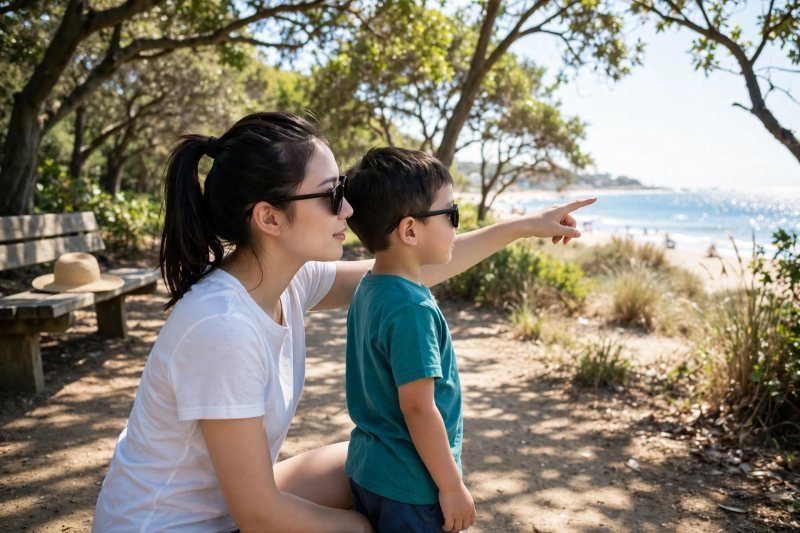
Understand why young eyes need shade. Start with the simple reason behind all of this: children's eyes are still developing, and young eyes let in more light than adult eyes do, so bright days can feel harsher for your child than they do for you. Explain the difference in plain language your child can hold onto: glare is the bright, squinty feeling that makes it hard to see comfortably, while the sun also sends out light you cannot see or feel at all — and good sunglasses help with the everyday comfort of being outside. Keep it light and brief; this is reassurance, not a science lesson, and no child needs to be worried about the sun to enjoy shade. Say, "Your eyes are still growing, so we look after them — sunglasses are like a shady tree for your eyes." Notice the signs as you go: a child who squints, turns away, or shades their face with a hand on bright days is telling you, in their own way, that shade would help.
-
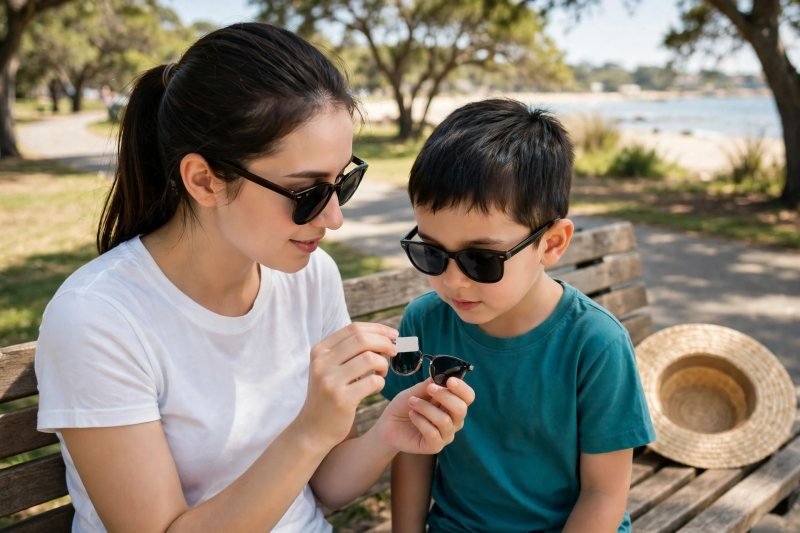
Read the label before anything else. Make the label your very first check, before color, before price talk, before your child falls in love with a pair: choose pairs whose printed label states they block both UVA and UVB rays. That wording on the label is the whole test — a dark lens by itself is just a dark lens, and darkness is not the same as protection. If a pair has no UV label at all, treat it honestly for what it is: a dress-up toy for indoor play, not eye protection for sunny days, and leave it out of your shortlist no matter how appealing it looks. Turn the check into a game your child can join, hunting for the special sticker together. Say, "First we find the special label — no label, no deal, even if they look super cool." A child who learns to check the label at five has learned a buying habit that will serve them for life.
-
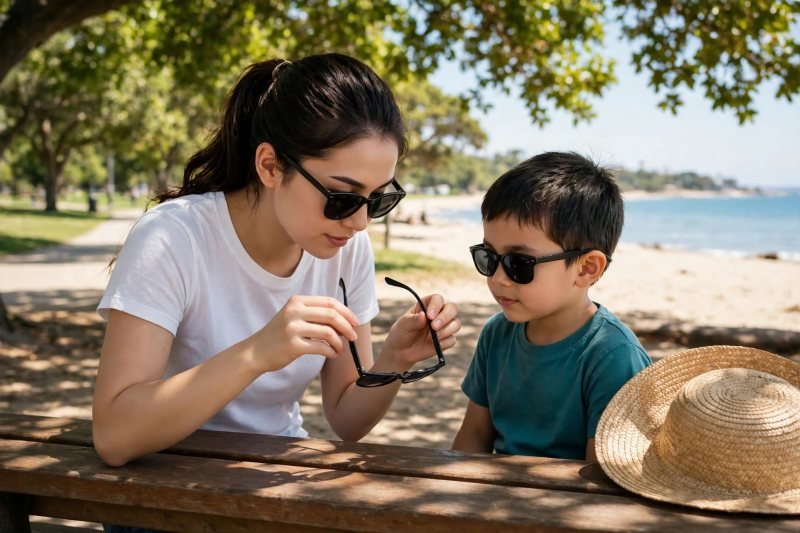
Choose lens and frame materials that survive childhood. Pick for the life these glasses will actually live: dropped on paths, sat on in the car, stuffed into bags, and worn at full running speed. Look for flexible frames that give a little when they are bent or twisted, rather than stiff frames that snap at the first accident, and for shatter-resistant lenses that are made to take knocks — never glass lenses for a child this age. Check hinges and edges with your own hands in the shop: everything should feel smooth, with no sharp points, no wobbly arms, and no tiny decorative parts that could work loose. A sturdy, simple pair worn every day beats a delicate pair kept for best. Say, "We need strong glasses for a strong kid — let's do the gentle bend test together." Let your child watch you check, because watching you choose carefully teaches them to value the pair when it is theirs.
-
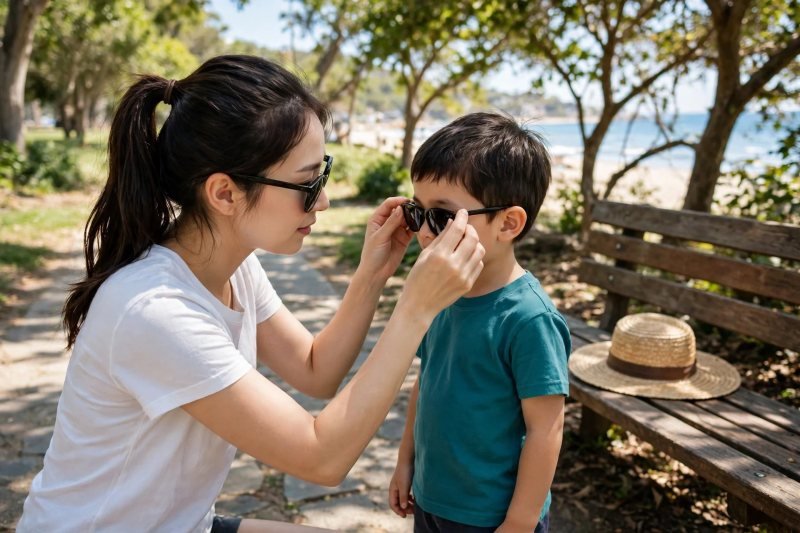
Fit them properly. A pair only helps when it sits right, so take a full minute over fit: the frames should sit close to the face with good coverage, including at the sides, without gaps that let bright light pour in at the edges. They should rest comfortably on the nose without sliding down every few steps, sit level on the ears without pinching behind them, and feel snug without squeezing at the temples. Try two simple tests together: the two-finger test — you should be able to slide a fingertip gently at the temple without the frames feeling tight — and the shake test, where your child shakes their head, nods, and does a little jump to see whether the glasses stay put. Above all, ask the wearer. Say, "Do they pinch, slide, or feel just right? You are the boss of how they feel." A small discomfort mentioned now is a pair still being worn next month.
-
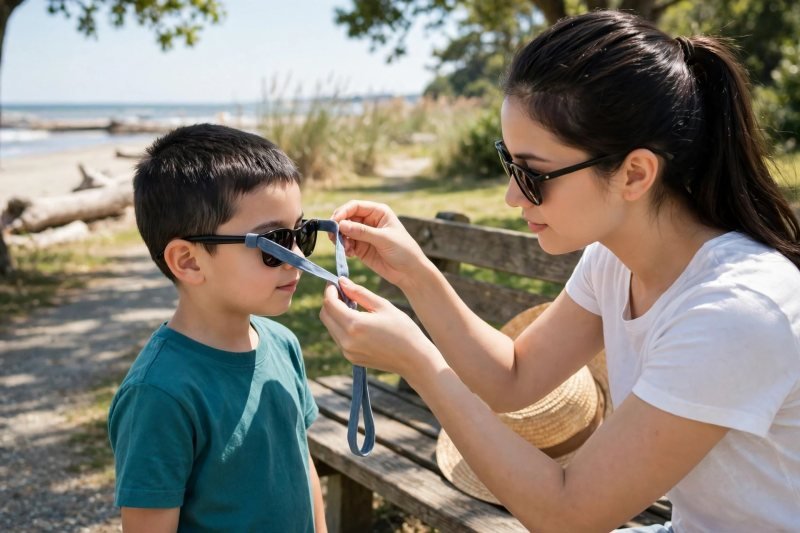
Add a breakaway retainer for active play. For running, scooting, and playground days, add a soft breakaway retainer — a short strap that attaches to the arms of the glasses and is designed to release if it ever catches on anything. Breakaway is the non-negotiable word here: never tie anything around your child's neck, never use a tight cord, a necklace-style loop, or a homemade string, and check the release works before the first outing. The strap's only job is humble and useful — it keeps the glasses from being lost when your child pulls them off mid-game, and it stops a dropped pair ending up under a shoe. For climbing frames and close-contact rough-and-tumble, the simplest choice is often glasses off and into the hard case with you, strap and all. Say, "This strap pops open to keep you safe — it is a helper, never a necklace." Show your child the release once, together, so it is familiar rather than mysterious.
-
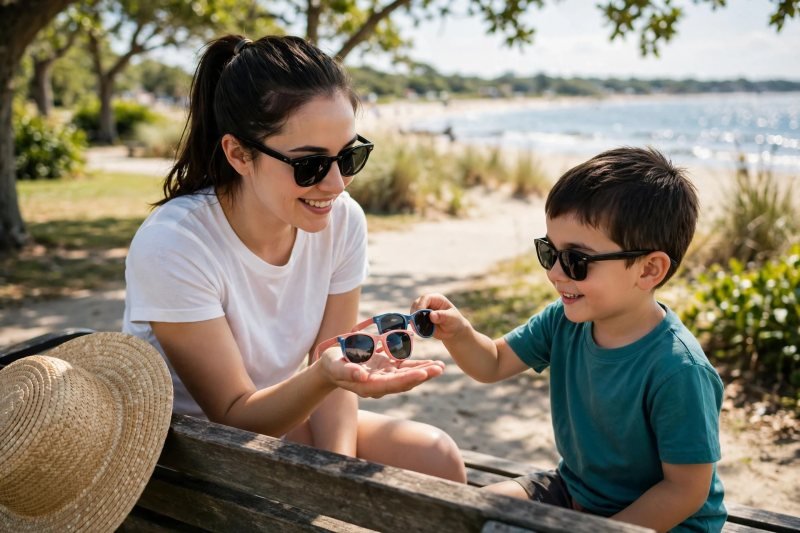
Let your child choose the style. Now hand over the decision that actually decides whether these glasses get worn: within your shortlist of labeled, sturdy, well-fitting pairs, your child picks the color and style. Two parent-approved options are plenty at this age — more choice mostly creates more dithering — and either answer is a win because you have already done the safety work behind the scenes. Let your child try both, check in a mirror, and commit like it matters, because to them it does. A pair they chose is their pair, in a way a pair handed to them never quite becomes, and ownership is the quiet engine of every wearing habit that follows. Say, "These two are both great for your eyes — which ones are the most you?" If they want the pair you secretly prefer least, smile and buy it anyway: the best sunglasses are the ones on their face, not in their case.
-
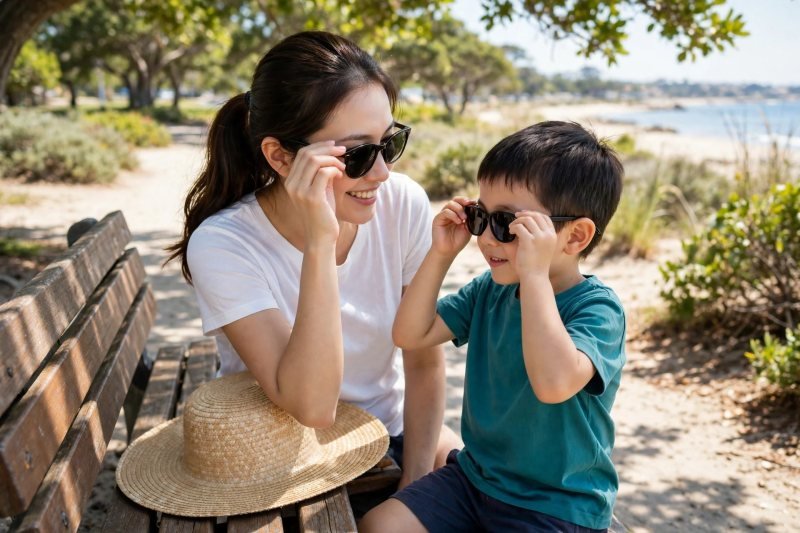
Build the wearing habit. Habits beat reminders, so give the glasses a home and a moment: at home they live in their hard case with the sun hat by the door, and putting them on becomes one step in the leaving-the-house routine, right alongside shoes and hat. This is the same kind of gentle routine-building behind preschool learning activities — small steps, same order, every day, until it runs itself. Wear your own sunglasses every single time, without making a speech about it; modeling does the persuading that nagging never will. Praise specifics when they remember on their own — not just 'good job,' but exactly what they did right. Say, "Hat, glasses, shoes — you remembered the whole sunny-day team by yourself." Within a couple of weeks, most children start reaching for the case before you do, and the habit, not your voice, is doing the work.
-
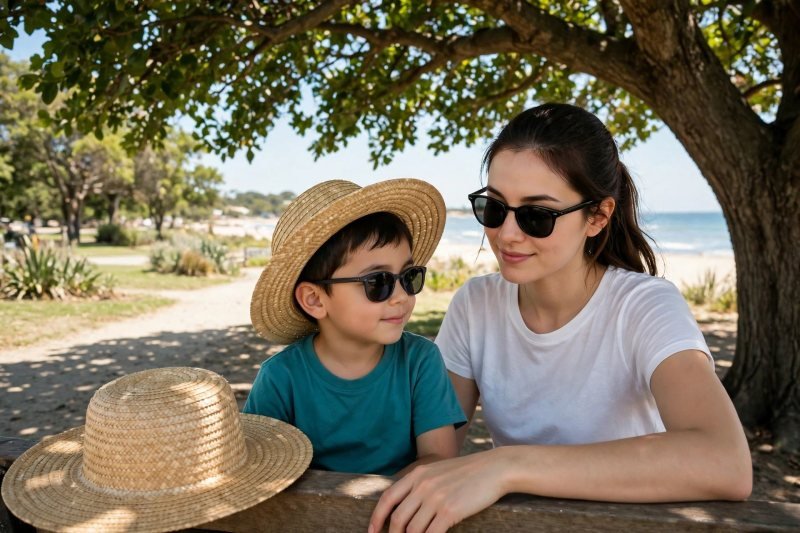
Pair sunglasses with hats and shade. Sunglasses work best as one part of a team of three, in this order: shade first, hat second, glasses third. Seek out the shady side of the park path, the tree at the beach edge, and the covered bench for snacks and rests, and treat bright, strong-sun parts of the day as times to linger in shade rather than bake in the open — when the sun feels strongest, that is your cue to move the game under a tree. A wide-brim hat shades the face and adds cover around the glasses, and the glasses handle the bright light that still reaches the eyes. It pairs naturally with the wider sun-care routines in a simple kids skincare routine — cover, shade, and cream each doing a different job. Knowing how often to reapply sunscreen keeps the cream part of the team working all day. On weather-watching days, a home weather station for kids makes a lovely companion, turning sun and shade into something your child observes and predicts on their own. Say, "Shade is our home base, hat is our roof, glasses are our windows — team of three."
-
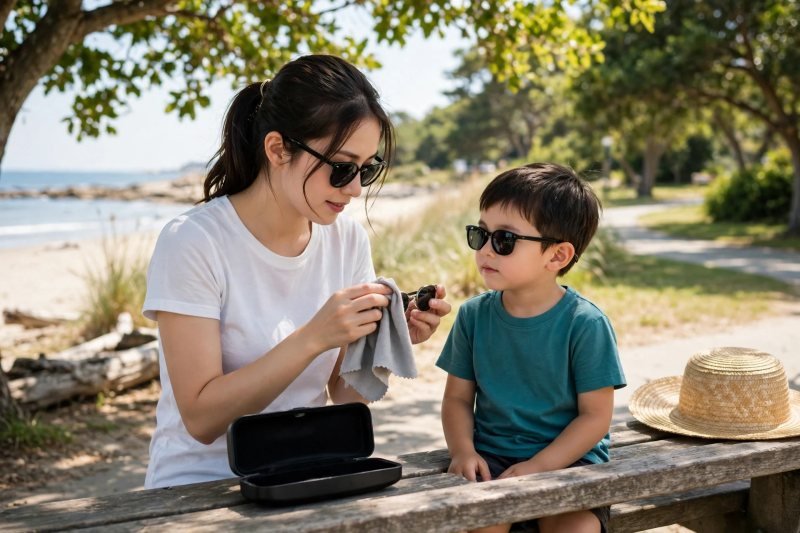
Care for them day to day. Teach the small care routine as part of ownership, not as fussiness: glasses go in the hard case when they come off — not on the car seat, not lens-down on a table, and never loose in a bag of toys. Sand and salt rinse off gently with plain water before wiping, because wiping gritty lenses grinds the grit across them; then a soft microfiber cloth, never a sleeve corner or a paper tissue, does the polishing. Your child's jobs are age-sized and real: carrying the case, doing the gentle wipe with you watching, and putting the case back in its home spot by the door. Say, "Glasses sleep in their case, just like you sleep in your bed." Pairs that are cared for stay clear and comfortable — and a child who can still see crisply through their lenses is a child who keeps choosing to wear them.
-
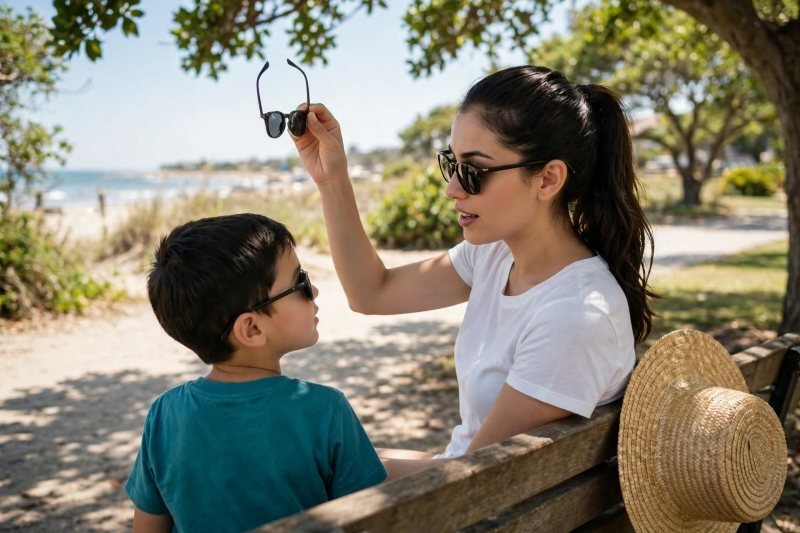
Know when to replace and when to see a doctor. Replace the pair when the lenses are scratched enough to blur the view, when the frames are bent out of shape, when your child has outgrown the fit and the coverage is no longer close, or when a beloved pair is simply lost — an ill-fitting spare is better than no pair while you shop. Then, separately, know the signs that are not about glasses at all: see a doctor if your child has persistent squinting that does not ease in shade, ongoing light sensitivity, eye pain or redness that does not settle, headaches that keep showing up around bright light, or any change in vision or behavior that worries you — book a pediatrician or an eye doctor and describe exactly what you have noticed. Glasses are not for looking at the sun, either: no one, child or adult, should ever stare directly at the sun, even while wearing sunglasses. Say, "New glasses fix old glasses — and doctors fix sore eyes. Those are two different jobs." Trust your instincts here; you know your child's ordinary, and anything persistently different deserves a professional look.


Make it easier
Shop with a shortlist of two: check labels and materials online or in one quick solo look first, then bring your child in only for fit and the final color choice — faster, calmer, and far fewer tears. Start with the park, not the beach: short, familiar outings build the habit gently before a long, bright, exciting beach day tests it. Use a picture checklist by the door — hat, glasses, shoes — that your child can point to and tick off each time you leave.
Make it harder
Make your child the family sun checker: each morning they look outside, announce whether it is a sunglasses day, and fetch their case and hat without being asked. Add a care station: a small tray by the door with the case, the cloth, and the hat, which they are in charge of resetting each evening. Let your child teach it back: have them explain the label check and the team of three — shade, hat, glasses — to a grandparent or a younger cousin in their own words.
Other ways to play it
- Beach days: lean hardest on the team of three — base the family in real shade, keep the hat on between swims, rinse sand and salt from lenses with plain water before any wiping, and supervise closely around water, where glasses come off for swimming and go straight into the hard case with you. Pick the cream to match with sunscreen for kids before you pack the bag.
- Sporty kids: the breakaway retainer earns its keep here — check its release before every game, choose the closest, most secure fit for running and ball play, and take glasses off entirely for climbing frames or rough contact games where a strap or frame could catch.
- Reluctant wearers: shrink the ask — start with two minutes in the brightest part of the garden, praise it warmly, and build up day by day; check fit again before assuming defiance, because a pinching pair explains most refusals, and let the chosen color do quiet persuading in the background.
How it changes by age
- Age 4: Four-year-olds wear sunglasses best as part of a routine an adult runs with them: you hold the case, you offer the pair at the door moment, and you check the fit as part of getting ready. Expect frequent removals — for looking at a bug, for rubbing an eye, for no reason at all — and treat each one neutrally, offering the pair back at the next sunny step rather than turning it into a contest. Two-option choices, mirror moments, and very specific praise work beautifully at four, and short outings are your friend: success on a twenty-minute park trip matters more than endurance on a long day out.
- Age 5: Five-year-olds can carry real responsibility for their pair: fetching the case, doing the shake test themselves, wiping lenses with the cloth, and reporting honestly when something pinches, slides, or looks blurry. This is a good age for the why conversation to deepen a little — developing eyes, invisible light, the team of three — because fives love a genuine explanation and will repeat it, accurately and proudly, to anyone who will listen. Many five-year-olds can also be trusted with the morning sun check, announcing the day's plan for hat and glasses like a small, serious weather reporter.
What they're learning
Sun habits: shade first, hat second, glasses third — a simple, ordered routine for bright days that your child can run and eventually teach. It is the same sequence behind teaching kids sun safety habits. Self-care: checking a label, reporting a pinch or a blur, and knowing that sore or changing eyes are a job for a doctor — early body care, owned by the child. Responsibility for own things: one pair, one case, one home spot — carrying, cleaning, and putting away something that matters and can be lost. Body awareness: noticing glare, squinting, and comfort in their own eyes, and learning that those signals are information worth acting on.
Clearing up
Clearing up is a thirty-second ritual at the door: rinse off any sand, salt, or sticky fingerprints with plain water, pat and polish gently with the microfiber cloth, check the arms and hinges once for wobbles or grit, and put the glasses in their hard case in their home spot beside the sun hat. Once a week, give the case itself a shake-out and a wipe, check the retainer's breakaway release still works, and glance at the lenses in good light for scratches that might mean a replacement is coming due. Stored this way, a good pair stays clear, comfortable, and findable — which is most of why it keeps getting worn.
Questions parents ask
Do young children really need sunglasses?
How do I know if a pair of kids' sunglasses actually protects?
What if my child keeps taking the sunglasses off?
Are straps and cords for kids' sunglasses safe?
When should I see a doctor about my child's eyes?

save it for later
Pin this for the next rainy afternoon
Keep it on a board so it is there when you need it, rather than when you happened to find it.
Save to Pinterest


