


Sequencing Activities for Preschoolers: 15 First-Next-Last Games
15 simple first-next-last sequencing activities for preschoolers ages 3–4 — picture card stories, recipe steps, daily routine games, and order words your child can practice all day.
Sequencing activities for preschoolers teach kids to put events in order using first, next, and last. Start with 2-step real-life routines, move to 3-card picture stories, and narrate the order words all day. These 15 games build story structure, temporal language, and early math logic for ages 3–4.

The short version
- Begin with 2-step daily routines before picture cards.
- Say first, next, and last out loud every time.
- Let your child arrange the cards — hands-on beats watching.
- Move from 3 steps to 4 only when 3 feels easy.
- Retell the story together to lock in the sequence.
- Age
- Ages 3–4
- Prep
- 5 min
- Play time
- 15 min
- Mess
- None
- Difficulty
- Easy
- Where
- Both
Why kids love this
Sequencing activities for preschoolers feel like play, not lessons. Kids love ordering picture cards and racing through an obstacle course where every station matters. They get to decide what comes first, next, and last.
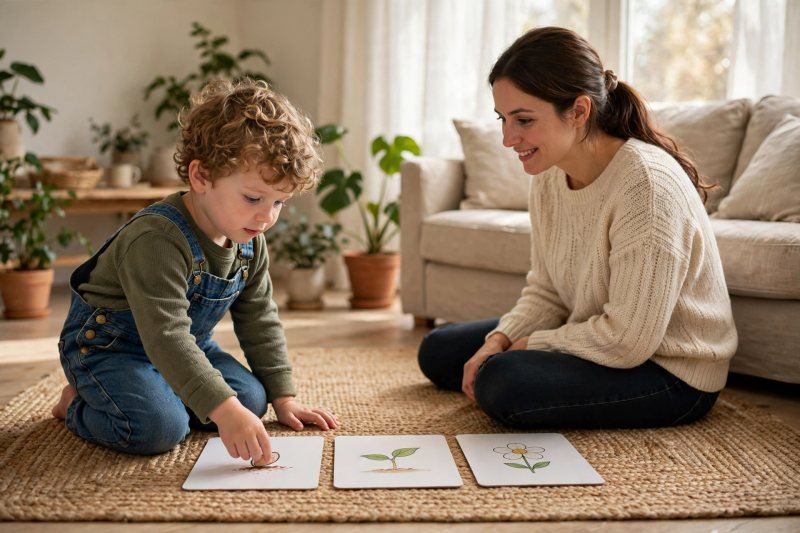
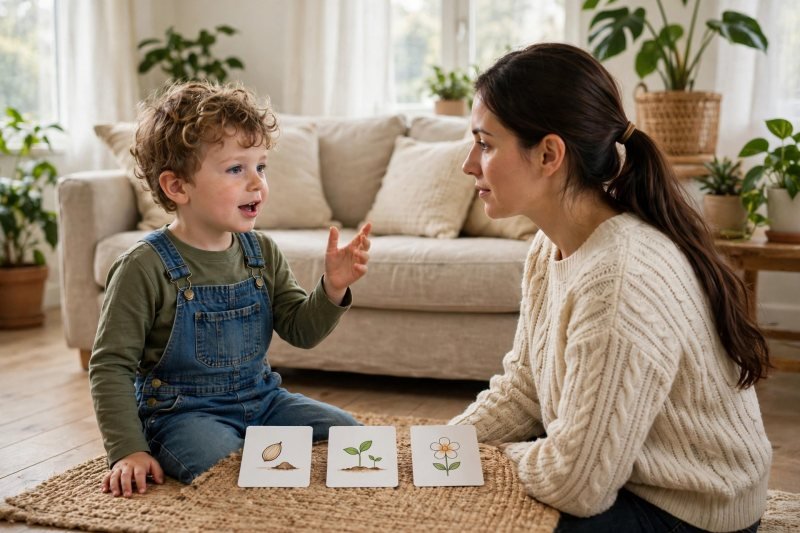
Game 1: How do you order a picture story? Make 3 cards: seed, sprout, flower. Your child lines them up first to last, then retells it — building story structure for future book summaries.
Game 2: Can your child retell their own day in order? At dinner, ask for three things: "First you... next you... last you..." This teaches that memories have a beginning, middle, and end.
Game 3: What are the steps for making breakfast? Let your child run breakfast: first bowl, next cereal, last milk. Narrate each step and ask "What comes next?" first — building working memory and independence.
Game 4: Can your child get dressed in the right order? Scramble their clothes and let them dress themselves: first shirt, next pants, last shoes. Funny wrong orders teach why sequence matters.
Game 5: What are the steps for brushing teeth? Chant it: first toothpaste, next brush, last spit and rinse. A picture checklist on the mirror lets your child "check off" each step.
Game 6: What happens first when you plant a seed? Plant a seed together: first dig, next drop the seed, last water it. Revisit the pot daily and ask your child to remember the steps.
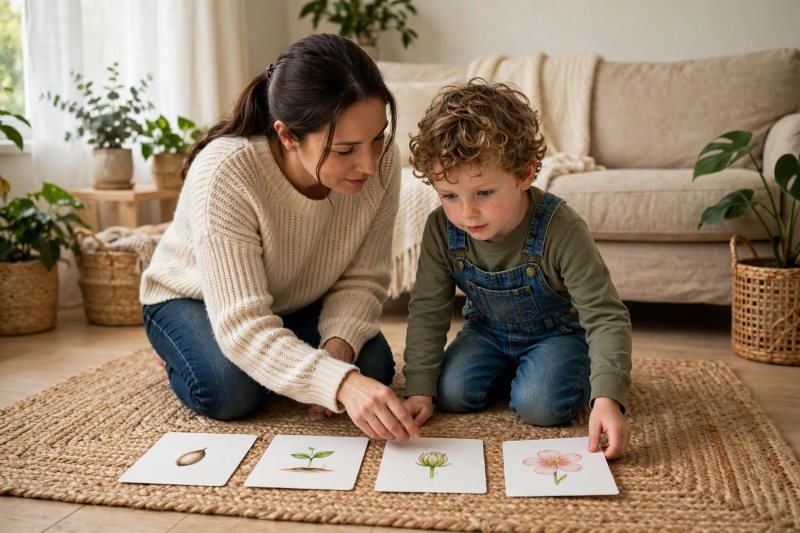
Game 7: How does a butterfly change in 4 pictures? Order four cards — egg, caterpillar, chrysalis, butterfly — into the life cycle. (Try our butterfly life cycle activity for preschoolers for a ready-made version.)
Game 8: Can your child copy your block-building sequence? Build a small 3-block tower, then your child copies it block by block in the same order. Take turns being the leader — building visual memory and pattern sense.
Game 9: What happens next in this picture book? While reading, cover the next page and ask "What do you think happens next?" before turning it. Guessing builds prediction from story order.
Game 10: Can your child order their own daily routine chart? Draw four pictures (wake up, breakfast, play, bedtime), scramble them, and let your child stick them on the fridge in order. Ask "What comes next?" each morning.
Game 11: Can you act out the Itsy Bitsy Spider in order? Act the rhyme in 4 moves: spider climbs up, rain washes down, sun dries up, spider climbs again. (More favorites in our nursery rhymes for toddlers collection.)
Game 12: Can your child follow an obstacle course in order? Set three stations: crawl through the tunnel first, hop around cones next, walk the beam last. Mark each with a card so they can "read" the course.
Game 13: Can your child copy a pattern block row in order? Line up colored shapes — circle, square, triangle — and your child matches the row exactly, left to right. Left-to-right order is pre-reading practice.
Game 14: What are the steps for cooking an egg together? With an adult on the heat: first crack the egg, next stir, last pour into the pan. Your child does the safe steps and narrates back.
Game 15: How do you play the first/then language game? Use "first/then" to make waits fun: "First we put on socks, then we go to the park." Soon your child will say it back to you.
Using first/next/last language all day. Narrate what you do: "First I'm peeling the banana, next I'm cutting it, last we're sharing it." Ask order questions at transitions: "What comes next after snack?" Soon the words become your child's own.
When to use 4 steps instead of 3. Stay with 3 steps until your child orders them correctly almost every time. Then introduce 4 with something familiar — like the butterfly life cycle — so only the length is new.
What you'll need
- 8–12 blank index cards or photo cards
- Crayons or markers
- Masking tape (for course markers)
- Everyday items: toothbrush, jacket, shoes, cereal box, small pot and seeds
Before you start
Draw or print 3–4 simple picture panels for one story (seed, sprout, flower). Scramble the cards and lay them face-up on the floor. Pick one daily routine to practice order words with first.
How to do it
-
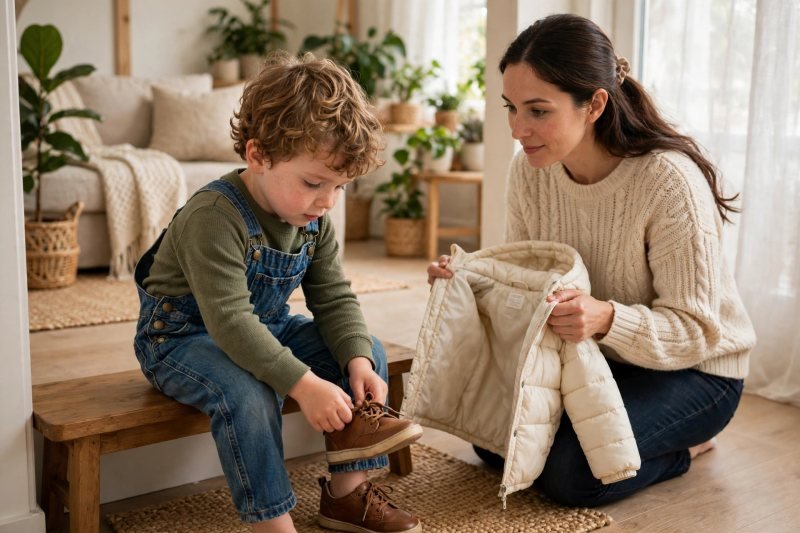
Start with a 2-step routine. "First shoes, then coat."
-
Lay out three picture cards in order. Lay out three picture cards for a simple story, already in order.
-
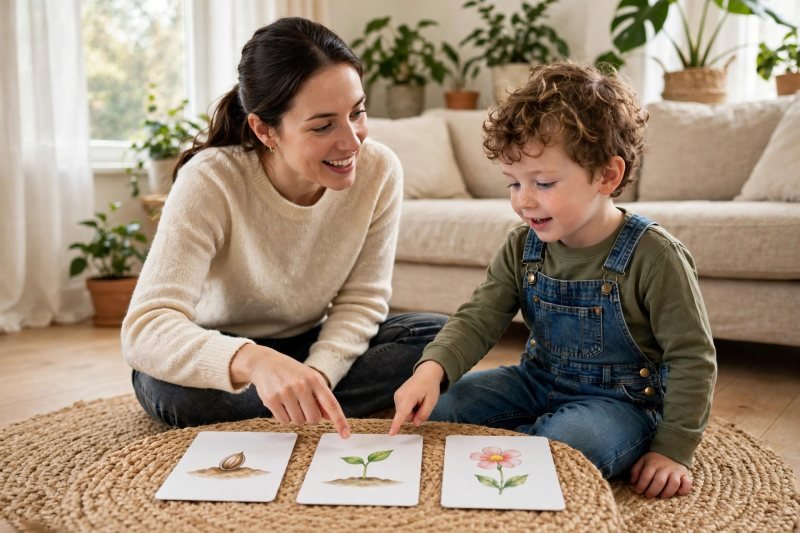
Point to each card and say the order words out loud. "FIRST the seed, NEXT the sprout, LAST the flower."
-
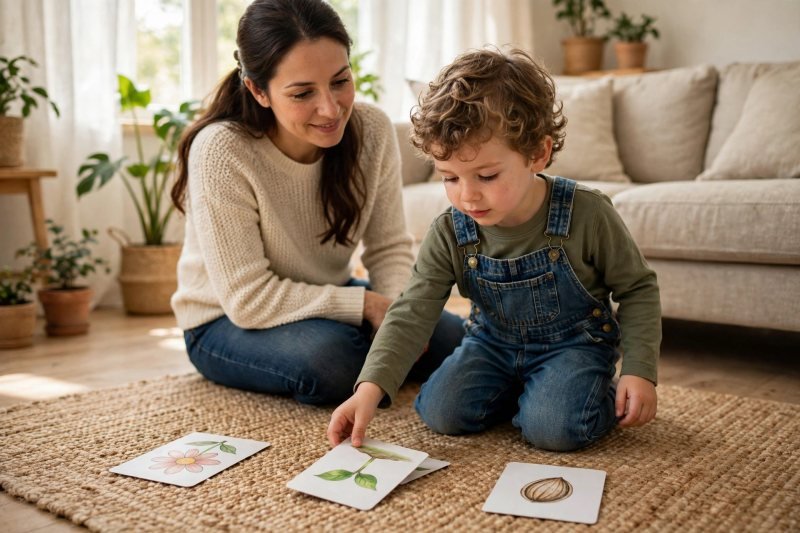
Mix the cards up and let your child arrange them. Mix the cards up and let your child arrange them in order.
-
Retell the story together. Retell the story together, with your child doing the talking.
-
Introduce a 4-card sequence. When 3 steps feel easy, introduce a 4-card sequence.
-
Use first/next/last in normal routines all day. Use first/next/last in normal routines all day to make it stick.



Make it easier
Start with 2-step routines: "First shoes, then coat." Model the order yourself before they try. Use photos of YOUR child doing each step — familiar is easier. Keep cards large and picture-only, with no text to decode.
Make it harder
Mix two story sets and have your child sort each one. Ask "Why can't the flower come first?" for cause-and-effect talk. Let your child draw a 4-panel story and teach it to you. Add time words: before, after, yesterday, tomorrow.
Other ways to play it
- Sticky-note sequencing on the wall for big movement.
- Sidewalk chalk squares — draw 4 and hop the order.
- Felt board stories with movable characters.
- Act-it-out sequencing — no cards, just bodies in motion.
How it changes by age
- Ages 2–3: 2-step real routines; you narrate, they follow.
- Ages 3–4: 3-card picture stories are the sweet spot; they arrange.
- Ages 4–5: 4-step sequences and "why" questions. Letter play in alphabet activities for toddlers fits naturally once 4-step sequences feel easy.
What they're learning
Sequencing: putting events and actions in logical order. Temporal language: first, next, last, then, before, after. Story structure: beginnings, middles, endings — the base of reading comprehension. Early math and logic: patterns, one-to-one matching, cause and effect.
Clearing up
Cards and blocks go back in their box or bag. Wipe up spills and put drawing supplies away. Return routine items (shoes, jacket, toothbrush) to their spots.
Questions parents ask
What are sequencing activities for preschoolers?
How do you teach first next last to a 3-year-old?
Why is sequencing important before reading?
How many steps should a preschool sequencing activity have?
What order words should preschoolers learn first?
Laminate picture cards if you can — they survive hundreds of rounds. Laminated cards also travel well — keep a set with other toddler learning activities at home for waiting rooms and car rides.

save it for later
Pin this for the next rainy afternoon
Keep it on a board so it is there when you need it, rather than when you happened to find it.
Save to Pinterest


