


Nursery Rhymes for Toddlers: 20 Classics That Build Early Reading Skills
Twenty classic nursery rhymes for toddlers, each one quietly building early reading skills. Bouncy action rhymes, gentle bedtime songs, counting rhymes and silly favorites — every one trains the rhythm, rhyme and sound awareness your child needs before letters even make sense.
The best nursery rhymes for toddlers are the classics you already half-remember: Twinkle Twinkle, Humpty Dumpty, The Wheels on the Bus, Five Little Ducks. Sing them with the actions, repeat the favorites daily, and don't worry about getting every word right — the rhythm and rhyme are what build early reading skills, not perfection.

The short version
- Rhymes train phonological awareness: hearing that "star" and "are" rhyme is a direct pre-reading skill.
- The actions matter as much as the words — clapping, bouncing and pointing build memory and motor skills.
- Repetition is the point: toddlers learn by hearing the same rhyme dozens of times.
- Sing slowly and leave gaps so your toddler can fill in the next word or action.
- Bedtime rhymes calm; daytime rhymes energize — match the rhyme to the moment.
- You don't need a good voice. Your toddler thinks yours is the best in the world.
- Age
- Ages 1–3
- Play time
- 10 min
- Mess
- None
- Difficulty
- Easy
- Where
- Both
Why kids love this
Because it's their favorite person being gloriously silly on demand. Toddlers don't love rhymes for the literary merit — they love that you fall down at "we all fall down", that you do the tickle at the end of This Little Piggy, that they know what's coming and get to shout it first. The fiftieth repeat isn't boring to them; it's mastery, and they can feel it.
How do nursery rhymes build early reading skills? Nursery rhymes for toddlers are pre-reading in disguise. Before a child can read words, they need to hear that words are made of sounds — that "boat" and "goat" end the same way, that sentences have a beat, that language has patterns. Rhymes deliver all of this in thirty seconds of silliness. The clapping and bouncing add a physical memory hook, so the words stick. That's why reading researchers treat early rhyme knowledge as one of the strongest predictors of later reading success — the US National Early Literacy Panel's 2008 review identified phonological awareness, the ability to hear rhymes and sound patterns, among the most reliable predictors of children's later literacy. A toddler who can finish "Twinkle, twinkle, little…" with "star!" already understands how language works. If you want the full roadmap from here, our guide on how to teach a child to read picks up exactly where rhymes leave off.
Which nursery rhymes are best for toddlers who love to move? High-energy rhymes with big actions — perfect for wiggly 2- and 3-year-olds, rainy afternoons, and burning off energy before lunch. 1. Head, Shoulders, Knees and Toes. Touch each body part as you sing, speeding up every verse until everyone collapses giggling. It teaches body vocabulary and the speeding-up game builds listening stamina. 2. The Wheels on the Bus. Roll your arms for the wheels, sway for the wipers, bounce for the people going up and down. The endless verses mean your toddler gets to request their favorite — choosing is language practice too. 3. Row, Row, Row Your Boat. Sit facing your toddler, hold hands, and rock back and forth like you're rowing. Start gently, then add a "splash!" verse with a big lean — the anticipation teaches them to predict what comes next. 4. If You're Happy and You Know It. Clap, stomp, shout hooray — then invent your own verses ("wiggle your ears", "touch your nose"). Making up new verses is early creativity and rhyming practice in one. 5. Ring a Ring o' Roses. Hold hands in a circle, walk round, and fall down together at "we all fall down!" Toddlers adore the falling-down part and will demand it approximately four hundred times. 6. This Little Piggy. Count the toes one by one, then "run" your fingers up their leg for the wee-wee-wee all the way home. It's a counting rhyme in disguise — and the tickle at the end guarantees a replay.
What are the best nursery rhymes for bedtime? Slow, soft, repetitive — these wind the day down. Sing them in a low, quiet voice, and keep the actions gentle or drop them entirely. 7. Twinkle, Twinkle, Little Star. The king of bedtime rhymes. Open and close your hands like twinkling stars, slow and sleepy. Most toddlers learn to "sing" this one first because the melody is so simple. 8. Rock-a-Bye Baby. Rock your toddler gently side to side as you sing. The rocking motion itself is the point — rhythm you can feel in your whole body. 9. Hush, Little Baby. Each verse promises something new (a mockingbird, a diamond ring), so it's naturally long — perfect for stretching out a bedtime routine. Hum the verses you forget; the soothing pattern matters more than the lyrics. 10. Golden Slumbers. A genuine traditional lullaby — slow, warm, and made for the last song of the night. If your toddler is too wired for words, hum the melody; the calm is in the tune. 11. Brahms' Lullaby. The classic "goodnight" tune every grandparent knows. Sing it while stroking their hair or patting their back in rhythm — touch plus melody is the fastest route to sleepy.
Which counting nursery rhymes help with early maths? These smuggle counting backwards and forwards into songs your toddler will request on loop. Pair them with our toddler learning activities at home for more number play. 12. Five Little Ducks. Hold up five fingers, then fold one down each verse as a duck "goes away". Counting down is genuinely hard for toddlers — this makes it a game instead of a lesson. 13. Five Little Speckled Frogs. Same countdown structure with sillier actions: sit the "frogs" on a log (your arm), then splash one off. The "yum yum!" line gets the biggest laugh in the house. 14. One, Two, Buckle My Shoe. Count to ten with a little action for each number — buckle, shut the door, pick up sticks. It's the fastest way to make counting to ten feel like play. 15. This Old Man. Each verse adds a number with a rhyming action (knick-knack on your thumb, on your shoe). The paddywhack rhythm is irresistible, and toddlers pick up the number sequence without noticing. 16. Ten Green Bottles. Line up ten toy bottles or cups and knock one down each verse. Watching the row shrink makes "one less" visible and concrete — real subtraction foundations at age 3.
What are some funny nursery rhymes toddlers love? Silly rhymes with surprises — the nonsense words and sudden endings are exactly what 2- and 3-year-olds find hilarious. 17. Humpty Dumpty. Build Humpty from cushions, then let him have his great fall — your toddler pushes the cushions over with enormous delight. "All the king's horses" is fun to act out with galloping round the room. 18. Hey Diddle Diddle. A cow jumping over the moon is objectively ridiculous, which is why toddlers love it. Mime the dish running away with the spoon — the sillier your acting, the better. 19. Jack and Jill. March up an imaginary hill (the stairs work brilliantly), then tumble down together. The tumble is the whole point — do it gently on a soft surface. 20. Hickory Dickory Dock. The mouse runs up the clock (your arm held high), then down again at "one". Use a ticking kitchen timer for the clock sound and watch your toddler's eyes widen at the ding.
How should I sing nursery rhymes with my toddler? Keep it simple and follow their lead. Sing the favorites on repeat rather than working through all twenty — three rhymes sung daily beat twenty sung once. Slow down and leave a gap before the last word of each line so your toddler can shout it ("Twinkle, twinkle, little… STAR!"). Add the actions even when you feel silly; they keep wiggly singers engaged and make the words stick. And sing in the car, in the bath, while waiting for pasta to boil — rhymes fit into dead time that would otherwise be whining time. This oral-language foundation is different from letter work: if you're also doing alphabet activities for toddlers, think of rhymes as the listening half and letters as the looking half.
What you'll need
- Your voice (the only essential)
- Your hands (for clapping, counting and tickling)
- Optional: a soft toy to "sing to", cushions for Humpty's wall, a kitchen timer for Hickory Dickory Dock
- Nothing to buy, nothing to print, nothing to charge
Before you start
None. Learn one rhyme yourself if you've forgotten the words — hum through the gaps, your toddler won't mind. Pick a moment: bedtime for the calm ones, after breakfast for the bouncy ones.
How to do it
-
Choose one familiar rhyme first. Start with one your toddler already half-knows.

-
Sing it slowly, with the actions, facing your toddler.

-
Repeat it immediately when they ask (they will).

-
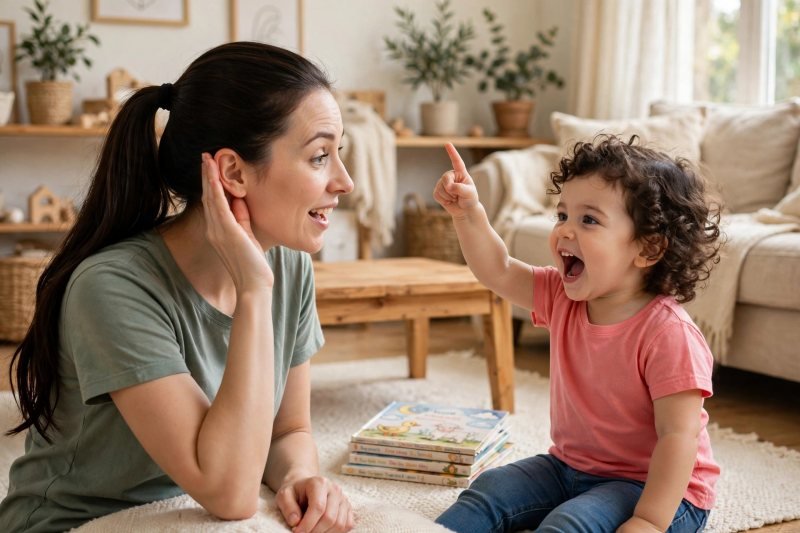
Pause before the last word and let them fill it in. Next time through, leave a gap before the final word of each line so your toddler can shout it.
-
Add one new rhyme every few days. Keep the favorites in rotation.
-
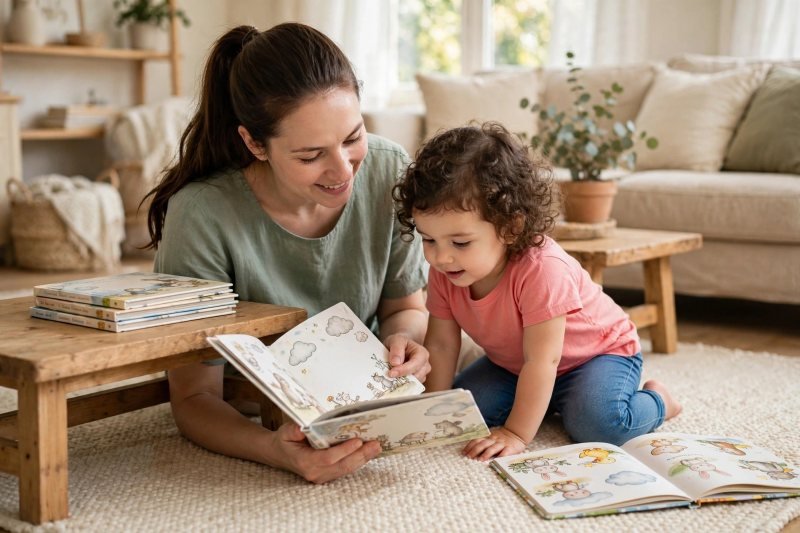
Sing the same bedtime rhyme nightly. The routine becomes the sleep cue.



Make it easier
Start with just the chorus or the catchiest verse. Hum the melody if you can't remember words — the rhythm still counts. Let your toddler do only the actions while you sing the words. One rhyme at a time; don't try to learn all twenty in a week.
Make it harder
Pause mid-line and let your toddler supply the rhyming word. Invent new verses together ("the wheels on the bus go… backwards?"). Ask "what rhymes with star?" after Twinkle Twinkle — early rhyming games. Our phonics activities for preschoolers have more sound-play games. Sing a counting rhyme backwards from a bigger number.
Other ways to play it
- Rhyme basket: put soft toys in a basket, one per rhyme; your toddler picks one and you sing its rhyme.
- Rhyme walk: sing a marching rhyme (Jack and Jill, This Old Man) on every walk.
- Whisper version: sing a favorite rhyme in a whisper for a calm-down game.
- Puppet show: act out Humpty Dumpty or the Five Little Ducks with stuffed animals.
How it changes by age
- Ages 1–3. Under-2s are listeners and bouncers — sing to them, rock them, let them clap along. Age 2 is the sweet spot for actions and joining in with single words; age 3 brings full verses, invented rhymes, and strong opinions about which verse comes next. Never too early, never too late.
What they're learning
Phonological awareness: hearing rhymes, beats and sound patterns — the core pre-reading skill. Vocabulary: rhymes pack unusual words (fetch, pail, speckled) into memorable contexts. Memory: reciting whole verses is serious memorisation work for a toddler brain. Counting: the number rhymes build forward and backward number sequences. Pair them with our counting games for preschoolers for more number play. Motor skills: clapping, pointing, falling down on cue — all coordination practice. Prediction: knowing what comes next in a familiar rhyme is early comprehension.
Clearing up
Nothing to clear up — that's the beauty of it. The only trace is a toddler humming Twinkle Twinkle under their breath at 6am, which is arguably not a trace at all.
Questions parents ask
When should I start singing nursery rhymes to my child?
How do nursery rhymes actually help with reading?
My toddler won't sit still for rhymes. What should I do?
How many nursery rhymes should my toddler know?
Should I use actions or just sing?
Can nursery rhymes be in another language?
Your voice is enough. You don't need the "right" version of any rhyme — families have sung these differently for generations, and your toddler's version is now the correct one. Sing badly, sing often, and let the fiftieth repeat be as joyful as the first. When your toddler outgrows the rhymes, the Bright Playday reading hub picks up where listening leaves off. Zero guilt about anything here: this is the good stuff.

save it for later
Pin this for the next rainy afternoon
Keep it on a board so it is there when you need it, rather than when you happened to find it.
Save to PinterestTry this next
-

Why Nursery Rhymes Matter for Reading: What the Research Says for Parents
Ages 2–3
-

Itsy Bitsy Spider Lyrics and Fingerplay: A Toddler Rhyming Favorite
Ages 2–3
-

What Order to Teach Letters and Sounds: Sounds First, Here's Why
Ages 3–4
-
Alphabet Recognition Activities for Preschool: 10 No-Worksheet Games for Ages 3–4
Ages 3–4


