


Day and Night for Kids: Simple Explanation + Activity
Day and night for kids: the Earth spins once every 24 hours, so the side facing the Sun has day and the side turned away has night — with a flashlight spin-the-Earth demo.
Explain day and night to a 5–6-year-old in one sentence: the Earth spins like a top — the side facing the Sun has day, the side turned away has night. Prove it with a flashlight and a spinning ball: your child rolls the "you" sticker from sunshine into darkness and back.

The short version
- The Earth spins; the side facing the Sun has day, the side turned away has night.
- The Sun doesn't cross the sky — the turning Earth makes it look that way.
- One full spin takes 24 hours. Spinning the ball themselves makes it stick.
- Age
- Ages 5–6
- Prep
- 5 min
- Play time
- 30 min
- Mess
- None
- Difficulty
- Easy
- Where
- Indoor
Why kids love this
They make sunrise happen with their own hands — rolling their sticker from sunshine into dark and back, and stopping it at the exact moment morning arrives. The spin-and-shout round — DAY! NIGHT! — turns a science fact into a game they beg to play again. And holding the ball on its dark side at bedtime turns “goodnight, Earth” into a ritual that locks the idea in as they fall asleep. Nothing here feels like a lesson: it’s a flashlight, a ball, and a child in charge of the planet. ## Why do we get day and night? Because the Earth never stops spinning. Sunlight reaches one side of our turning planet: the lit half is daytime, the shadowed half is night. One full turn takes 24 hours — one day-and-night cycle. Every morning, your part spins back into the sunlight. ## Does the sun really move across the sky? It looks like it — low at sunrise, high at noon, low at sunset. But the Sun stays put; the Earth turning underneath us makes it seem to travel. In the demo, your child watches "sunrise" while the flashlight never moves an inch. Follow the Sun through a whole day and its path draws one smooth arc — climbing from the horizon in the morning, peaking around midday, then sliding back down by evening. That arc is why shadows stretch long at breakfast, shrink to almost nothing at noon, and stretch long the other way by dinner.
What you'll need
- 1 large plain ball (globe, beach ball, or big orange — nothing printed on it)
- 1 sticker or tape dot ("you are here")
- 1 flashlight
- A room you can make dim
- chalk for the shadow check
Before you start
Dim the room. Set the flashlight on a chair, beam across the space — the Sun, which will not move. Place the ball a few feet away, "you" dot facing you. Five minutes.
How to do it
-
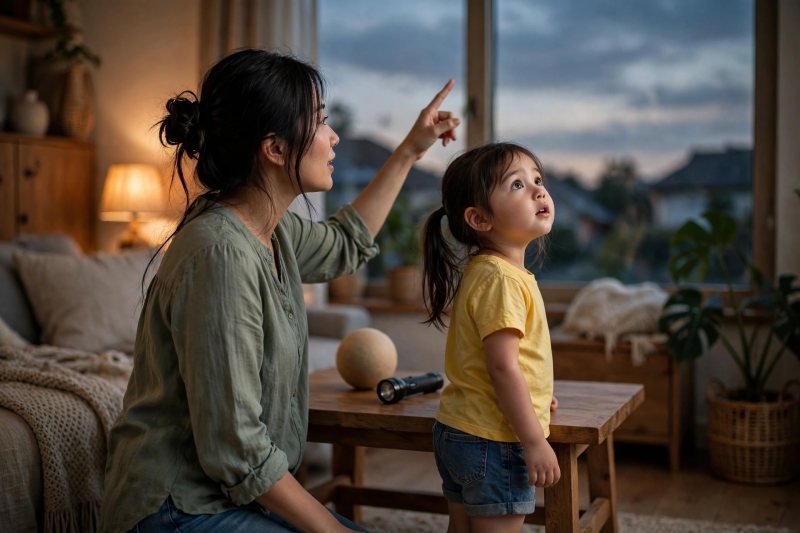
1. **Ask the wonder question.** "Where does the Sun go at night?" Listen — "it sleeps behind the mountains" is a perfect start. Dim the lights: "Let's find out."
-
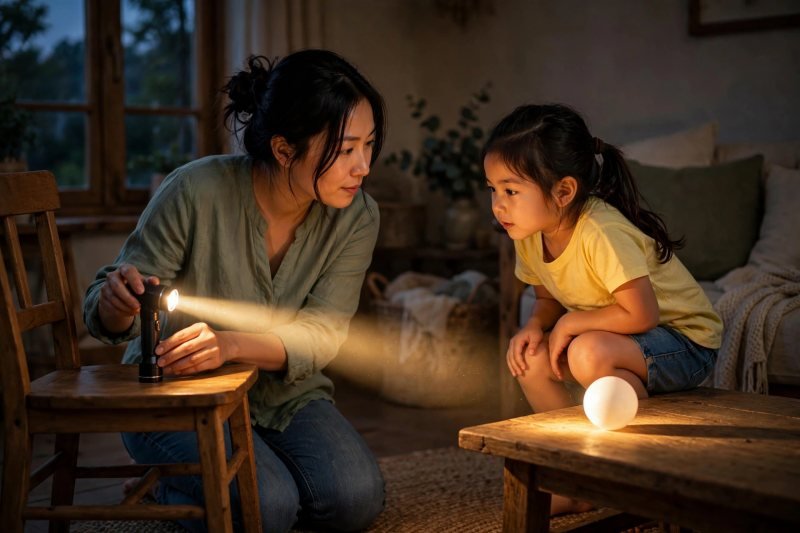
2. **Build the model.** "This flashlight is our Sun — it never moves. This ball is Earth — where we live."
-
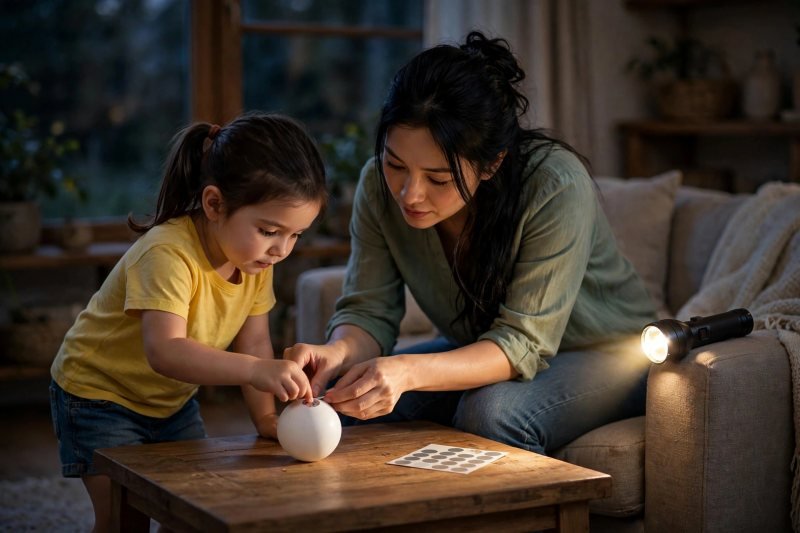
3. **Put "you" on the planet.** Stick the dot facing the flashlight. "That's you! It's daytime, because the sunlight reaches you."
-
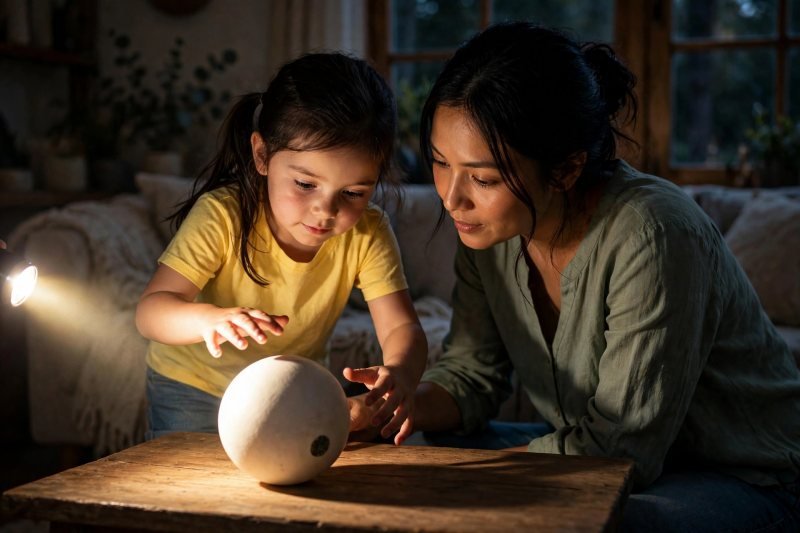
4. **Show daytime.** Aim the flashlight at the ball; your child holds a hand by the lit side, then the dark side. "Light side is day. Dark side is night."
-
5. **Spin into nighttime.** Turn the ball VERY slowly so the dot swings away from the light. "You rolled into night. The Sun didn't move — the Earth spun."
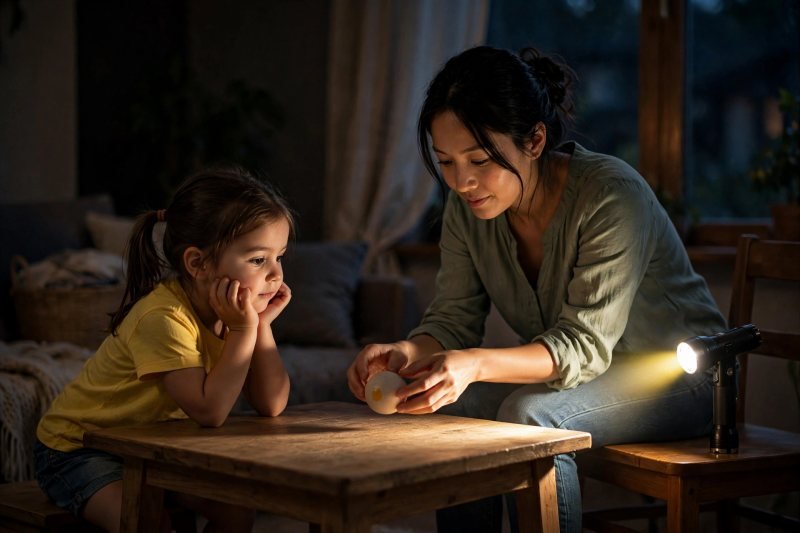
-
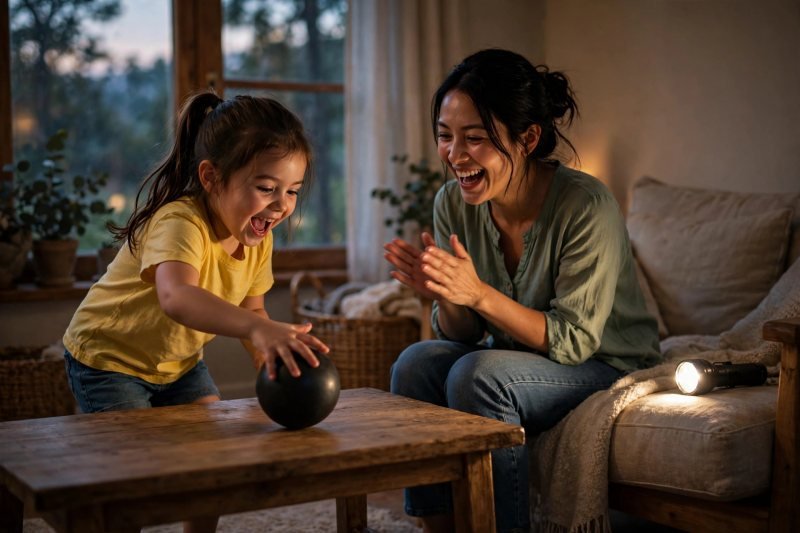
6. **Let them drive.** "Spin slowly. Dot in light — shout DAY! Dot in dark — shout NIGHT!" Five or six spins. This is the memory anchor.
-
7. **Make a sunrise.** "Find the moment morning comes." They spin until the dot touches the light. "That's sunrise — you made morning."

-
8. **Connect it to the real sky.** At a window: "Our real Earth is spinning right now. Is our side in light or dark?" Name it together — and spot the Sun.

-
9. **Catch a moving shadow.** Mark a shadow's tip with chalk. Check it an hour later. "The shadow moved, but the Sun didn't — our spinning Earth moved us."

-
10. **End with goodnight Earth.** At bedtime, hold the ball with the dot on the dark side. "We've spun away from the Sun — that's why it's night. Now spin toward morning: you'll wake in the light." Lights out.



Make it easier
Do steps 1–7 first; the window and shadow checks can wait. You spin while they shout DAY and NIGHT — calling it out is the learning part at 5.
Make it harder
Ask: "If it's night for us, is it night for everyone?" Spin the dot dark, point at the lit side: "Someone over there is eating lunch in sunshine — right now!" Add the Moon: a smaller ball circling the Earth-ball while it spins.
Other ways to play it
- Morning Sun check: for a week, glance out each morning — is the Sun "up yet"? Your child is catching their real sunrise.
- Night-sky follow-up: after the demo's dark side, find the Moon outside, then sing it down.
- Sky journal: note daily whether the Sun is out or gone on a simple chart.
How it changes by age
- Ages 5–6. Most 5-year-olds grasp the spin in the demo but need the shadow check days later for it to feel real; 6-year-olds can explain it back after a few spins. By 6, set that as the expectation: hand your child the ball and ask them to show you, in their own words, why it is night here and morning somewhere else. If your child insists the Sun really does move, don’t argue the point — repeat the shadow check (step 9) a few days later and let the moved shadow make the case. Next step: revisit the demo on a cloudy day and talk about what changed.
What they're learning
Earth science: the Earth rotates; day and night come from the spin, not a moving Sun. Cause and effect: turning the ball moves the sticker in and out of light. Observation + scientific habit: guess, test with a model, check the real sky.
Clearing up
Sticker off, flashlight away, curtains open — done in five minutes.
Questions parents ask
How do you explain day and night to a 5-year-old?
Does the sun move across the sky, or does the earth move?
Where does the sun rise and set?
What age do kids understand day and night?
How long does it take the earth to spin around once?
Can I do the day and night experiment without a globe?
This demo is about the daily spin only — the seasons are a different story (Earth’s tilt and its year-long trip around the Sun), so don’t let the two ideas get tangled. Repeat the demo every few months rather than every week: your child is older each time, so the same spinning ball answers a bigger question on every round. School will call this spin the Earth’s rotation on its axis — using those two words at home now and then means your child meets a familiar idea, not a new one, when the terms arrive in class.

save it for later
Pin this for the next rainy afternoon
Keep it on a board so it is there when you need it, rather than when you happened to find it.
Save to Pinterest
