


Short A CVC Words: 40 Words (Cat, Hat, Map) + Blending Tips
40 real short a CVC words (cat, hat, map) grouped by word family, with a three-step blending routine: oral blending, finger blending, read it.
Short a CVC words like cat, hat and map are the best first words to sound out, because every letter makes its expected sound. Teach them in word families (-at, -an, -ap, -ad, -ag, -am) with a three-step blending routine: first you stretch the sounds aloud, then your child slides a finger under the letters, then they read the whole word. Ten minutes a day, one family at a time.

The short version
- Short a is the easiest vowel to hear and say — the ideal first sound-out list.
- All 40 are genuine three-letter CVC words with the short-a sound, in six families: -at, -an, -ap, -ad, -ag, -am.
- The method is one three-step routine: oral blending, finger blending, read it.
- One family per session, ten minutes a day; if blending stalls, play spoken blending games for a week, then return.
- Age
- Ages 4–5
- Prep
- 5 min
- Play time
- 10 min
- Mess
- None
- Difficulty
- Easy
- Where
- Indoor
Why kids love this
Short a is the easiest vowel to hear and make — a big open "ah." Once your child blends cat, hat and map, they have cracked the code behind every other short vowel.
Short a is always the same open "ah," so these short a CVC words are the perfect first word list. Work one family at a time, ten minutes a day: you stretch the sounds aloud, your child slides a finger under the letters, they read the whole word.
What you'll need
- Index cards or small slips of paper (about 40)
- A marker
- A small unbreakable mirror
- A paper bag for the sorting game
Before you start
Write each of the 40 words on its own card, one family per pile (-at, -an, -ap, -ad, -ag, -am). Word only, no pictures.
How to do it
-
Warm up the ear: oral blending. Stretch sounds and let your child squash them together: say "c–a–t" slowly, mouth wide open on the middle sound — "What word is that?" Three or four tries is a full warm-up.

-
Meet the short-a sound. At the mirror: mouth open wide, tongue down, "ah." Try it silly — a doctor checking throats. Hear the "ah" hiding in "cat," "hat," "map."

-
Start with the -at family. One card at a time: cat, hat, bat, sat, rat, mat, pat, fat. The clue: a cat in a hat, sitting on a mat. You read the first — "c–a–t… cat!" — then your child takes the next. Same ending, new beginning.

-
Move to the -an family. Next pile: man, can, pan, van, ran, fan, tan. The clue: a man waving from a van. Only the first letter changes, so your child leans on the pattern they already cracked.

-
Then the -ap family. Next set: map, tap, cap, nap, lap, gap, zap. Clue: a pirate's treasure map. You stretch, they blend — the words come faster now.

-
Next, the -ad family. The pile: bad, dad, had, sad, mad, pad, lad. Clue: "dad is never mad." Ham it up — a sad face for sad, a grumpy one for mad.

-
Continue with the -ag family. Lay out: bag, rag, tag, wag, sag, gag. Clue: a shopping bag with a price tag. Wag like a puppy's tail while they read it.

-
Finish with the -am family. Last pile: jam, ham, ram, yam, dam. Clue: sticky jam on warm bread — all forty short a CVC words read from print.

-
Blend it three ways. Loop back through favorite cards. Oral: you stretch ("m–a–p"), they say the word. Finger: they slide one finger under the letters, then sweep back fast and say the whole word. Read it: eyes on the card, whole word in one breath.
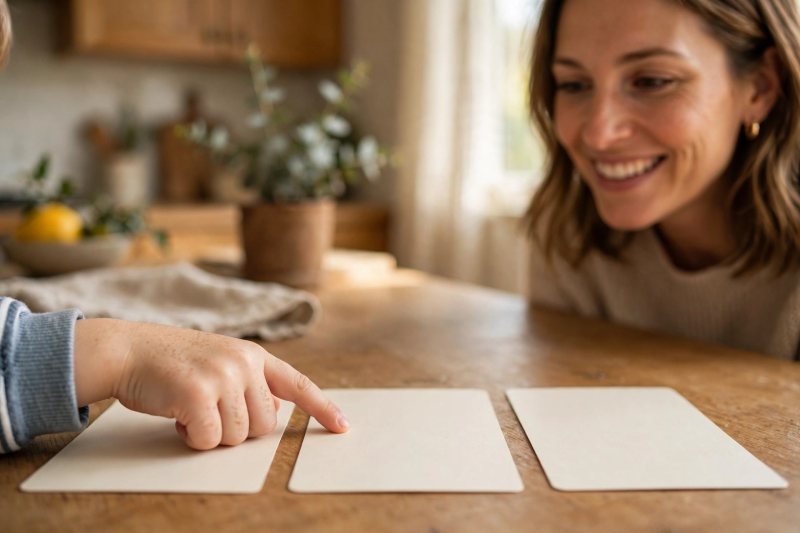
-
Play read-and-act, then celebrate. Shuffle six cards and take turns drawing: read the word, then act it out — nap means everyone pretends to sleep. End on an easy word, then celebrate with a high-five!



Make it easier
Do just one family per day. The -at family alone is a complete first session. Keep the cards face down and flip only the one you are reading. If blending stalls, drop the letters and play oral blending games for a week.
Make it harder
Mix two families into one pile (cat, can, cap) so your child reads the whole word, not just the pattern. Cover the first letter with your thumb and let them figure it out from the ending. When all 40 are easy, try the full CVC words list — 160 words, all five short vowels. A few memorized words pair well with sounding out: our first 10 sight words for preschool.
Other ways to play it
- Word-family bag: Toss all 40 cards in the paper bag. Your child pulls one, reads it, and sorts it into the right family pile.
- Robot voice: Read the cards in a stiff robot voice, stretching each sound. Kids love correcting the robot.
How it changes by age
- For 4–5-year-olds who know most letter sounds and can hear sounds inside spoken words. Younger fours may need a week of oral blending games first.
What they're learning
Blending — the core skill of sounding out words — plus onset-rime awareness (hearing how cat and hat share an ending), letter-sound fluency, and left-to-right tracking through finger blending. Our CVC word games turn the same blending routine into play.
Clearing up
Cards back into their family piles, mirror on the shelf. Leave the -at pile out — seeing it tomorrow invites another round.
Questions parents ask
How do I teach short a CVC words to my preschooler?
How many short a CVC words should my 4-year-old know?
Which short vowel should my child learn after short a?
My child says each sound but can't blend them into a word — what do I do?
Should I teach all six short-a word families at once?
Short a is the easiest vowel to hear and say. Our CVC words for kids guide covers all five vowels with six playful games. For the full word-family approach, our word families for kindergarten guide groups every family the same way.

save it for later
Pin this for the next rainy afternoon
Keep it on a board so it is there when you need it, rather than when you happened to find it.
Save to Pinterest


