


Tricky Words Reception: Phase 2 Words Explained for Parents (UK)
A UK parent's guide to the six phase 2 tricky words: what makes them tricky, the full list in teaching order, and four playful practice games.
The phase 2 tricky words are I, no, go, to, the and into — six words reception children learn in Letters and Sounds before they can sound them out. They are called tricky because they contain spellings or sounds your child hasn't been taught yet. Introduce two or three at a time, practice for five to ten minutes a day, and recognize them on sight rather than sounding them out.

The short version
- The six phase 2 tricky words are I, no, go, to, the and into — taught in reception alongside the first letter sounds.
- They are called tricky because they can't be sounded out with the phonics a child knows yet; they are recognized as whole words instead.
- Introduce two or three at a time, in the order your child's school teaches them, and add more only when the first feel instant.
- Practice through play — hunts, book detectives, write-and-wipe, word trains — in five to ten minute sessions, never drills.
- If your child forgets a word, say it warmly yourself and move on; forgetting is a normal part of learning at four.
- Phase 3 adds twelve longer words (he, she, we, me, be, was, you, they, all, are, my, her); Phase 4 adds fourteen more and expects spelling too.
- Age
- Ages 4–5
- Prep
- 10 min
- Play time
- 10 min
- Mess
- None
- Difficulty
- Easy
- Where
- Indoor
Why kids love this
Nothing beats your child pointing at a page and reading a whole word alone. Tricky words deliver that feeling fast — they hide in every early reading book. A ten-minute game hunting the behind the sofa cushions doesn't feel like learning; it feels like winning.
If your child is in reception at a UK school, you'll hear the phrase "tricky words" a lot. The phase 2 tricky words are a small set of common words that children meet during the first stage of systematic phonics, Phase 2 of Letters and Sounds. They're called tricky because your child can't sound them out using only the letter sounds they've been taught so far.
Think about it from a four-year-old's point of view. They've just learned that s says "sss" and a says "a", and they're proudly blending s-a-t into "sat". Then they meet the. The th sound hasn't been taught yet (it arrives in Phase 3), and the final e doesn't behave the way they'd expect. Sounding it out letter by letter simply doesn't work — so the word is taught as a whole, to be recognized on sight.
Some schools say "common exception words" — the National Curriculum term — and newer phonics schemes order them slightly differently. The idea is the same everywhere: words your child learns to recognize instantly, because sounding out would lead them astray.
There are just six of them, and most schools introduce them in this order, a couple at a time alongside the letter sounds. Taught first — the, to. These arrive early because children meet them constantly in first reading books and captions. Your child will see the on almost every page. Taught next — no, go, I. An honest note: no and go aren't truly rule-breakers — a child who knows all their letter sounds could work them out. They're included early simply because they're so useful, and some schools teach them as decodable words instead. I stands out as a capital-letter loner, which is exactly why children remember it. Then — into. Into is really in (which your child can sound out) plus to (which they now know by sight). It's the satisfying moment where two known pieces click together. That's the complete set: I, no, go, to, the, into. If you see longer lists labeled "phase 2" online, they're usually rolling the Phase 3 words in too — worth knowing, so you don't accidentally overload your child.
Because the phonics knowledge isn't there yet — and that's by design, not a problem. A tricky word is only tricky for now. Later phases teach the missing spellings, and words that once had to be memorised start making sense. The becomes decodable once th is taught in Phase 3. The whole system is built on this promise: learn the letter sounds, and keep a small collection of whole words in your pocket for the gaps. So never ask your child to sound out a tricky word as if it will work. If they try tuh-huh-eh for the and get corrected, they learn that sounding out sometimes fails — a discouraging lesson in the first weeks of reception. Instead: notice the tricky bit together, then say the whole word smoothly and move on.
Two or three — never the whole set at once. Your child's teacher will introduce them gradually over the autumn term, and home practice should follow the same gentle pace. Pick the words your child's class is currently learning (a quick ask at the school gate saves guesswork), play with just those for several days, and add the next ones only when the first feel instant. Short, happy sessions beat long ones every time. Five to ten minutes a day — a game while dinner cooks, a hunt before bath time — builds far more than weekend cramming. And always stop while it's still fun: a child who begs to play again tomorrow is learning faster than one drilled to tears today.
First, expect it. Forgetting is how four-year-old brains file things away — a word that's wobbly on Tuesday is often rock solid the following Monday. When your child hesitates, simply say the word warmly yourself and carry on reading. No sighing, no "we did this yesterday". The goal is that tricky words feel safe, never tested. If one word keeps slipping after a week or two, try a different door in: write it big in chalk on the patio, spot it together in a favorite book, or give it a silly voice. Children who struggle with a word on a card often know it perfectly inside a story — context is a powerful memory aid. If several words are all wobbly, pause new words and play only with the old ones for a while. Going back isn't going backwards.
Phase 2's six words are the shortest and simplest — mostly two or three letters, and children only need to read them at this stage. Each new phase adds a bigger batch and raises the bar. Phase 3 adds twelve (he, she, we, me, be, was, you, they, all, are, my, her). These arrive with the digraphs (th, sh, ch) that explain some earlier mysteries. Phase 4 adds fourteen longer words (said, have, like, so, do, some, come, were, there, little, one, when, out, what) — and by now children are expected to spell the tricky words too, not just read them. The pattern to notice: the words get longer, the lists get bigger, and reading-only gradually becomes reading and spelling. No rush to peek ahead — a child solid on all six phase 2 words is exactly where they should be.
What you'll need
- Six word cards: index cards or cut-up cardboard with one word per card, written in clear lowercase with a chunky marker (let the ink dry fully)
- A favorite picture book your child knows well
- A mini whiteboard and pen, or a shallow tray of salt for finger-writing
- Sticky notes and a magnet for the fridge
Before you start
1. Check which tricky words your child's class is learning this week — start there, not with all six. 2. Make cards for this week's two or three words only; keep the rest out of sight for now. 3. Choose a calm ten-minute slot when your child is fed, rested, and not mid-cartoon.
How to do it
-
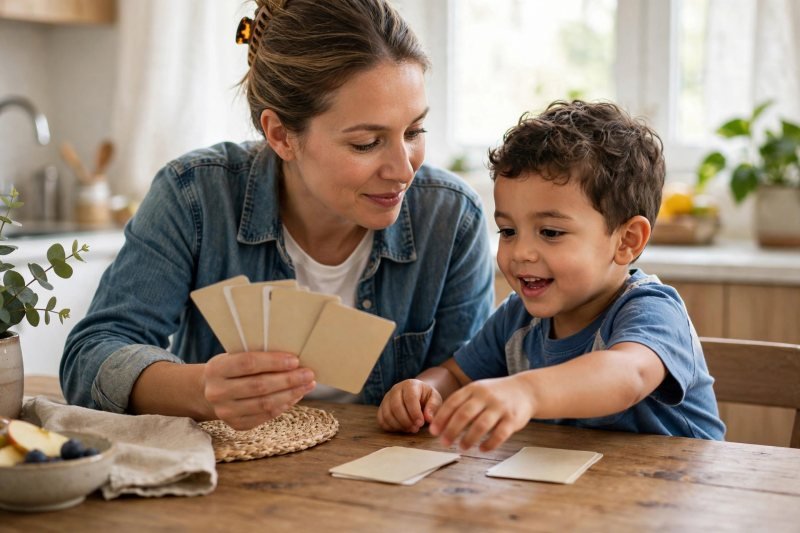
Choose this week's words. Lay out just two or three cards — the and to are the usual starting pair. Say each word aloud yourself first, nice and clearly.
-
Show, don't quiz. Hold up the first card: "This word is the. It's a tricky word — we can't sound it out yet, we just know it." Let your child repeat it. No testing, just meeting.

-
Spot the tricky bit. Run your finger under the word and wonder aloud: "That e is being sneaky, isn't it?" Noticing why it's tricky helps it stick far better than drilling.
-
Try the robot test. Say the word in silly robot sounds, then smoothly the real way; your child copies both. The contrast teaches them some words just need to be known whole.

-
Play the tricky-word hunt. While your child covers their eyes, hide the cards — behind a cushion, under a toy, on the stairs. They hunt, and every find gets read aloud with a cheer.

-
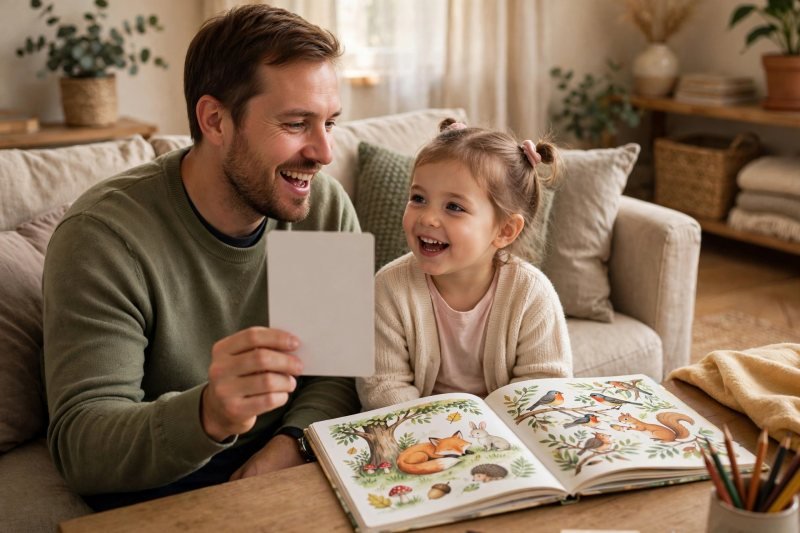
Be word detectives in a book. Open a favorite picture book and hunt the week's words together. Your child "reads" each one they spot — this is real reading, and they know it.

-
Write and wipe. Your child copies each word onto the mini whiteboard or traces it in the salt tray, saying the word as they write, then wipes it away. The wiping is half the fun.

-
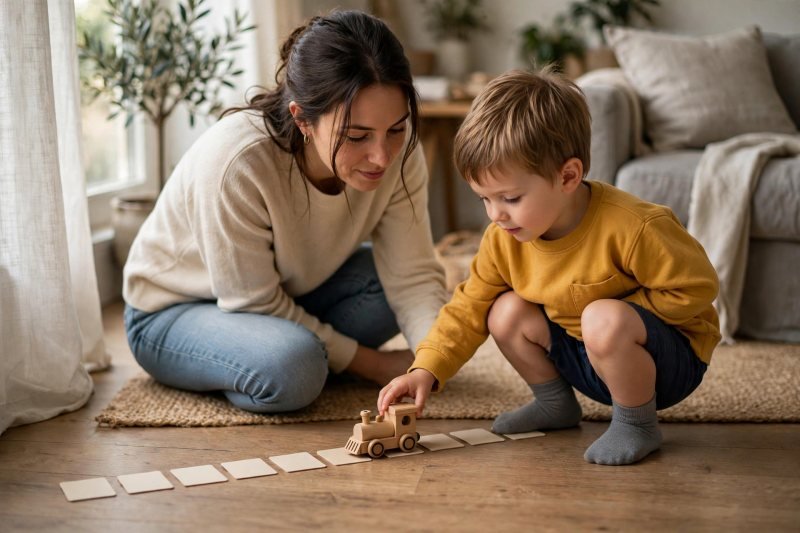
Build a tricky-word train. Line the cards up end to end like carriages and "read the train" together, front to back. Add a toy engine for full effect.
-
Do a speedy recap. Fan the cards out and celebrate every instant read with genuine delight. Hesitation? Say the word warmly yourself and move on.

-
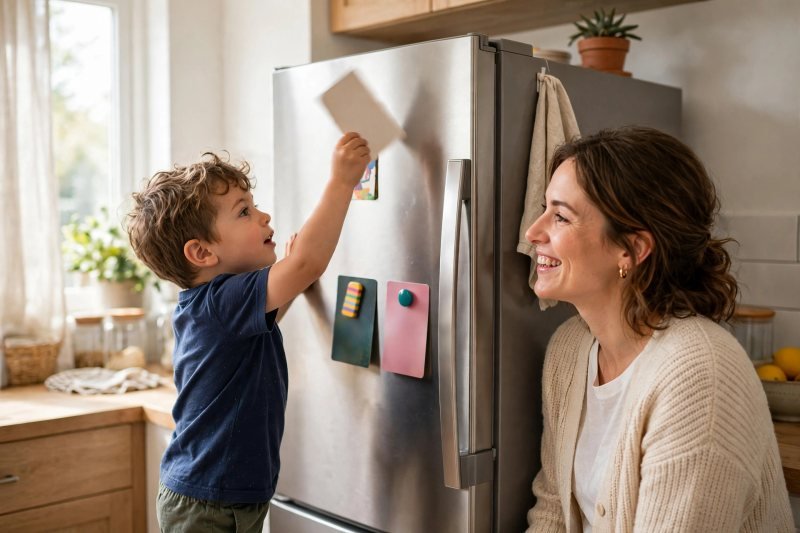
Park the words where they'll be seen. Stick this week's cards on the fridge. Old words stay up while new ones join — seeing them daily does quiet, powerful work.


Make it easier
Start with a single word — I is a lovely first win — and add a second only when it feels effortless. You read every word aloud; your child just points to the card that matches. Use oversized cards and pair each word with a silly action: march for go, shake your head for no.
Make it harder
Mix this week's words with last week's into one deck and let your child beat their own best "instant read" run. Ask for a spoken sentence using each word: "I can…", "We go to…". Hide the cards around the garden for an outdoor hunt, or have your child write each word from memory in chalk.
Other ways to play it
- Tricky-word snap: two sets of the week's cards; shout each matching word.
- Bath crayons: write the words on the tub wall for a splashy recap.
- Spot it out and about: hunt the week's words on signs, shop fronts, and cereal packets.
- Bedtime round: one card by the toothbrush for a sleepy last read.
How it changes by age
- Ages 4–5 (reception): the sweet spot — two or three new words at a time, five to ten playful minutes a day.
- Confident threes who know some letter sounds can try a single word like I or no; follow their lead and stop at the first yawn.
- Year 1 children who missed these words can run through all six as a warm-up before the Phase 3 set.
What they're learning
Instant recognition of the six phase 2 tricky words — the fast lane to reading fluency That some words are learned whole because their spellings aren't taught yet Print awareness: words are read left to right, one complete word at a time Confidence — the "I read that myself" feeling that powers everything next Early sentence sense, as I, to, and the start combining in real reading
Clearing up
Cards live in their pouch or on the fridge, ready for tomorrow's five minutes. If a word goes wobbly after a break, that's normal — a day or two of playful review brings it back. Already instant on all six? Celebrate, then ask the teacher which Phase 3 words are coming next.
Questions parents ask
What are the phase 2 tricky words?
Why are tricky words called tricky?
How many tricky words should my reception child learn at once?
What is the difference between tricky words and sight words?
When will my child move on to Phase 3 tricky words?
Follow your school's phonics scheme order — schemes introduce these words in slightly different sequences, and matching the classroom keeps things simple. Reading aloud together daily builds more pre-reading skill than any cards; tricky-word games are the seasoning, not the meal. This guide uses the standard Letters and Sounds phase groupings; other schemes use the same words in a different order.
Keep the momentum going: our high-frequency words for reception lists the 45 words your child will meet next; blending sounds activities build the sounding-out skill that runs alongside tricky-word recognition; phonics activities for preschoolers offer more sound play for the same age; and when your child is ready for the next word set, first 10 sight words for preschool, sight words for kindergarten, and sight words for pre-k pick up where this guide leaves off.

save it for later
Pin this for the next rainy afternoon
Keep it on a board so it is there when you need it, rather than when you happened to find it.
Save to Pinterest


