


Number Patterns for Kids: Odd, Even and Skip-Counting Sequences
Number patterns for kids click when odd and even become two teams to join. Ten activities take ages 6–8 from the leftover test through the evens to 40, the 5s and 10s to 100, and spot-the-rule cards.
Pair real objects two by two: no leftovers means even, one leftover means odd. Chant the evens to 40, the 5s and 10s to 100. Then give short sequences like 4, 7, 10, 13 — name the rule, say what's next.

The short version
- Even = pairs up with no leftovers; odd = one left over. The test works for any number.
- Evens 2, 4, 6… to 40; odds 1, 3, 5… to 39 — both "add 2" chains.
- The 5s alternate odd/even to 100; the 10s are all even.
- Name the rule out loud before extending — that habit is the math skill.
- Addition parity by pairing: even + even = even, odd + odd = even, even + odd = odd.
- Age
- Ages 6–8
- Prep
- 10 min
- Play time
- 40 min
- Mess
- None
- Difficulty
- Medium
- Where
- Indoor
Why kids love this
Why do odd and even numbers feel like a secret code? Every number belongs to one of two teams, and nobody told them the password. Once kids learn the leftover test, they test everything in the house.
What makes spot-the-rule games feel like detective work? A short row with one hidden rule is a solvable mystery. Naming the rule out loud — "it adds 3 each time" — feels like cracking a case.
What you'll need
- 20–30 small pairing objects (socks, buttons, beads, coins) and 2 baskets
- Masking tape, blank 10-by-10 grid, crayons in two colors
- 20 blank index cards, wooden blocks, home stairs (or hallway)
Before you start
1. Bowl 20 pairing objects; set out two team baskets. 2. Tape a ten-foot line on the floor. 3. Leave cards blank — build sequences together.
How to do it
-
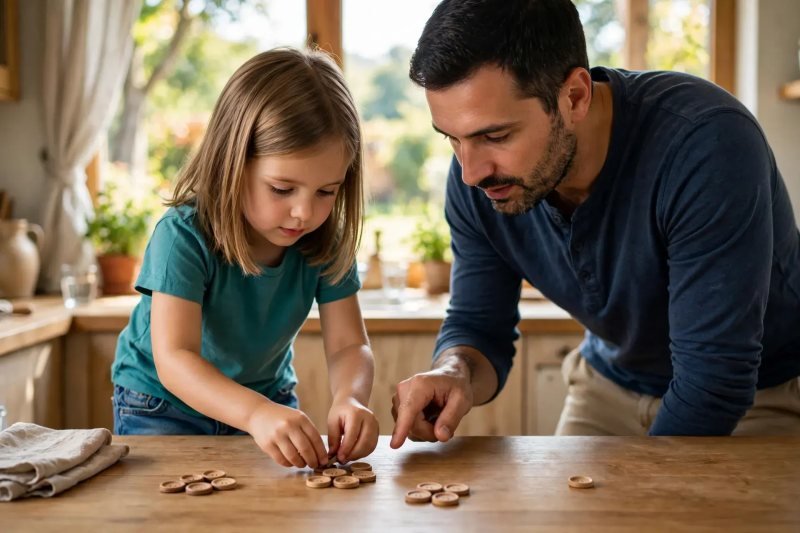
Test odd and even with the leftover test. Pair up buttons. Four pair up neatly — no leftovers — so 4 is even. Five leave one alone — so 5 is odd. Sort 1–10: odds 1, 3, 5, 7, 9; evens 2, 4, 6, 8, 10. Rule: no leftovers means even, one leftover means odd.

-
Stomp the odds and clap the evens. Stomp odds, clap evens, counting 1 to 20. Chant the evens: 2, 4, 6, 8, 10, 12, 14, 16, 18, 20, 22, 24, 26, 28, 30, 32, 34, 36, 38, 40. March the odds: 1, 3, 5… to 39.

-
Walk the evens line. Hop the taped line, one jump per even: 2, 4, 6… to 40, then back for the odds: 1, 3, 5… to 39. Race: you take evens, your child takes odds.

-
Find the +2 rule. Build block rows — odd (3, 5, 7, 9), even (2, 4, 6, 8). Each adds 2. Extend: odds 11, 13, 15; evens 10, 12, 14. Big idea: both are "add 2" chains with different starts.

-
Chant the 5s and 10s to 100. Chant the 5s: 5, 10, 15, 20, 25, 30, 35, 40, 45, 50, 55, 60, 65, 70, 75, 80, 85, 90, 95, 100 — switching teams every step. Then the 10s: 10, 20, 30, 40, 50, 60, 70, 80, 90, 100 — all even.

-
Play spot-the-rule cards. Lay four cards: 5, 10, 15, 20 — rule: add 5, so 25, 30, 35. Tricky: 4, 7, 10, 13 — add 3, so 16, 19, 22. Showstopper: 2, 4, 8, 16 — each doubles — so 32, 64. Name the rule first.

-
Reveal patterns on a hundred chart. Number the grid 1 to 100. Color evens one color, odds another — alternating columns. Which team claims 100? (Even.) 99? (Odd.)

-
Walk patterns backward on the stairs. Top of the stairs: evens backward — 40, 38, 36… to 2, one stair each. Climb up: odds backward — 39, 37, 35… to 1.

-
Solve addition like a detective. 2 + 4 = 6, no leftovers: even + even = even. 3 + 5 = 8, all partnered: odd + odd = even. 2 + 3 = 5, one leftover: even + odd = odd. Predict the team first: 6 + 8 = 14, 7 + 9 = 16, 4 + 5 = 9.
-
Play the secret-rule game. Your child builds a hidden-rule sequence — 25, 50, 75, 100, or 1, 4, 9, 16 — while you look away. Name the rule, say what's next, swap roles. Victory lap: evens to 40, fast.



Make it easier
Stay between 1 and 10 for steps 1–2 until sorting feels automatic. Skip steps 6 and 10 first — tricky rules can wait a week. Keep pairing real objects instead of doing it mentally. Skip counting: skip counting by 2s, 5s and 10s is the same skill, chant form.
Make it harder
Extend doubling: 2, 4, 8, 16, 32, 64, 128. Square numbers as a secret rule: 1, 4, 9, 16, 25. Alternating rules "add 2, add 3": 5, 7, 10, 12, 15. For the addition side, number bonds to 20 pair with step 9. Backward chains: counting backwards activities extend step 8.
Other ways to play it
- Sidewalk chalk: draw the number line outside and hop it.
- Car-ride rules: call a starter (3, 6, 9…) and alternate naming the rule.
- Dice build: roll for the start number and the rule, then build.
- Compare the rules: comparing numbers games turn sequences into contests.
How it changes by age
- Age 6: steps 1–4 — leftover test, chants, +2 discovery.
- Age 7: add steps 5–8 — 5s/10s, rule cards, chart, backward walks.
- Age 8: all ten steps. For the hundreds chart, counting to 100 activities.
What they're learning
Odd/even ID and the pairing strategy; 2s, 5s, 10s as pattern rules; spotting and extending sequences; addition parity; naming rules before predicting.
Clearing up
Count objects back by 2s — one last pattern. Peel tape slowly. Paperclip the cards for next time.
Questions parents ask
How do you explain odd and even numbers to a 6-year-old?
What are number patterns for kids in math?
Why do kids learn number patterns before multiplication?
How can I help my child spot the rule in a sequence?
Is skip counting by 2s the same as the even numbers?
Short daily sessions often work better than one long session. Praise rule-naming over right answers. For ordering practice, number order activities build the before-and-after sense.

save it for later
Pin this for the next rainy afternoon
Keep it on a board so it is there when you need it, rather than when you happened to find it.
Save to Pinterest


