


Counting Backwards Activities: Build Number Fluency in Both Directions
These counting backwards activities turn the hardest counting skill into the funniest: the countdown. Ten playful games for ages 4–5 that build number fluency in both directions.
Counting backwards means saying the number sequence in reverse — 10, 9, 8, 7, 6, 5, 4, 3, 2, 1 — instead of forward. Most 4–5-year-olds learn it through countdown play like rocket launches and balloon pops. It strengthens number fluency and lays the groundwork for subtraction.

The short version
- Backward is a separate skill from forward — it has to be taught, not waited for.
- Countdowns give the reverse sequence a reason to exist.
- Start at 5 to 1, then stretch to 10 to 1; surprise starting numbers come last.
- Wobbles cluster around 7 to 6 and 4 to 3 — slowing down fixes most of them.
- Ten short games, rotated over a few weeks — no worksheets.
- Age
- Ages 4–5
- Prep
- 5 min
- Play time
- 15 min
- Mess
- Low
- Difficulty
- Medium
- Where
- Both
Why kids love this
Why does counting backwards matter if my child can already count forward? Forward counting is a memorized song; backward counting is navigation. Forward, each number pulls the next along. Backward, every step asks: what comes before 7? That question builds real number-line knowledge — and makes subtraction far less scary.
Why is counting backwards so much harder than counting forward? Forward sequences get practiced hundreds of times — songs, books, stairs. Reverse sequences almost never, and each forward word cues the next. Backward, there is no cue — which is why countdown games work: the rocket, the timer, the popping balloon supply the missing structure.
At what age do kids learn to count backwards? Most children manage 5 to 1 by around age 4 and 10 to 1 by age 5 — but practice matters more than age. Expect the start of the sequence to flow, then pauses in the middle — the classic sticky spots are covered in Clearing up below. A few short sessions a week smooths it out within weeks.
What you'll need
- Fingers, painter's tape, blocks, balloons, cardboard box, chalk, kitchen timer, foam die
How to do it
-
Fold the fingers: 5 to 1. Hold up five fingers. Say "five" and fold one down, then "four," folding another — down through "one."

-
Launch the rocket: 10 to 1. Crouch together and count backwards from 10, sinking lower with each number. At "one," jump up shouting "blast off!"

-
Walk the backwards number line. Lay a strip of painter's tape on the floor. Walk backward along it, one step per number, counting down from 10.

-
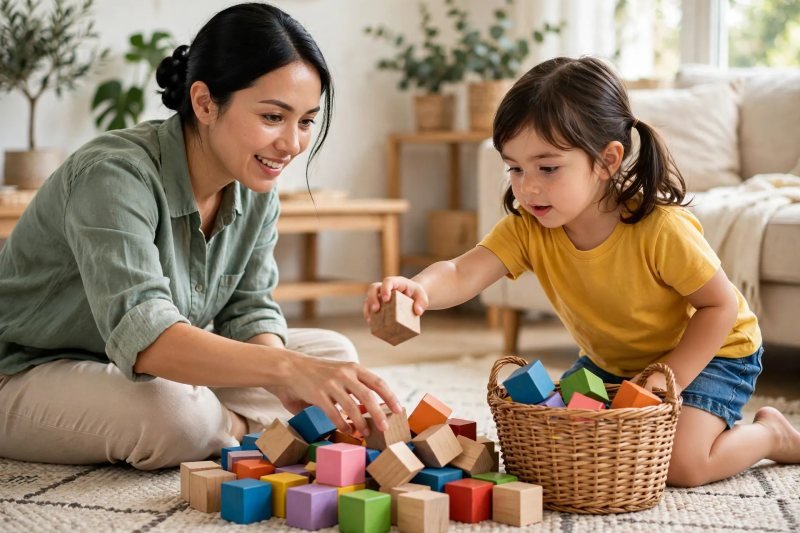
Play the take-away race. Pile up ten blocks; your child pulls one out per backward number — "ten" (pull), "nine" (pull)… First to empty the pile wins.
-
Pop the countdown balloons. Blow up five balloons. Count down 5 to 1, popping one balloon per number — you handle the pin (see Safety notes).

-
Ride the elevator down. Put a small toy in a cardboard-box "elevator." Call out floors from 10 down to 1 while lowering the box. At 1, doors open. Then ride back up.

-
Hop reverse hopscotch. Draw a chalk grid and hop through it backwards from 10 to 1, calling out the number you land on before each hop.

-
Count down hide-and-seek. Your child covers their eyes and counts down from 10 while you hide — a new, sillier spot every round.

-
Beat the timer. Set a kitchen timer for one minute: tidy the toy bin before it dings. Chant the final countdown together.

-
Surprise starts. Roll a soft foam die; whatever lands face-up starts the countdown — 6, 4, 3… The graduation step.



Make it easier
You count; your child folds fingers, pops balloons, or hops. Stay at 5 to 1 until it is easy, then stretch to 10 to 1 over a few days. Let them whisper the hard transitions (7 to 6, 4 to 3) instead of saying them loud.
Make it harder
Count backwards from 20, then from 30. Start from a surprise number above 10 — call out "start at 14!" Whisper the odds, shout the evens, all the way down. When 20 feels easy, try our counting to 20 activities.
Other ways to play it
- Bathtime: count five rubber ducks down into the tub — "five, four, three, two, one — splash!"
- Snack math: five apple slices on the plate, eaten one per backward number.
- Staircase: walk downstairs counting each step backwards from the top stair.
- Car ride: count down the minutes until you arrive — "ten more minutes… nine more…"
How it changes by age
- Young 4s thrive on steps 1–4 with you counting alongside (see our counting activities for toddlers for the earliest number play). Older 4s and 5s can run all ten and lead the countdowns. If backwards from 10 is rocky, build the forward sequence first: our counting games for preschoolers.
What they're learning
Math: the reverse number sequence to 10 and beyond — number fluency in both directions. Math: the mental motion subtraction runs on — taking away is counting backwards. Memory: holding a number in mind while finding the one before it. Language: "what comes before…?" thinking and before/after vocabulary. Self-regulation: pacing themselves against the stronger forward pull. Math foundations: the reverse sequence is core early math — see our math hub for what comes next.
Clearing up
"They keep sliding back into forward counting." Normal — the forward chain is years stronger. Pause, laugh, restart together. "They always get stuck at 7 to 6 and 4 to 3." The two classic sticky spots — slow down and rehearse just those pairs. "They can count back from 10 but not from 6." Normal — starting mid-sequence is harder. Step 10 builds exactly that. "They won't even try." Return to step 1 with you counting; listening is the first phase.
Questions parents ask
At what age can children count backwards?
Why is counting backwards harder than counting forwards?
How can I teach my child to count backwards from 10?
Does counting backwards really help with subtraction?
My child says the backwards numbers out of order. Is that normal?
How do I move from counting backwards from 10 to counting backwards from 20?
Countdowns are everywhere: microwaves, crosswalk signals, elevators. Narrate them backwards together and practice happens for free. Keep a "countdown of the day" at a fixed moment — bedtime, the school run. Tiny rituals beat long sessions. If forward counting to 10 is shaky, build that first. Backward counting sits on top of it.

save it for later
Pin this for the next rainy afternoon
Keep it on a board so it is there when you need it, rather than when you happened to find it.
Save to Pinterest

