


Growing Patterns for Kids: Spot the Rule and Extend It
These growing patterns activities for kids turn "what comes next?" into a detective game for ages 6–8. Build block staircases, chain toothpick squares, and stack growing triangles — then spot the rule that makes each pattern grow and extend it yourself.
A growing pattern is a sequence where each stage gets bigger by a fixed rule — like block stairs of 1, 2, 3, 4, 5 blocks. Build the first stages together, then ask "how many more did we add?" Writing the numbers in a row (4, 7, 10, 13) makes the rule visible, and building the predicted next stage to check is where the real learning happens.

The short version
- A growing pattern gets bigger the same way each time — the "rule" is how much is added.
- Build first, count second; then write the numbers in a row — rules reveal themselves in sequences.
- "How many more did we add?" turns guessing into rule-finding.
- Test every prediction — predict, check, adjust.
- Let your child invent a pattern; rule-making cements rule-finding.
- Age
- Ages 6–8
- Prep
- 5 min
- Play time
- 15 min
- Mess
- Low
- Difficulty
- Easy
- Where
- Indoor
Why kids love this
Every step feels like cracking a code. They build something, squint at it, and suddenly shout "I see it!" — then prove it by building the next stage. There's the drama of the doubling cups, the beauty of the flower row, and inventing a pattern tricky enough to stump a parent.
What is a growing pattern? — A growing pattern is a sequence where every stage gets bigger the same way each time. A block staircase is the classic: one block, then two, then three, four, five — the rule is "add one more block each time." Once a child can name that rule, they can predict stair six without building it. That leap, from seeing what happened to saying what will happen, is where the real learning happens.
Why are growing patterns the next step after repeating patterns? — Repeating patterns teach a child to look back: red, blue, red, blue, so red comes next. Growing patterns teach them to look for the engine: how much did we add, and was it the same again? That shift — from what repeats to how something changes — turns counting practice into reasoning.
How do I help my child spot the rule without giving it away? — Ask "how many more did we add?" instead of "what's the rule?" — the rule falls out of the countable answer. Cover the later stages so only the first three show, and write the numbers down (4, 7, 10, 13…) — it usually helps: rules hide in objects but show themselves in number rows. If your child is stuck, think aloud — "I added three this time and three last time, so I bet it's three again" — and let them test your bet.
What's the difference between a growing pattern and a repeating pattern? — A repeating pattern comes back to where it started — red, blue, red, blue — and the question is "what repeats?" A growing pattern doesn't cycle back; it keeps getting bigger, and the question is "how much bigger each time?" Repeating patterns train prediction from memory, while growing patterns train prediction from a rule.
My child keeps guessing the next number instead of finding the rule — is that okay? — Completely normal, and a good sign. A guess is a hypothesis; what matters is what happens next. Don't say right or wrong — say "let's build it and check." Testing a guess by building the next stage is exactly how mathematicians work: predict, test, adjust.
What you'll need
- - Wooden blocks or building bricks (about 50 pieces)
- - Toothpicks or short craft sticks (about 40)
- - Colorful pompoms (about 40) and a few buttons for flower centers
- - Pennies or flat counters (about 20)
- - 5–6 paper cups
- - Number cards, or paper slips with numbers written on them
- - A tray or placemat to build on, plus paper and crayons for the number rows
Before you start
Sort the materials into small bowls — toothpicks, pompoms, pennies — so each step starts tidy. Clear a table or floor space with room to line up five or six pattern stages in a row; seeing all the stages at once is what makes the rules visible. Keep paper and crayons within reach. Nothing else needs setting up.
How to do it
-
Build the staircase. Stack blocks into stairs: 1, 2, 3, 4, 5. Line them up, then ask: "How many blocks will stair six need?" The rule — add one more each time — is the gentlest there is.

-
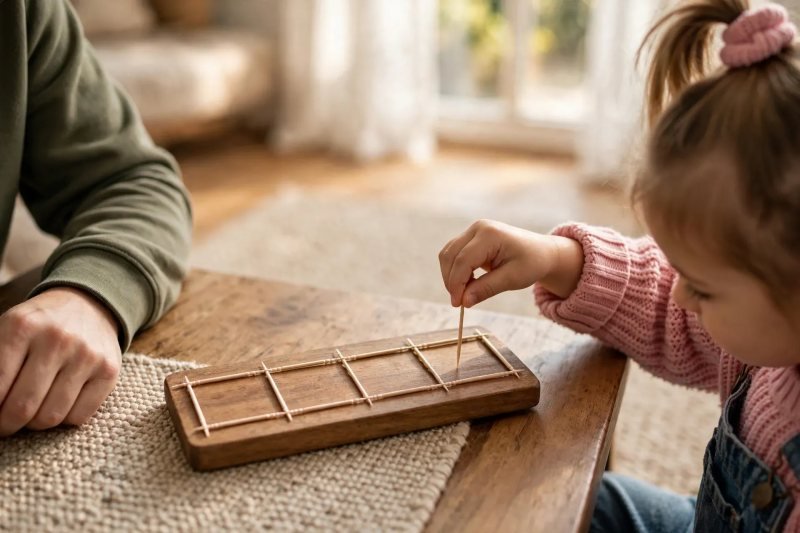
Chain toothpick squares. Lay one square (4 toothpicks), then a second sharing a side (7), then 10, 13, 16. Write the row — 4, 7, 10, 13, 16 — so the rule jumps off the page: add 3 each time.
-
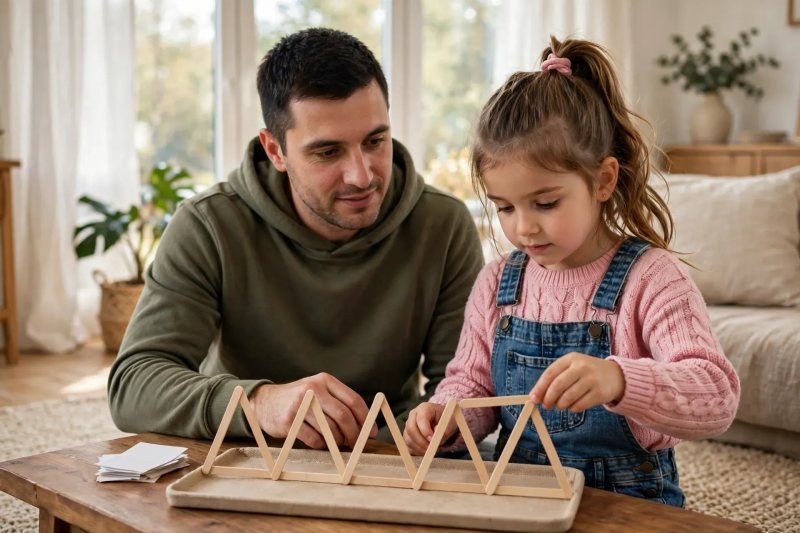
Chain toothpick triangles. Same game, new shape: 3, 5, 7, 9, 11, each triangle sharing a side. Which shape's rule adds more — squares add 3, triangles add 2? Comparing rules is early algebra.
-
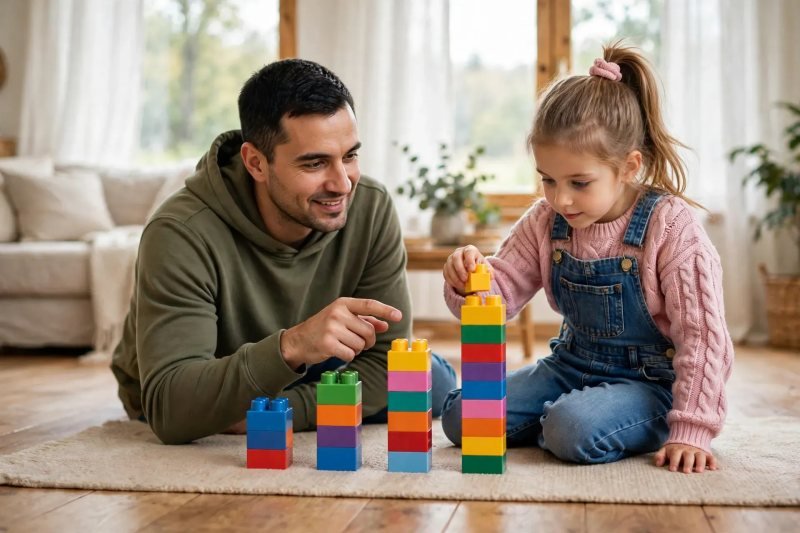
Stack two-at-a-time towers. Build brick towers in jumps of two: 2, 4, 6, 8, 10 — skip counting your child can climb. Try our skip counting by 2s, 5s and 10s activities when they're ready for numbers without blocks.
-
Grow a pompom flower. Button center, then petals: 4, 8, 12, 16, 20. Each flower adds 4 petals. Line them up — counting by fours hides inside the beauty.

-
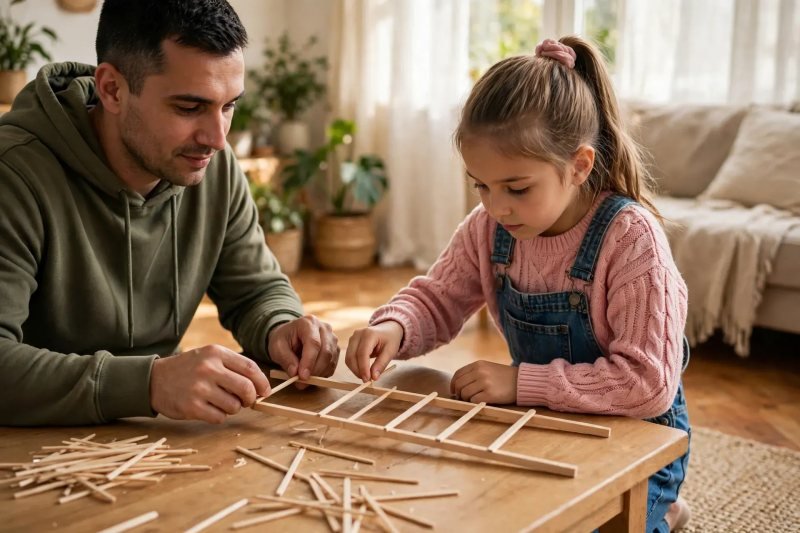
Build a stick ladder. Two rails, then rungs: 3 sticks for one rung, 4 for two, 5 for three, 6 for four. The rule — add 1 each time — hides inside a ladder.
-
Play number detective: 2, 4, 6, 8. Lay out number cards: "What's the rule? What comes next?" Extend together — 10, 12, 14 — and say it in words: "add 2 each time." Then start fresh: 3, 6, 9, 12… does the rule change?

-
Build the growing triangle. Stack pennies: 1, 3, 6, 10, 15. Check the additions: 2, then 3, then 4, then 5. The rule itself is growing — save this for a proud moment.

-
Double the cups. Line up cups: 1 pompom, 2, 4, 8, 16. Each cup doubles the last — ask how many the sixth needs (32). Doubling is a growing pattern with a dramatic rule.

-
Invent your own growing pattern. Hand over the materials box: your child builds a growing pattern from anything — buttons, beads, snacks — and the family guesses the rule. Rule-making cements rule-finding.


Make it easier
- Start with steps 1 and 6 only — both use the simplest rule, "add 1 each time."
- Build the first four stages yourself and let your child spot the rule from the finished row.
- Keep the numbers written down for every step; reading the rule off a number row is easier than finding it in the objects.
- Play our one-more-one-less games first if "one more" still feels wobbly — that fluency makes every growing rule easier.
- Shaky on digits? Number recognition activities for preschoolers firm up the symbols first.
Make it harder
- Give only the numbers: "4, 7, 10, 13 — draw stage five."
- Try the rule-that-grows: 1, 3, 6, 10, 15 (add 2, then 3, then 4, then 5).
- Show stages 3–5 and ask your child to work backward to stages 1 and 2.
- Connect step 4 to number bonds to 20: which pairs make each tower?
- Have your 8-year-old write the rule with a blank: "Each stage adds ___ more."
- Quick-see practice: subitizing activities for kindergarten sharpen the instant-counting behind rule-spotting.
Other ways to play it
- - Snack patterns: grow a pattern with cereal pieces or berries — eat stage one as the reward for predicting stage six.
- - Sidewalk chalk stairs: draw a giant staircase outside and hop the growing numbers.
- - Nature growth: collect leaves or pebbles on a walk and build the staircase from found objects.
- - Pattern journal: a notebook where every discovered rule gets logged like a scientist's notes.
- - Stump the grown-up: the child invents a pattern; the adult must find the rule.
How it changes by age
- Ages 6 to 8. At 6, stick to the physical builds with "add 1" and "add 2" rules (steps 1, 3, 4, 6) and celebrate every spotted rule. At 7, the toothpick chains and number detective click — the sweet spot. At 8, push the number-only challenges and step 8's rule-that-grows. If step 1 feels tricky at 6, spend more time on repeating patterns first — no rush. For the counting base, counting to 10 activities keep the numbers fluent.
What they're learning
- Rule identification: finding the consistent change behind a sequence — early algebraic thinking. - Prediction and verification: using a rule to predict the next term, then testing it. - Addition fluency: adding 1, 2, 3, and 4 repeatedly, in context. - Skip counting: the towers (2, 4, 6, 8) and flowers (4, 8, 12, 16) with a physical anchor. - Multiplication readiness: the cups show how doubling grows numbers fast. - Math language: describing a rule in words — "add 3 each time." - Persistence: sitting with "I don't see it yet" until the rule clicks.
Clearing up
A common mix-up is thinking a growing pattern is just counting by ones. Counting by ones is only one growing rule — adding 2, 3, or 4 each time, or doubling, are growing patterns too, and the rule is what matters, not the size of the jump. Another mix-up is thinking the rule has to stay the same. In step 8 the rule itself grows (add 2, then 3, then 4), and that still counts as a growing pattern — spotting a changing rule is the next level, not a mistake.
Questions parents ask
What is a growing pattern in math for kids?
At what age do kids learn growing patterns?
What is a good example of a growing pattern for a 7-year-old?
What is the difference between a repeating pattern and a growing pattern?
What comes after growing patterns in math?
How can I make growing patterns harder for my 8-year-old?
Resist explaining the rule before your child has wrestled with it — the wrestling is the learning. A spotted rule lasts; a told rule evaporates by dinner. If frustration builds, build one more stage together instead of revealing the answer.
Cleanup: blocks and building bricks go back in the bin — count them in for a bonus pattern. Toothpicks get their own jar (endlessly reusable). Pompoms, buttons, and pennies return to their bowls; cups stack with the craft supplies. Five minutes, tops.

save it for later
Pin this for the next rainy afternoon
Keep it on a board so it is there when you need it, rather than when you happened to find it.
Save to Pinterest


