


Subtraction Word Problems: Real-Life Stories Within 10
Subtraction word problems kindergarten learners can actually picture: 10 real-life take-away stories within 10, acted out with counters, drawn before-and-after, and said as full subtraction sentences. Ages 6–8.
Subtraction word problems kindergarten learners can picture: 10 real-life take-away stories within 10 — marbles, pancakes, library books — acted out with counters, counted, said as full subtraction sentences, and written as number sentences. The routine is always the same: find the start, act out what went away, count what's left.

The short version
- A subtraction word problem is a story where something goes away — the child finds what is left.
- The routine is start, change, check: find the starting number, slide away the change, count what remains.
- Stories should come from the child's own day — their marbles, their pancakes, their library books.
- Say the full sentence before writing it: "Nine take away three leaves six."
- Two or three stories per sitting is plenty; stop while it is still fun.
- Age
- Ages 6–8
- Prep
- 5 min
- Play time
- 20 min
- Mess
- None
- Difficulty
- Easy
- Where
- Indoor
Why kids love this
The stories are theirs — their marbles, their pancakes, their library books — not a stranger's apples on a worksheet. The bowl of counters turns every story into something they can touch, slide, and count, so the maths feels like play. And the routine never changes: start, change, check. Once they know the three beats, they can run the whole thing themselves. Fluency here is not speed — it is knowing the answer, getting it right, and knowing how to get there when they forget.
What you'll need
- 10 story cards — write or print the stories from the Instructions steps below, one per card.
- A bowl of 10+ counters (dried beans, buttons, or wooden discs).
- Plain paper and crayons for drawing the story.
- A folder to keep finished stories in.
- Star stickers (optional).
Before you start
1. Write the 10 stories on index cards, one per card — the stories appear inside the Instructions steps below, so copy each one onto its card as you work through them. 2. Put the counter bowl between the two seats, with paper and crayons to the side. 3. Read the first story to yourself once, spotting the "went away" moment so your delivery stays smooth.
How to do it
-
Lay out the cards and the counter bowl. Subtraction stories are different from addition stories because something goes away — that is the whole point of the routine: start, change, check. Find the starting number, act out the change, then check what is left. If your child already enjoys addition word problems for kindergarten, this is the natural next chapter: same story cards, same counters, the opposite direction. Lay the story cards face-down in a pile and put the bowl of counters between you.

-
Read the first story aloud together. Turn over the first card and read it slowly, letting your child picture the scene: "You had 9 marbles in your jar. 3 rolled under the couch. How many are left?" Read it twice if needed — a child who cannot picture the story cannot solve it yet, and the picture matters more than the numbers.

-
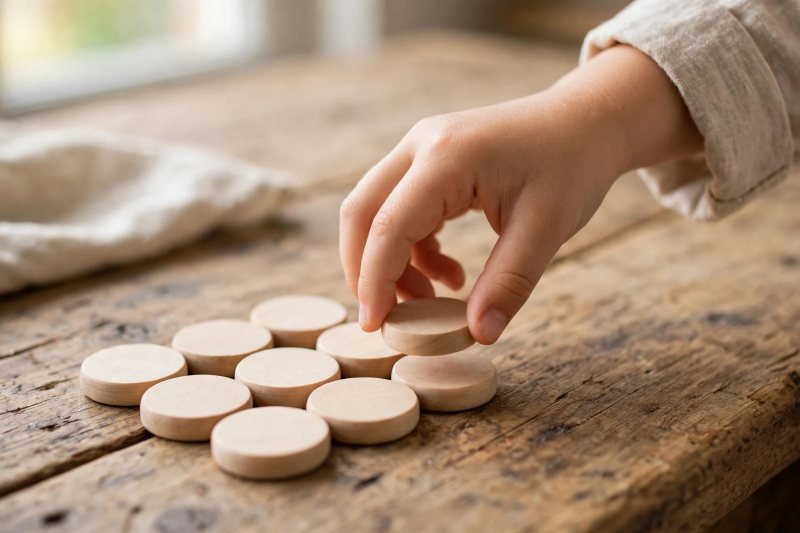
Find the start and build it with counters. Ask, "What did the story START with?" — then count out that many counters together: "You had 7 pancakes. You ate 2. How many are left?" Lay the 7 counters in a neat row so the starting number is visible before anything moves.
-
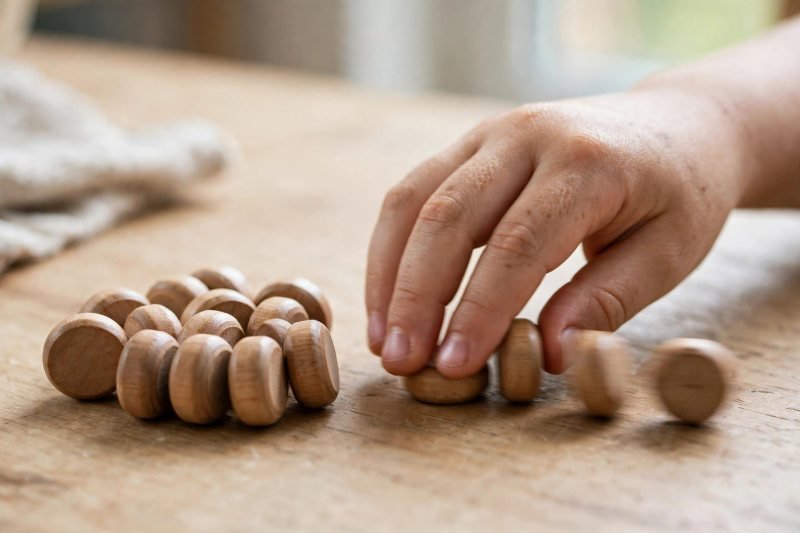
Slide away what went away. Ask, "What went AWAY?" — then slide that many counters off the end, one by one: "You had 8 toy boats. 5 sailed off. How many are left?" Keep the taken-away counters visible in their own little pile, so the change is something your child can see, not just remember.
-
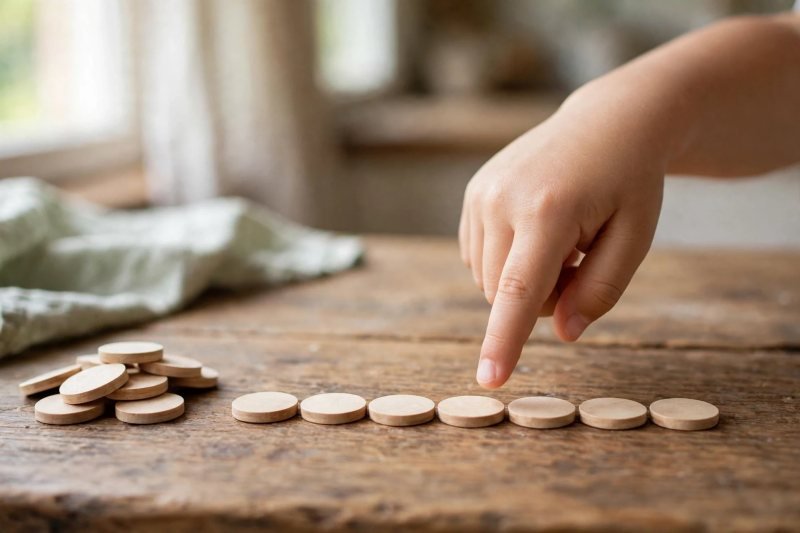
Count what's left, touching each counter. Ask, "So what is LEFT?" and count the remaining counters together, touching each one: "You had 6 library books. You returned 4. How many are left?" The slow, one-by-one pointing is the same careful counting that counting to 10 activities build into a habit — never let your child rush past it.
-
Say the full subtraction sentence together. Turn the count into words before you write anything: "You had 10 ladybugs on the leaf. 6 flew away. How many are left?" Then say it as a sentence — "Ten take away six leaves four" — the way you would say the marble story, "Nine take away three leaves six." The sentence is the subtraction; the number comes later.

-
Write the number sentence on paper. Hand your child the pencil and let them write it: "You had 5 stickers. You gave 1 to a friend. How many are left?" becomes 5 − 1 = 4. Writing the sentence is where the bond becomes visible — the same pairs that number bonds to 10 activities practice, now written as a take-away sentence.

-
Draw the story before and after. Give your child the paper and crayons and ask them to draw the story twice: "You had 8 sparrows on the fence. 7 flew away. How many are left?" — the starting number on the left, what's left on the right. The drawing is the check: if the picture shows one sparrow left, the answer is one.

-
File the finished story and celebrate it. Slide the solved card into the folder and let your child add a star sticker if they like: "You had 10 coins. You spent 4. How many are left?" The folder is the record of their work — six stories solved, four to go, and the pile of finished cards grows every sitting.

-
Take the next story when you're ready. Two or three stories per sitting is plenty, so stop while it is still fun and save the rest for tomorrow: "You had 9 cones. You knocked over 2. How many are left?" and "You had 10 party hats. 10 children took one each. How many are left?" — the last one is the trick that makes them laugh, because the answer is zero, and zero is a perfectly good answer.



Make it easier
If counting past 5 is still shaky, play with stories whose start is 5 or less first. Use real objects instead of counters: the story's own things, counted out loud. Keep the cards face-up for the first few stories so the picture is always visible.
Make it harder
Say the full subtraction sentence before counting — can your child guess what's left from the words alone? Let your child invent a story of their own, with a start of 10 and any change they choose. Once take-away within 10 is instant, the mental number-line work in one more one less games is the natural next step.
Other ways to play it
- Snack stories: use food they can eat at the end: crackers, grapes, blueberries — count what's left, then eat the answer together.
- Toy stories: toy cars, dolls, blocks — anything they love becomes the story, and the counters become the toys themselves.
- Outdoor stories: take the cards to the garden and act the stories out with stones, leaves, and sticks — the routine is the same, the scenery is new.
- Draw-first version: for a child who loves drawing, sketch the story before touching the counters — the picture tells you the start, and the counters confirm the answer.
How it changes by age
- Ages 6–7: read the story aloud yourself, let them count the counters, and write the number sentence together. Keep to two stories per sitting.
- Ages 7–8: let them read the card, count silently, and write the sentence alone — you check it after, not during.
- Not ready yet: if stories feel too hard, step back to hands-on take-away practice first — subtraction activities for kindergarten build the same idea without the story layer, and the stories will be there when they are ready.
What they're learning
Subtraction as take-away, in story form — the numbers always mean something real. Number sentences — writing 9 − 3 = 6 from a story they acted out. Counting what's left — the habit of counting the remaining group, not the group that left. The start–change–check routine — a method they can use on any word problem they meet. Zero as an answer — 10 − 10 = 0 is a real result, not a mistake.
Clearing up
A subtraction word problem is not a worksheet sum with words stuck on it — it is a story where something goes away, and the child has to find out what is left. If your child can act the story out with counters and say the sentence, they understand subtraction, even if they cannot write the number sentence yet. And this is a storytime routine, not a worksheet drill: read it, act it, count it, write it, draw it — stop while it is still fun, because confidence builds story by story, not session by session.
Questions parents ask
What is a subtraction word problem?
When should my child start subtraction word problems?
My child freezes on word problems. What helps?
Is "take away" the same as "how many are left"?
How many stories should we do at once?
Should my 7-year-old read the stories herself?

save it for later
Pin this for the next rainy afternoon
Keep it on a board so it is there when you need it, rather than when you happened to find it.
Save to Pinterest


