


Comparing Numbers Games: Greater Than, Less Than, Equal To
Six comparing numbers games for ages 5–6 that make greater than, less than and equal to click: number cards, dice, block towers and one very hungry paper alligator. Five minutes of setup, real practice with the >, < and = symbols, numbers to 20, zero worksheets.
Comparing numbers games for ages 5–6 work best when children compare real things first: flip two number cards, roll two dice, and decide which is bigger using the >, < and = symbols. The hungry-alligator trick — the open mouth always faces the bigger number — makes the symbols click fast. Play 10–15 minutes, keep numbers to 20, and say every comparison out loud as a full sentence.

The short version
- Teach the symbols with real things first — cards, dice, block towers — before anything on paper.
- The alligator rule: the open mouth always faces the bigger number; the sharp point always hugs the smaller one.
- Give equal to its own game; it gets the least practice and fades first.
- Say every comparison as a full sentence: "7 is greater than 4."
- Keep the numbers to 20; bigger numbers turn comparing into a counting exercise.
- Short rounds win: 10–15 minutes of games beats 30 minutes of worksheets.
- Age
- Ages 5–6
- Prep
- 5 min
- Mess
- None
- Difficulty
- Easy
- Where
- Indoor
Why kids love this
Because somebody gets eaten. The alligator's appetite turns every round into lunch, and children will flip cards for twenty minutes to feed it. Card War has real stakes — win the cards! — and knocking down a tower after proving "mine is taller" never gets old. Nothing here looks like school, which is exactly why the math sticks.
What you'll need
- 20 index cards with numerals 1–20, hand-written together in marker (writing them is bonus practice).
- Three large symbol cards: >, < and = drawn big on cardstock.
- Green paper or a paper plate, plus scissors (the hungry alligator).
- Two ordinary six-sided dice (pips, not numerals; jumbo foam dice if your child still mouths things).
- Wooden blocks or building bricks — a good pile, at least 20.
- Small counters: buttons, dried beans, or dried pasta (the alligator's lunch).
- Ten number cards in five matching pairs (Equal Twins Hunt).
- Masking or washi tape (the floor number line).
- A small bowl of tokens for Dice Duel Compare.
Before you start
Five minutes: write the numerals 1–20 on index cards, draw the three big symbol cards, and cut the alligator's wide V-shaped mouth from green paper — a bold zigzag is perfect; it doesn't need to look like art. Tape a floor number line of 20 squares if you're playing Number Line Hop today. Everything else just needs to be within arm's reach.
How to do it
-
**Spread the materials.** Set everything on the table and let your child explore for a minute — pick up the cards, roll the dice, open and close the alligator mouth.

-
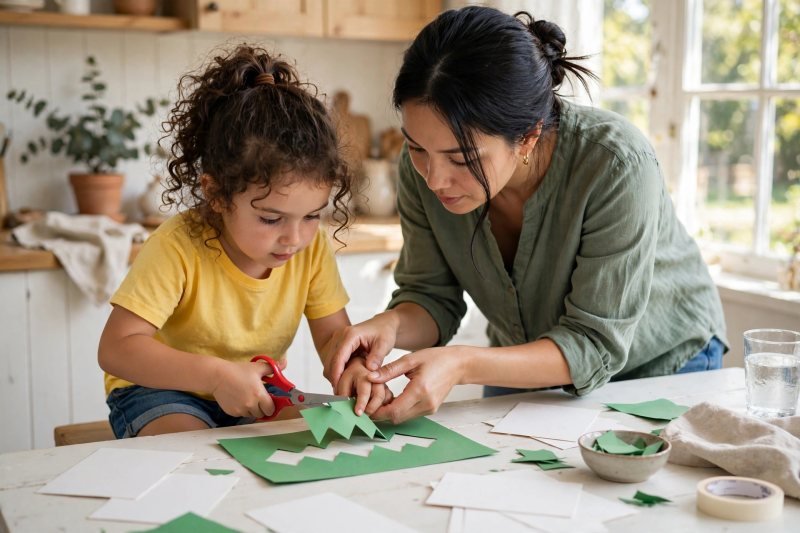
**Cut the alligator mouth.** Finish cutting the green paper alligator mouth and show how it opens and closes: "It's always hungry, and the open mouth always faces the bigger number."
-
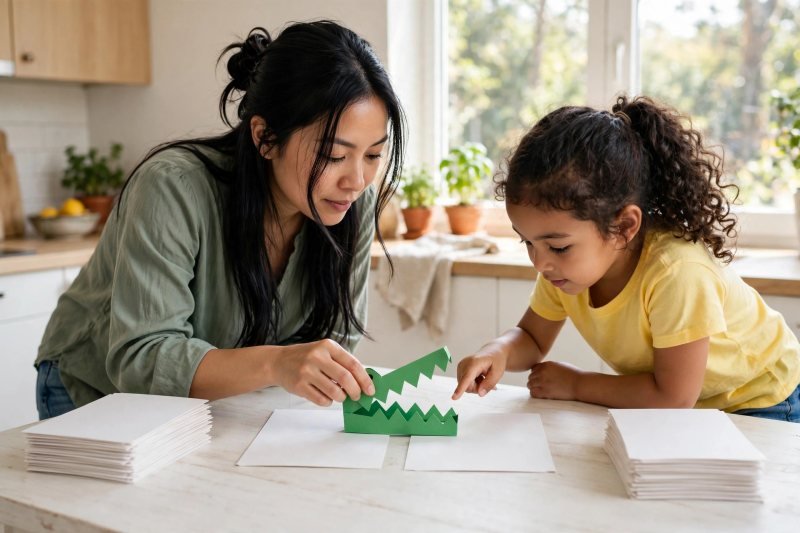
**Teach the symbols.** Put two cards on the table — 7 and 4 — open the mouth toward the 7 and read it together: "7 is greater than 4." Flip to 3 and 9: "3 is less than 9." Then 5 and 5: the mouth rests, "5 is equal to 5."
-
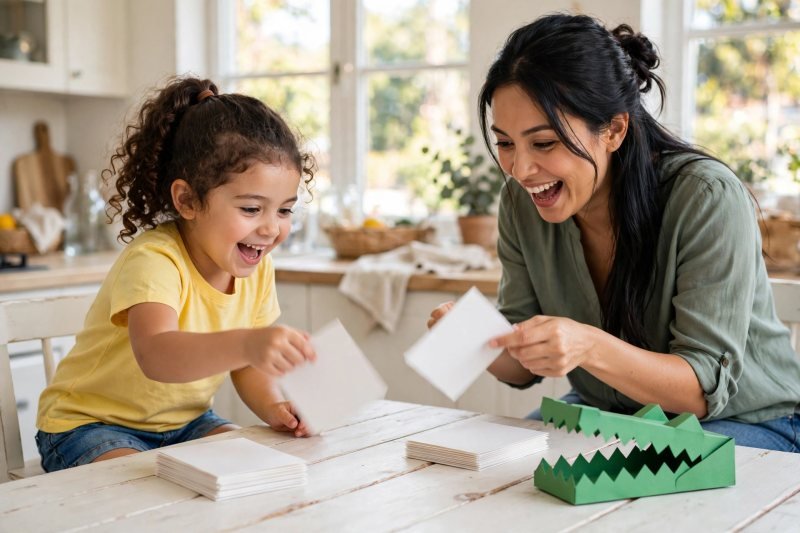
**Play Number Card War.** Deal the number cards and flip together, read both numbers out loud, and let the bigger card take both.
-
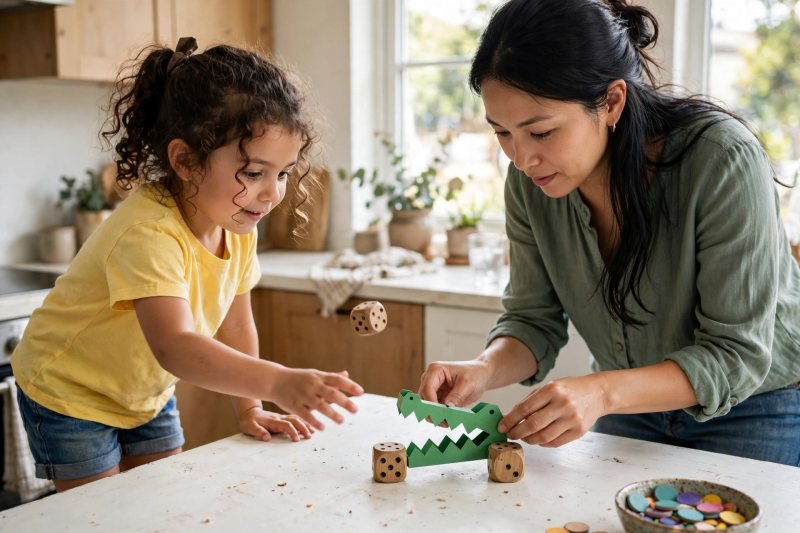
**Play Dice Duel Compare.** Each player rolls one die, place the right symbol card between the dice, and read the comparison out loud.
-
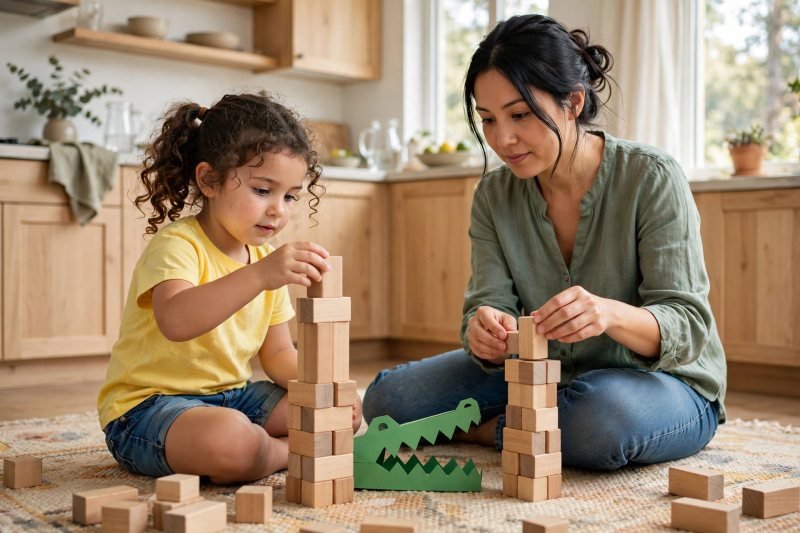
**Play Staircase Towers.** Build two towers of different heights, lay the symbol card between them, and let the taller tower win the round.
-
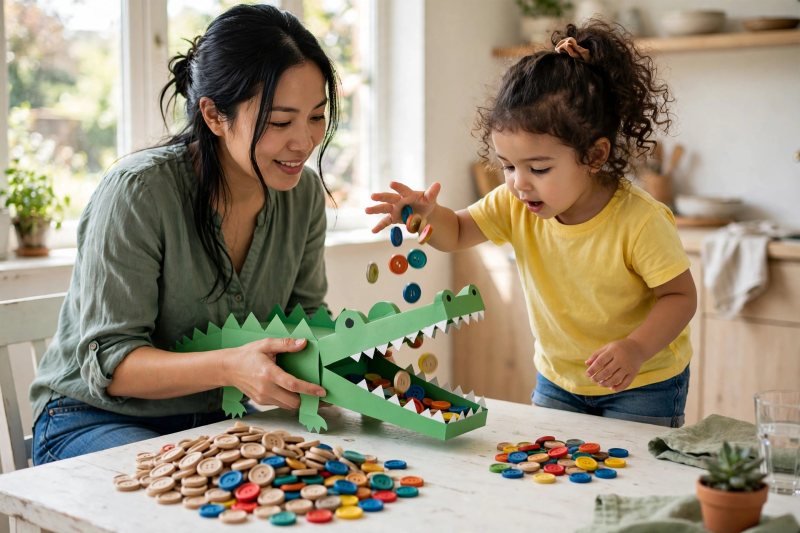
**Play Hungry Alligator Lunch.** Count the two counter piles, feed the bigger pile to the alligator, and roar.
-
**Play Equal Twins Hunt.** Flip two cards, keep the matching pairs with the = card, and say the comparison even when the cards don't match.

-
**Play Number Line Hop.** Tape 20 squares in a line on the floor and hop along it — feel which number sits further along.

-
**Spot comparisons in real life.** Find bigger and smaller numbers on the walk home, on letterboxes, on the microwave — and declare the alligator full for today.



Make it easier
Play with numbers 1–5 only; every game works the same, just smaller. Use the alligator mouth instead of the symbol cards — one less thing to remember. Let your child count the towers or piles before every comparison; comparing comes after counting. Play cooperatively against a stuffed toy so there's no losing, only feeding.
Make it harder
Stretch the range to 20, then to 50 for confident comparers. Roll two dice each and compare the totals: 5 and 2 make 7, 4 and 3 make 7 — "7 is equal to 7!" Try 6 and 6 against 3 and 4: 12 is greater than 7. Play Card War with three cards each and compare the sums. Ask "how much bigger?" after every round — 9 against 5 is 4 bigger, and that's subtraction's front door.
Other ways to play it
- Sidewalk version: draw the alligator mouth huge in chalk on the driveway and lay out numbered cards inside its reach.
- Snack math: compare two piles of crackers at the table — then eat the evidence.
- Sibling version: older kids compare to 100 or compare two-dice totals; younger ones just point to the bigger card.
- Travel version: one rubber-banded set of number cards plays Card War anywhere.
How it changes by age
- Ages 5–6. Start with numbers 1–10; move to 1–20 when 1–10 comparisons are instant and the symbols stop reversing. Children who still count every card finger-by-finger need more counting first — our counting to 20 activities build that foundation. When the symbols feel easy, our number bonds to 20 are the natural next game.
What they're learning
Number comparison: deciding which of two numbers is greater, less, or equal — the core skill, practiced dozens of times per session. Symbol meaning: > opens toward the bigger number, < points to the smaller, = means exactly the same. Math language: saying "greater than," "less than," and "equal to" in full sentences. Number sense to 20: especially the tricky teens, which sound bigger than they are. Counting before comparing: counting piles and towers first builds one-to-one correspondence. Working memory: holding two flipped cards in mind in Equal Twins Hunt. Pairs naturally with our one more, one less games and number bonds to 20 for a rounded early-math routine.
Clearing up
Two minutes: number cards back in their rubber band, symbol cards stacked on top, counters back in the jar, the alligator mouth saved for tomorrow — it gets hungrier overnight, apparently. Let your child "feed" the leftover counters into the jar while counting them: one last compare on the way out.
Questions parents ask
What age should kids learn greater than and less than?
How do you explain the alligator trick for comparing numbers?
My child always mixes up the symbols. What helps?
Should kids learn comparing before addition?
Can you teach comparing numbers without worksheets?
The alligator doesn't care if your child gets the symbol backwards — it just gets hungry again next round. That's the secret of comparing games: unlimited fresh pairs, zero red marks, no wrong answers staring back from a page. If your child asks to feed the alligator again tomorrow, the symbols are sticking. And if they'd rather just build towers and knock them down — that's fine too; the comparing will still be there next week.

save it for later
Pin this for the next rainy afternoon
Keep it on a board so it is there when you need it, rather than when you happened to find it.
Save to Pinterest


