


Money Worksheets for Kids: Counting Coins Printables
These money worksheets for kids turn spare change into math practice: counting coins printables for ages 6–8 covering coin values, skip counting, and mixed-coin totals — one skill per page.
Money worksheets for kids give ages 6–8 structured counting-coins practice: penny, nickel, dime, and quarter pages that build from counting by ones to skip counting by fives and tens, then mixed-coin totals and making change. Print the pages, set out real coins, and let your child work through them.

The short version
- Start penny-only, then nickels by fives, dimes by tens.
- Count mixed coins biggest-value first.
- Three ways to pay 30¢: quarter + nickel, three dimes, six nickels.
- Count-up method for change: 17¢ paid with a quarter → 8¢ back.
- Real coins beside the page beat pictures alone.
- Check answers together and celebrate finished pages.
- Age
- Ages 6–8
- Prep
- 5 min
- Play time
- 45 min
- Mess
- None
- Difficulty
- Easy
- Where
- Indoor
Why kids love this
They feel like a mission, not a lesson: count this row, circle the matching pile, find three ways to pay 30 cents. Kids this age love the grown-up feeling of real coins, and each finished page is something to show you. No timer — just count, write, check, done.
What you'll need
- Printed counting-coins worksheet pages (publish-time download: "Counting coins practice pages (PDF)")
- Real US coins: about 15 pennies, 15 nickels, 10 dimes, 8 quarters
- A pencil, a crayon or marker, and a small bowl for the coins
Before you start
1. Print the counting-coins practice pages — one set per child. 2. Count roughly 15 pennies, 15 nickels, 10 dimes, and 8 quarters into a bowl. 3. Clear a table; set the worksheets face-up with the coin bowl beside them. 4. Skim page one yourself so you can explain it in one sentence.
How to do it
-
Lay out the pages in order. Spread the pages in a row, easiest first: "Only pennies — our warm-up." Kids work better seeing the finish line.

-
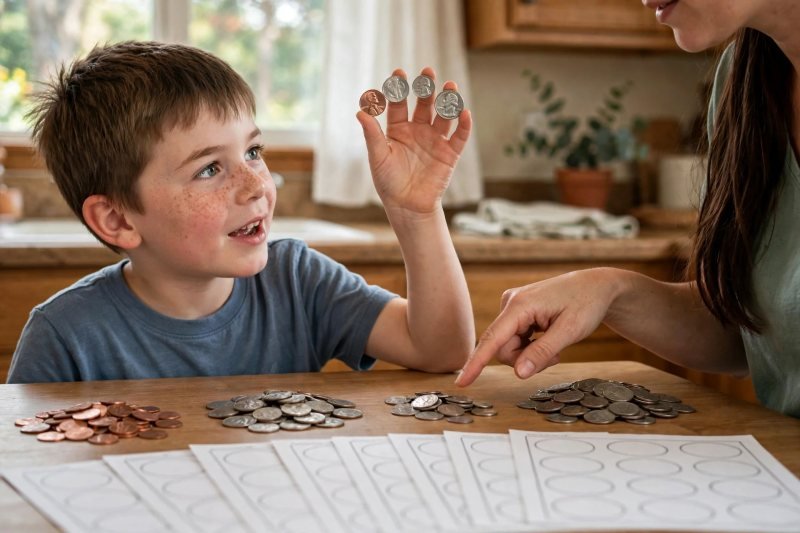
Review the four coins. Dump the coins on the table. Your child picks up one of each and says name and value: penny 1, nickel 5, dime 10, quarter 25 cents. Thirty seconds now saves ten minutes of confusion later.
-
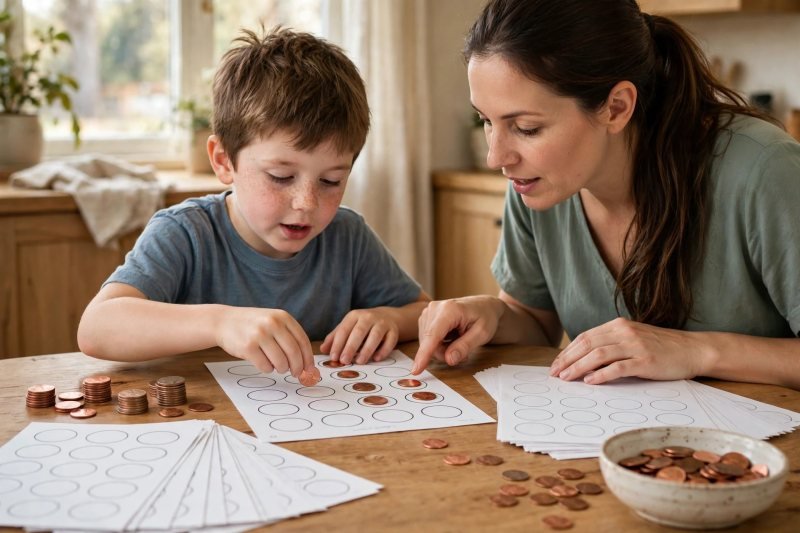
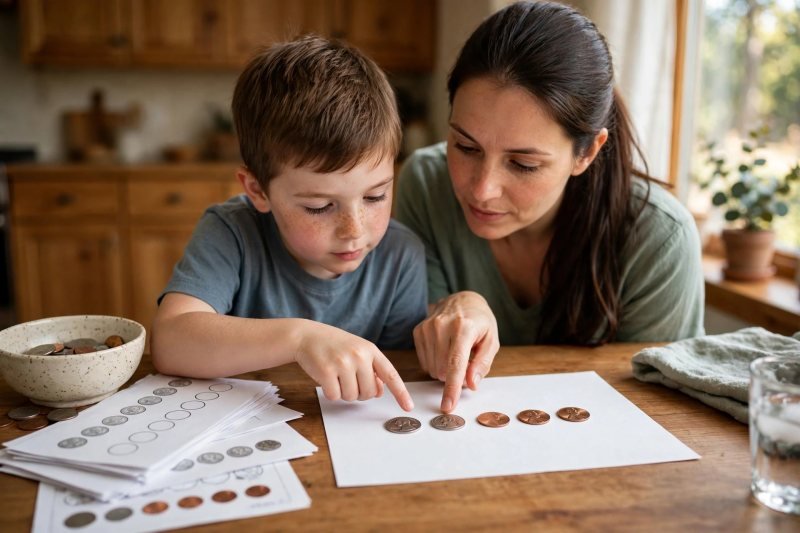
Count pennies by ones. On page one your child sets a real penny on each printed coin, counts aloud touching each, and writes the total. Eyes and fingers together keep counts honest.
-
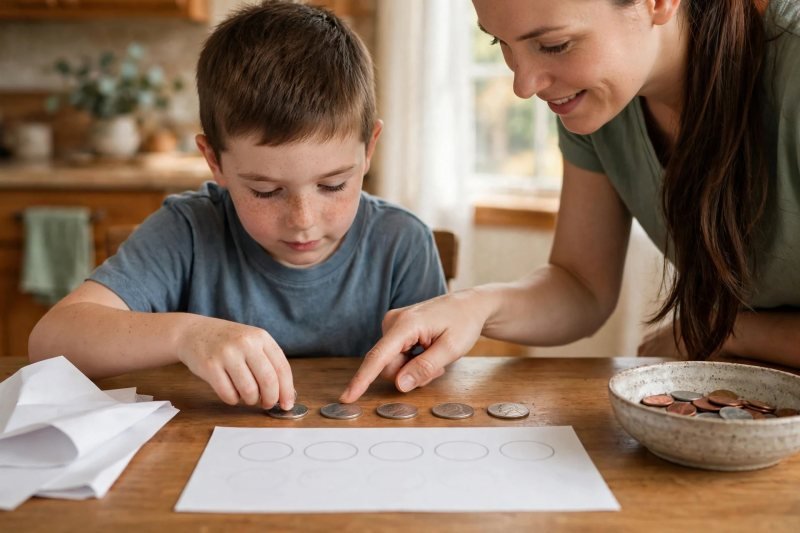
Skip-count nickels by fives. Page two is nickels only. Line up five and count together: five, ten, fifteen, twenty, twenty-five. Your child counts each row the same way and writes the totals.
-
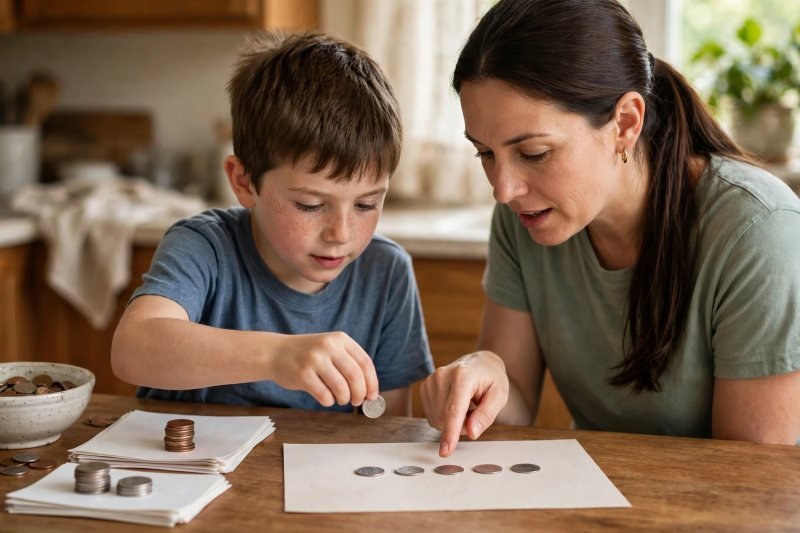
Skip-count dimes by tens. Page three is dimes. Line up four: ten, twenty, thirty, forty. Say it out loud: "Tiny coin, ten cents." Your child counts each row by tens and writes the answers.
-
Count mixed-coin rows. Page four mixes coins per row — count biggest value first. A quarter, a dime, and three pennies: twenty-five, thirty-five, thirty-six, thirty-seven, thirty-eight. Your child writes 38¢, checking with real coins beside the page.
-
Find different ways to pay. Page five asks for three ways to pay 30 cents. Do the first together: quarter plus nickel. Then your child finds two more: three dimes, and six nickels. Same total, different coins — the moment money math clicks.

-
Solve the pretend receipt. Page six is a tiny shop receipt: juice box 12 cents, apple 15 cents. Your child adds them — twelve plus fifteen is twenty-seven — writes 27¢, then pays it in real coins.

-
Make change on paper. Page seven: a toy costs 17 cents, paid with a quarter. Count up: seventeen… twenty (three pennies), …twenty-five (a nickel). Eight cents back. Your child draws the change coins and writes 8¢ — hardest page, give it the most time.

-
Check answers and celebrate. Check each page against the answer key, circling correct ones in a bright color. Finished them all? They are officially a coin counter. Fridge the best page.



Print it out
Make it easier
Pennies-only pages first; add nickels when ones are solid. Keep a coin value chart beside the page — checking is a skill, not cheating. Cover all but one row with a blank sheet so the page feels smaller. Do the first row of every page together. If coin names wobble, our coin recognition activities rebuild them first. For a gentler start, our counting worksheets for kindergarten keep numbers small and friendly.
Make it harder
Add half-dollars (50¢) to the mixed-coin pages. Try totals near a dollar: three quarters, two dimes, four pennies — our counting money to one dollar guide builds exactly that skill. Remove the real coins for the last page — count from pictures only. Time the final mixed-coin page and beat the record tomorrow.
Other ways to play it
- Coin detective: lay out a mystery pile; your child counts it and writes the total on blank paper.
- Worksheet race: siblings each take a page — first finished with all answers right wins.
- Real receipt math: your child adds two small prices from a grocery receipt.
- Design your own: draw coin circles on blank paper, swap with a sibling to solve. (Full play-shop version: money games for kids.)
How it changes by age
- Built for ages 6–8, when most children count past 50 and skip-count by fives and tens. Five-year-olds can try the penny and nickel pages with an adult reading along. By eight, most finish the change pages solo — and notice real store prices.
What they're learning
Coin values: penny 1¢, nickel 5¢, dime 10¢, quarter 25¢. Skip counting: by fives and tens, the engine of all coin math — our skip counting by 2s, 5s and 10s games build the counting. Mixed addition: combining different-valued coins, biggest first. Making change: the count-up method from price to payment. Checking work: finishing a page, then verifying answers.
Clearing up
Print single-sided so the coin bowl can sit on the blank backs. Draft mode is fine — outlines matter, not color. Keep sessions under 45 minutes; tired counters guess.
Questions parents ask
What age is right for money worksheets for kids?
What should a counting coins worksheet include?
How do I teach my child to count mixed coins?
What are the values of the four US coins?
Should kids use real coins with money worksheets?
Spread the pages over a few days — one page a day builds the habit without burnout. If the change page stalls, replay it as a play-shop game first (see money games for kids), then return to paper. More coin play: our counting coins activities turn the same skills into games. Praise the checking — "You caught your own mistake" teaches more than any worksheet.

save it for later
Pin this for the next rainy afternoon
Keep it on a board so it is there when you need it, rather than when you happened to find it.
Save to Pinterest


