


Measuring in Centimetres: Worksheets and Activities (UK)
Ten measuring in centimetres activities for 6–8-year-olds: proper ruler technique, millimetre counting, draw-to-length worksheets, and a guess-and-record chart — hands-on metric fun with zero mess.
Measuring in centimetres teaches 6–8-year-olds to read a metric ruler properly: line objects up with the zero mark, read whole centimetres off the big numbered lines, and count the small lines as millimetres — ten millimetres make one centimetre. Children practise with guess-and-record worksheets, draw lines to exact lengths, then discover that one hundred centimetres make a metre.

The short version
- Always start at the zero mark — not the ruler's edge. The number-one measuring mistake.
- Big numbered lines are whole centimetres; the small lines are millimetres.
- The two sentences to memorise: 10 mm = 1 cm, and 100 cm = 1 m.
- Guess first, then measure — estimation sharpens quickly with practice; the more-or-less comparisons in more and less activities build the same judgment.
- Draw-to-length worksheets build the same skill in reverse.
- Age
- Ages 6–8
- Prep
- 10 min
- Play time
- 37 min
- Mess
- None
- Difficulty
- Medium
- Where
- Indoor
Why kids love this
Hand a six-year-old a ruler and the house becomes a building site: the remote is "twenty long," the cat "forty long." That enthusiasm is why measuring in centimetres needs proper technique — most children start at the ruler's edge instead of the zero. Ten steps fix it: worksheets, draw-to-length challenges, and a metre walk. If your child is still at the compare-and-order stage, measurement activities for preschoolers builds those ideas first with blocks and hand spans.
What you'll need
- A 30 cm school ruler (clear plastic is best) and a retractable tape measure
- Pencils, crayons, felt tips, plain paper, sticky notes
- The two worksheet sheets from Preparation
- A crayon, pencil, spoon, mug, paperback book, library card, 10p coin
Before you start
Draw six wavy lines (4–18 cm) on paper — the "measure the lines" worksheet. Rule up the record chart: Object, My guess, Measured, Nearest cm; six empty rows. Lay out the ruler, objects, crayons, both sheets. Clear hallway floor for the metre walk.
How to do it
-
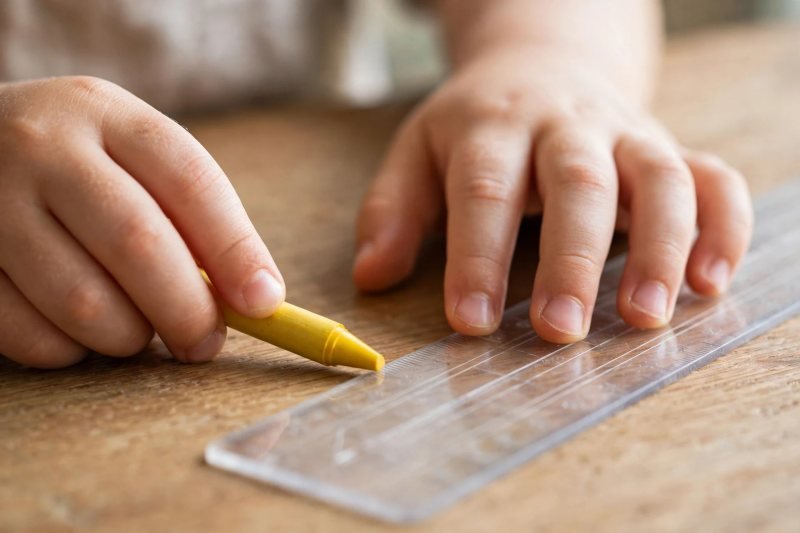
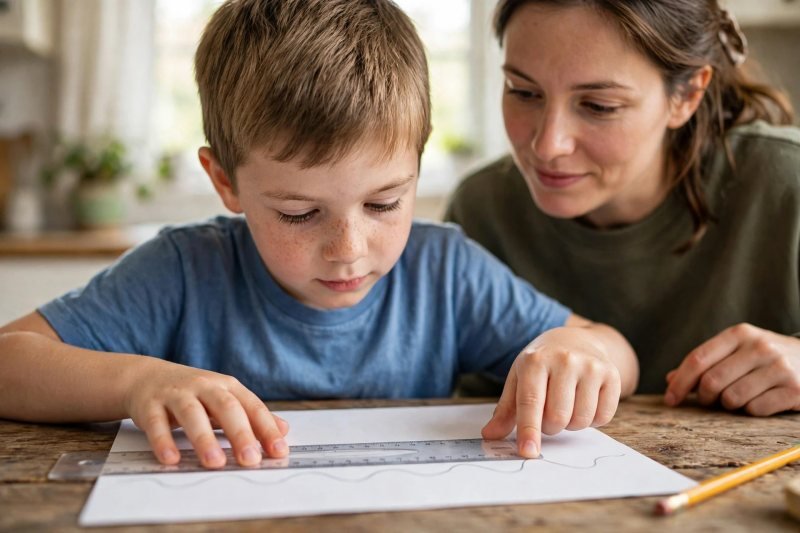
Start at zero — not at the edge. Lining up with the ruler's end makes everything read long. Find the little 0 — "the starting line." Slide the crayon onto it, read the far end. "Measuring begins at zero."
-
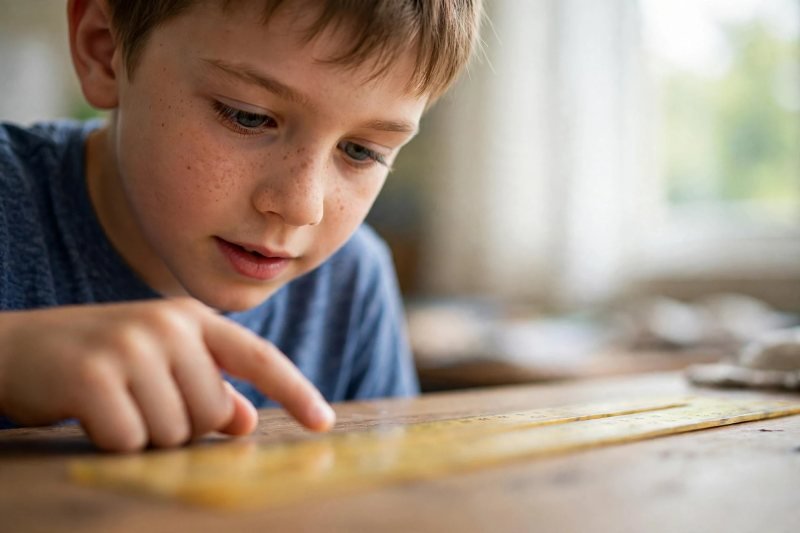
Meet the big lines — those are the centimetres. Long lines with big numbers are whole centimetres. "Each jump is exactly one centimetre — the same in every house." Count along the spoon: "About eighteen centimetres."
-
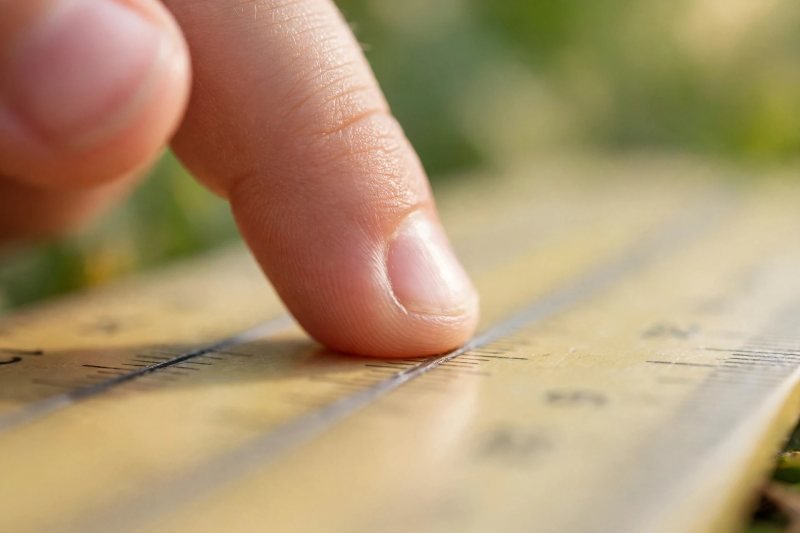
The little lines are millimetres — ten make a centimetre. Between big lines hide ten tiny lines: one millimetre each. Count from 0 to 1 cm — ten steps. Remember: "Ten millimetres make one centimetre." A 10p coin is about two and a half centimetres across.
-
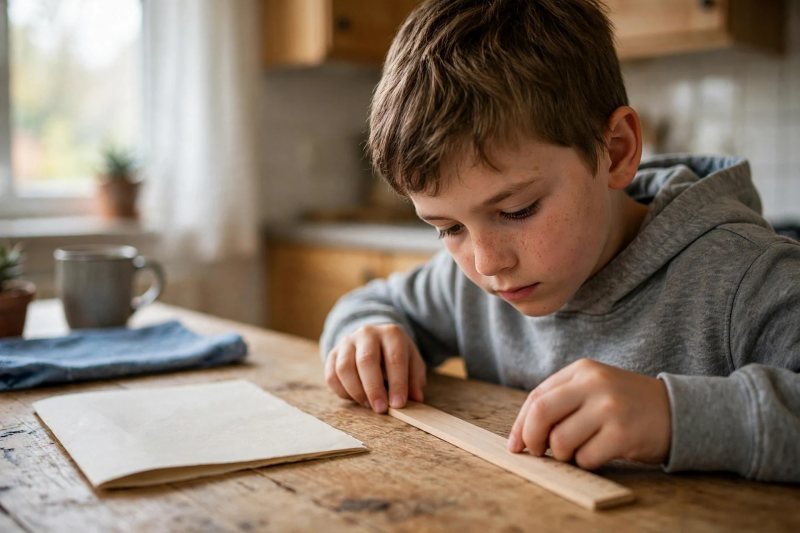
Measure the pencil to the nearest centimetre. Pencil end on the zero, ruler flat: about 17 centimetres. Between two big lines? Take the nearer — "to the nearest centimetre." Log it as the chart's first row.
-
The guess-and-record worksheet. Six objects, one row each: crayon, spoon, mug, paperback, library card, fork. Guess first — "how many centimetres tall is the mug?" — write it, measure, fill in the real number. (Crayon ~9 cm, spoon ~18 cm, mug ~10 cm, paperback ~20 cm, library card ~8.5 cm wide, fork ~20 cm.)

-
Measure the wavy lines. Zero at each wavy line's start, read straight across, write the length beside it. Six lines, six numbers; the zero habit sticks.
-
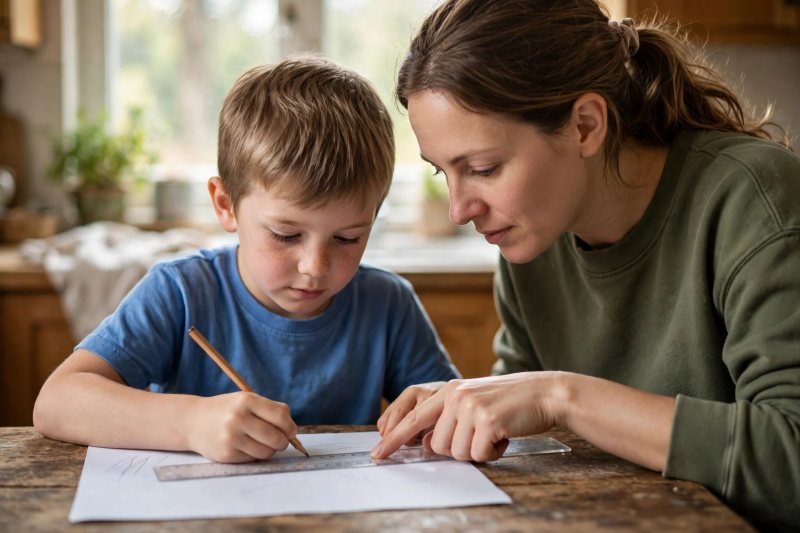
Draw it to length. Flip the paper: "Draw a line exactly 7 centimetres long." Then 12 cm. Then four and a half — halfway between 4 and 5. Check each with the ruler.
-
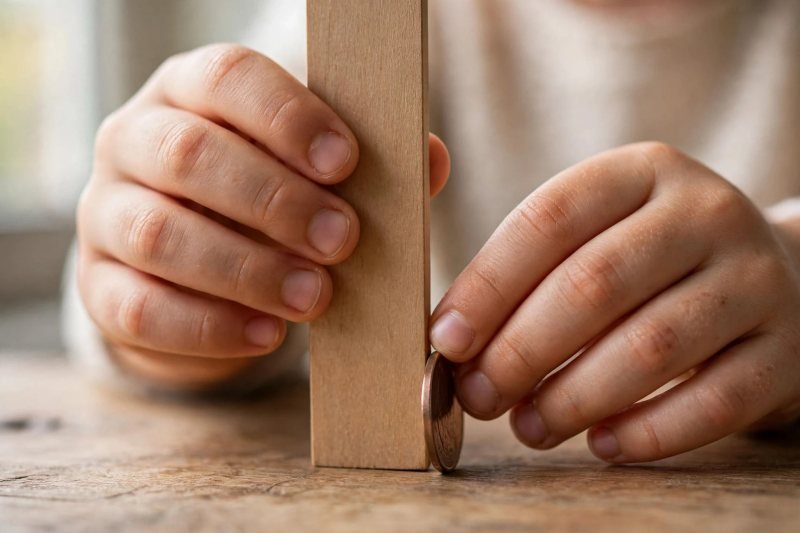
The millimetre mission. The 10p coin's thickness: about 2 millimetres. The crayon's width: about 8 millimetres. A toy building brick: just under a centimetre — about 10 millimetres. Impossible without the little lines.
-
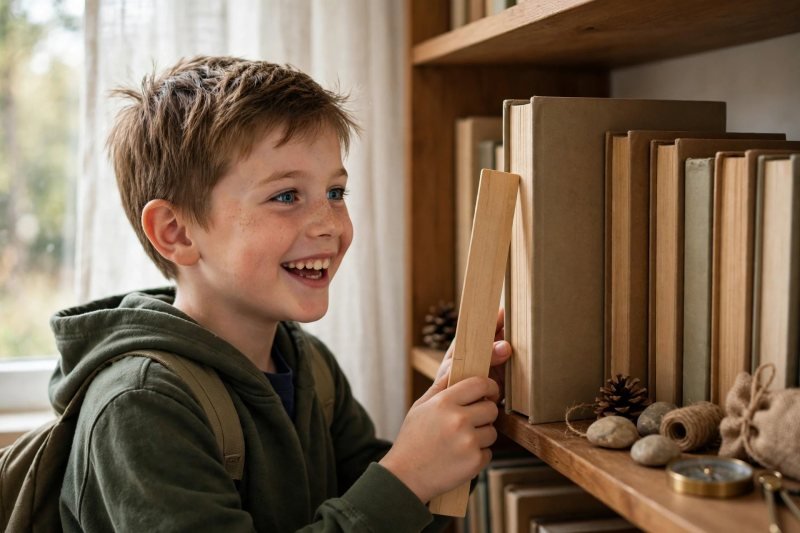
The centimetre hunt. "Find me something exactly 10 centimetres long." Then 15. Then 20. Cut a 10 cm card strip — "your ten-centimetre friend." Benchmarks turn guessing from a lottery into a skill.
-
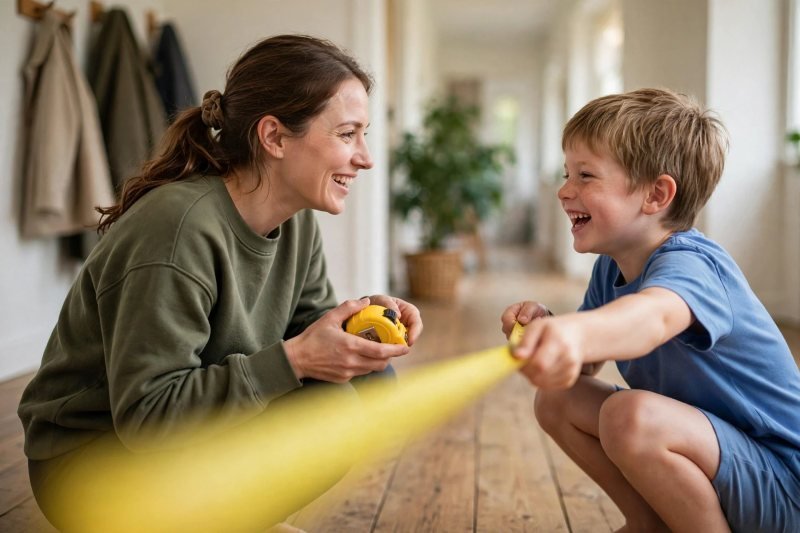
One hundred centimetres make a metre. Stretch the tape measure out: "One hundred centimetres — a metre." March the 30 cm ruler end to end — three rulers is 90 cm, so a metre is three rulers and a little more. The doorway: about 2 metres, or 200 centimetres.


Print it out
Make it easier
Steps 1–3 on day one (technique), worksheets on day two. Tape the ruler's ends down so it cannot slip. Count the millimetre lines aloud together — the same count-aloud play as counting activities for toddlers. Skip millimetres — whole centimetres only (steps 1, 2, 4, 5, 10).
Make it harder
Measure to the millimetre: 20.4 cm. Convert both ways: 3 m = 300 cm; 450 cm = four and a half metres. Guess a curled string's length, straighten it, measure.
Other ways to play it
- Outdoor: measure leaves, sticks, and paving slabs; chalk each number beside it — rain washes it away.
- Sibling: the older child reads millimetres, the younger reads whole centimetres; the chart gets a column each.
- Order first: before measuring, order the six objects shortest to longest — the same compare-and-order play as sorting activities for toddlers, with numbers added after.
How it changes by age
- Six is technique: the zero mark, the big lines, the nearest centimetre (steps 1, 2, 4, 5). Seven adds millimetres, halves, and the draw-to-length page. Eight brings metre conversions and estimates within a centimetre.
What they're learning
Ruler technique, the metric ladder (10 mm = 1 cm; 100 cm = 1 m), estimating before measuring, recording results in a table, and fine motor control — the same steady hand work as fine motor activities for preschoolers — plus the vocabulary: length, width, height, nearest, exactly, about. Counting in tens up the metric ladder is an early taste of number patterns for kids.
Clearing up
File the worksheets and chart — a keepsake of the day measuring clicked. Retract the tape measure fully and clip it shut. Crayon shavings in the bin, ruler back in the pencil case.
Questions parents ask
How do you teach a child to read a ruler in centimetres?
What is the difference between centimetres and millimetres?
Why does my child always measure one centimetre too long?
At what age should children learn centimetres?
How many centimetres are in a metre?
What are good first objects to measure in centimetres?
Two worksheet PDFs go through the CMS Downloads repeater at publish time (typeset 2026-11-20, in this article folder): (1) worksheet-measure-the-lines.pdf — six wavy lines of 4, 7, 10, 12, 15 and 18 cm, with an answer key on page 2; (2) worksheet-draw-it-to-length-and-record-chart.pdf — draw lines of exactly 7 cm, 12 cm and 4.5 cm, plus the guess-and-record chart (Object / My guess / Measured / Nearest cm) for the six objects in Step 5.

save it for later
Pin this for the next rainy afternoon
Keep it on a board so it is there when you need it, rather than when you happened to find it.
Save to Pinterest


