


Subitizing Activities for Kindergarten: See It, Don't Count It
Subitizing activities for kindergarten (ages 5–6): dot-card flashes, finger games, dice call-outs, and quick-look challenges that build at-a-glance number recognition.
Subitizing is instantly recognizing how many items are in a small group without counting them. These subitizing activities for kindergarten — dot-card flashes, finger games, dice call-outs, and quick-look challenges — train ages 5–6 to "see" quantities 1–5 at a glance. Ten to fifteen minutes of joyful flashing a day is enough.

The short version
- Subitizing means knowing "how many" without counting — the root of number sense.
- Perceptual is instant (1–3); conceptual groups parts ("3 and 3 is 6").
- Flash for 2–3 seconds: too fast to count, slow enough to succeed.
- Ask "How did you see it so fast?" to grow conceptual subitizing.
- 10–15 minutes a day is plenty.
- Age
- Ages 5–6
- Prep
- 5 min
- Play time
- 15 min
- Mess
- None
- Difficulty
- Easy
- Where
- Indoor
Why kids love this
A speed game with a magic trick: the answer arrives before the counting starts. Kids love beating the flash — and stumping you when they run the cards.
What you'll need
- 15 blank index cards and a thick marker
- One dot die (soft foam is ideal)
- 10 counters: buttons, beans, or blocks
- A small bowl or cup; dominoes (optional)
Before you start
Draw dots on 15 cards: three each for 1–5, varied layouts (dice patterns, rows, circles, scattered). Put the die, counters, and dominoes in a bowl beside you. Sit side by side to flash cards between you.
How to do it
-
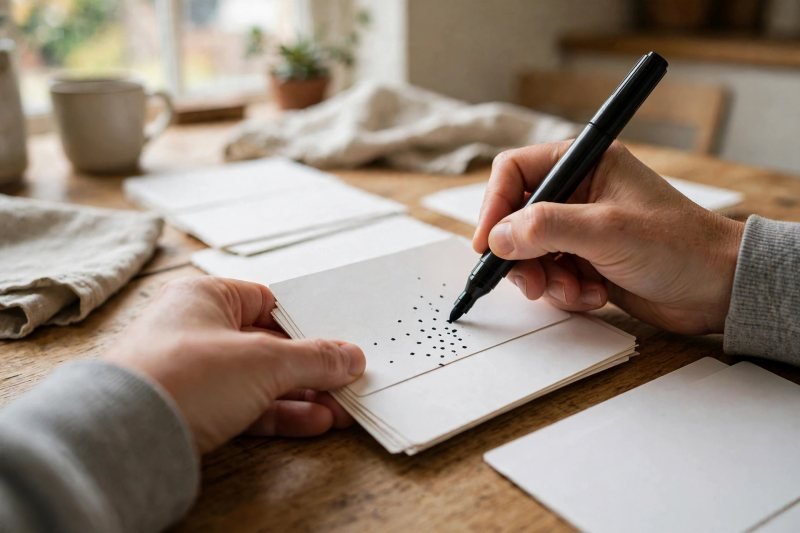
Make the dot cards together, three cards for each number 1 to 5. Sit side by side with 15 blank index cards and a thick marker, and draw the dots together — three cards for 1, three for 2, and so on up to 5, each card in a different layout: a dice pattern, a straight row, a circle, a scattered handful. Say the job out loud as you draw: "We are making quick-look cards — dots you can see in one glance." Your child's job is checking your work: after each card, ask them to count the dots once, slowly, and confirm the number before the card joins the pile. That slow count now is what makes the fast glance later trustworthy — they know the cards are right because they checked them. Mix the layouts on purpose; a card that only ever shows dots in a row teaches counting, not seeing. Cards checked and stacked face down: now set the one rule that makes the game work.
-
Set the one rule: look, don't count. Before the first flash, say the rule the same way every time: "We don't count — we just LOOK. First answer wins." Then run one practice flash so the rule is a thing they did, not a thing you said: hold up a 2-dot card for three seconds, flip it face down, and ask "How many?" Your child raises a hand and calls it — that raised hand is the whole game in miniature, a fast answer offered before counting can start. Praise the speed, not just the right number: "That was fast — you saw it." If they start counting under their breath, smile and say the rule again rather than correcting them; the habit changes by flashing a little faster next time, not by scolding the counting. Rule set and practiced: start with the smallest numbers, where success is almost certain.

-
Flash 1 to 3 until the answers are instant. Hold up a card for three seconds, flip it face down, and ask "How many — no counting?" Stay with 1 to 3 for the first few rounds, shuffling the layouts so the same number keeps arriving in a new shape — a row of three, then a triangle of three, then three scattered dots. Your child's job is the first answer that pops into their head, even if it feels like a guess; guesses that land are how the glance gets faster. If the number words themselves are still wobbly, warm up first with our counting games for preschoolers so the words are solid before the speed arrives. When 3 is instant in every layout, add the 4 cards, then the 5s — one number at a time, never a jump that turns the game into a test. Ones, twos, and threes flying: now ask the question that turns fast answers into real number sense.

-
Ask how they saw it — and name the trick they used. After a fast answer, pause the flashing and ask: "How did you see it so fast?" If they say "It just looked like three," that is perceptual subitizing — instant recognition of a small group, usually 1 to 3, sometimes 4, where the pattern simply looks like its number. If they say "I saw two and two," that is conceptual subitizing — combining small recognized groups to see a bigger one, like 4 as 2 and 2, or 6 as 3 and 3. Praise the grouping, not just the correct total: "You saw two and two — that is the clever part." This is the moment the game becomes teaching, because once a child sees 3 and 2 inside 5, addition stops being a counting chore and starts being a thing they can see. Name it once, plainly, then move on — the idea needs playing with, not lecturing on. The trick named: now the same glance moves to their own hands.

-
Play finger flashes with both hands. Hold up 1 to 5 fingers for just one second — one hand, then the other, then both together — and your child calls the number before the hand drops. Say the setup line each round: "Fingers up — how many?" Mix it deliberately: three fingers on one hand and two on the other, then ask "Three and two — how many altogether?" so the fingers become a first glimpse of parts inside a whole. If a flash is too fast, slow it to two seconds rather than dropping the game; if it is too easy, flash two hands at once and ask for the total. Finger flashes pair naturally with our counting to 10 activities — the same numbers, a different way of seeing them — and fingers have one advantage no card can match: they travel everywhere, so the game can happen in the car, in a queue, or at the dinner table. Hands down, fingers flashed: now give the glance a little speed and luck.

-
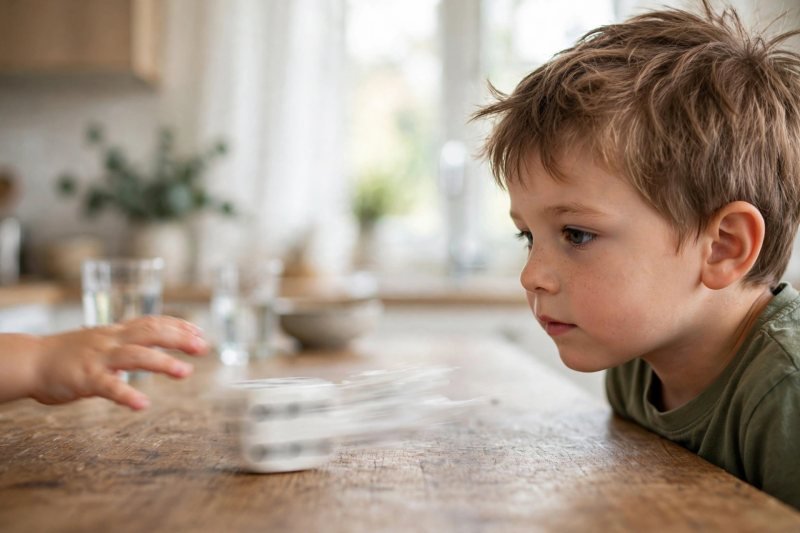
Roll the die and call it before it settles. Roll the soft foam die across the table and your child calls the number before it stops wobbling — the moving pips make counting impossible, so the glance has to do the work. Say it like a race: "Call it before it stops!" Then trade roles: your child rolls, you answer, and every so often miss one on purpose so they get the pleasure of correcting you — "No! It was four!" — which is secretly the best practice of all, because correcting you forces them to trust their own glance. Keep the die soft and the table clear; a die that bounces off the table ends the game faster than any wrong answer. Once call-outs are instant, the same die becomes first sums in our addition games for kindergarten — roll two dice and call the total without counting. Die called, roles traded: now stretch the glance past 5.
-
Try a ten-frame glimpse and listen for the five inside it. Build 6 to 9 counters in a ten frame — a two-by-five grid drawn on a card, filled left to right — flash it for two seconds, then cover it and ask "How many?" Listen for the answer that shows the five-anchor working: "Five and two more" or "I saw five, then two." If they count one by one, drop back to 6 or flash a fraction faster; the frame is doing its job when the full top row reads as five at once. Our ten-frame activities build the same frame into filling games and make-10 pairs, so this glimpse is a first taste of a tool they will use for months. Two seconds is the whole secret — long enough to see, too short to count. Frame glimpsed, five found: now hide some and make them work out what is missing.

-
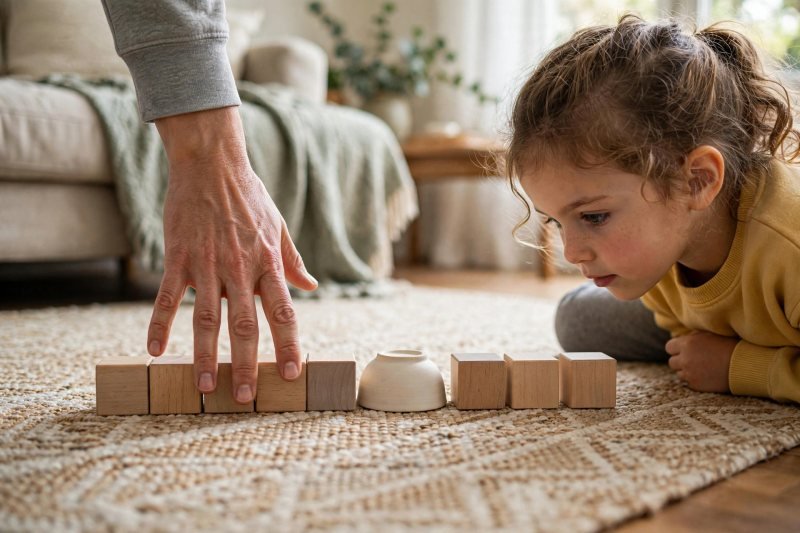
Play what's hiding and let the missing part do the teaching. Line up 5 blocks in a row, let your child see them all, then cover some with a cup or your hand and ask: "I see 3 — how many are hiding?" Your child answers from the part they can see, not from counting what is gone — 5 with 3 showing means 2 are hiding, and that is number bonds in disguise. Say the thinking out loud the first time: "Three showing, five altogether — so two must be hiding." Then let them run it: they cover, you guess, and they check you. Seeing parts inside the whole is the start of our number bonds to 10 activities — the same missing-part question, stretched to 10. If 5 is too hard, start with 3 blocks and one hidden; if it is too easy, stretch to 7. Hiding solved by seeing: now hand the whole game over.
-
Hand them the cards and let them be the teacher. Give your child the deck, sit back, and let them run the show: they flash, you answer — and you miss one on purpose so they can catch you. Say the handover line: "Your turn to be the teacher — flash it fast." Teaching forces the glance in a way answering never does: to flash a card well, they have to know the number instantly themselves, hold it in mind while you answer, and judge whether you were right. When they correct you, praise the correction itself — "You caught me! It was four!" — because a child who trusts their glance enough to correct an adult has genuinely learned the skill. Let them set the pace, choose the cards, and invent their own rules for a round or two; the game is theirs now, and your job is to be a good, slightly fallible student. Teacher installed: close with the loudest, happiest round of all.

-
Close with a victory scatter and one last comparing glance. Toss 5 counters onto the table — no neat rows, no pattern, just a scatter — and let your child call the number from one look: "How many — just look?" The scatter proves the point of the whole session: subitizing works on any arrangement, not just tidy cards. Cheer the call, whatever it is, and end with one last round — toss two small piles and ask which one holds more, a quick bigger-or-smaller call that points toward our comparing numbers games. Then stop while it is still fun: ten to fifteen minutes, one or two quick games at a time, is plenty. Five happy minutes beat twenty reluctant ones, and a child who ends the game asking to play again tomorrow has learned more than a child who was drilled until they were bored.



Make it easier
Stay with 1–3 for the first week; add 4 and 5 when 3 is instant. Flash for a full three seconds — slower is easier. Let them count to CHECK after each flash; checking builds trust in the glance.
Make it harder
Stretch to 6–8 with two colors: "3 red and 3 blue — how many?" Roll two dice and call the total without counting. Seeing parts inside the whole leads to number bonds to 10 — try our number bonds to 10 activities. Ready for real sums? Our addition games for kindergarten turn "seeing" into adding.
Other ways to play it
- Domino dots: lay a domino face up: "How many dots here?" Then both sides together — the two halves are a natural first look at parts inside a whole.
- Snack dots: arrange 3–5 blueberries on a plate: "How many — just look?" Then eat them, one counted bite at a time.
- Copy my pattern: show a counter arrangement for three seconds, hide it, and let them rebuild it from memory — the glance has to hold still long enough to copy.
- Chalk flashes: giant driveway dots; they shout the number from the porch.
- Window dots: dot stickers on a window; flash-guess while dinner cooks.
- Real-world spy: "How many birds on that fence — no counting?"
- Sibling face-off: two kids, one card, fastest answer wins.
How it changes by age
- Ages 5–6 is the sweet spot. Eager 4-year-olds can play with 1–3; 7-year-olds who still count one by one benefit just as much.
What they're learning
Perceptual subitizing: instant recognition of 1–4. Conceptual subitizing: seeing small groups inside bigger ones. Number composition: 5 as 2 + 3, 7 as 5 + 2. Arrangement awareness: quantities hold in any layout.
Clearing up
Subitizing does not replace counting — it partners with it. Keep counting games in the rotation. Finger counting at 5 is normal. The goal is choice, not shaming the fingers. Store cards and die in a zip bag for grab-and-go play.
Questions parents ask
What is subitizing in simple terms?
What is the difference between perceptual and conceptual subitizing?
At what age do kids learn to subitize?
How can I help my child stop counting everything one by one?
How long should a subitizing game last?
Subitizing is knowing how many are in a small group without counting — like instantly seeing that a pair of socks is two. Most children recognize 1–3 at a glance by age 4–5, and kindergarten practice stretches it to 4 and 5. There are two kinds to listen for: perceptual subitizing, the instant recognition of a small group that "just looks like three," and conceptual subitizing, combining small groups — seeing 6 as "3 and 3," or 7 as "5 and 2." One fifteen-minute session runs in three parts: you model, your child copies, then they take over as teacher. Subitizing does not replace counting — it partners with it, so keep counting games in the rotation. Five happy minutes beat twenty reluctant ones. If they count under their breath, just flash a little faster next time.

save it for later
Pin this for the next rainy afternoon
Keep it on a board so it is there when you need it, rather than when you happened to find it.
Save to Pinterest


