


One More, One Less Games: The Easiest Bridge Into Addition
Nine one more one less games that turn counting into real addition and subtraction for 5- and 6-year-olds. Stack one more block, hop one square back, sneak one cookie away — every game teaches +1 and −1 with things you already own.
One more one less games teach the +1/−1 idea that turns counting into adding: "4 and one more makes 5" is real addition, and "5 take away one is 4" is real subtraction. Play short hands-on games — stack one more block, hop one square forward or back, add one more cookie — for about 10 minutes a day, and say the number sentence out loud every round.

The short version
- "One more" is baby addition and "one less" is baby subtraction — master these and formal adding gets much easier.
- Every round ends with a spoken number sentence ("4 and one more makes 5") — saying it is what makes it stick.
- Always count the objects again after the change; the recount is where the learning happens.
- Keep sessions to 10–15 minutes and stop while it's still fun.
- Start with "one more" only; add "one less" once +1 feels easy.
- Age
- Ages 4–6
- Prep
- 5 min
- Play time
- 12 min
- Mess
- None
- Difficulty
- Easy
- Where
- Indoor
Why kids love this
What do "one more" and "one less" mean in early math? "One more" means adding a single object to a group; "one less" means taking one away. No symbols, no worksheets, no memorized facts. Why do these tiny ideas matter? Because every number in the counting sequence is one more than the number before it — each step up as your child counts 1, 2, 3, 4 is a +1 they already know. These games take that familiar climb and rename it: addition. If your child can handle counting to 10 reliably, these games just connect the dots.
Why is one more, one less the bridge into addition? What does "4 + 1 = 5" ask a 5-year-old to do? Start at 4, take one step forward in the counting sequence, land on 5. A child who has played "one more" a hundred times does this without thinking — and 4 + 2 becomes "one more, and one more." Subtraction is the reverse: 5 − 1 is "one less than 5." That is the whole bridge: counting → one more/one less → adding and subtracting. Once +1 and −1 are reflexes, the rest follows.
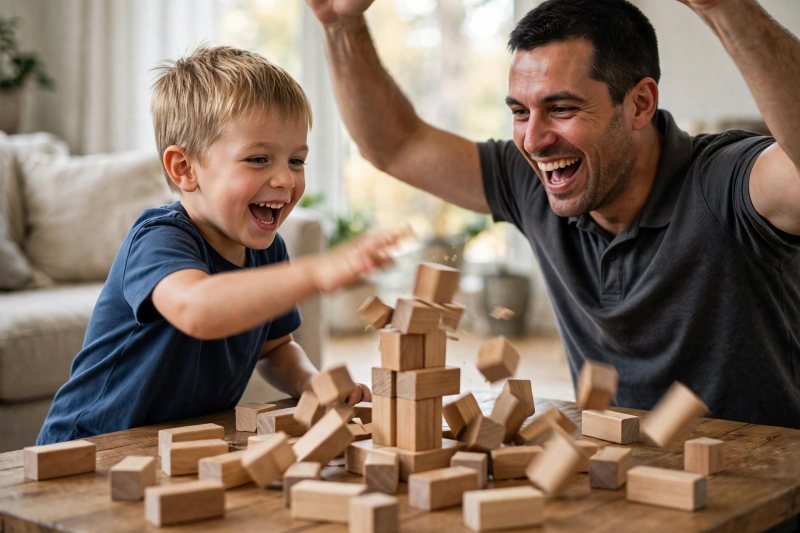
What is the easiest first game for one more and one less? The One More Tower. Build a little block tower together, add one block and count: "3 and one more makes 4." Take one away: "4 take away one is 3." It shows both directions in a single toy; the full step-by-step is in the Instructions below. Play it first: it teaches the language ("one more," "one less," "makes") every other game reuses. If your child insists on knocking the tower down after every round, let them — rebuilding is just more counting, and it is often during a rebuild round that the number sentence finally comes out on its own.
Which dice game teaches "one more" fastest? Roll Plus One. One die, a small pile of blocks. Your child rolls — say it lands on 4 — builds 4 blocks, then adds one more: "4 and one more makes 5." Roll again: a 6 becomes 7, a 2 becomes 3. Once +1 is instant, flip it: Roll Minus One. Roll a 5, build 5, take one away — "5 take away one is 4." Roll a 1, take it away: "Nothing left! Zero!"
How can jumping games teach adding and subtracting one? Number-Line Hops. Lay blank masking-tape squares on the hallway floor. Your child stands on one: "Hop one more forward!" Then backward: "Hop one less — back one square!" Add counting as you go: stand on 4, hop forward — "5!" — hop back — "4 take away one is 3!" Backward hops are gloriously silly, so they'll beg for another round.
Staircase Countdown. Stand on the bottom steps. Start on step 5: "Five! Hop down one — one less!" Land: "4!" Keep hopping: "3! 2! 1! Zero — blast off!" (5 − 1 = 4 down to 1 − 1 = 0.) Climbing back up reverses it: "1 and one more makes 2!"
What snack games teach one more and one less? One More Cookie. Put 3 crackers on a plate: "1, 2, 3." Slide one more on: "One more! Now how many?" Count together: "4! 3 and one more makes 4!" Repeat to 6 or 7 — then Take One Away, Please. Your child eats one: "One less! 6 take away one is 5!" Keep eating and counting down. Delicious math, automatic cleanup — and "one less" clicks because the cookie is genuinely gone.
Which guessing games build "one less" thinking? What's Missing? Line up 6 small toys and count them. Your child closes their eyes (no peeking!) while you sneak one behind your back. "Open! How many now?" They count: 5. "6 take away one is 5!" "One less" feels like a magic trick. Then swap roles.
The Magician's Hand. Show 4 blocks in your closed fist. "Abracadabra!" Pull one more from your pocket: "One more! 4 and one more makes 5!" Reverse it: close your fist around 5, open it with one secretly palmed — "One less! 4!" Perfect for waiting rooms.
Finger Flash. Hold up 3 fingers. "Three! One more finger!" Pop up a fourth: "4!" Fold one down: "One less — 3!" Zero setup — car, checkout line, waiting room.
What you'll need
- Wooden blocks, one die, masking tape, small toys, crackers.
How to do it
-
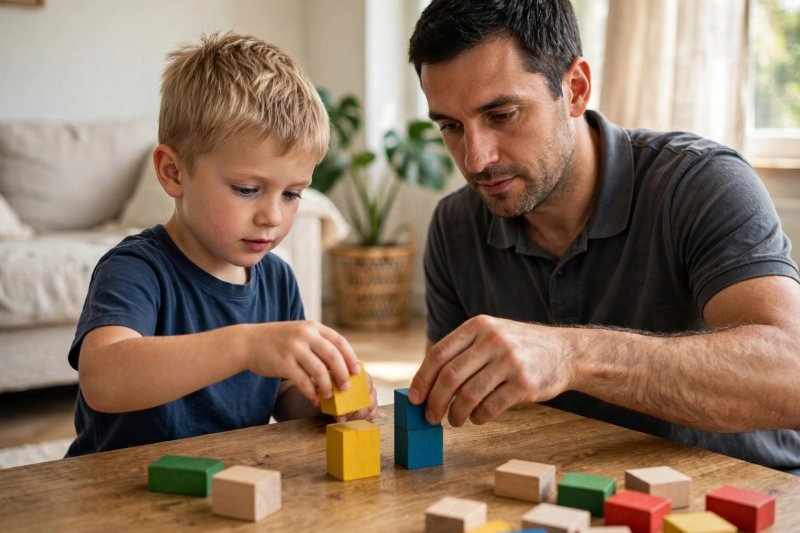
Build the starting tower together. This is the One More Tower — play it step by step: take turns stacking blocks until a wobbly tower of 3 stands on the table, and narrate as you go ("One for you, one for me, one for the tower") so the first counting happens before the game even starts.
-
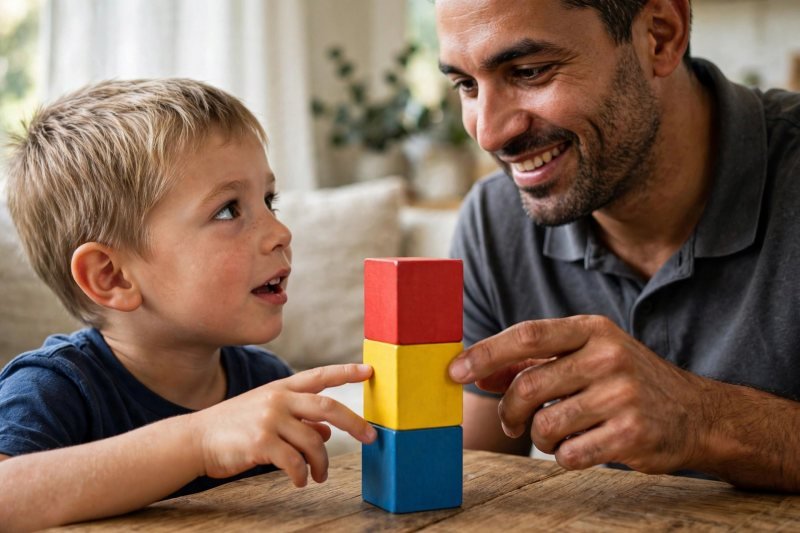
Count every block out loud. Touch each block together as you count — "1, 2, 3 — three blocks!" — the touch is non-negotiable, because one touch per number is what stops skips and double-counts; let your child set the pace while you shadow their counting.
-
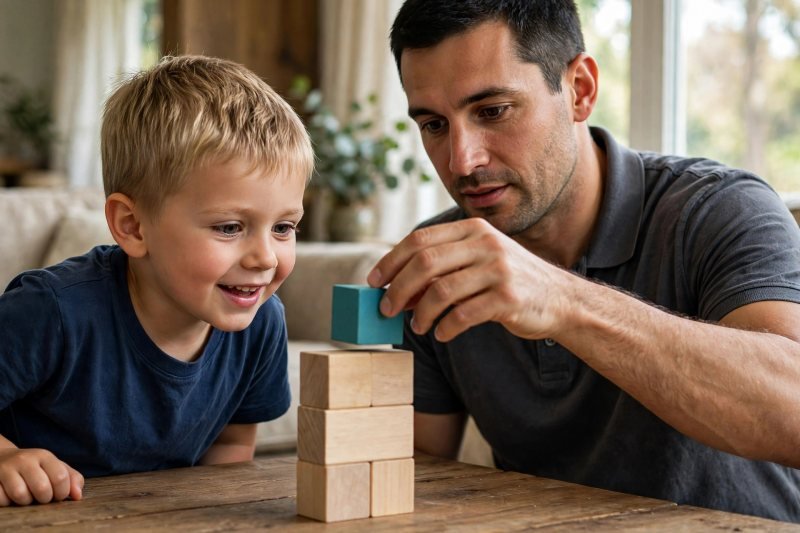
Add one more yourself. YOU add the next block — make it theatrical, a slow-motion placement — then ask, "Now how many?" and count the tower again together: 4. This first demo round shows the whole idea: one block went on, and the number changed.
-
Say the magic sentence together. This is the sentence the whole bridge is built on, so chant it out loud like a spell: "3 and one more makes 4" — say it twice, let your child say it solo, and make it the ritual ending of every round from here on, because saying the number sentence is what turns counting into adding.

-
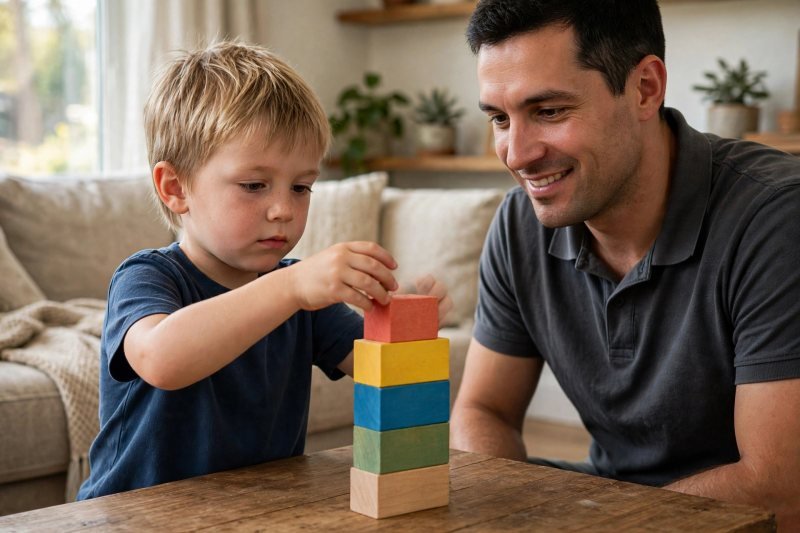
Hand the adding to your child. It's their turn now: they place one more block while you count together — 5 — and they say the sentence themselves: "4 and one more makes 5." Resist the urge to say it for them; the slightly-too-slow sentence said in their own voice is the learning happening.
-
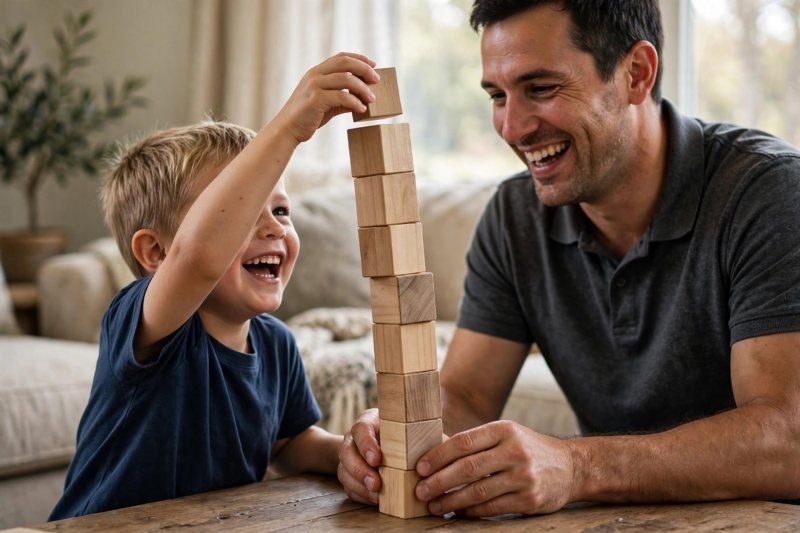
Climb the tower one block at a time. Keep going to 7 or 8, alternating who adds, and say the magic sentence every single round — "5 and one more makes 6... 6 and one more makes 7" — the repetition is the point: +1 needs to feel boringly automatic before anything new enters the game.
-
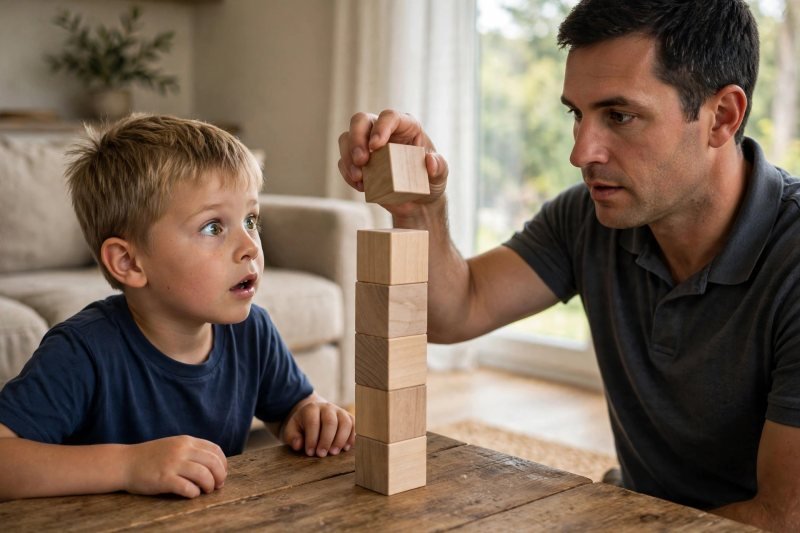
Flip to one less. YOU take one block off — again, slow and theatrical — and announce, "One less! 7 take away one is 6." Keep the same ritual sentence shape but swapped, so your child hears that one less is just the mirror image of one more, not a brand-new idea.
-
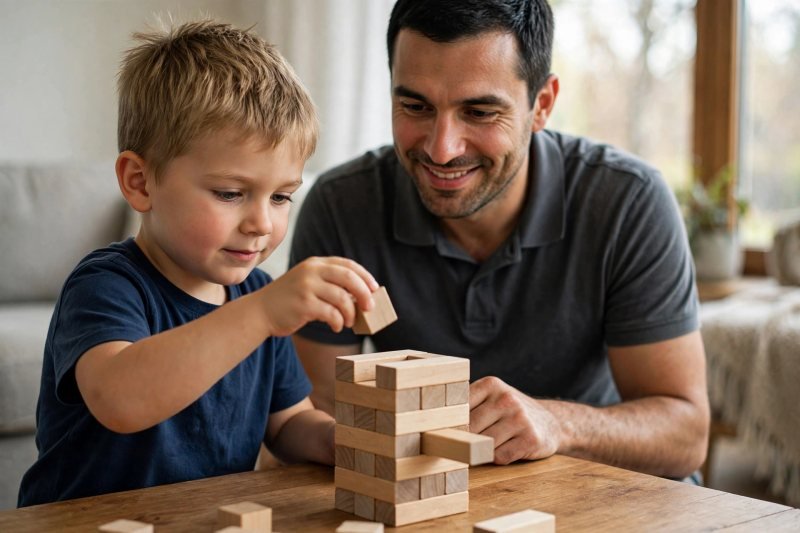
Let your child take one off. Their turn to shrink the tower: "6 take away one is 5," then wiggle down to 4, one careful removal at a time — if they try to touch each block and count from 1, let them; the recount is where the subtraction idea lands.
-
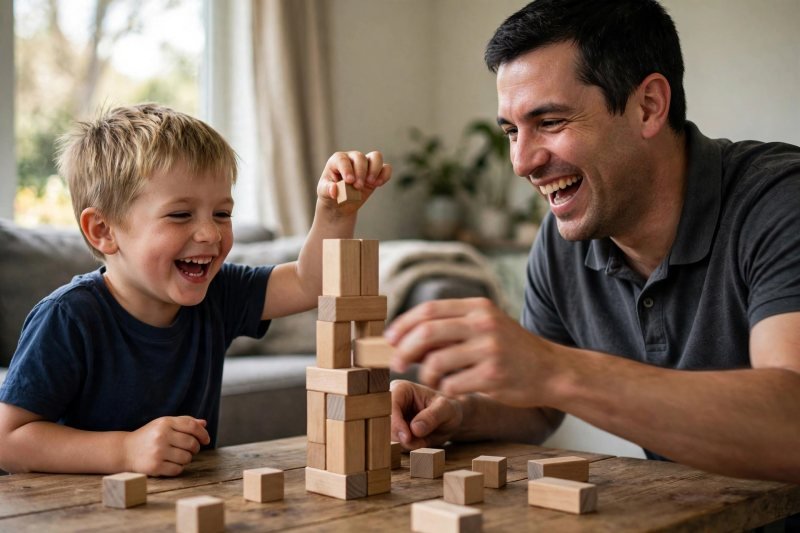
Bounce up and down. Now go back and forth — one more, one less — and watch the number bounce: "5 and one more makes 6... 6 take away one is 5... 5 and one more makes 6!" Call out the direction each round ("One more!... One less!...") and let your child predict the number before counting to check.
-
Cheer and knock it down. Count the tower up by ones one last time, cheer for the tallest tower of the day, then let your child smash it flat — the knockdown is the payoff, and the promise of "we'll build it taller tomorrow" is what brings them back for the next round of +1 and −1.


Make it easier
Start with a 2-block tower and totals under 5. Play "one more" rounds only for the first few days; add "one less" once +1 feels easy. Count every block from 1 each time — the recount is the lesson. Split the job: your child adds while you say the sentence.
Make it harder
Start the tower at 8 and climb to 12 — bigger numbers, same idea. Try "two more": add two blocks — "6 and two more makes 8." (One more, and one more!) Ask before counting: "We have 6 — add one more, what will it be?" Play Roll Plus One with blocks out of sight: roll, then answer from the number alone. Once +1 and −1 are instant, stretch the range with counting to 20 activities — and see what comes next in our math hub. Once one more is instant, our addition games for kindergarten pick up right where these leave off.
Other ways to play it
- Teddy's tower: build for a stuffed animal; teddy "says" the number sentences in a silly voice.
- Pebble tower: stack flat stones outside — one more pebble, one less pebble, same math.
- Sibling edition: an older sibling plays "two more / two less" on the same tower.
- Bedtime version: one more page of the story, then lights out — "one less light on!"
How it changes by age
- The sweet spot is ages 5–6, when most children count reliably but haven't connected counting to adding. Four-year-olds can play too — "one more" only, totals under 5, plus our counting games for preschoolers. For shaky 7-year-old adders, the predicting version in "Make it harder" beats drilling facts.
What they're learning
+1 fluency: every number is one more than the last. −1 fluency: one less, including the discovery of zero. Counting on: "4 and one more makes 5" without recounting from 1. The addition link: one more IS adding 1; one less IS subtracting 1. Prediction: guessing before counting — the first step to mental math. Math language: "one more," "one less," "makes," "take away."
Clearing up
Blocks go back in the bin — count them in for one last sneaky round of one-more math. Peel up the tape squares. Trays and dice go back in the game cupboard. Cookie crumbs are your child's department.
Questions parents ask
What does "one more, one less" mean in early math?
At what age should children learn one more and one less?
How does one more and one less lead to addition?
My child can count to 20 but can't add. Will these games help?
What if my child mixes up "one more" and "one less"?
How long should we play one more one less games?
The sentence is the secret: a child who can say "4 and one more makes 5" without counting from 1 is adding — genuinely adding. No pressure, no timing, no worksheets. If they ask to build the tower again tomorrow, the bridge is holding.

save it for later
Pin this for the next rainy afternoon
Keep it on a board so it is there when you need it, rather than when you happened to find it.
Save to PinterestTry this next
-
How to Teach a Child to Tell Time: A Step-by-Step Parent Guide
Ages 5–6
-
Counting to 100 Activities for Kindergarten (That Aren't Worksheets)
Ages 5–6
-

Counting Backwards Activities: Build Number Fluency in Both Directions
Ages 4–5
-

Addition Word Problems for Kindergarten: Picture Stories Within 10
Ages 5–6


