


Five Senses Observation Journal for Kids (Printable)
A free printable five senses worksheet journal for ages 6–8: seven days of drawing and writing prompts — one sense a day — that turn noticing into a real scientific observation habit.
A five senses observation journal is a week-long printable where kids 6–8 record what they notice each day — one sense per day — through drawing and writing prompts. Print the nine pages, bind them into a journal, and spend 15–20 minutes daily on sight, hearing, smell, taste, touch, comparing, and an outdoor day. It builds scientific observation and early data-recording skills.

The short version
- A five senses observation journal stretches the classic five senses worksheet across seven days — one sense per day for ages 6–8.
- The free printable has nine pages: a cover, seven daily pages, and a week-in-review page, each with a drawing box and writing lines.
- Daily rhythm: day 1 sight, day 2 hearing, day 3 smell and taste, day 4 touch, day 5 tally and compare, day 6 outdoors, day 7 review and sign.
- Each page works as a standalone five senses worksheet with one focus question guiding what to notice.
- Builds real science skills: sustained observation, recording data, tallying, comparing, and concluding.
- Taste and smell days use parent-provided foods only — never taste foraged items.
- Age
- Ages 6–8
- Prep
- 10 min
- Mess
- Low
- Difficulty
- Easy
- Where
- Both
Why kids love this
By six or seven, many kids are serious notebook collectors — and this five senses worksheet journal is a notebook with a mission. Each day hands them one sense to investigate like a real scientist: sitting still to truly see the backyard, closing their eyes to map every sound, sniffing mystery spices, or reaching into a pillowcase to identify objects by touch. It feels like detective work, not homework: a fresh page daily, a big drawing box per page, a tally chart and "scientist signature" at the end. Best of all, it builds — by day seven they flip through their own data like researchers. And it is theirs: they bind it, decorate it, sign it.
What you'll need
- The free printable observation journal (PDF, added at publish time): cover, seven daily pages, and a "week in review" page. Each daily page is a standalone five senses worksheet: drawing box, writing lines, one focus question.
- Paper and a home printer (black-and-white is fine)
- A stapler, binder clips, or a hole punch with ribbon
- A pencil, crayons or colored pencils
- A clipboard for the outdoor day
- Taste-day foods: a strawberry, a cheese cube, a banana slice (see our taste test for preschoolers for more sweet, salty and sour ideas)
- Smell-day items: a cinnamon stick, a lemon peel, a cotton ball with vanilla
- A pillowcase "mystery bag" with five familiar objects: spoon, cotton ball, pinecone, sponge, key
Before you start
Print all nine pages single-sided, stack in order, and bind the left edge: staples (a parent job), binder clips, or ribbon through punched holes. Show your child the format: drawing box, writing lines, one focus question per page. Pick a "journal spot" — the same chair by the same window daily — so the day-five comparisons are genuinely interesting.
How to do it
-
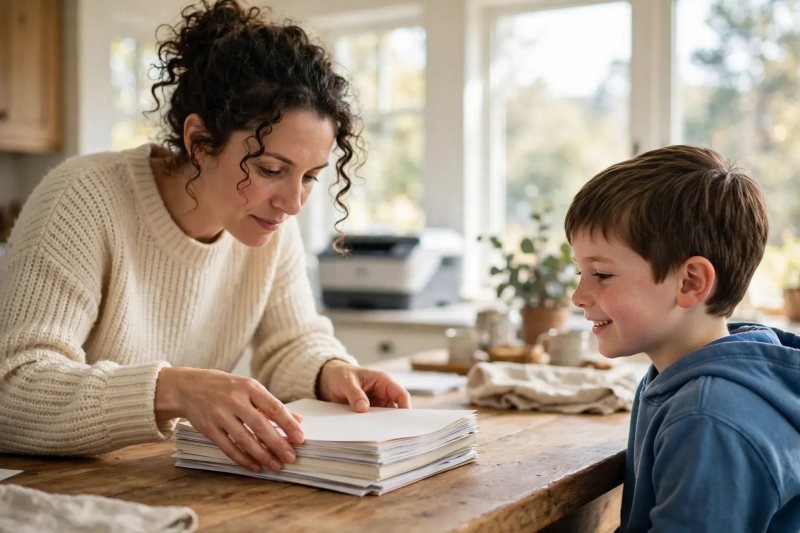
Print the journal pages. Print the free PDF single-sided: cover, seven daily pages, week-in-review page — each with a drawing box, writing lines, and one focus question.
-
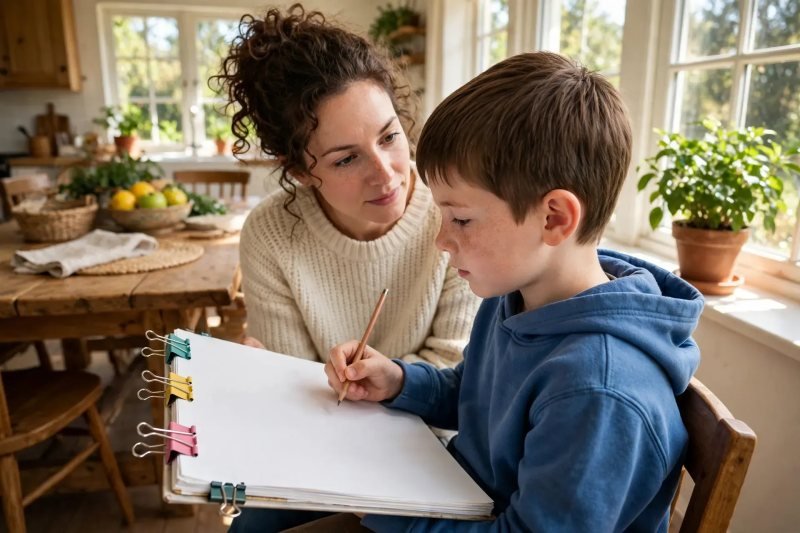
Bind the pages into a real book. Stack in order and bind the left edge — staple the spine (a parent job), clip it, or thread ribbon through punched holes. A bound book makes the week feel official.

-
Decorate the cover. Your child draws themselves as a scientist — goggles, magnifying glass, wild hair — then writes their name and the start date.

-
Day 1 — Sight: find five things you never noticed. Sit in the journal spot for five full minutes and look slowly. Mission: spot five things never really noticed — the crack in the window frame, dust in a sunbeam, the yellow edge on a green leaf. Draw two, with one describing sentence under each. Push past "green leaf" toward "a leaf with a yellow-brown edge, curled like a tiny boat."
-
Day 2 — Hearing: make a sound map. Two minutes, eyes closed, just listen. Then draw a "sound map": your child in the middle, near sounds close, far sounds at the edges. Write which sound was loudest, softest, and one never noticed before. The room was never actually quiet.

-
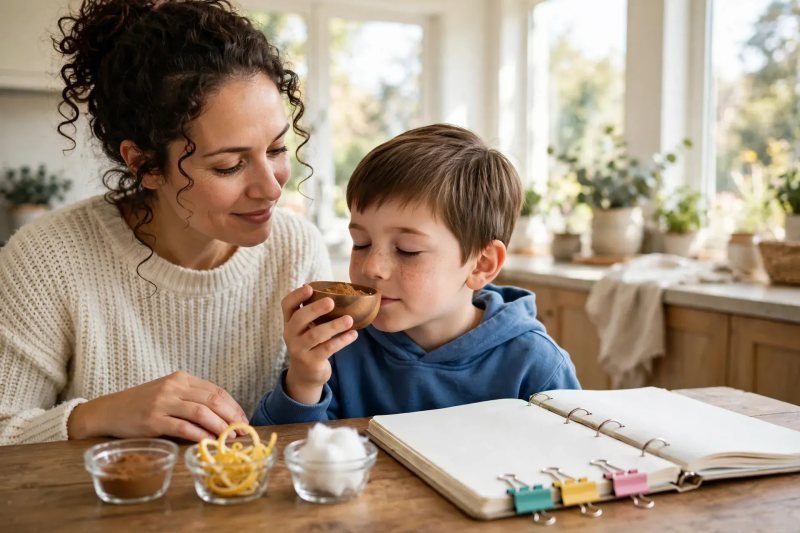
Day 3 — Smell and taste: the kitchen laboratory. A parent lines up three smell cups (cinnamon, lemon peel, vanilla cotton ball) and two familiar tastes (strawberry, cheese cube). Eyes closed, your child sniffs each cup and guesses before looking — then tastes like a "taste scientist": one small bite, chewed slowly. They draw each item, write their guess beside the real answer, and finish the focus question: "Which sense was right more often — my nose or my tongue?"
-
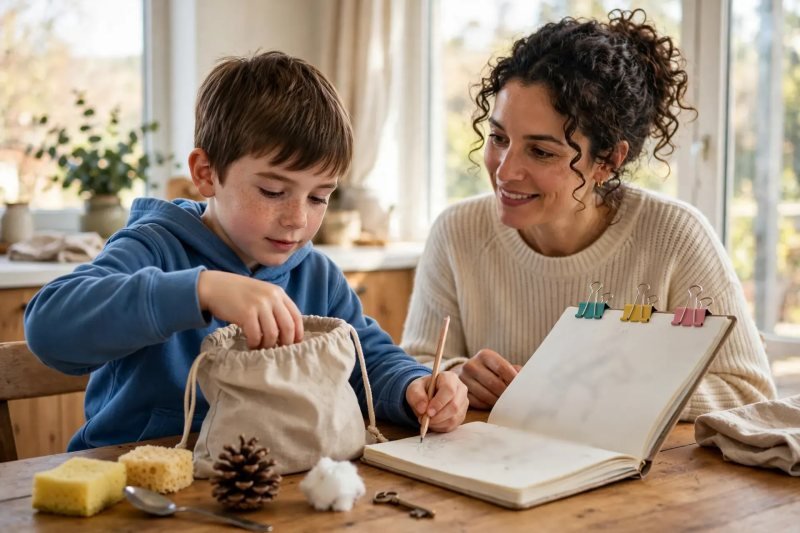
Day 4 — Touch: the mystery bag. A parent fills a pillowcase with five familiar objects (spoon, cotton ball, pinecone, sponge, key) — nothing sharp or breakable. Without looking, your child feels each one, draws what they think it is before pulling it out, and writes one touch word underneath: smooth, bumpy, squishy, scratchy, cold. Wrong guesses are the best part — a sponge feels like a small animal until you look.
-
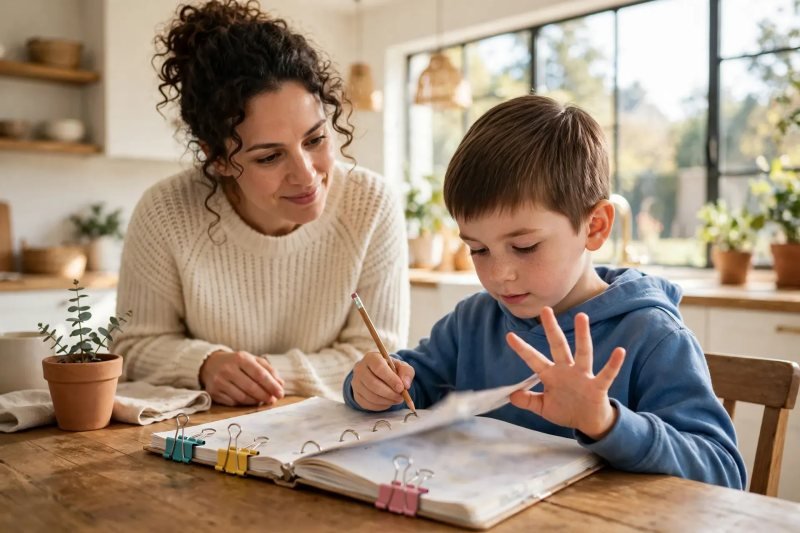
Day 5 — Tally and crown the busiest sense. Flip back through days 1–4. Your child tallies everything each sense found and circles the top scorer — the "busiest sense of the week." Focus question: "Which sense was hardest to use, and why?" Most pick hearing (you cannot see sounds) or smell (everything fades fast) — that reasoning is the real science.
-
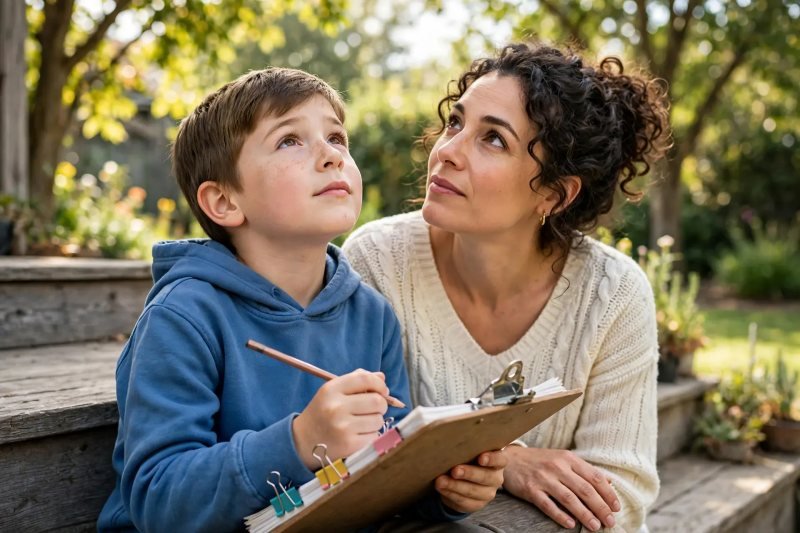
Day 6 — Outdoor expedition: all five senses at once. Take the journal and a clipboard to the backyard, a park, or the front step. Fifteen minutes, all five senses on one page: one quick drawing and one sentence per sense — seen, heard, smelled, felt, and (parent-provided only) tasted. Nature turns the volume up — day-six pages always look wilder.
-
Day 7 — The week in review: sign like a scientist. Your child draws their favorite discovery, writes three things their senses taught them, and signs "like a real scientist." Then they present the journal to the family — seven days of their own data. Tape the decorated cover to the fridge for a day. It earned it.


Print it out
Make it easier
If writing is a chore, scribe while your child dictates — observations are the point, not handwriting. Just the drawing boxes works for a 6-year-old building stamina. Three days (sight, hearing, touch) make a fine mini-journal.
Make it harder
Add a prediction line before each day: "I think I will find ___ sounds" — a hypothesis, and 8-year-olds love the word. Two kids can keep journals side by side and swap day-three pages. On day five, trade tally marks for a bar chart.
Other ways to play it
- Weekend sprint: all seven days in one rainy weekend — two senses Saturday morning, two in the afternoon, three Sunday.
- Nature-only: every day outdoors — backyard, park, garden as the laboratory.
- Dinner-table version: one sense per dinner; the taste day becomes a family event.
- Classroom or co-op: one journal per child, shared smell cups and mystery bags, compare "busiest sense" Friday. Our preschool learning activities at home collection has more structured ideas for this age.
How it changes by age
- At 6: do best drawing and dictating — you write, and the day-five tally marks are a great first data skill.
- At 7: most manage the full page alone — though the taste day still needs a parent in the kitchen.
- At 8: can add predictions and bar charts, compare journals with a friend, and run the mystery bag for a younger sibling (you check the bag first).
- For a preschooler tagging along: hand them crayons and a blank page — our five senses activities for preschoolers has versions built for their age.
What they're learning
A week-long journal is the early scientific method in disguise: observe, describe, record — which turns noticing into data. The day-five tally page is a genuine first statistics lesson: count, compare, conclude ("smell found the most"). Each focus question builds reasoning — why was hearing harder than sight? — and seven days of follow-through builds real research persistence. For a quicker single-session experiment, try our dancing raisins experiment — and for younger children, our five senses activities for toddlers build the same noticing skills.
Clearing up
The journal goes on the bookshelf — kids revisit these for months. Return the cinnamon and lemon peel to the kitchen, wash the smell cups, empty the mystery bag.
Questions parents ask
What is a five senses observation journal for kids?
What should a five senses worksheet include?
How long does the five senses journal take?
How do observation journals help kids learn?
What ages is a five senses observation journal best for?
Do you need the printable, or can kids use a plain notebook?

save it for later
Pin this for the next rainy afternoon
Keep it on a board so it is there when you need it, rather than when you happened to find it.
Save to Pinterest

