


Egg Drop Challenge for Kids: 5 Engineering Designs That Actually Work (Ages 6–8)
The classic egg drop challenge for kids ages 6–8: five egg drop project ideas — padding pod, parachute, crumple zone, suspension cage, and layered box — with safe testing and a redesign step that teaches real engineering.
The egg drop challenge asks kids to build a container that protects a raw egg dropped from a height. The best kid-friendly designs are a cotton-ball padding pod, a plastic-bag parachute, a newspaper crumple zone, an egg suspended by rubber bands in a box, and a bubble-wrap layered box. Always test from adult height with an adult dropping, then redesign and retest — that's the real lesson.

The short version
- Classic engineering challenge for ages 6–8: protect a raw egg dropped from a height
- Five kid-tested designs: padding pod, parachute, crumple zone, suspension cage, layered box
- One design step = one action: plan, build, test drop, check the egg, redesign
- Padding absorbs impact; a parachute slows the fall by catching air
- An adult does every drop; drop onto grass or a tarp, never hard floors
- Redesign at least once — iteration is the engineering lesson
- Cleanup: bin shell shards, wipe surfaces, wash hands with soap
- Age
- Ages 6–8
- Mess
- Some
- Difficulty
- Medium
- Where
- Outdoor
Why kids love this
It is a raw egg versus gravity, and they get to play engineer in the middle. There is genuine suspense — the slow count to three, the drop, the breath-holding pause before the lid comes off — that no worksheet has ever produced. Six-to-eight-year-olds are old enough to understand why their first design cracked and young enough to laugh about the yolk everywhere. And because there's no single "correct" design, every kid's contraption looks different — parachutes, padding fortresses, newspaper nests — and half the fun is showing it off before the drop.
What you'll need
- Raw eggs (a dozen — you'll want spares for the redesign round)
- Small boxes — cereal boxes, shoe boxes, takeout containers
- Padding: cotton balls, bubble wrap, newspaper, paper towels
- Masking tape (easiest for kid fingers) and duct tape for the ambitious
- String, ribbon, or yarn, plus a light plastic bag or large napkin (parachute canopy)
- Rubber bands (for the suspension design)
- Scissors and a marker for labeling designs
- A tarp or old sheet, paper towels, trash bags, and soap (cleanup station)
- Optional: a stepladder or access to a safe second-story window — the ADULT handles all height
Before you start
Set up outdoors if you can: a backyard, driveway, or grassy park corner. Lay the tarp on the drop zone — hard floors crack eggs that would have survived a soft landing, and raw egg on concrete is a miserable cleanup. Decide before you start how many test drops each design gets (two is a good number: one drop plus one redesign is where the learning lives). Put the cleanup station — paper towels, trash bag, soap or wipes — within arm's reach, and read the Safety section before anything leaves the ground.
How to do it
-
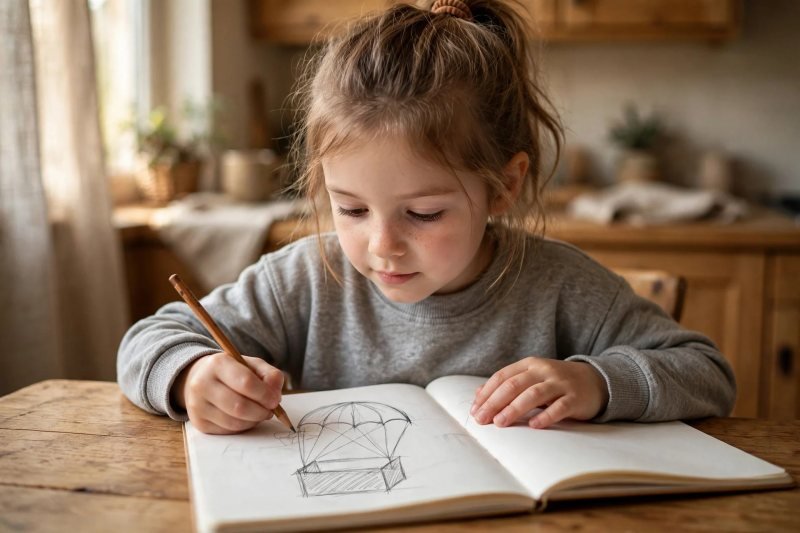
Plan the design on paper first. Before touching a single cotton ball, have your child sketch their container. What will slow the fall, and what will cushion the landing? Even a rough drawing slows kids down enough to actually think — and it gives them something to point at later when they explain what they changed.
-
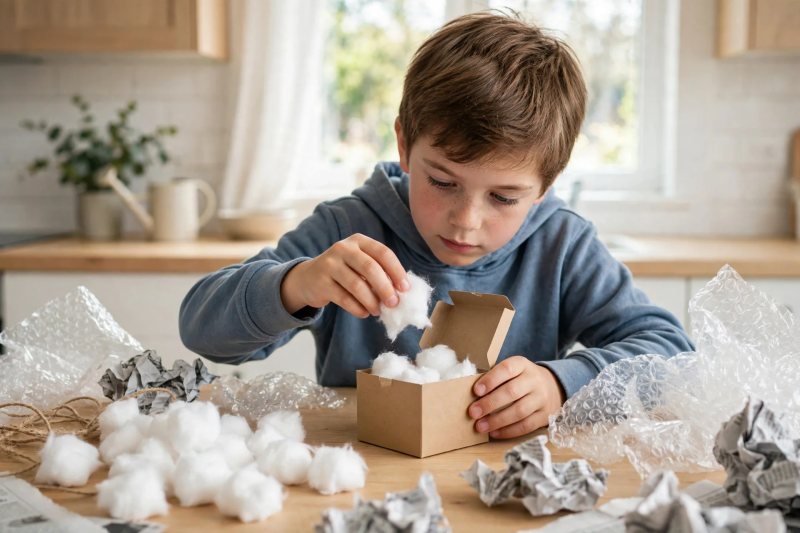
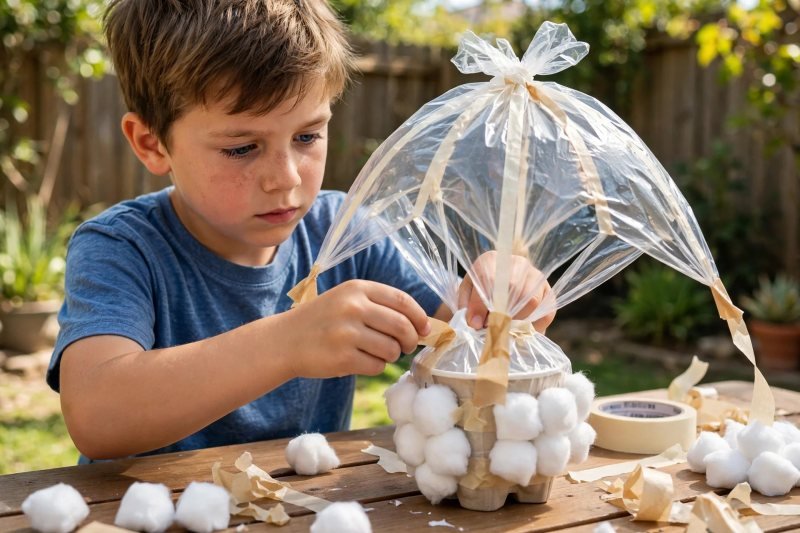
Build the container — they lead, you assist. Set out all the padding materials and let your child build their sketched design. Resist fixing it for them; a design that fails teaches more than a parent-engineered design that survives. Keep the egg out until the build is finished — nesting it last prevents accidental cracks during construction.
-
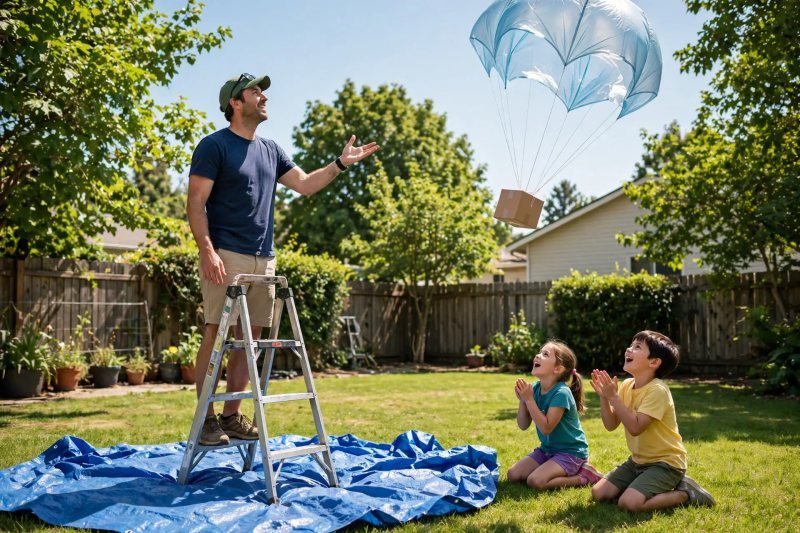
Run the test drop — ADULT ONLY does the dropping. Place the raw egg inside, seal the container, and carry it to the drop point. The adult stands at height (a stepladder, a balcony, a second-story window — steady footing, never leaning out) while the child watches from the ground at a safe distance. Count down together and let go, aiming for the tarp.
-
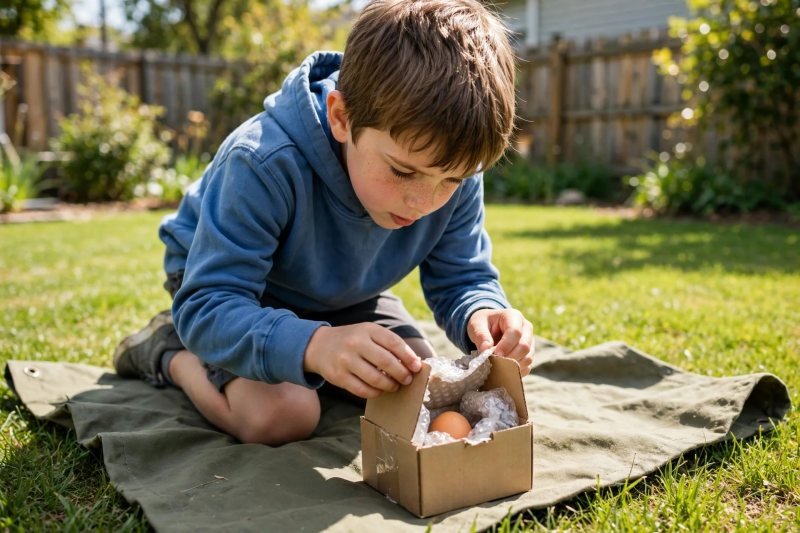
Open it and check the egg. Carry the container back down before opening it. Unwrap slowly. A cracked egg is not a failure; it is data. Ask where it cracked — the crack's location points at the weak spot, like padding that was too thin on one side or a hard corner that punched through.
-
Redesign and drop again. This is the step that makes it engineering. Based on what the crack (or the survival) taught them, your child changes ONE thing — more padding on the weak side, a bigger parachute, a softer bottom — and you drop it again. Test, observe, change one variable, retest: that's iteration.


Make it easier
For younger sixes or first-timers: drop from standing adult height (just overhead) instead of a ladder — many padding designs survive that, which builds confidence. Pre-cut the tape strips and set out a "starter kit" (one box, cotton balls, newspaper) so the build doesn't overwhelm. Allow two eggs per design so a first crack doesn't end the fun.
Make it harder
Raise the drop height a step at a time — kids love earning the "second floor" attempt. Add a constraint: the container must fit inside a shoebox, weigh less than a paperback, or use only recyclable materials. A Skittles rainbow experiment makes a colorful warm-up before the big drop. Time the parachute designs with a stopwatch — can they engineer the slowest descent? Or run a family tournament: everyone builds a design, one drop each, most intact egg wins.
Other ways to play it
- Parachute-only: no boxes allowed — just the egg, tape, string, and a canopy. Pure air resistance.
- Ramp landing: drop so the container lands on a slide or ramp; a rolling landing adds a whole new design problem.
- Group edition: each kid designs their own, all dropped one after another — the redesign round gets competitive fast.
- Mystery materials: let kids pick five items blindfolded from a bag; engineering with constraints is the real deal.
- Slow-motion reveal: film the drop in slow motion — kids love watching the parachute open frame by frame. After the tournament, cool down with magic milk — swirling color with a much smaller cleanup.
How it changes by age
- Built for ages 6–8. Six-year-olds will need help with taping and cutting, and their designs will be glorified egg burritos — celebrate that; the physics still works. Seven- and eight-year-olds can plan, build, and iterate mostly on their own, and they start arguing about why designs work, which is the whole point. Under six, this is a watch-the-drop activity, not a build-it one. Younger siblings can start with easy science experiments for toddlers while the big kids build. Every age needs an adult doing the drops — non-negotiable (see Safety).
What they're learning
The engineering design cycle (plan → build → test → redesign); cause and effect with one variable at a time; how padding absorbs impact by spreading force over a larger area and a longer time; how a parachute slows a fall by catching air; predicting outcomes and comparing predictions to results; handling a failed design without quitting — resilience dressed up as a game. For more kitchen-table science, try our baking soda and vinegar volcano and the dancing raisins experiment — both reward the same test-and-observe thinking in a glass.
Clearing up
Scoop cracked-egg mess into the trash bag with paper towels — not down the sink in big globs (yolk and drains are not friends). Wipe the tarp with warm soapy water and hang it to dry. Wash hands with soap and water, always. Salvage reusable padding like bubble wrap and rubber bands for the next round; bin the yolk-soaked newspaper. Cleanup included, the whole activity fits inside about an hour.
Questions parents ask
What do you need for an egg drop challenge for kids?
What is the best design for an egg drop project?
How do you keep an egg from breaking in an egg drop?
What does the egg drop challenge teach kids?
Is the egg drop challenge safe for kids?
What age is the egg drop challenge good for?
Film the drop in slow motion — the frame-by-frame replay of a parachute opening is worth more than any explanation of air resistance. Let kids name their designs ("Egg Fortress 3000" energy is encouraged), and keep one intact egg as a trophy if a design survives. For more build-and-test fun, our sink-or-float game for toddlers runs the same design-test-redesign loop on the water.
