


Easy Science Experiments for Toddlers: 10 Safe First Experiments (Ages 2–3)
10 safe, taste-friendly science experiments for toddlers ages 2–3 — sink or float, color mixing, fizzing colors, ice melting and more, all using things you already own.
The best science experiments for toddlers are safe to touch, give instant results, and use things you already own. Try sink or float, color mixing, fizzing bicarbonate colors, ice melting, and magnet hunts — all taste-friendly, all set up in five minutes, all perfect for ages 2–3 with an adult alongside.

The short version
- At 2–3, science means noticing: cause and effect, not explanations.
- All 10 experiments use taste-friendly, non-toxic ingredients and five-minute setups.
- Water play (sink or float, ice, pouring) is the easiest place to start.
- Adults handle vinegar pouring and balloons; toddlers do the exploring.
- "What do you think will happen?" is the most powerful question — guessing is the skill.
- Repeat favorites for days; repetition is how toddlers learn.
- Age
- Ages 2–3
- Prep
- 5 min
- Play time
- 15 min
- Mess
- Some
- Difficulty
- Easy
- Where
- Indoor
Why kids love this
You don't need a kit, a lab coat, or a science degree — the best science experiments for toddlers use water, ice, and things from your kitchen cupboards. At two and three, "science" isn't about explanations; it's about noticing. What happens if I drop it? What happens if I mix it? These 10 safe first experiments are built for exactly that curiosity: taste-friendly ingredients, nothing hot or sharp, and every single one set up in about five minutes. Pick one per session, follow your toddler's lead, and let the splashing count as learning — because it is. (You'll find more sensory play ideas for this age in the Bright Playday learning hub.)
Toddlers are natural scientists — they already test everything by dropping it, mouthing it, and pouring it on the floor. These experiments give that instinct a stage: fizzing colors, floating toys, disappearing ice. No right answers to get wrong, no sitting still required — and water is involved in half of them, which is basically a toddler guarantee of joy.
What makes a good experiment at this age? Three things: safe to touch (and probably taste), instant results, and repeatable — if nothing happens in ten seconds, a two-year-old is gone. Good toddler science is adult-led but child-driven: you set the safe boundaries; they do the pouring, dropping, and squishing. Say the science words out loud — sink, float, melt, mix, fizz — because vocabulary is half of what they're learning.
What you'll need
- Everything comes from your kitchen and toy box: a washing-up bowl, cups and spoons, food coloring, bicarbonate of soda, white vinegar, ice cubes, chunky fridge magnets, a torch or lamp, a sponge, a balloon, books for ramps, toy cars, and a funnel. No shopping trip needed.
Before you start
Lay a towel or shower curtain under the play area — half of these involve water. Decant ingredients into small bowls before your toddler arrives (toddlers and open bags of bicarbonate are a combination). Keep a dry flannel nearby. Then invite, don't instruct: "Shall we see what happens?"
How to do it
-
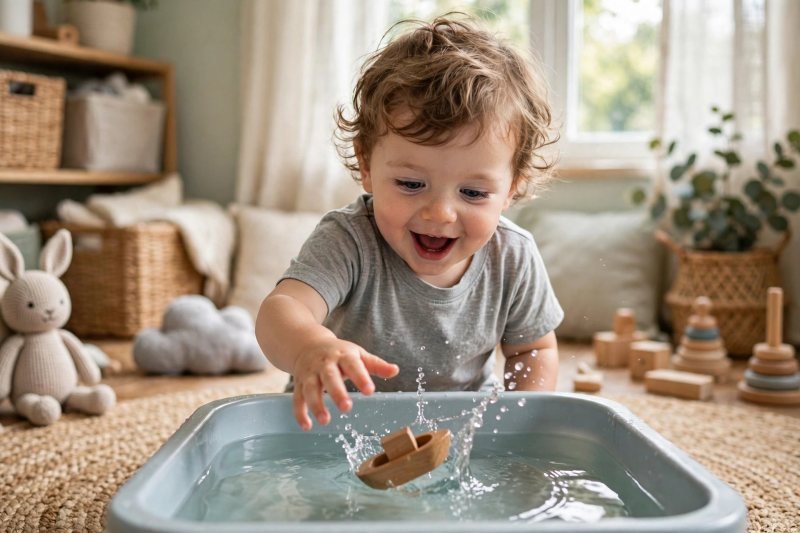
Sink or float — drop things in water. Fill a washing-up bowl with lukewarm water — towel underneath first — and gather a wooden toy, a stone, a plastic spoon, and a leaf. Hold each one up and ask, "sink or float?" — let your toddler guess, then drop it in together. Narrate what happens: "The stone sank! The leaf is floating!" Let the splashing run its course; fifteen minutes of deep splashing beats an hour of flitting between activities. Tip the water out when you are done and keep the towel down — more water play is coming.
-
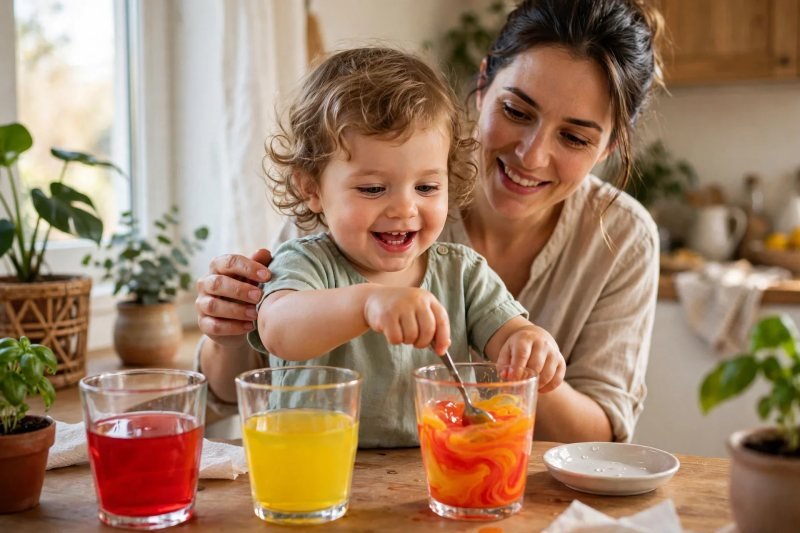
Mix colors in cups. Set out three clear cups of water and add one drop of food coloring to two of them — red in one, yellow in another — leaving the third plain. Hand your toddler a spoon and invite them to mix: "What happens if we put red in the yellow?" The gasp when orange appears is chemistry a two-year-old can see. Let them try every combination — red into yellow, yellow into red, a little of everything into the plain cup — and repeat it tomorrow; repetition is how toddlers learn, not a sign of boredom.
-
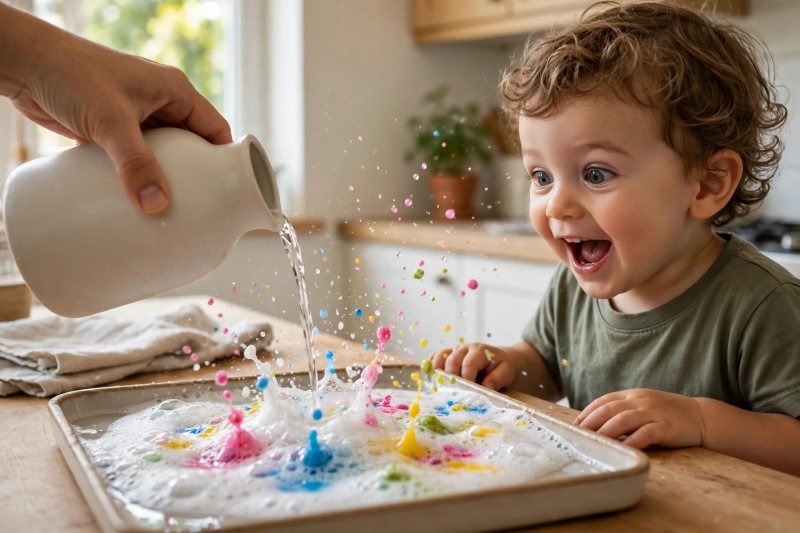
Make fizzing colors. Spread bicarbonate of soda on a baking tray and add drops of food coloring over it. Fill a squeezy bottle with white vinegar yourself — adults always handle the pouring — then hand it to your toddler and say, "Squirt it! What do you hear?" The fizzing, bubbling color gets the biggest gasp on this list. Let them squeeze until the tray goes quiet, then offer one refill. Set the fizzy tray aside when they are done; the mess is bigger than it looks and the flannel earns its keep.
-
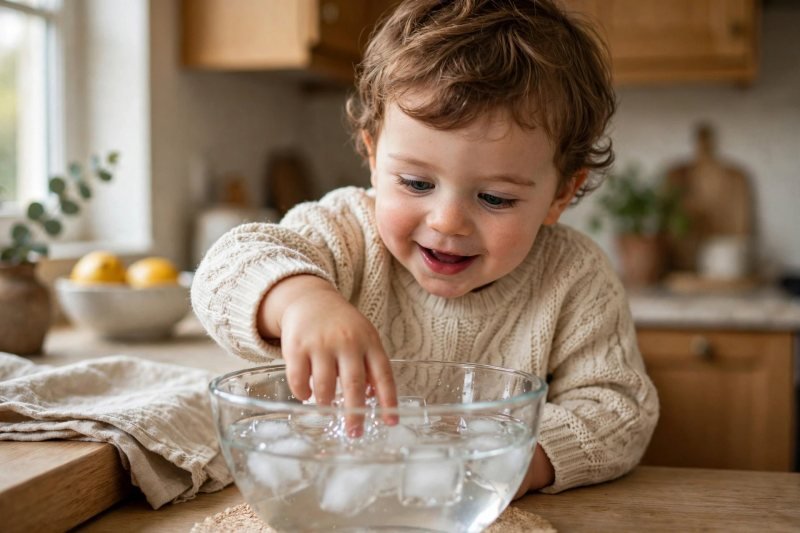
Play with melting ice. Tip a bowl of ice cubes onto the table — nothing else needed. Let your toddler touch, hold, stack, and watch them shrink: "It's getting smaller! My hands are cold!" Ask where the ice went — "It turned into water!" For older threes, set one bowl in sunshine and one in shade: "Which one melts first?" The purest experiment here, and free. When the puddles take over, wipe down — magnets are up next.
-
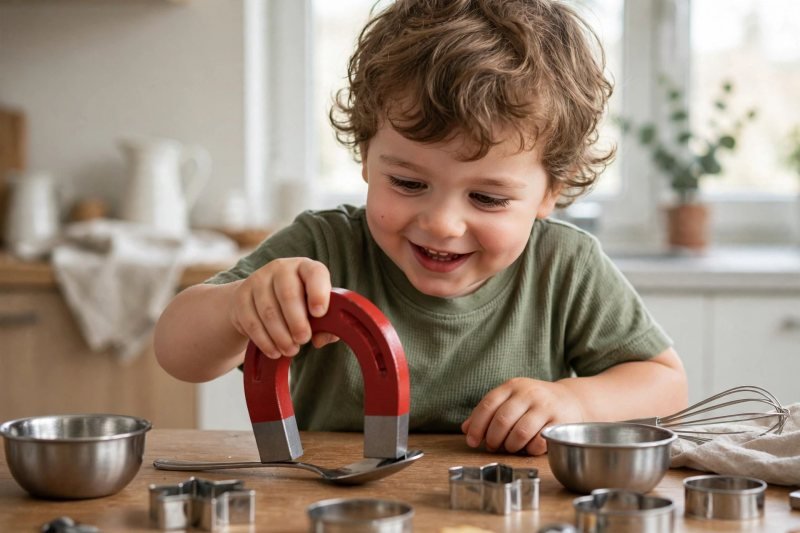
Hunt with magnets. Gather chunky fridge magnets — big ones only, nothing small enough to fit through a toilet roll tube — and a tray of safe objects: a metal spoon, a wooden block, a plastic toy, a wooden peg. Say, "Let's see what sticks!" and let them test everything. Narrate the pattern: "The spoon stuck! The block didn't!" The invisible pull is endlessly re-testable. Pack the magnets away yourself when they are done; little magnets stay far away from little mouths. Now kill the lights — shadow play is next.
-
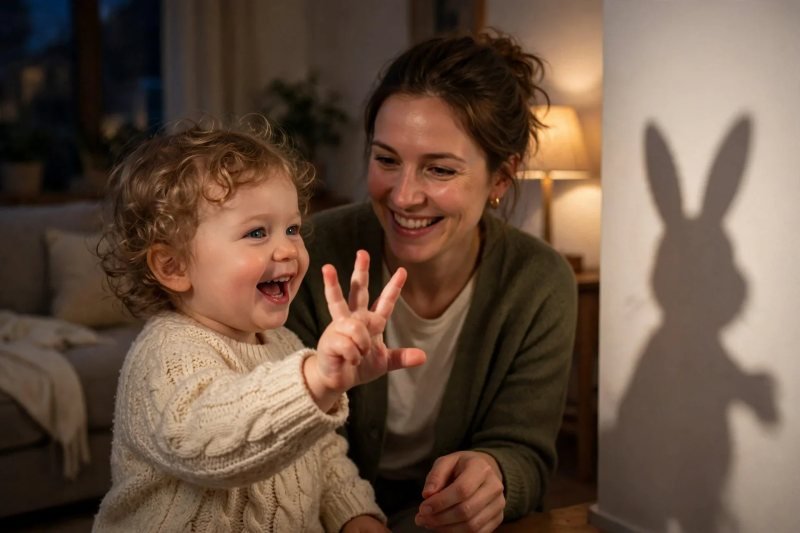
Make shadow puppets. Dim the room, aim a lamp or torch at a blank wall, and wave hands, toys, and a kitchen sieve through the beam. "Look — a bunny!" Move closer and further away: "The shadow got huge!" Let your toddler try making shadows themselves and watch them discover the connection between their hand and the wall. First lessons in light, with zero setup. When the lights come back up, dry off your hands — the rain jar is next.
-
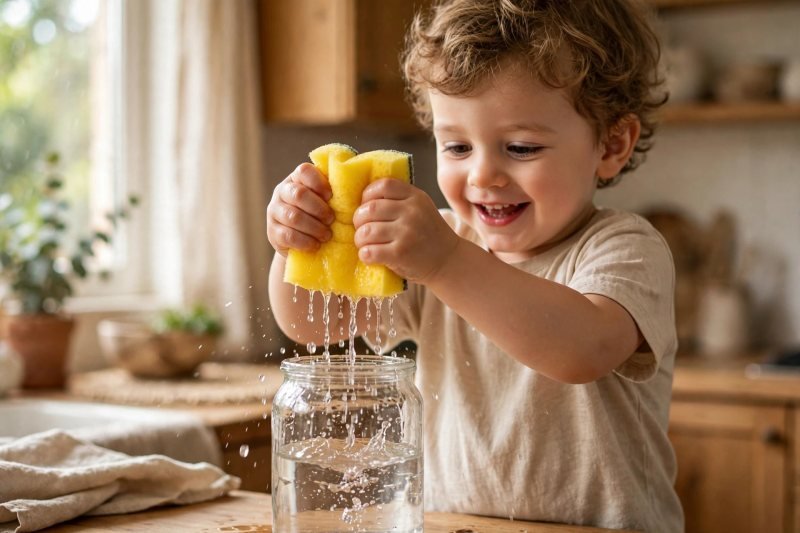
Squeeze a sponge rain jar. Fill a clear jar with water. Soak a sponge in colored water, hold it above the jar, and squeeze — colored "rain" falls through in slow ribbons. "It's raining blue!" Let your toddler soak and squeeze the sponge themselves; squeezing is hard, satisfying work for little hands. Do it again and again — and mind the towel, because this is the experiment that finds every dry patch of table.
-
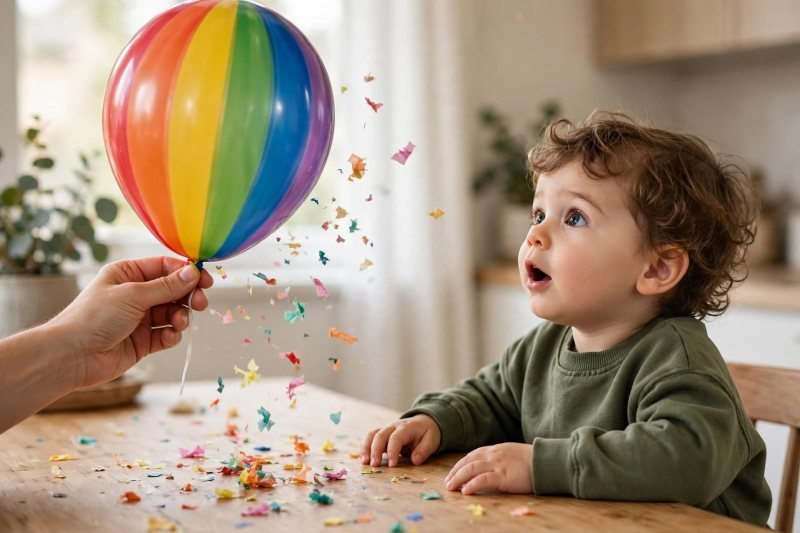
Try balloon static magic. Rub a balloon on your hair — you do this, and the balloon stays in your hands at all times — then hold it just above tiny torn pieces of tissue paper. "Look — the paper is jumping up!" Let them watch the pieces stick to the balloon, then fall. When the amazement fades, the balloon goes straight back in a cupboard: balloons are a choking hazard and never stay out with a toddler. Then clear some floor space — the ramp is next.
-
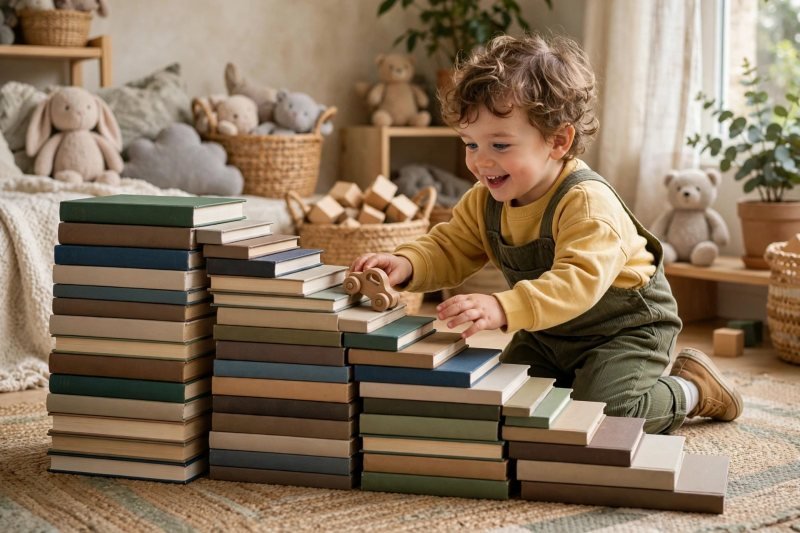
Race cars down a ramp. Lean a baking tray or big book against the sofa to make a ramp. Let your toddler roll toy cars, a ball, and a wooden block down it: "Which one goes fastest?" Then make the ramp steeper with more books — "Faster!" Racing two cars side by side gets maximum excitement. Steep versus shallow is physics a toddler can feel. One pouring experiment left — clear the floor and fetch the funnel.
-
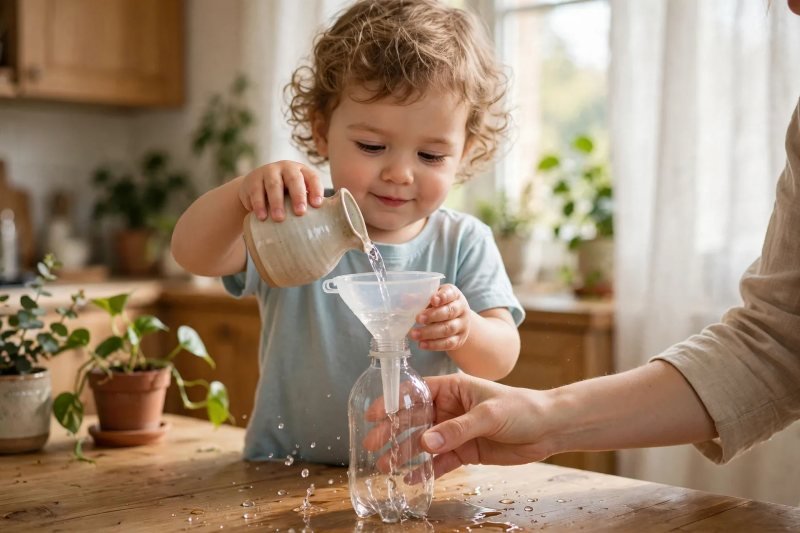
Pour through a funnel — the grand finale. Set a funnel over a bottle and hand your toddler a small jug of water: "Can you get it all into the bottle without spilling?" Pouring through a funnel without spilling is hard, fascinating work for little hands — one of the best fine-motor workouts on this list. Cheer every drop that makes it in and laugh at the spills; both count as learning. When the bottle is full, you are done: a scientist who can pour is a scientist who can help wipe the table, so let them finish the job alongside you.


Make it easier
Start with the water ones — sink or float, ice melting, funnel pouring. Water is forgiving, familiar, and endlessly re-playable. Love the water and color combo? Our color mixing with toddlers is built for exactly that. Repeat the same experiment three days running; at this age, repetition means it's working.
Make it harder
For older threes ready for more: let them predict out loud before each test ("I think the stone will sink"), compare two things side by side (ice vs frozen peas — which melts first?), and "record" results by sticking picture cards onto the fridge.
Other ways to play it
- Bath-time lab: sink or float and pouring experiments migrate beautifully to the bath.
- Garden version: ramp rolling down a slide, shadow play in sunshine, ice melting in sun vs shade.
- Grandparent show: toddlers love demonstrating fizzing colors to an audience.
How it changes by age
- For ages 2–3. Younger twos will mostly splash, pour, and watch — that's perfect. Older threes start predicting and comparing. Every experiment is adult-led: you handle vinegar pouring, balloons, and anything mouthable unsupervised. In a heavy mouthing phase, stick to the water-only experiments for now.
What they're learning
Cause and effect ("I dropped it — it sank!"); early prediction ("what will happen?"); sensory exploration (cold, fizzy, smooth, rough); fine-motor control (pouring, squeezing, stirring); first science vocabulary (sink, float, melt, mix, fizz). When mixing steals the show, our color mixing activities for preschoolers build on it. You are also teaching the scientific method without ever saying the words: predict ("what do you think will happen?"), observe ("look! it's fizzing!"), compare ("this one sank and this one floated!"). Resist explaining why — "the heavy stone sank" is plenty; nobody needs density at snack time. Wonder out loud alongside them — curious parents raise curious children, and "hmm, I wonder why that happened?" is the most scientific sentence in any language.
Clearing up
Most experiments rinse clean with water. Wipe the table, wring out the towel, tip leftover colored water down the sink (food coloring can stain light worktops — wipe quickly).
Questions parents ask
Are science experiments safe for 2-year-olds?
What do toddlers actually learn from science experiments?
My toddler just wants to splash — is that okay?
What if my toddler tries to eat everything?
How long should a toddler science activity last?
Do I need to buy a science kit for toddlers?
Follow the toddler, not the plan: if ice-melting becomes a 20-minute game of "ice in my wellies", that's a win. Photograph the fizzing colors for the grandparents. If your toddler can't get enough of the fizz, try our baking soda and vinegar volcano for preschoolers. For more ideas in this vein, our toddler learning activities at home collection has dozens of sensory activities for ages 2–3.

save it for later
Pin this for the next rainy afternoon
Keep it on a board so it is there when you need it, rather than when you happened to find it.
Save to Pinterest

