


Water Play Measuring: Cups, Funnels and Volume Fun
A sensory water play station where 2- and 3-year-olds pour, scoop, and swirl water through funnels and cups. This gentle first taste of water play measuring builds early volume sense, pouring control, and cause-and-effect thinking — with plain US cups and simple everyday words as their first "units."
Water play measuring is sensory pouring play for toddlers using cups, funnels, and scoops. Set up a shallow water tray, hand your 2- or 3-year-old unbreakable cups, and narrate with words like full, empty, pour, and more. Stay within arm's reach the whole time. The pouring itself builds early volume sense, hand control, and concentration — no numbers or rules needed.

The short version
- For a 2-year-old, measuring is sensory: pouring, filling, dumping, and refilling.
- US measuring cups and small pitchers are perfect first units — a word and an object in one.
- Narrate with full, empty, more, and pour as things happen — that is the lesson.
- Arm's-reach supervision always: shallow water is still water.
- Pouring concentration now transfers later to math, science, and real cooking.
- Age
- Ages 2–3
- Prep
- 10 min
- Play time
- 25 min
- Mess
- Some
- Difficulty
- Easy
- Where
- Both
Why kids love this
What does water play measuring mean for a 2-year-old?
Water play measuring is simple: your toddler pours water from one container to another while you put words to what their hands figure out. At two, measuring is not numbers — it is discovering that the big cup needs three little scoops to fill, that a funnel makes water swirl and gurgle, that a full cup thunks down heavy while an empty one tips easily. You are not teaching math facts; you are laying the sensory foundation that makes "how much does it hold?" click years later.
Why do toddlers pour the same water back and forth for twenty minutes?
Because it answers back. Pour water into a funnel and it sings — glug, swirl, splash. Water is the richest sensory classroom there is: cool on fingers, sparkling in sunlight, heavier than it looks, gone with a tip of the wrist. Pouring also gives a 2-year-old something rare — real control over when it starts, stops, flows fast, or trickles. That twenty minutes is sustained concentration, hand-eye coordination, and the earliest form of "what happens if I try this?" — the same curiosity behind our easy science experiments for toddlers.
Water obeys them here. They pour and the water level answers; they aim for the funnel and it glugs approval. There is no wrong way, no adult correcting their grip, and the splashing is officially allowed.
What you'll need
- A shallow plastic storage bin, water table, or large baking tray
- A big plastic pitcher of water — the grown-up's refill supply (you lift it, not them)
- One 1-cup plastic measuring cup
- Two small plastic pitchers or creamers
- One wide-mouth funnel (plastic)
- Three to four plastic cups in different sizes and shapes
- One big spoon or small ladle for scooping
- One tall thin container and one short wide container
- Towels and a waterproof mat or old shower curtain for the floor
- A drop of food coloring (optional, see Variations)
- Sponges for the cleanup game
- Which tools turn splashing into measuring play?
- Less than you think: a 1-cup plastic measuring cup (a unit and a word in one — about 8 ounces in US kitchens), two small plastic pitchers, and a wide-mouth funnel. Add a few cups in different sizes, a big spoon for scooping, and one tall thin container plus one short wide one, so your child notices on their own that shapes hold differently. Plastic only — nothing glass. Choose a wide funnel mouth, because a toddler's aim is optimistic. A dedicated pouring station Montessori setup shows the same pour-and-transfer play with pitchers and cups. Skip anything tiny enough to fit through a toilet-paper tube: small lids and caps are choking hazards.
Before you start
Pick your spot: patio or backyard is easiest; indoors, set a tray on the waterproof mat near the sink. Set the bin low and fill it a few inches deep with lukewarm water — shallow only. Fill the big pitcher three-quarters full. Only you lift and pour from it. Arrange the cups, measuring cup, pitchers, funnel, and spoon around the bin within reach. Keep towels in YOUR reach and dress your toddler in clothes that can get wet.
How to do it
-
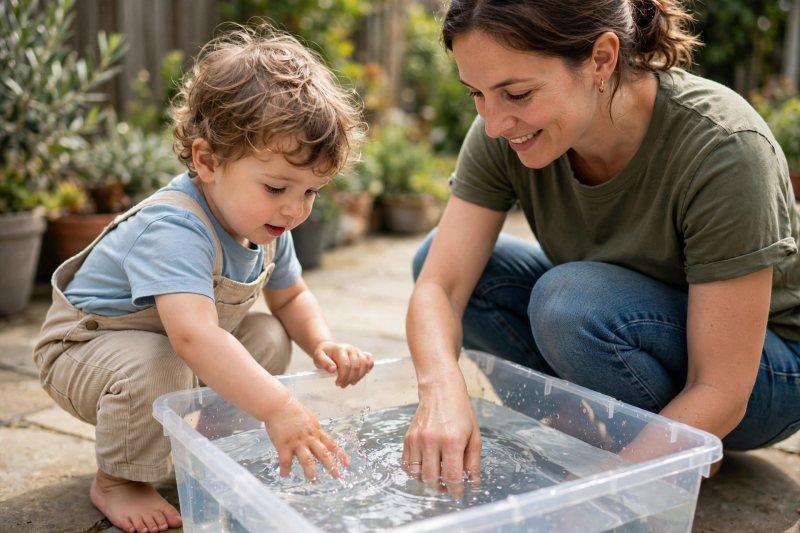
Invite them in. Crouch beside the bin and let your toddler touch the water first. "Cool water! Dip your hands in."
-
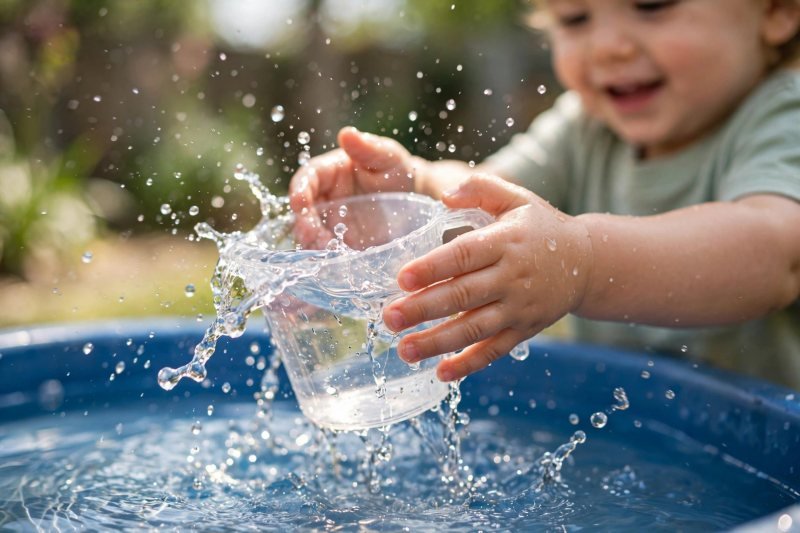
Hand them the measuring cup. "This is our cup! Scoop the water up." Let them scoop, lift, and watch it slosh — no grip corrections.
-
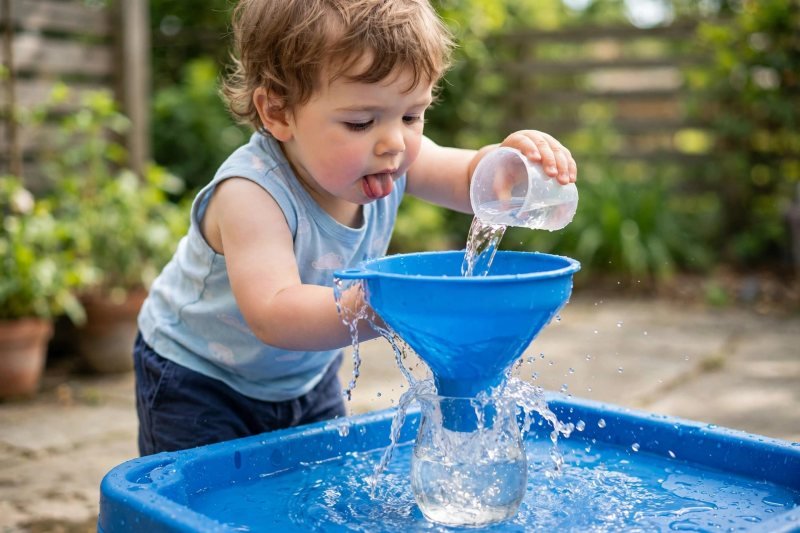
Pour through the funnel. Hold the funnel over a small pitcher. "Pour it through — listen!" The gurgle is the reward.
-
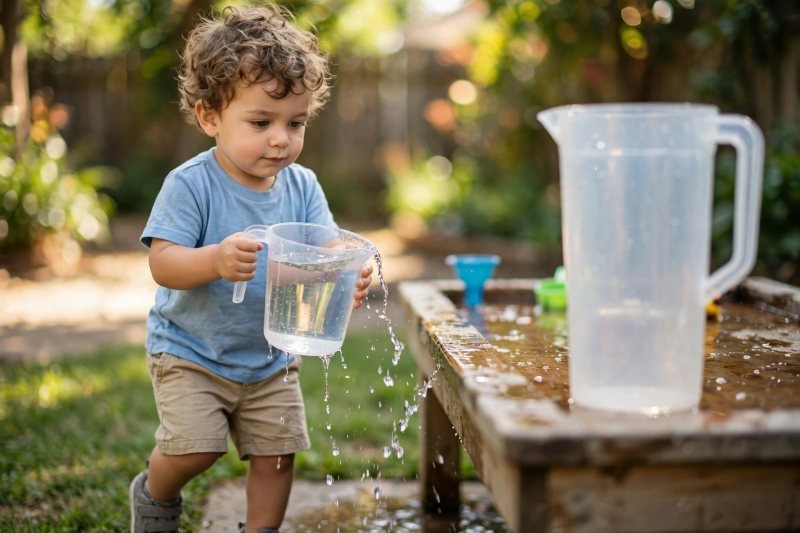
Fill the big container. "Can you fill the BIG one?" They ferry cupfuls back and forth, counting scoops if they like.
-
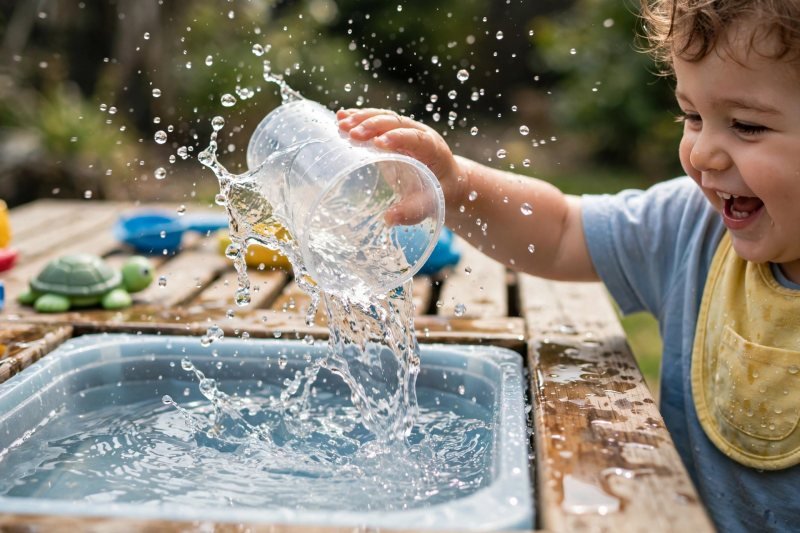
Discover full and empty. When a cup overflows: "Too much — it's FULL! Tip it out… EMPTY!" Toddlers adore this contrast.
-
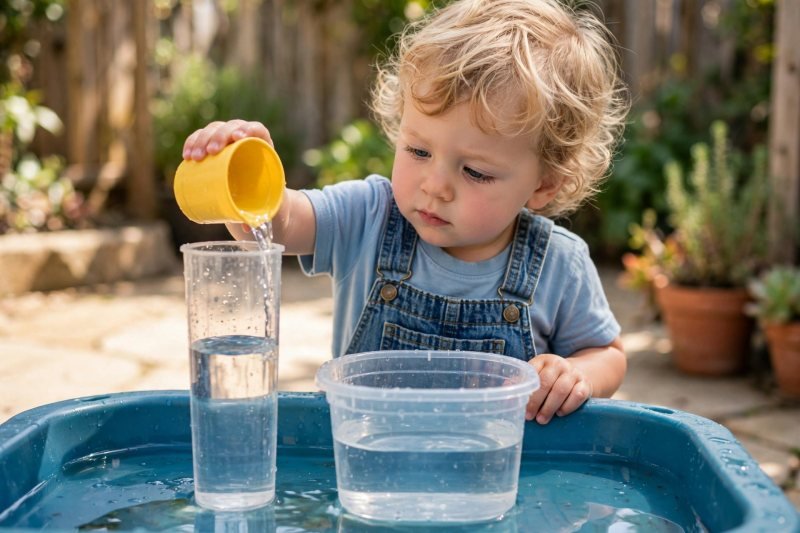
Try the tall and the wide. Set both containers side by side. "Fill this one. Now that one." Say nothing — let them notice.
-
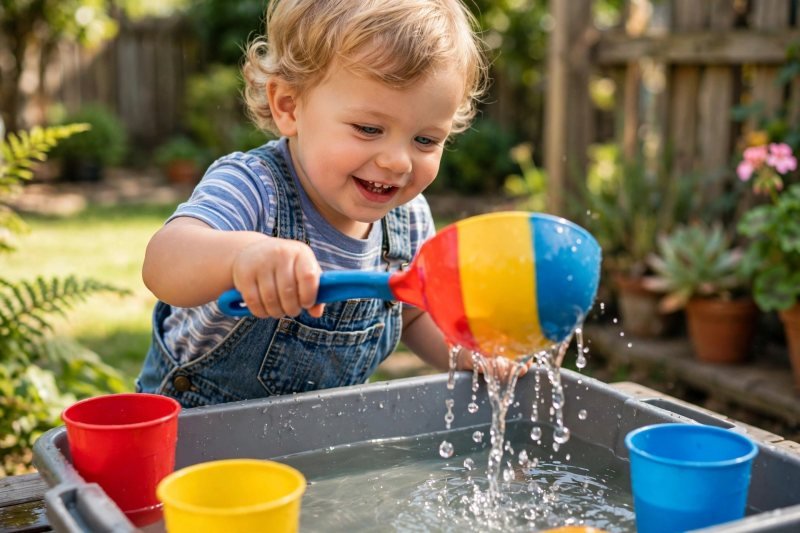
Scoop with the spoon. "Scoop with the spoon — it takes more scoops!" Different tool, different pace, same water.
-
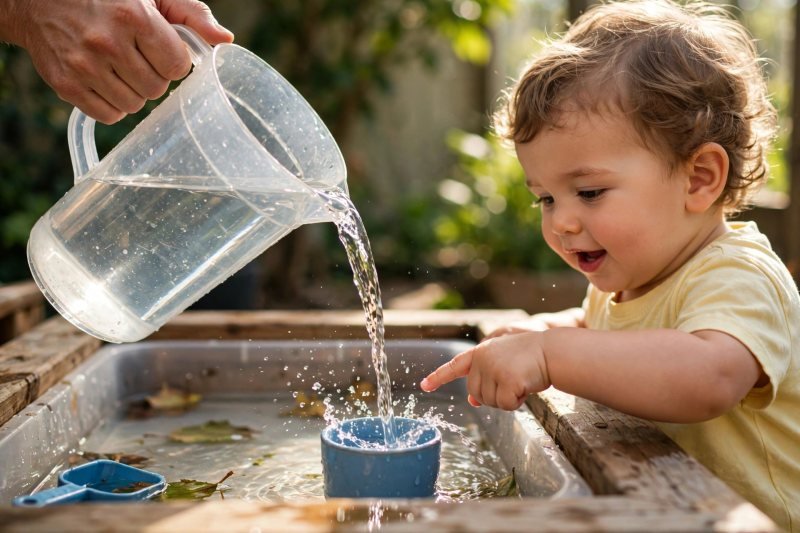
You pour the big pitcher. Let your toddler direct it: "Tell me where — here? Pouring… stop!" They control the flow with words.
-
The great dump. Let them tip the small containers out, then refill everything. Dumping teaches empty the satisfying way.
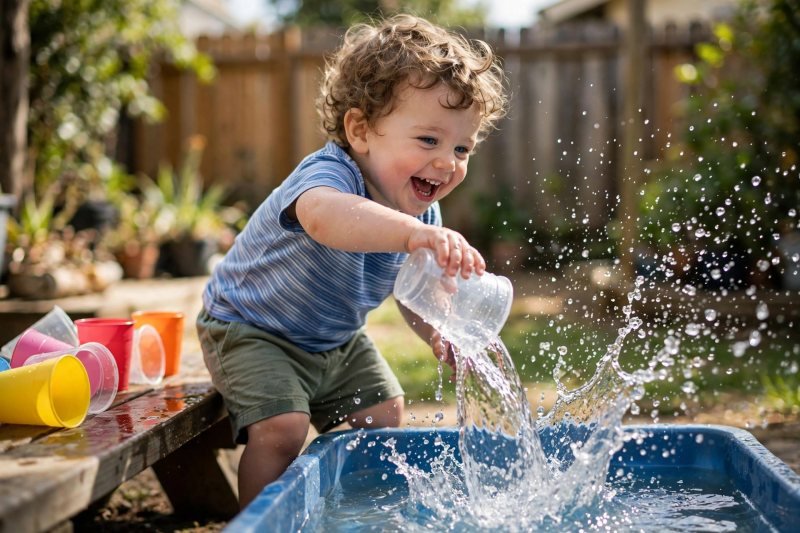
-
Sponge it up. "Soak up the splashes!" Wringing the sponge into the bin is the perfect finale — and real cleanup help.
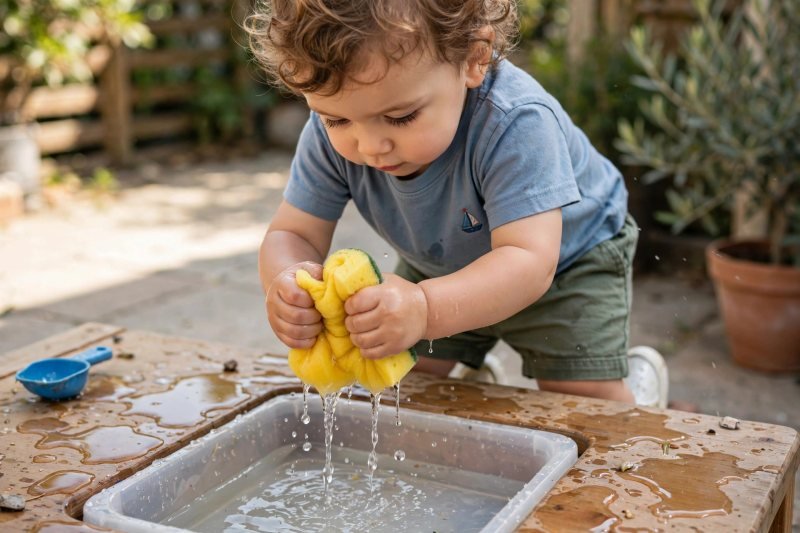


Make it easier
Start with ONE cup and the water only — no funnel, no choices. Use a smaller, shallower tray so there is less to manage. Pour together at first, your hand loosely over theirs. Skip food coloring the first time; plain water is one less variable.
Make it harder
Add a second funnel and two bottles for a pour race: "Which fills first?" Introduce "half full" — fill a cup halfway: "Is it full? Nooo… it's half!" (best for 3+) Let them pour from the small pitcher instead of the cup — heavier, harder, bigger win. Float a ball they try to "catch" by pouring water around it.
Other ways to play it
- Color pour lab: a drop of food coloring in each of two cups, then pour both through the funnel and watch the swirl. Our color mixing activities for preschoolers goes further when they are older, and color mixing toddlers water play has more water-colour mixing ideas for this age. Play clothes — colors stain lightly.
- Bathtub edition: the same tools at bath time — zero cleanup, since the mess was the plan.
- Ice rescue: freeze small toys in a bowl of ice, float the ice in the tray, and pour warm water to melt them free. Fist-size ice only, closely supervised.
How it changes by age
- 2 years: Sensory explorers — scooping, dumping, splashing, and drinking attempts ("water is for pouring!"). Ten to fifteen minutes of deep focus is a full workout.
- 3 years: Pattern seekers — noticing "this one holds MORE," lining cups by size, counting scoops aloud. They manage the funnel alone and invent games (pouring "soup" for stuffed animals is a classic). Follow their lead.
- When is my child ready for real measuring cups and volume words?
- Around age four, children start wanting to know which holds more on purpose — guessing first, then checking. That is when measuring play grows into predicting and comparing, like discovering a tall thin glass and a short wide bowl can hold the same amount. When your toddler points at two cups asking "which one bigger?", they are ready. Our capacity activities for kids picks up exactly there, with pour-and-check experiments for 4- and 5-year-olds. Until then, keep it sensory — the pouring is the preparation.
What they're learning
Early volume sense: full vs. empty, more vs. less, the feel of "how much fits" — the sensory roots of measurement. Hand-eye coordination: scooping, aiming for the funnel, stopping a pour before the overflow (sometimes). Cause and effect: tilt more = faster flow; tip it = gone. Math vocabulary: pour, full, empty, more, less, splash, scoop — the words measurement is built on. Concentration and calm: ferrying cupfuls is a genuine multi-step task, and rhythmic pouring settles busy toddler nervous systems. What should I say while my toddler pours? Narrate the action, not a lesson: "You're pouring! The cup is getting FULL… now it's EMPTY!" "That one holds MORE. This little one holds LESS." Sound words land hard at this age: drip, drop, splash, gurgle, swirl, plop. Count sometimes — "one scoop, two scoops, three scoops — FULL!" — but never correct. Your child is collecting the vocabulary of volume, and vocabulary is the part of measuring a 2-year-old can keep. Our counting activities for toddlers pair well with the scoop-counting that happens naturally here.
Clearing up
Let your toddler pour leftover water onto the grass — "watering the plants" ends the session on a high. Tip the bin, rinse it, and leave it upside down to dry so it does not get slimy. Rinse colored water promptly — food coloring can tint light trays if it sits.
Questions parents ask
How much water do I need for toddler water play measuring?
What age can my child start water pouring activities?
Is water play safe for a 2-year-old?
How do I teach volume to a toddler without using numbers?
What can I use instead of a water table?
Can I do this water activity indoors?
This is a process activity, not a product one — nothing to keep. The learning happened in the pouring. Repeat weekly if your child asks — repetition is the curriculum at two. Reuse this vocabulary (full, empty, more, less) at the sink, the tub, and the beach — measuring words work everywhere water does.

save it for later
Pin this for the next rainy afternoon
Keep it on a board so it is there when you need it, rather than when you happened to find it.
Save to Pinterest


