


Toddler Boy Halloween Costumes
Twenty-five toddler boy Halloween costumes for ages 2-3: soft classics, roaring animals, mini helpers, funny foods, storybook heroes and sports stars - every one mask-free, warm-layer friendly and rehearsed at a calm home try-on.
The best toddler boy Halloween costumes for ages 2-3 are soft, mask-free and layered over warm clothes: a pumpkin tunic, lion hood, firefighter jacket, dinosaur suit or skeleton-style pajama costume, sized up, tried on at home a week early, and finished with real shoes and a glow light.

The short version
- Twenty-five ideas, one filter: faces visible, necks free, layers underneath, sitting and snacking possible.
- Pajama costumes (skeleton pajamas) and closet builds (lumberjack, cowboy, baseball player) are the efficiency champions.
- Capes are short and breakaway; hats are soft and toddler-removable; props are soft, big, and optional.
- Dark costumes need light: glow stick or reflective tape on the tote, adult flashlight street-side.
- The home try-on a week early is the step that makes the night — rehearse layers, shoes, and sitting.
- Age
- Ages 2–3
- Prep
- 10 min
- Play time
- 10 min
- Mess
- Low
- Difficulty
- Easy
- Where
- Indoor
Why kids love this
Toddler boy Halloween costumes fail in the same four ways: the mask that terrifies its own wearer, the handsome suit that fits over nothing warm, the tail that makes sitting impossible, and the costume first worn at 6 p.m. on October 31st in front of a crowd. This guide's 25 ideas are pre-filtered against all four failures. The toddler rules run through every step: faces stay visible (hoods, hats, and ears instead of masks — toddlers need peripheral vision for curbs and steps, and parents need to read their faces); costumes go OVER ordinary warm clothes, never instead of them; bottoms open fast for diaper and potty logistics; and anything that cannot survive a sit, a stumble, and a lollipop is decoration, not costume. The ideas are grouped the way boys this age actually choose — roaring animals, helping jobs, funny foods, storybook heroes, big creatures, outdoor adventures, and sports — so you can shortlist by what your son already loves, try the winner on at home with great ceremony, and let Halloween be the second wearing, not the premiere.
What you'll need
- The shortlist method in step 1 — pick the category your toddler already loves (animals, jobs, food, heroes, sports)
- Base layers in costume colors (long-sleeve tees, leggings) — the warmth and the backup plan in one
- The costume itself, sized UP one size so it layers (costumes are worn over clothes, not on skin)
- Real shoes, broken in — costume feet and slippers sit out wet pavement
- Optional: face paint crayons (water-based, patch-tested) for whiskers and noses — the mask substitute
- A tote or bucket with a handle your toddler can carry, plus one glow stick or clip-on light for visibility
- The home try-on: 15 unhurried minutes, a mirror, snacks — the rehearsal that saves the night
Before you start
Shortlist three ideas from three different steps — toddlers choose best between a few loved options, not twenty-five. Buy or assemble the winner a week early; the try-on (step 10) needs runway time in the schedule. Check the forecast two days out and stage the warm layers — Halloween weather writes the final costume notes.
How to do it
-
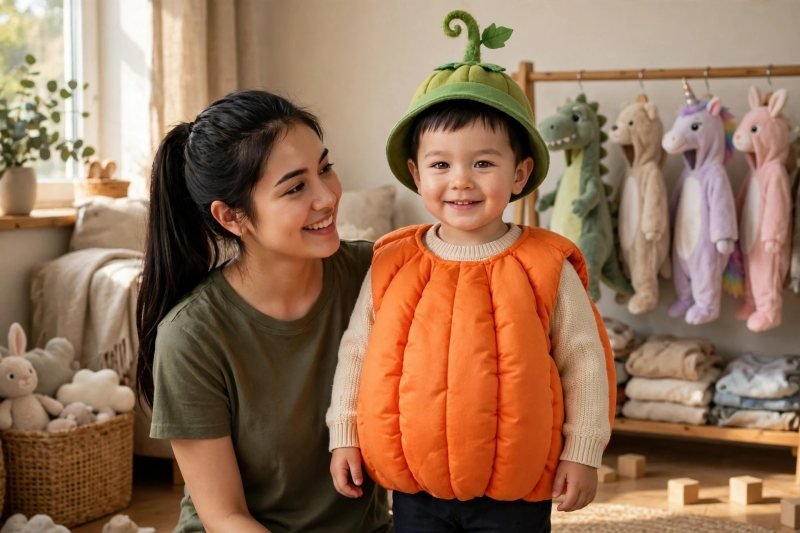
Start with the classics — pumpkin, friendly ghost, skeleton pajamas. The three costumes that defined toddler Halloween before tutorials existed, and still the benchmarks for easy: (1) pumpkin — a padded orange tunic over green or brown layers, a soft stem hat, zero small parts, and roundness that forgives every layer under it; (2) friendly ghost — a soft white tunic with a smiling face appliquéd at the belly and a white hood, NEVER a sheet over the head (tripping, vision, and breathing all vote no), because the ghost reads by its shape and smile; (3) skeleton pajamas — black pajamas with a white bone print, so the entire costume is pajamas: warm layers under, bedtime after, the efficiency champion of the twenty-five. The choosing rule for all 25 ideas starts here: one or two pieces, nothing at the throat, face fully visible. The classics anchor the Halloween seasonal collection, the same mask-free, layer-first rules in seasonal form. Say, "Pick your favorite — costumes are for wearing, not for looking at." If he chooses with his whole heart, half the night's battles are already won.
-
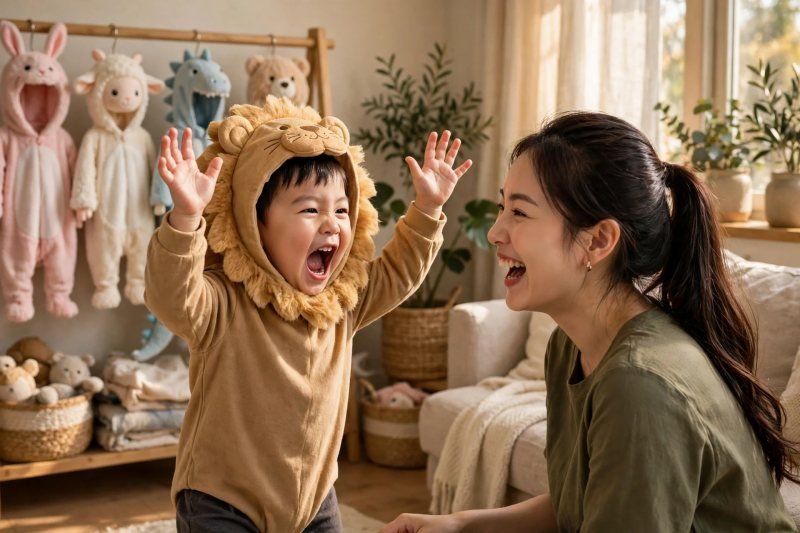
Roar with the animals — lion, dinosaur, shark. Three costumes carried by a hood or a soft suit, which is the toddler genius format — the headpiece cannot fall off, get lost, or cover the face: (4) lion — a tan hooded suit or hoodie with a felt mane framing the face, the hood mane doing all the work while roaring practice is strongly encouraged; (5) dinosaur — a green hooded suit with soft spikes down the back and a high, short tail attached at the waistband so sitting stays easy and nothing drags on steps; (6) shark — a gray-blue hooded fin suit, the fin standing soft on the hood, worn over warm layers with real shoes below. Hood rules: ears, manes, and fins sit ON the hood, the hood's edge stays behind the hairline, and elastic — never a drawstring — keeps it placed. Say, "The hood does the magic; you just do the roaring." Animal lovers shortlist here first; the winning suit is also next month's dress-up bin royalty.
-
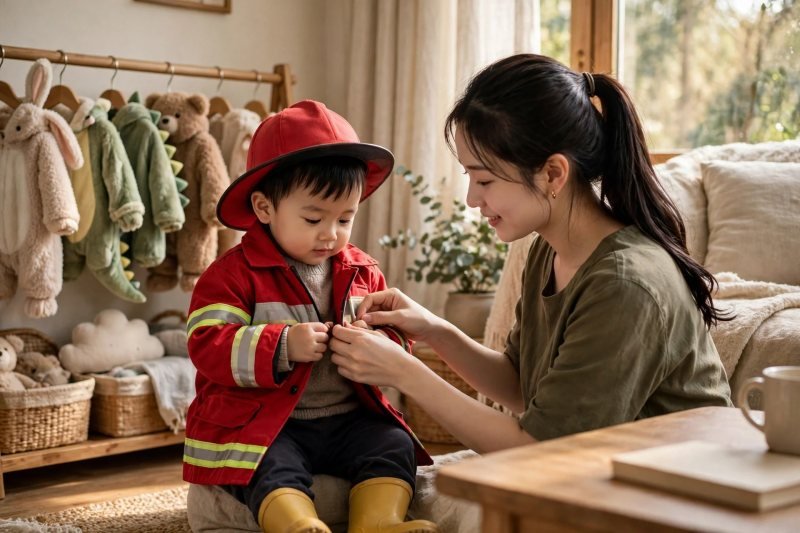
Dress the mini helpers — firefighter, construction worker, train conductor. For the toddler whose love language is vehicles and jobs: (7) firefighter — a striped jacket over anything, a soft helmet, and rain boots that are actually his rain boots, so the footwear is already broken in; (8) construction worker — a bright vest over his warmest layers, a soft hard hat, and a tool belt holding exactly one soft tool; (9) train conductor — a soft cap, a vest or striped layers, and a ticket prop he punches or waves at every door, because paper-and-pride props survive the whole route. Prop discipline for this whole guide: props are soft, big enough to never fit in a mouth, and optional at every moment — a costume that needs its prop is a costume with a failure mode. Say, "Helpers wear their jobs; the tools are just visiting." These three also photograph beautifully in daylight, before a single piece of candy enters the frame. Helpers built from ordinary clothes are close cousins of the toddler Halloween costumes guide, which covers the whole family in the same mask-free style.
-
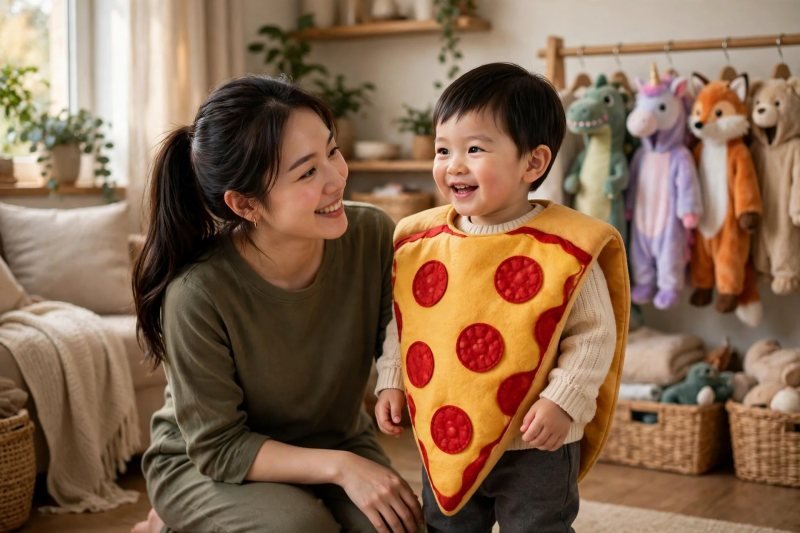
Join the funny foods — pizza slice, banana, avocado. The food trio, beloved by grandparents and guaranteed to stop porch traffic: (10) pizza slice — a triangle tunic in golden and red felt tones worn over warm layers, point down, toppings appliquéd flat so nothing snags; (11) banana — a padded yellow suit with a soft stem cap, the roundest and silliest silhouette in the guide, sized up generously so layers fit beneath; (12) avocado — a green tunic with a big brown belly circle appliquéd at the front, worn over green or brown leggings. Food-suit rules: padding must compress for car seats and chairs (or the suit goes on after the drive), fastenings pass a parent's-hand test, and the food gets photographed before the first chocolate, for obvious reasons. A rainy-weekend session of halloween crafts for toddlers is the perfect way to let him help glue one flat felt topping onto his own slice. Say, "You're good enough to eat — but we'll stick to candy."
-
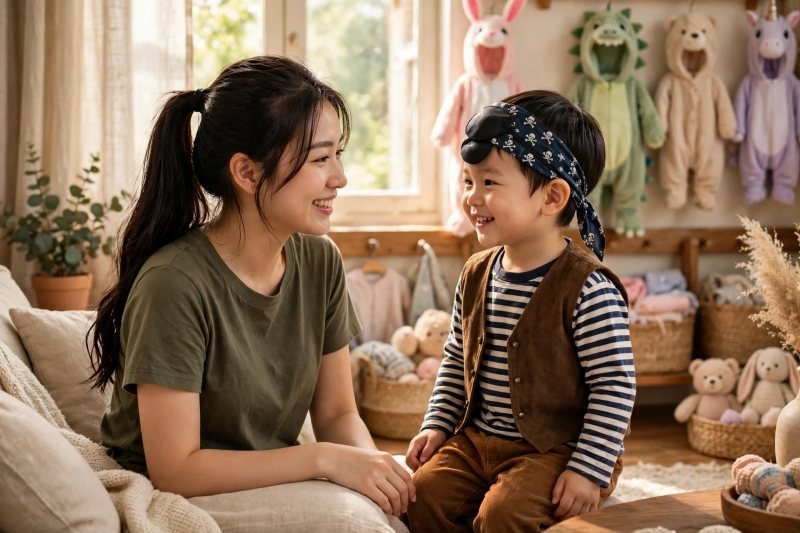
Cast the storybook heroes — pirate, knight, superhero. Three costumes built from an over-layer and one soft signature piece: (13) pirate — a striped tee, a vest, and a bandana, with the eye patch worn ON THE FOREHEAD like the veterans do, because over the eye costs depth perception a toddler cannot spare; (14) knight — a silver-gray tabard over warm layers with a foam shield that doubles as a candy tray in a pinch, plus a soft helmet-hat he can remove himself; (15) superhero — his own design: colored layers, a felt emblem he chose, and a SHORT breakaway cape fastened at the shoulders, above the waist, never tied at the neck, because capes catch on everything and doors are undefeated. Hat and hero rules across the guide: soft, crushable, elastic-secured, and removable by the toddler himself — power over his own head is non-negotiable at two. Say, "Every hero needs gear that lets go." All three layer warm underneath and disassemble for the car seat in seconds.
-
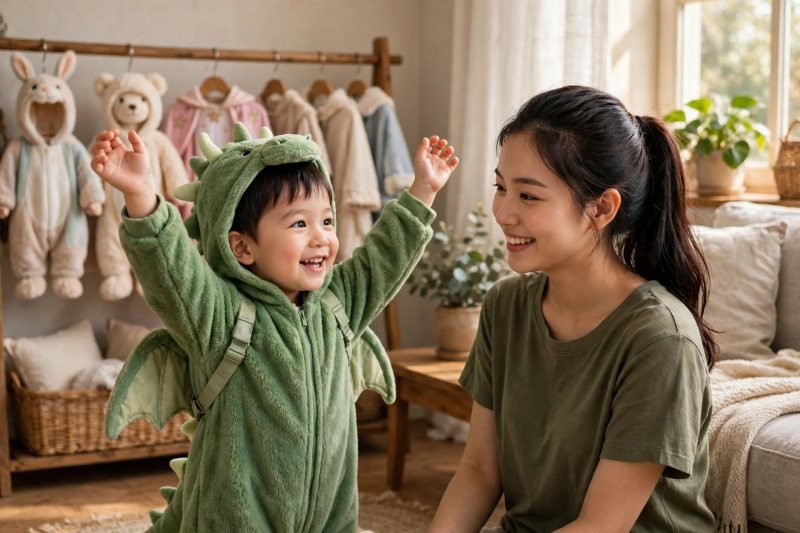
Stomp in as the big creatures — dragon, friendly monster, robot. The hood-and-harness heavyweights, softened to toddler strength: (16) dragon — harness wings on a soft vest over a hooded suit, belly scales in felt, hood horns too soft to matter, and wings that fold flat when he sits; (17) friendly monster — a fuzzy hooded suit in a bright color with soft hood horns and a big smiling face appliquéd at the belly, spooky in silhouette and cheerful up close; (18) robot — a cardboard-style tunic in soft fabric with rounded, soft edges, dials and buttons appliquéd flat, worn over gray layers with his real shoes below. Creature rules: spikes, horns, and wings are all soft or harness-mounted with no wire edges at face height; vision and hearing stay unobstructed; and anything attached sits high and short so chairs, car seats, and stairs stay safe. Say, "Stomp practice now — big creatures walk like they mean it." If any idea makes your toddler hide from the mirror, it is retired by acclamation; frightened is never the aesthetic.
-
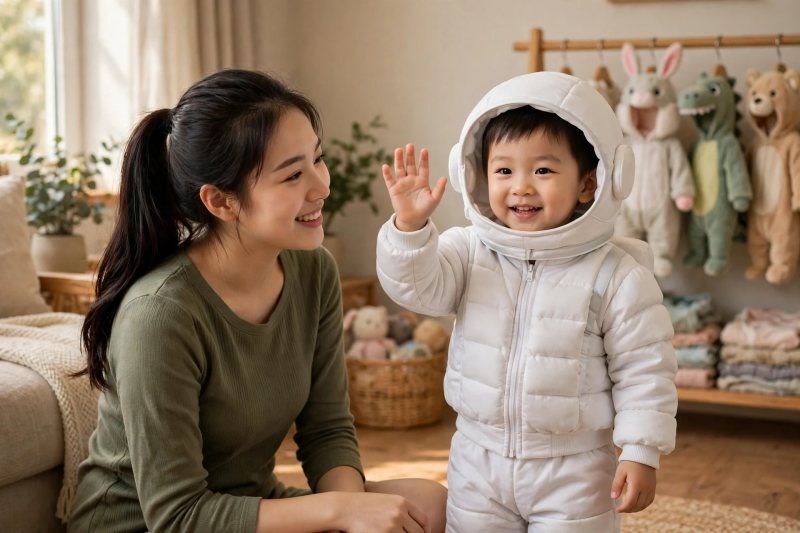
Head outdoors — lumberjack, astronaut, cowboy. Three adventurers built almost entirely from clothes he already owns: (19) lumberjack — a flannel shirt over warm layers, jeans or sturdy pants, and a soft beanie, with one soft toy tool carried only if he insists; (20) astronaut — white layers or a white one-piece, an open-face soft helmet-hat (open face, always), and felt patches a parent sews or glues while the toddler chooses where they go; (21) cowboy — a vest over a checked shirt, a soft hat with NO neck cord, and boots that are his real boots, with any bandana worn loose at the shoulders by a parent's hand, never knotted tight. This is the step where layering earns its keep: add the family's warm-layer drill from the toddler winter outfits playbook — base layer, costume over, jacket if the night demands — because October 31st does not care about your theme. Say, "Adventurers dress for the weather first and the story second."
-
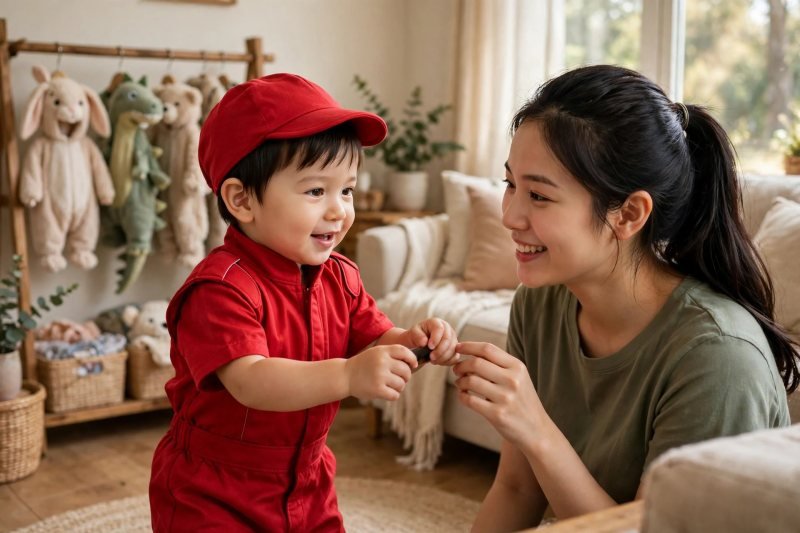
Take the field — race car driver, soccer player, baseball player. For the boy whose Halloween should move at his speed: (22) race car driver — jumpsuit-style layers in one bold color, a soft cap, and checker details appliquéd flat, with real shoes standing in for racing boots; (23) soccer player — a jersey and shorts worn OVER leggings, so the kit reads instantly while his legs stay warm, finished with his everyday sneakers; (24) baseball player — a team-color tee, a soft cap, pants over a warm base layer, and a soft foam bat that is optional, carried by a parent between doors if it slows him down. Sports rules: kits are clothes first and costumes second, nothing hangs below the knees to trip a runner, and every prop in this step can be dropped without the costume collapsing. Say, "Champions wear their kit; the trophy is the tote." These three win the cold-night prize too, because the warmest layers hide invisibly under a jersey or jumpsuit.
-
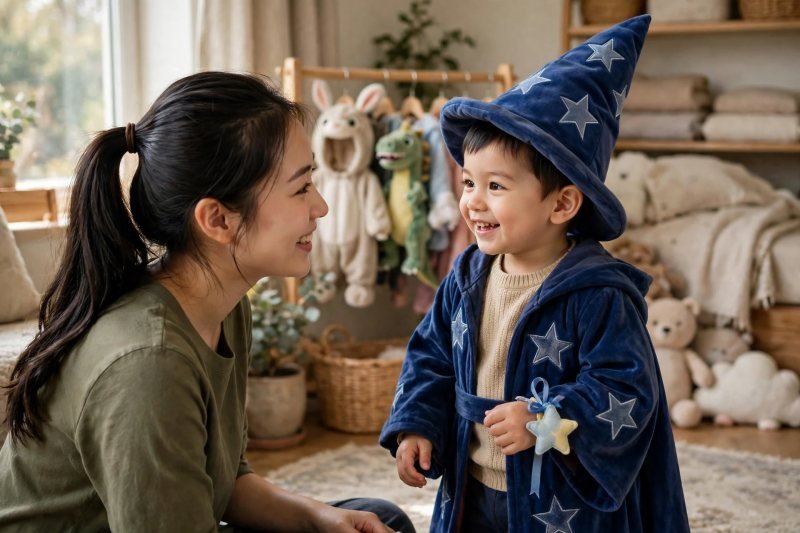
Finish with one magical finale — the wizard. After twenty-four practical heroes, one costume of pure storybook magic: (25) wizard — a deep-blue or purple robe over warm clothes, a crushable cone hat secured with soft elastic he can pull off himself, star shapes appliquéd in felt, and the wand solved the toddler way: a soft star on a ribbon loop worn at the WRIST, never a hard stick waved at face height. Robe rules: the robe stops above the ankles so stairs stay honest, it opens fast at the front for car seats and quick changes, and the hat is crushable enough to survive being sat on, which it will be. Cutting the felt stars together is a calm Halloween craft for kids afternoon before the night. Say, "One wave for spelling, one wave for candy." The wizard is also the easiest finale to rehearse, because the whole costume goes on and off in under a minute — which matters more than magic when a tired magician needs his pajamas at the end of the night.
-
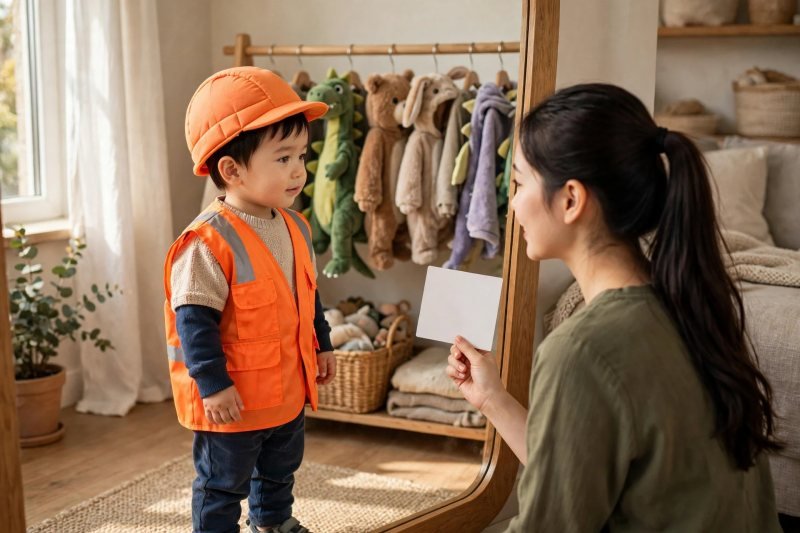
Hold the home try-on ceremony — a week early, in the calm. The step that makes all twenty-five work: a full week before Halloween, put the winning costume on over the planned layers, shoes on, tote in hand, and run the whole ceremony — a practice march to the mirror, one lap of the house, the sitting test on a real chair, the snack test at the table, and the parent's checklist (vision clear? neck free? hood placed? layers warm? shoes real? prop droppable?). Anything itchy, tight, draggy, or frightening gets adjusted or swapped NOW, in the calm, the same way the 2nd birthday party system rehearses a big day before it's big. Say, "Tonight we practice; on Halloween, we just go be it." Let him wear the winner for play the next day too, so the fabric, the hood, and the mirror-face are all old friends by the night itself. A rehearsed toddler in a simple costume outshines an unrehearsed one in a masterpiece every single year.


Make it easier
The pajama shortcut: skeleton pajamas (3) are literally pajamas — buy the size up and the costume serves bedtime the same night and all winter. The closet costume: lumberjack (19), cowboy (21), and baseball player (24) assemble almost entirely from clothes and one accessory each — zero specialty shopping. The tote matters more than the costume at two: spend the saved effort on a bucket he can carry and a glow light he can see by. If he refuses the costume on the night, the pajama fallback plus a tote still counts as Halloween — offer the costume once, happily, and never force it.
Make it harder
Family theme: the funny foods (10–12) plus a chef parent; the big creatures (16–18) plus a zookeeper; the mini helpers (7–9) as a full crew — group themes are the advanced class. DIY one element together: he glues (with you) the felt topping on the pizza slice or picks the superhero emblem — a made piece makes the costume his in a way shopping can't. The photo plan: pick the parade, porch, or pumpkin-patch shot in advance — costumes photographed in daylight at the weekend event often out-treasure the dark-night documentation.
Other ways to play it
- Cold-night version: every idea here layers — size up, base layers under, hat-compatible hoods swapped for ear headbands under a warm hat when the forecast turns; the costume is the middle layer, not the outer.
- Warm-night version: the vest-and-hat ideas (8, 13, 21, 23) run light: a tee underneath, no padding, padded food suits traded for their tunic-only cousins.
- Sibling-coordinated version: one from each of three groups (a classic, an animal, a hero) reads as a deliberate set in photos without a single matching purchase.
How it changes by age
- Age 2: Twos get the simplest architectures — one-piece suits, pajama costumes, hood animals — tried on twice (the ceremony plus one encore), with the night's route kept to a handful of known doors. Their Halloween is 30 enchanted minutes, perfectly sized.
- Age 3: Threes can carry a soft prop, choose between finalists with real opinions, walk a longer route with breaks, and star in the family-theme cast. The try-on becomes a fashion show; let him direct it.
What they're learning
Choice and identity: picking who to be for a night — from loved categories, inside safe bounds — is early self-expression with training wheels. Body autonomy: hats he can remove, costumes he rehearsed, a veto that retires frightening ideas — his comfort is consulted and obeyed, which outlasts Halloween. Community ritual: knocking, greeting, thanking, and the tote's growing weight — the neighborhood's kindest civics lesson, in costume. Counting and categories (sneakily): twenty-five ideas in nine families, spider-free but full of counting — costumes sorted by kind, doors counted on the route, candy counted at home.
Clearing up
Costumes come off into the dress-up bin (their second career starts tonight), face paint washes off in the regular bath, the tote is emptied into the adult-checked candy bowl, and reflective bits and glow sticks are retired. Photograph the costume flat before storing if it's a keeper — next October's shortlist starts with evidence of what actually got worn happily, versus what merely got bought. Pass a keeper on only if its fastenings, flame-resistant labeling, and soft-prop rules still pass — a hand-me-down that fails the try-on tests is a dress-up-bin costume, not a route costume.
Questions parents ask
What are the easiest Halloween costumes for a 2-year-old boy?
Should toddler boys wear Halloween masks?
How do you keep a toddler boy warm in a Halloween costume?
What if my toddler refuses to wear his costume?
How long should trick-or-treating last for a 2- or 3-year-old?
Internal links: Halloween seasonal collection (step 1); toddler Halloween costumes (step 3); halloween crafts for toddlers (step 4); toddler winter outfits (step 7); Halloween craft for kids (step 9); 2nd birthday party (step 10). Title-count verification: the H1 promises 25 ideas; all 25 are named and numbered inline — (1) pumpkin, (2) friendly ghost, (3) skeleton pajamas, (4) lion, (5) dinosaur, (6) shark, (7) firefighter, (8) construction worker, (9) train conductor, (10) pizza slice, (11) banana, (12) avocado, (13) pirate, (14) knight, (15) superhero, (16) dragon, (17) friendly monster, (18) robot, (19) lumberjack, (20) astronaut, (21) cowboy, (22) race car driver, (23) soccer player, (24) baseball player, (25) wizard. Costume safety discipline (per wave spec): children fully and appropriately costumed in all imagery, parent present in scenes; text enforces mask-free, neck-free, soft-prop, visibility, and candy-check rules throughout. Zero brands, zero prices; criteria-based throughout.

save it for later
Pin this for the next rainy afternoon
Keep it on a board so it is there when you need it, rather than when you happened to find it.
Save to Pinterest


