


Thin, Fine Toddler Hair: Care Tips and Styles That Add Fullness
Gentle care for toddler thin hair at ages 2-3: wash kindly, detangle without pulling, and use a soft side part, tiny puff and loose pigtails so fine hair looks fuller — with clear signs to see a pediatrician.
For toddler thin hair at ages 2-3, wash gently two or three times a week with a small amount of gentle shampoo, condition and detangle wet hair from the ends up, dry by patting, and style loose — a soft side part, tiny puff or low pigtails — so hair looks fuller without any pulling or products.

The short version
- Fine, wispy, sparse-looking hair is usually normal at 2-3 — looking thin is not the same as unhealthy, and no routine changes how hair grows.
- Wash two or three times a week with fingertips, not nails; condition the lengths only and detangle wet hair ends-up with fingers, then a wide-tooth comb.
- Pat dry with a soft towel or t-shirt and air dry — no rough rubbing and no heat styling, ever, on toddlers.
- Fuller looks come from styling only: a soft side part, a tiny loose top puff, loose low pigtails, and tiny trims that tidy wispy ends.
- See a pediatrician for patchy bald spots, a red, scaly or itchy scalp, hair falling out in clumps, no new growth over time, or sores.
- Age
- Ages 2–3
- Prep
- 5 min
- Play time
- 12 min
- Mess
- Low
- Difficulty
- Easy
- Where
- Indoor
Why kids love this
If your toddler has thin hair, you are not doing anything wrong — fine, wispy hair is completely normal at two and three, and so is hair that still looks sparse while it slowly fills in at its own pace. This gentle routine works for toddlers because it never hurts: no tugging through knots, no tight styles pulling at tender scalps, no long battles at the sink. Washes are short and playful, detangling happens slowly with fingers first, and styling takes two minutes with soft bands that come out easily. It works for parents, too, because it is honest and simple. Nothing here claims to make hair grow faster or become thicker — no routine can do that — but kind handling means less breakage, and a few styling choices genuinely make fine hair look fuller and tidier. Your child gets to hold the comb, choose the band color, and feel proud of her hair exactly as it is, while you get a weekly rhythm that fits real family life without stress.
What you'll need
- Gentle shampoo made for young children, described generically — a small amount only; all bottles blank and unlabeled in any photo
- Gentle conditioner for the lengths of the hair — again, plain and unlabeled, kept off the scalp if it feels heavy
- A wide-tooth comb — smooth teeth, no sharp seams, sized for small heads
- A soft-bristle brush — gentle enough that it never scratches or pulls
- Soft fabric hair bands — stretchy, seamless, and easy to remove; never rubber bands
- A spray bottle filled with plain water — for the morning refresh, nothing added
- A soft towel or an old soft t-shirt — for patting hair dry without rough rubbing
- A smooth pillowcase — silky-feeling fabric that lets hair glide instead of snagging overnight
- A small stool so your toddler can reach the basin or mirror safely with you beside her
Before you start
1. Set up a calm corner: stool at the basin or bath edge, towel within reach, comb, brush, and plain unlabeled bottles lined up where your toddler can see them and feel included. 2. Agree the simple weekly rhythm in advance — most fine toddler hair only needs washing two or three times a week, with water-only refreshes and gentle brushing on the other days. 3. Check the scalp and hair calmly before you start: look for any redness, scaly patches, sores, or bald spots, and if you spot the red flags listed in step 10 and the Safety notes, pause the styling and book a pediatrician visit instead.
How to do it
-
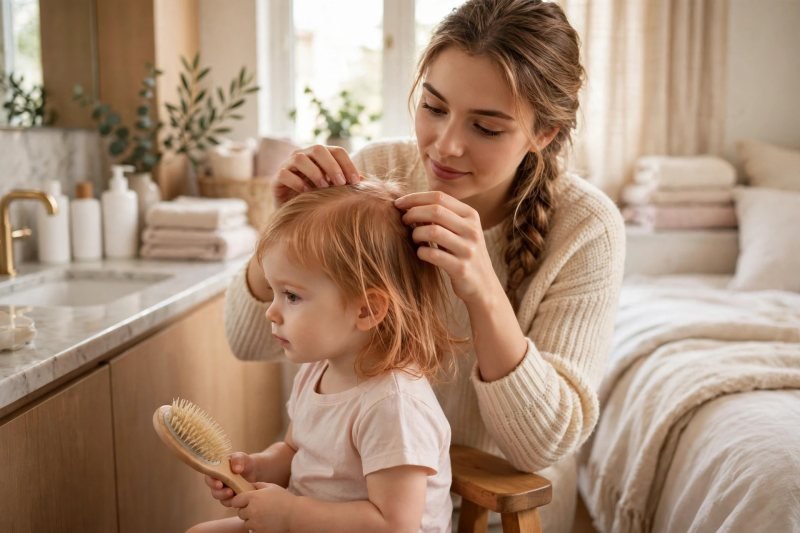
Get to know fine toddler hair. Fine toddler thin hair tangles and breaks more easily than coarser hair because each strand is delicate, and at two and three it is completely normal for hair to still look sparse, wispy at the ends, and uneven in length while it matures at its own pace — looking thin is not the same as being unhealthy, and no home routine changes how fast hair grows or how thick each strand is. Start every care session by simply looking and touching gently: notice where the tangles gather, usually at the back where hair rubs on pillows and car seats, and where the ends look see-through. Say, "Your hair is soft and light, and we are going to take gentle care of it together." Let your toddler hold the soft brush while you look, because understanding her hair calmly — without worry or comparison to other children — is the foundation everything else in this guide builds on.
-
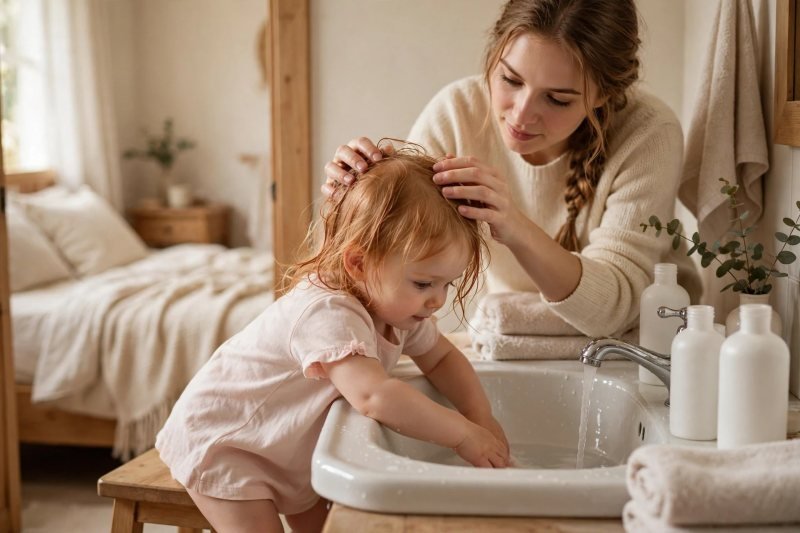
Wash gently and not too often. Most fine toddler hair stays happiest washed just two or three times a week, because washing every day can leave delicate strands dry and more prone to snapping; on other days a plain-water rinse or a simple spritz refresh is plenty. Use lukewarm water, never hot, wet the hair at the basin or over the bath edge with your child in her top, and use only a small pea-to-coin-sized amount of gentle shampoo, massaging the scalp with your fingertips — never your nails — in slow little circles. This kind, unhurried washing pairs naturally with the same gentle approach used in a simple kids skincare routine, where mild products and a light touch do all the work. Say, "Fingertips, not nails — we wash your scalp like we are giving it a tiny, kind massage." Rinse until the water runs clear and the hair feels clean but not squeaky.
-
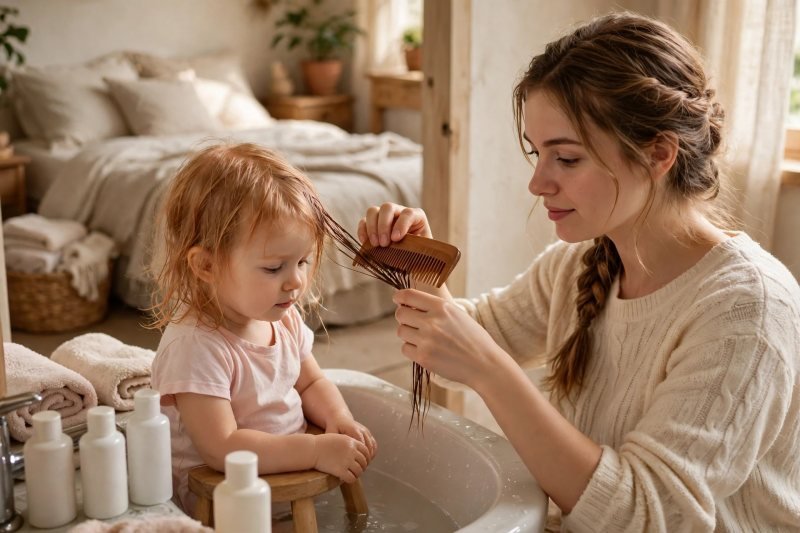
Condition and detangle while wet. Fine hair tangles fastest when it is wet and unconditioned, so smooth a small amount of gentle conditioner through the lengths and ends only — not the scalp, where it can weigh fine hair down and make it look flatter — and let it sit for a minute while your toddler plays with a bath toy or counts the bubbles. Detangle in this exact order: fingers first to find and ease apart the bigger knots, then the wide-tooth comb, always starting at the very ends and working upward in tiny sections, holding the hair above the knot with your other hand so the pull never reaches her scalp. Never drag a brush through wet, tangled hair, and never rush — a knot teased apart patiently is a strand saved from breaking. Say, "Ends first, then a little higher — slow and gentle wins every time." If a tangle truly will not ease, add a touch more conditioner and water rather than more force.
-
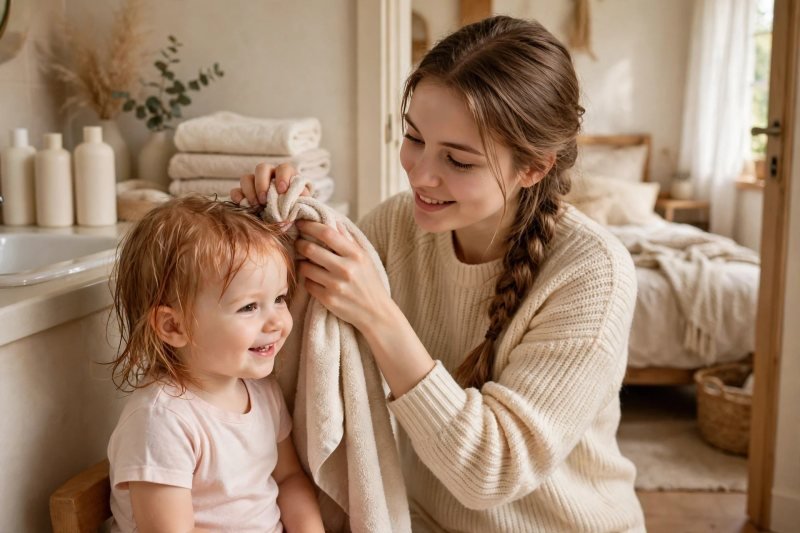
Rinse and dry the kind way. Rinse the conditioner out with lukewarm water until the lengths feel smooth and clean, then lift the hair into a soft towel or an old soft t-shirt and pat and squeeze gently — never rub back and forth, because rough rubbing roughens fine strands, creates instant tangles, and can snap the most delicate ends. Let the hair air dry whenever you can; fine toddler hair is short and light, so it dries quickly on its own, and there is never a need for heat styling tools on a two- or three-year-old, which this guide does not use at all. While it dries, keep little hands and play gentle — no hats pulled on and off, no rough towel games. Say, "Pat, pat, squeeze — we dry your hair the kind way, no rubbing." Once dry, the hair should feel soft and swingy, ready for a brush-through or a simple style with no product needed at all.
-
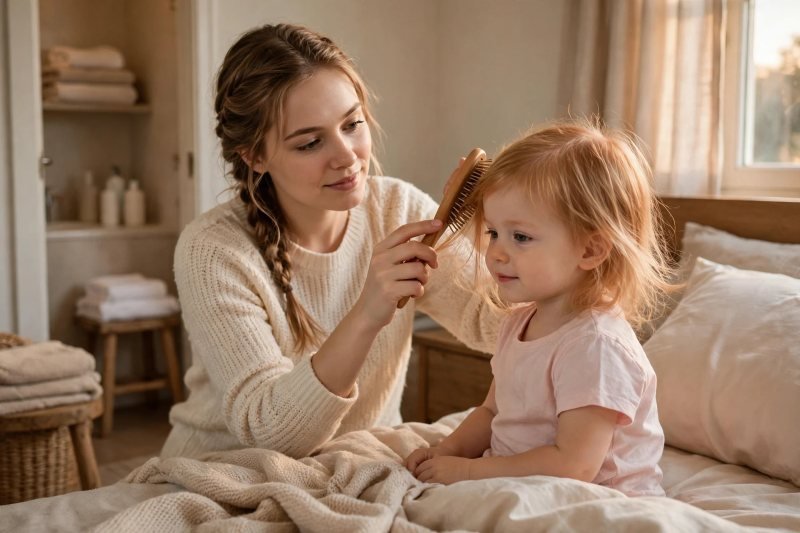
Brush and smooth on dry hair. On dry hair, use the soft-bristle brush in slow strokes from ends to roots, the same patient direction as combing, and stop the moment you meet resistance — a knot is a signal to go back to fingers and gentle teasing, never to rip through it, because every ripped-through knot is broken hair that then looks even thinner at the ends. Mornings are easier with the water spritz refresh: lightly mist the hair with plain water from the spray bottle, smooth it with your palms, re-part it with your fingertip or the comb tail, and brush softly into place — two minutes, no wash needed. Let your toddler do the final two brush strokes herself, however wobbly, because that small ownership is what turns hair care from a battle into a habit. Say, "Mist, smooth, brush — see how quick our morning hair is?" Keep the brush and comb in one known spot so the routine always starts calmly.
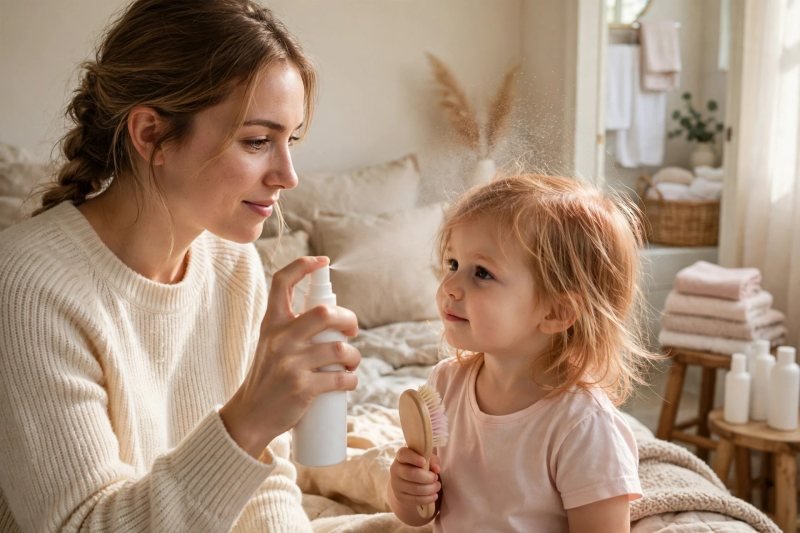
-
Trim the wispy ends. Those see-through, straggly ends are the oldest, most delicate part of fine hair, and tiny, regular trims — just the wispy tips, done by an adult or a child-friendly hairdresser — make the whole head of hair look noticeably fuller and tidier, simply because the ends line up instead of fading away; be clear-eyed that a trim changes how hair looks, not how it grows. If your toddler has never had a trim, read our toddler first haircut guide first, so the chair, the cape, and the snipping sounds are all familiar before anyone picks up scissors, and keep the visit short, upbeat, and finished with praise. At home between trims, never attempt fiddly shaping yourself — tidying is a professional's or a confident adult's tiny job, done on dry, combed hair, a few millimeters at a time. Say, "We are just tidying the wispy ends so your hair looks neat and full." Most families find a small trim every couple of months keeps fine hair looking its best.
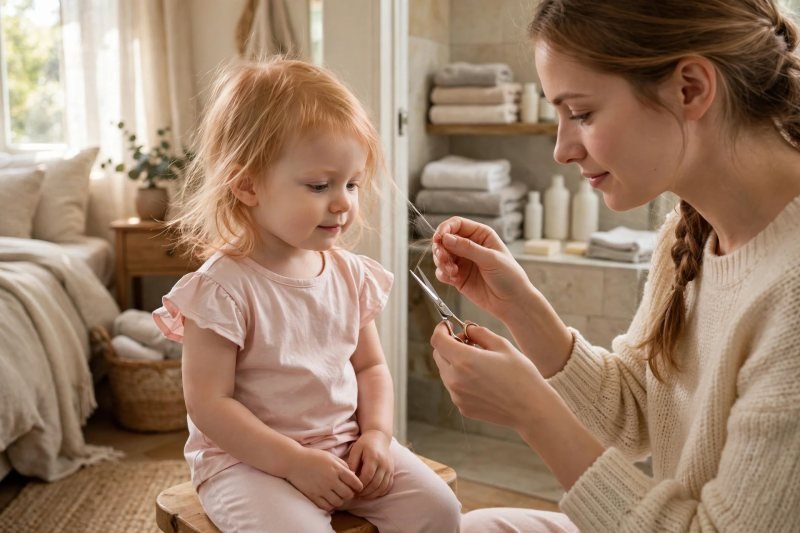
-
Style for fullness with a soft side part. The simplest fuller-looking trick costs nothing: change the part. A soft side part, swept gently with your fingertip or the comb and falling naturally to whichever side the hair prefers, lets the hair at the roots lift and lie over itself, so it looks fuller on top than a flat middle part or hair brushed straight back — this is styling only, creating the look of volume at the roots without any pulling, teasing, or products. Create it on damp, spritzed hair, parting slightly off-center, smoothing the longer side across with your palm, and letting it air dry in place; if it flops back by lunchtime, that is fine — re-spritz and re-part in ten seconds, or simply leave it, because a toddler's hairstyle should never be a source of fuss. Keep the tension at zero: the hair is laid, never yanked, into place. Say, "A new part, a little lift — look how full your hair looks today." Photograph the result if she is proud of it; pride is the point.
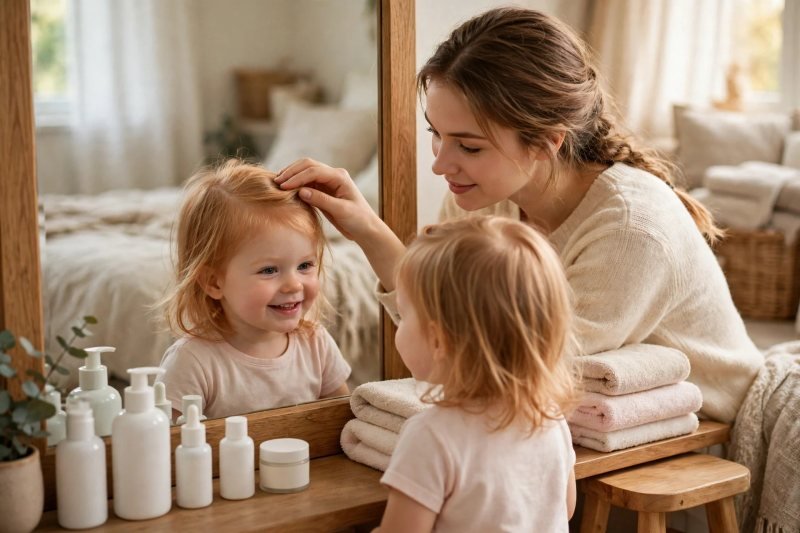
-
Style for fullness with a tiny top puff and loose pigtails. For a second fuller-looking option, gather just the front-top section into a tiny, loose puff secured with a soft fabric band, or split the hair into two low, loose pigtails — both styles lift hair away from the scalp and create the impression of more hair, while the looseness keeps them completely kind. The non-negotiable test is slack: you should be able to slide two fingers easily under every band and under the gathered hair, the band should never leave a dent, a red mark, or pulled-up little bumps, and your toddler should forget she is wearing it within a minute; if she touches it, fusses, or says it hurts, it comes straight out and is redone looser or abandoned for the day. Use only soft bands, remove them before naps and bedtime, and never re-use the exact same tight spot day after day. Say, "Loose and bouncy, with room for two fingers — comfy hair only." Two minutes, zero tension, and fine hair that suddenly looks plentiful in photos.
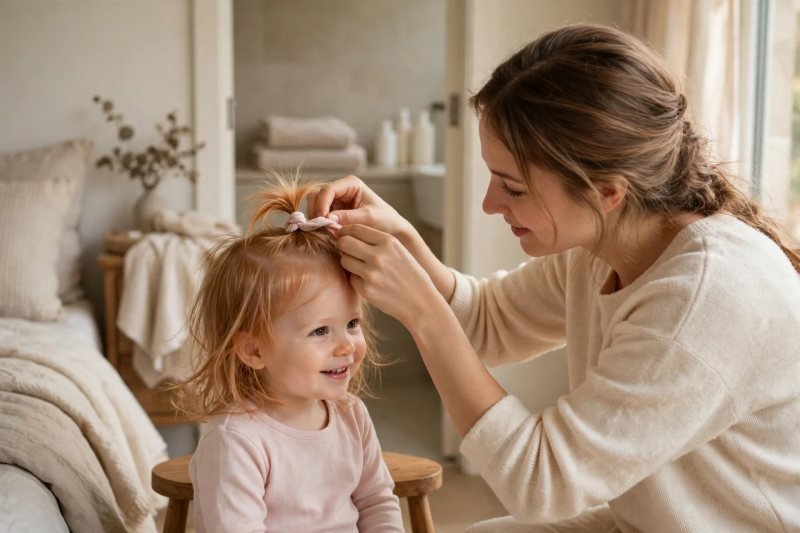
-
Protect hair at night. Nighttime friction is a quiet cause of morning tangles and breakage for fine hair, because cotton pillowcases grip delicate strands as toddlers roll and turn — a smooth, silky-feeling pillowcase lets the hair glide instead, so your toddler wakes with hair that needs only the quick morning spritz refresh from step 5 rather than a full detangle battle. Always take styles out before bed: bands removed, puffs and pigtails released, hair brushed softly once so nothing sleeps pulled, twisted, or trapped; sleeping in a style is uncomfortable and tugs at the same spots all night. Keep the bedtime moment part of the calm routine — band out, gentle brush, story, sleep — in the same spirit as the wind-down in the calm bedtime routine: predictable, kind, and quick. Say, "Bands out, brush soft, hair sleeps free and comfy." In the morning, check the pillowcase is still smooth and flat, spritz, smooth, and you are done.
-
Know the red flags and keep the simple weekly rhythm. Your whole week now fits on one calm loop: wash gently two or three times with conditioner and patient detangling; spritz, smooth, and brush on the other mornings; style loose — a side part, a tiny puff, or low pigtails — when you feel like it; bands out and hair free every night; and a tiny ends trim every couple of months, a rhythm that supports the independence celebrated in toddler learning activities at home, where small daily routines are how toddlers learn to care for themselves. Alongside that rhythm, stay alert and see a pediatrician promptly if you notice any of these red flags: patchy bald spots; a red, scaly, or itchy scalp; hair falling out in clumps; no new growth over time; or sores on the scalp — these are the signs that need medical eyes, not home styling, and this guide makes no medical claims beyond urging you to get them checked. Say, "We care for your hair gently every week, and doctors help if we ever see something sore or patchy." Simple, honest, and calm — that is good hair care at two and three.


Make it easier
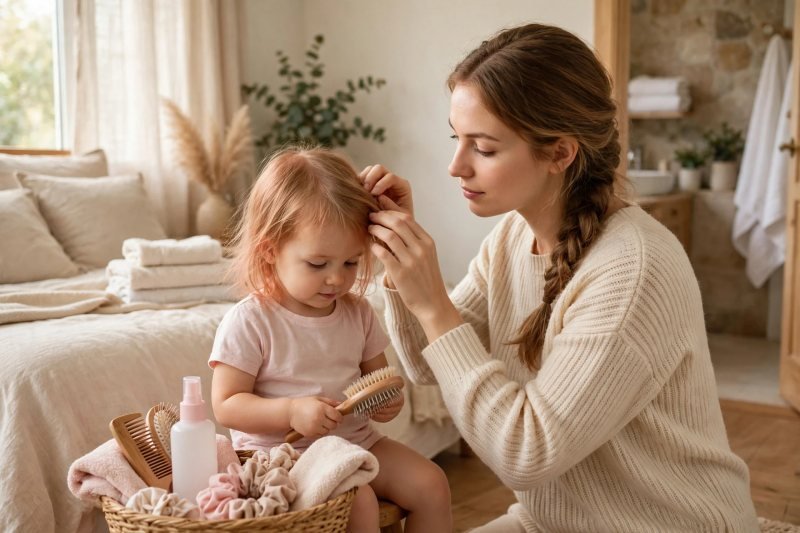
Wash at the basin or kitchen sink with your toddler standing on a stool and leaning over a towel — shorter, warmer, and far less daunting than a full bath for a quick wash day. Keep a tiny hair kit in one basket — comb, soft brush, spray bottle, soft bands — so every session starts in seconds with nothing to hunt for; pick a gentle one with our guide to the best hair brush for toddlers. Style with fingers only on busy mornings: spritz, side part with a fingertip, smooth with palms, done in under a minute with no tools at all.
Make it harder
Let your toddler choose the day's style from two photo options you take yourself — side part or top puff — and practice naming her choice, building decision-making into the routine. Add a gentle counting game to detangling: count each comb section together as you work ends-up, turning patience practice into early number play. Start a simple hair diary together: one photo a month in the same light and style, so you can both see slow, normal change over time without day-to-day worry.
Other ways to play it
- For boys' short fine hair: skip the bands and puffs entirely — the same gentle washing, conditioning of the longer top lengths, soft brushing, side-part sweep, tiny ends trims, and smooth pillowcase give short fine hair its fullest, tidiest look with zero styling fuss.
- For fine hair with a curl: detangle only when wet and conditioned, never brush it dry (dry brushing separates curls into frizz and can break them); scrunch the curls gently upward with wet hands after rinsing, spritz to refresh the curl pattern in the morning, and use the loose puff only on the front section.
- For very sparse toddler hair: keep expectations especially kind — hair may simply be on a slower timetable, and that alone is not a concern without the red flags in step 10; choose the soft side part over gathered styles, keep trims minimal and professional, and focus on the scalp staying clean, comfortable, and protected from sun with a hat outdoors.
How it changes by age
- Age 2: At two, hair care is almost entirely adult-led and comfort-led: seated on your lap or standing with you at the basin, washes kept to a few playful minutes, detangling broken into very short bursts with songs or counting to carry her through, and styles limited to a fingertip side part or one tiny, very loose puff that you check with the two-finger slack test. Expect wriggles, expect to pause mid-comb for a cuddle, and treat any session she truly resists as finished — trust built at two is what makes three easy.
- Age 3: At three, your toddler can become a real partner: holding the spray bottle and doing the misting herself, choosing between two soft band colors, attempting the final brush strokes, and telling you if a style feels tight — a report you always act on immediately. Sessions can be a little longer and calmer, picture-day styles like loose pigtails become manageable, and she can learn the bedtime rule (bands out, hair free) as her own job, checked by you with a smile.
What they're learning
Independence: holding the brush, doing the morning misting, and choosing a style or band color — small, real jobs that build "I can care for myself" confidence. Body care habits: a predictable wash, brush, and bedtime rhythm teaches that looking after your body is an ordinary, pleasant part of every day. Patience: waiting through slow, ends-up detangling and short trims shows that gentle things take a little time — and that discomfort is always a signal to stop, not endure — the same calm approach in wash toddler hair without tears. Sensory comfort: learning the difference between a style that feels fine and one that pulls teaches body awareness and the confidence to speak up about how things feel.
Clearing up
Rinse the comb and brush under warm water to remove loose hairs and conditioner, shake them dry, and return them to the hair basket with the spray bottle refilled with plain water. Bands go straight back into their small adult-kept container — count them in, so none are left on the floor, in bedding, or within a younger sibling's reach. Towels and the t-shirt used for drying go in the wash, the smooth pillowcase gets a quick shake and smooth before bedtime, and any loose hairs at the basin are wiped away now rather than left to become tomorrow's drain tangle. The whole reset takes two minutes, and a tidy kit is what makes the next calm session possible.
Questions parents ask
Is it normal for a 2-year-old to have thin, sparse-looking hair?
How often should you wash fine toddler hair?
How do you detangle fine toddler hair without hurting?
How can you make toddler thin hair look fuller?
When should you see a pediatrician about toddler hair?
Honesty note for publisher: this guide makes no medical or growth claims and no product promises. Nothing in it claims any routine, product, trim, or style thickens hair, changes how hair grows, or speeds growth. "Fuller" throughout means looks fuller through styling, alignment of trimmed ends, and reduced breakage from gentle handling only.

save it for later
Pin this for the next rainy afternoon
Keep it on a board so it is there when you need it, rather than when you happened to find it.
Save to Pinterest


