


DIY Toddler Halloween Costumes: 20 Easy No-Sew Ideas
Twenty easy no-sew DIY toddler Halloween costumes for ages 2-3, built with felt, cardboard and glue dots over clothes she already owns - mask-free, neck-free and tug-tested.
The best DIY toddler Halloween costumes are no-sew builds over clothes she already owns: a glued felt pumpkin tunic, a cardboard robot, pajama skeleton bones, a paper-plate turtle shell and a felt crown. Use large glue dots, tug-test every piece, keep faces visible and necks free, and rehearse at a home try-on a week early.

The short version
- Twenty builds, zero sewing: felt, cardboard, glue dots and fabric glue over clothes she already owns.
- Parent cuts and glues; toddler places big pieces, chooses colors, and runs the mirror test.
- Every piece is large, firmly pressed and tug-tested — loose small pieces never get worn.
- Capes fasten at the shoulders, shells and jetpacks use harness straps — nothing ties at the neck.
- The home try-on a week early — layers, shoes, sitting, tug test — is the step that makes the night.
- Age
- Ages 2–3
- Prep
- 10 min
- Play time
- 30 min
- Mess
- Low
- Difficulty
- Easy
- Where
- Indoor
Why kids love this
DIY toddler Halloween costumes turn the week before Halloween into part of the fun, because your toddler helps make the thing she will wear: pressing a felt dot onto a ladybug shell, choosing where a robot dial goes, and watching pajamas turn into a skeleton on the kitchen table. These 20 no-sew builds use only felt sheets, plain cardboard, glue dots, self-adhesive felt and fabric glue handled by parent hands, so there is no sewing machine, no hot glue gun, and no costume shop panic. Every build goes over clothes she already owns, keeps her face fully visible with no mask, and leaves her neck completely free — nothing ties, wraps, or fastens around a toddler's throat. Pieces are cut large, pressed firmly, and tug-tested before wearing, because a costume a two-year-old can sit in, snack in, and stomp in beats a masterpiece she tears off at the first door. You build two ideas per step, she picks her favorite, and the home try-on a week early turns Halloween into the second wearing, not the premiere.
What you'll need
- Felt sheets in costume colors (orange, red, black, yellow, green, white, cream, brown) — the main building material for tunics, spikes, bones and emblems
- Plain cardboard — a large box for tunics and wings, plus a flat back panel for the jetpack and turtle shell
- Glue dots, large size — pressed firmly by parent hands; the no-sew fastener for almost every piece
- Self-adhesive felt — peel-and-stick shapes for quick stripes, spots and patches
- Fabric glue — parent use only, for the joins that need extra hold (hoodie spikes, pajama bones)
- Ribbons — short lengths for the conductor's ticket and wrist loops only; never tied at a child's neck
- Safety scissors for PARENT use — every cut in this guide is a grown-up job, done before the toddler joins in
- Base clothes she already owns — plain tees, hoodies, pajamas, leggings and a flannel shirt in costume colors
- Headbands (plain, soft) — the base for stems, antennae, ears, fronds and crowns
- Two clean empty bottles with caps on, a roll of soft fabric strips, a paper plate, stuffed socks, and a mirror for the try-on
Before you start
1. Pick one step together and shortlist two builds — toddlers choose best between two loved options, not twenty. 2. Parent-only cutting session first: cut every felt shape, cardboard panel and fabric strip, then put the scissors away before your toddler sits down. 3. Lay the base clothes flat on the table, stage glue dots and shapes in unlabelled bowls, and clear a drying corner where finished pieces rest untouched for an hour.
How to do it
-
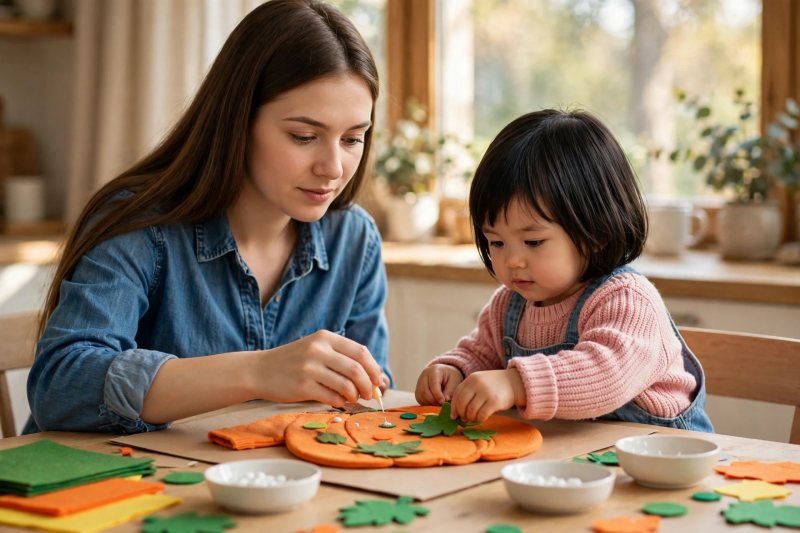
Start with felt-sheet starters — pumpkin tunic and ladybug shell. The two fastest builds in the guide, and the perfect first halloween crafts for toddlers session because the cutting is simple and the gluing is forgiving: (1) pumpkin tunic — an orange felt poncho-style panel worn over her clothes, with black felt face shapes (two triangle eyes, a smiling mouth) glued on the front by parent hands while she points to where each piece goes, finished with a green felt stem glued to a soft headband; (2) ladybug cape-shell — a red felt shell panel worn over black clothes, with large black felt dots glued across the back and a soft headband carrying two short felt antennae. Every shape here is cut big on purpose — small loose pieces are a mouthing hazard, so each dot and face piece is pressed firmly with a glue dot and tug-tested before the panel leaves the table. Say, "You point, I press — that's how a costume gets made." If a piece pops off in the tug test, re-glue it bigger or leave it off entirely; a pumpkin with one eye is still a pumpkin.
-
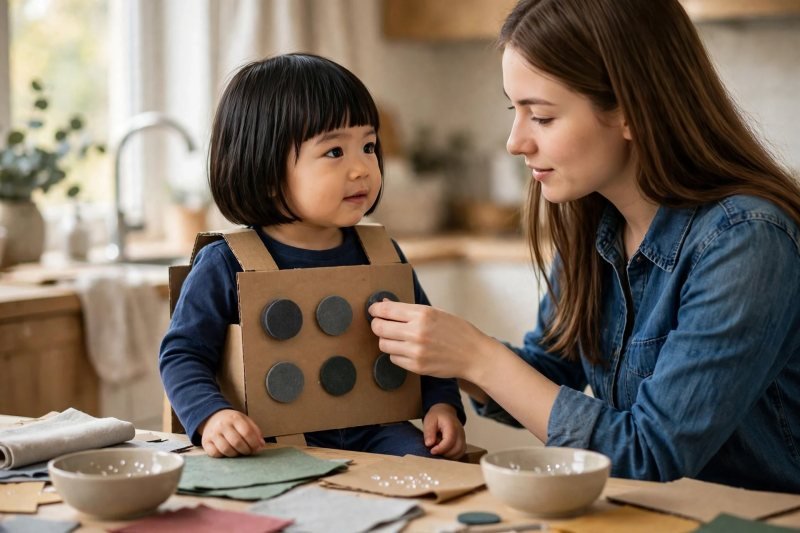
Build with cardboard — robot tunic and rocket jetpack. Cardboard is free, sturdy, and cuts into the two most impressive silhouettes in the guide: (3) robot — a cardboard box tunic with head and arm holes cut by a parent, worn over gray clothes, decorated with felt dials, circles and a heart shape, all glued on — keep every decoration abstract, with no readable letters or numbers drawn anywhere, because shapes read as robot at toddler scale; (4) rocket jetpack — two covered bottles fixed to a cardboard back panel with fabric glue, felt flames in orange and yellow glued at the bottle bottoms, and wide soft harness straps over the shoulders so it is worn like a backpack, never hung from the neck. Let her carry the bottles to the table and choose the flame colors — carrying and choosing are real jobs at two. Say, "Robots beep, rockets zoom — which sound is yours?" Check the jetpack panel sits flat for sitting: a jetpack she cannot lean back in stays home. The cardboard skills in this step are the same ones behind Halloween crafts for kids, so a robot built on Tuesday can gain a matching cardboard rocket or planet by the weekend.
-
Upgrade a hoodie — spider legs and dinosaur spikes. A plain hoodie is a costume waiting for felt: (5) spider — six stuffed socks fixed along the sides of a black hoodie by a parent using fabric glue and large glue dots (pinned securely by parent hands before wearing, checked at the try-on), so her own two arms plus six soft legs make eight — count them together, out loud, every time; (6) dinosaur — felt triangle spikes glued along a green strip of self-adhesive felt running down the back of a green hoodie, with a soft felt tail fixed high at the back waistband so she can sit on chairs without sitting on herself. This is where her fine motor activities practice shows: placing a spike in a row, in order, biggest to smallest, is pattern work disguised as costume making. Say, "Eight legs! Count them with me — one, two…" Stop the build while it is still fun; a hoodie finished tomorrow beats a hoodie finished through tears today.

-
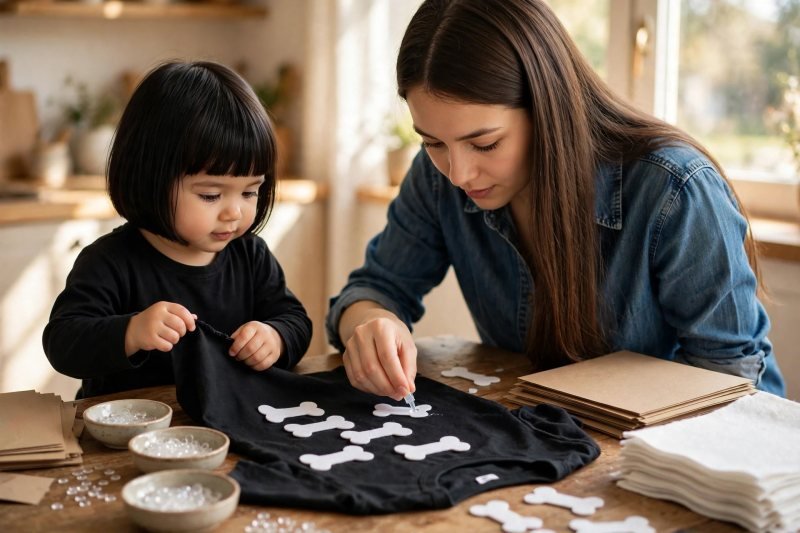
Transform pajamas — mummy wraps and skeleton bones. Pajama costumes are the efficiency champions: the costume is bedtime-ready the same night: (7) mummy — cream pajamas with soft fabric strips glued flat onto the front and sleeves with fabric glue by parent hands — the strips are attached to the pajamas, never wrapped around her body and never tied, so nothing winds around her neck, arms, or legs; (8) skeleton — black pajamas with white felt bones (ribs, arm bones, leg bones) glued on the front in one parent-led gluing session while she holds the pajama edge and hands you the next bone. Bone placement does not need anatomy accuracy — a rib near the knee is comedy, not error, at this age. Say, "Hold the edge tight — you're the skeleton builder's assistant." Lay both pajama sets flat to dry fully before the try-on, and tug-test every bone and strip: pajamas get pulled over heads and tugged at all night.
-
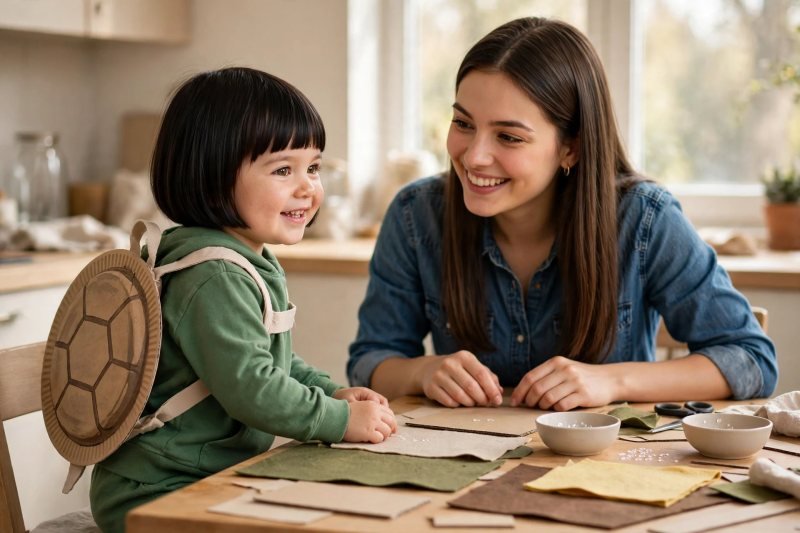
Make paper and plate magic — turtle shell and owl cape. The lightest builds in the guide, for toddlers who reject anything heavy: (9) turtle shell — a paper-plate shell (two plates glued rim to rim for dome shape, or one large plate panel) painted-look finished with green felt patches glued on, worn backpack-style with soft wide straps over the shoulders, over green clothes; (10) owl cape — a cape panel covered in layered rows of felt feather shapes glued on like shingles, worn over a warm top and fastened at the shoulders with soft tabs, finished with an ear-tuft headband. Feather rows are her job to place — overlapping, crooked rows look more owlish, not less. Say, "Owls don't worry about straight lines, and neither do we." The turtle shell must pass the chair test at the try-on: if she cannot sit back comfortably, trim the plate smaller. The same paper-plate skills make a paper-plate spider web for the porch, which gives the turtle shell and owl cape a place to be seen before the night itself.
-
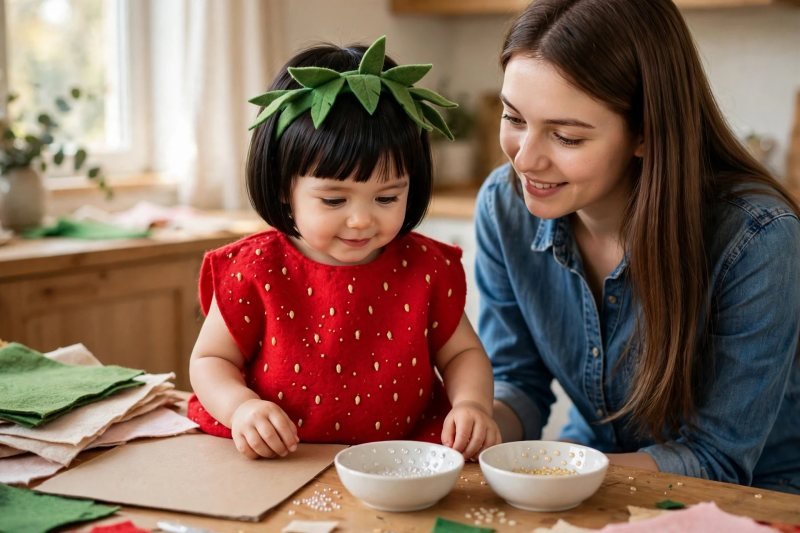
Serve the food costumes — strawberry and pizza slice. Sweet, round, and instantly readable across a dark street: (11) strawberry — a red felt tunic worn over green leggings, with small white and yellow felt seed dots glued all over the front (each one large, firmly pressed, and tug-tested) and a green felt frond headband; (12) pizza slice — a big triangle felt panel in golden crust tones worn over her clothes, topped with glued felt toppings: red pepperoni circles, pale cheese drips, green pepper strips — she chooses the toppings, you glue them. Food-costume rule: every topping is decoration glued flat, nothing dangles, and nothing small sits where little fingers can pick at it during a long evening. Say, "Extra cheese? The chef decides." Photograph both food costumes before the first chocolate of the night, for obvious reasons.
-
Give her wings — butterfly and bumblebee. Two flyers built on the same safe architecture — soft harness straps over the shoulders, nothing at the neck: (13) butterfly wings — cardboard wings covered in felt, with big felt spots glued on both sides, fixed to a soft harness she wears like a backpack, over her brightest clothes; (14) bumblebee — a yellow vest panel with black self-adhesive felt stripes pressed on, a soft felt wing panel fixed at the back shoulders, and an antennae headband with soft felt balls on short stalks. Wing rules: cardboard edges are covered with felt so nothing stiff sits at face height, wings come off in seconds for the car seat, and a wing she can flap by shrugging beats a wing she must hold. Say, "Fly to the mirror — let's see those wings work." If wings wilt or annoy at the try-on, the vest and headband alone still read perfectly.

-
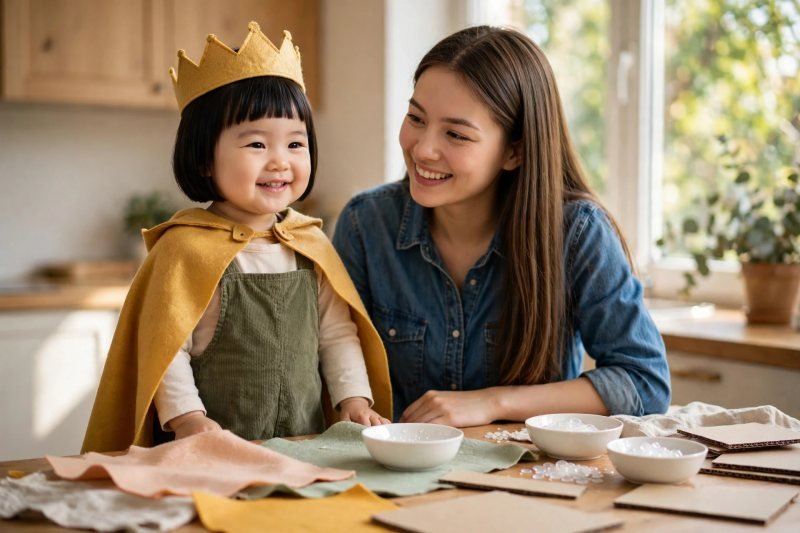
Go royal and heroic — crown royal and superhero. The dress-up-bin royalty, built to survive all winter: (15) crown royal — a felt crown glued into a band and worn on the head, plus a cape panel fastened at the SHOULDERS with soft tabs by parent hands — never tied at the neck, never knotted at the throat — over her fanciest everyday clothes; (16) superhero — a felt emblem shape (star, heart, or lightning-free simple bolt silhouette) glued onto a plain tee, plus a short cape panel with the same shoulder-tab fastening, in colors she picks. Cape discipline is this guide's sternest rule, repeated on purpose: capes are short (above the waist), fasten at the shoulders with soft tabs that release with a tug, and nothing — nothing — ties around a toddler's neck. Say, "Heroes wear capes that let go." Let her name her hero and her royal title; a named costume gets worn longer.
-
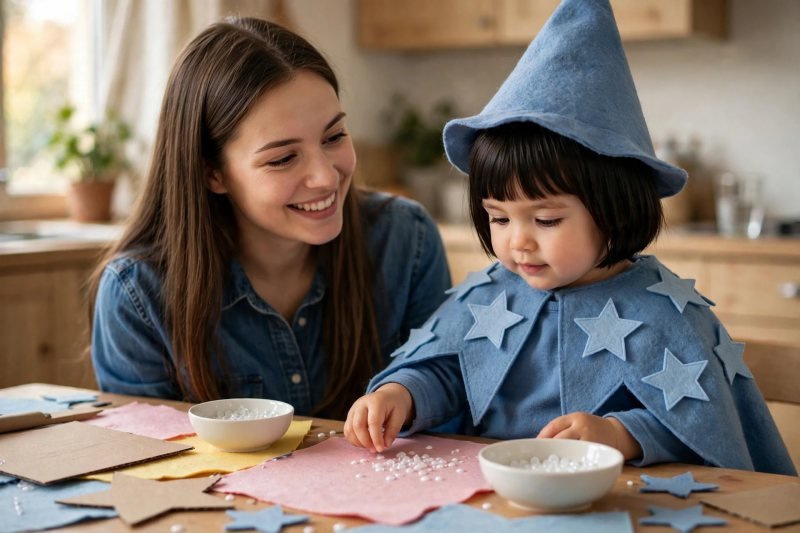
Cast the storybook pair — wizard and scarecrow. Two characters built from a hat and an over-layer: (17) wizard — a deep-blue felt star robe panel worn over clothes, covered in glued felt stars and a moon, with a crushable felt cone hat (soft, no stiff brim, elastic-free — it sits soft and comes off with one toddler hand); (18) scarecrow — a flannel shirt she already owns with felt patches glued on, straw-look felt fringe glued at the cuffs and hem (felt strips, never real straw near faces), and a soft floppy hat. The wizard's wand is retired in favor of a felt star on a short ribbon loop worn at the wrist — soft props only, and props are always optional. Say, "Wizards cast spells, scarecrows guard gardens — both get snacks." Both builds layer warm underneath and come apart in seconds for diaper changes and car seats.
-
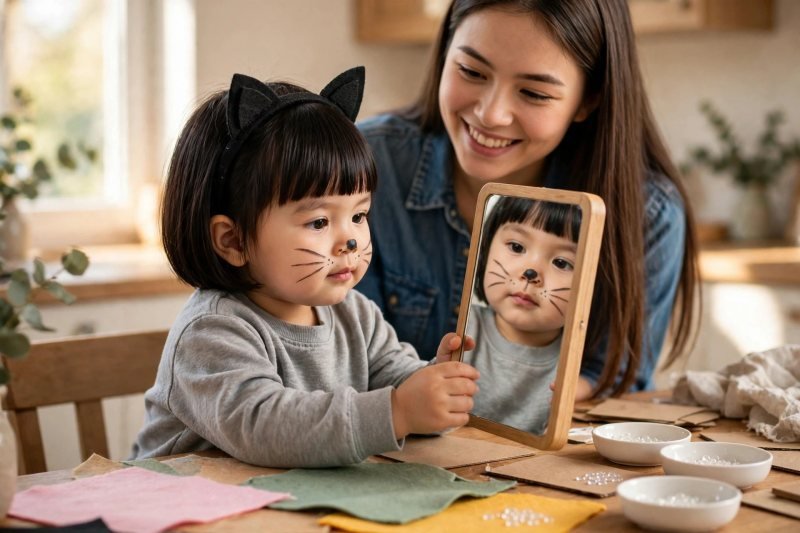
Finish with the final pair — cat set and train conductor — and hold the home try-on. Two closet classics close the twenty: (19) cat set — a felt ear headband, a soft felt tail fixed at the back waistband by a parent, and whiskers drawn on by a parent while she watches in the mirror (three soft strokes per cheek, water-based and patch-tested); (20) train conductor — a striped bandana worn as a hat, a vest or jacket over her clothes, and a felt ticket she punches with a parent-operated hole punch at every door — the ticket is the prop that survives the night. Then the step that makes all twenty work: the home try-on ceremony, a full week early — costume on over the planned layers (the toddler winter outfits layering logic: base layer, costume over, jacket if the night demands), real shoes on, a practice march to the mirror, the sitting test, the snack test, and the parent's tug test — check every glued piece is firmly attached, pull gently at each dot, bone, spike and stripe, and re-glue or remove anything that fails, in the calm, a week before it matters. Say, "Tonight we practice; on Halloween, we just go be it." A rehearsed toddler in a homemade costume outshines an unrehearsed one in a shop-bought masterpiece every single year. When the costume is decided, everyday pretend play keeps a homemade costume in the dress-up bin long after Halloween.


Make it easier
The pajama shortcut: skeleton (8) and mummy (7) are literally pajamas — build them on a size-up set and the costume serves bedtime the same night. The one-panel shortcut: pumpkin (1), strawberry (11), and pizza slice (12) are a single glued felt panel over clothes she owns — one table session, done. Pre-cut everything the night before: parent cutting alone takes ten quiet minutes and turns the toddler session into pure placing and choosing.
Make it harder
Let her design the decoration: she arranges the robot's felt dials, the pizza's toppings, or the butterfly's spots before you glue — a designed costume is hers in a way a copied one never is. Build the sibling set: fruit bowl (11 plus 1), storybook pair (17 and 18), or hero and royal (15 and 16) — two builds, one table session, coordinated photos. Add the practice route: extend the try-on into a dress rehearsal at two friendly doors, tote in hand — stamina and confidence, trained like anything else.
Other ways to play it
- Cold-night version: every build here goes over clothes by design — size base layers warm, add leggings and a long-sleeve tee under tunics and panels, and swap headbands under a warm hat when the forecast turns.
- Warm-night version: run the vest and panel builds light — bumblebee (14), superhero (16), and conductor (20) over a short-sleeve tee, no extra layers, wings and capes off for breaks.
- No-table-time version: self-adhesive felt only — stripes on the bee vest, bones on the skeleton pajamas, and spots on the butterfly wings press on in minutes with zero glue drying time.
- When glue will not hold: if a felt piece pops off twice at the tug test, the surface is the problem — rough or fuzzy fabric defeats glue dots, so move that piece to a smooth felt panel pressed firmly by a parent, and never stack more glue dots on top of a failed join.
How it changes by age
- Age 2: Twos get the simplest builds — pumpkin tunic (1), skeleton pajamas (8), turtle shell (9) — where their job is placing one big piece and choosing one color. Keep the making session under 20 minutes, do all gluing yourself, and try the costume on twice before the night.
- Age 3: Threes can place rows (owl feathers, dinosaur spikes), choose toppings and dials with real opinions, and carry a soft prop like the conductor's ticket. The try-on becomes a fashion show they direct; the tug test becomes a game they help run — gently.
What they're learning
Fine motor control: placing felt shapes, pressing glue dots flat with a parent, and lining up spikes and feathers — hand strength and precision in costume form. Choice and identity: picking who to be, which colors, and where the pieces go — early self-expression inside safe, parent-built bounds. Counting and patterns: eight spider legs counted on her own body, seed dots, stripes and feather rows — number sense and sequencing in felt. Patience and process: a costume made in stages — cut, place, glue, dry, try on — teaches that good things are built, not just bought.
Clearing up
Glue dots peel off the table with a fingernail, felt scraps go into a craft box for the next build (spare shapes are tomorrow's repair kit), cardboard offcuts go to recycling, and finished costumes hang or fold flat with a spare glue-dot sheet tucked alongside for Halloween-night repairs. Photograph the flat costume before storing — next October's build starts with evidence of what she actually loved wearing.
Questions parents ask
How do you make a toddler Halloween costume with no sewing?
What is the easiest DIY costume for a 2-year-old?
Are glue dots safe on toddler costumes?
How do you make a cape that is safe for a toddler?
When should you start a DIY toddler costume?

save it for later
Pin this for the next rainy afternoon
Keep it on a board so it is there when you need it, rather than when you happened to find it.
Save to Pinterest


