


Bath Routine for Toddlers: A Simple Nightly Plan
A simple, safe bath routine for toddlers ages 2-3: gather everything first, check warm water, wash in the same order, brush teeth, pajamas, book and song — a calm nightly plan that never leaves your child alone in water.
A bath routine for toddlers works best when it happens at the same time, in the same order, every night: gather everything first, run shallow warm water and test it, never leave your child alone in the tub, wash gently, brush teeth, dress in pajamas, and finish with a book and song.

The short version
- Same time, same cue, same order every night — predictability is what makes toddlers cooperate with bath time.
- Gather everything before any water runs, so you never need to leave the tub — not for a towel, phone, or doorbell.
- Test warm water with your inner wrist or elbow first, fill shallow, and keep your child away from the faucet end.
- Wash top-to-bottom in the same order, keep hair washing to planned nights, and brush teeth at the sink inside the routine.
- Empty the tub straight after, drain the toys, and finish with pajamas, one book, the same goodnight song, and lights down.
- Age
- Ages 2–3
- Play time
- 25 min
- Mess
- Low
- Difficulty
- Easy
- Where
- Indoor
Why kids love this
A bath routine for toddlers works because toddlers love knowing what comes next. When bath time starts at the same time, with the same little song and the same order of jobs, there is nothing to argue about and nothing to be surprised by — the routine itself does the persuading. Warm water helps too: splashing, pouring from a cup, and watching a rubber duck bob around are real play, not just getting clean, and that play happens while your child is sitting still in one safe place with your full attention. For many families the bath also becomes a calm bridge to bed. The day is loud and busy; the bathroom is warm, quiet, and dim. Washing, drying, pajamas, and a book slow everything down in small, predictable steps, so by the time the goodnight song arrives your toddler has already been winding down for twenty minutes. Two- and three-year-olds may still splash, stall, or demand one more pour — that is normal — but inside a familiar routine those moments stay small, because the next step is always the one they already know.
What you'll need
- A soft bath towel, ideally a large hooded one — for the big wrap straight out of the tub
- A soft washcloth — for gentle washing, plus a spare in case the first one lands on the floor
- An unbreakable cup — for rinsing hair and for pouring play
- A few simple bath toys — a rubber duck, stacking cups, or a small boat; only what fits easily in the tub
- A non-slip bath mat — inside the tub, plus a mat or towel on the floor for stepping out
- A small amount of gentle, generic cleanser — in a plain, unlabelled bottle; and a gentle, generic shampoo for hair-wash nights only, also in a plain, unlabelled bottle
- Pajamas, a clean diaper or underwear, and socks if your home is cool — all laid out before the bath starts
- A soft toothbrush sized for a toddler and a pea-sized amount of generic toothpaste — in a plain, unlabelled tube
- A gentle, generic moisturizer — in a plain, unlabelled bottle, for dry-prone spots after drying
- A small comb, one short picture book, and a clean change of clothes within reach for any big splash
Before you start
1. Choose your nightly order and keep it: cue, gather, run and test the water, undress and lift in, play then wash, hair on hair-wash nights, teeth, out and dry, moisturize and pajamas, book and song. Say the order out loud the first few nights so your toddler learns it with you. 2. Set up the bathroom before dinner if you can: non-slip mat in the tub, towel over the rail, pajamas folded nearby, toys in the tub dry, and every bottle plain and unlabelled within adult reach but out of your child's reach once she is in the water. 3. Decide your hair-wash rhythm for the week — for most toddlers, washing hair two or three nights a week is plenty, with plain warm water play on the other nights — and tell your toddler at the cue whether tonight is a hair night, so there are no surprises mid-bath.
How to do it
-
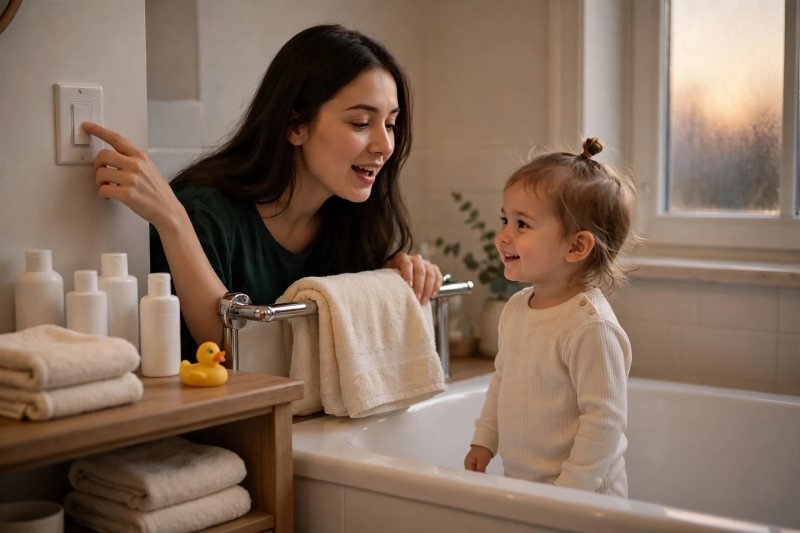
Set the same time and the same first cue. Start the bath at roughly the same time every night — after dinner and a short play is a rhythm most families can keep — and open with the same cue every time: dim the bathroom light a little, lay the towel over the rail where your toddler can see it, and sing or say your bath-time cue, such as a short made-up bath song you use only for this moment. Think of it as a routine chart in words rather than on paper — one small part of a calm bedtime routine that repeats every night: cue first, then water, then wash, then pajamas, then book — the same spoken list, in the same order, until your toddler starts finishing your sentences. That predictability is the whole engine; a child who can predict bath time rarely needs to fight it. Say, "Bath time, bath time — first the cue, then the bubbles, then pajamas and a book." If tonight is a hair-wash night, name it now, kindly and briefly, so it arrives as part of the plan and not as an ambush.
-
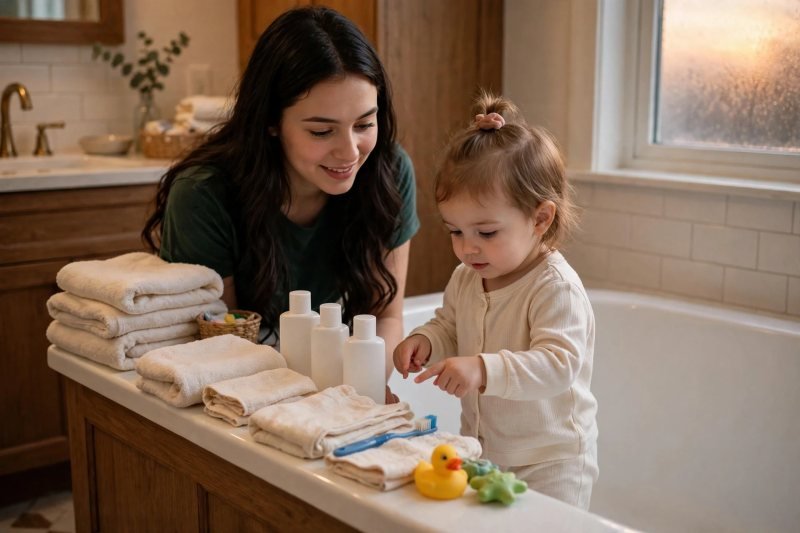
Gather everything before any water runs. This is the safety step the whole routine hangs on, so treat it as non-negotiable: before a single drop of water goes into the tub, gather everything you will need and put it within arm's reach of where you will kneel — the towel; the washcloth; the cup; the bath toys; the cleanser; pajamas; a clean diaper or underwear; the toothbrush and toothpaste; the moisturizer; and the book for the finish. Put your phone in another room or face-down and out of reach; it does not come to the bath. The reason is simple and absolute: once your toddler is in the water, you do not leave — not for a second, not for a towel, not for the phone, not for the doorbell. If it is not in the room when the bath starts, the bath waits until it is. Say, "Everything is here, so I get to stay right here with you the whole time." Check the pile once, out loud, like a pilot's checklist; toddlers love joining in the counting.
-
Run the bath and check the temperature. With everything gathered, run the bath while your toddler waits safely outside the tub — playing nearby with you in sight, or with another adult — because a child never gets into water that has not been tested yet. Fill the tub shallow, to about your seated toddler's waist, which is deep enough for pouring play and warm coverage with bubbles and shallow enough for steady sitting. Then test the water the adult way, every single time: swirl it with your hand so there are no hot patches, and check it against your inner wrist or elbow, where skin is sensitive; it should feel warm and comfortable, never hot. If it feels hot on your wrist, it is too hot — add cold water, swirl, and test again. Keep your toddler away from the faucet end of the tub throughout the bath, and never add hot water while she is in it. Say, "My turn to test first — warm and cozy, just right for you." Only when the water passes your test do you bring your toddler in for the next step.

-
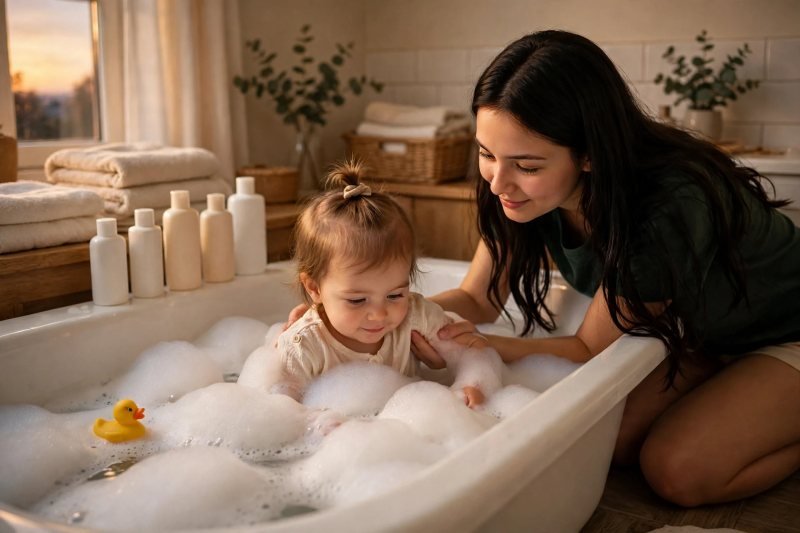
Undress and lift in safely. Bring your toddler into the bathroom, close the door against drafts and wandering, and undress her beside the tub where you can hold her securely the whole time. Lift her in with both hands under her arms, lower her straight down onto the non-slip mat into a sitting position, and let her feel the water arrive gradually rather than dropping her in with a splash. Stay kneeling right beside the tub, within arm's reach, for the entire bath — this is the rule stated plainly, with no exceptions: never leave a toddler unattended in water, not for a second, not for a towel, a phone, or the doorbell; if something truly urgent pulls you away, you lift your child out, wrap her in the towel, and take her with you. Bath seats are not safety devices and they never replace your hands and eyes; a seat can tip and a child can slip, so treat it, if you use one at all, as a comfort aid only while you stay right there. Say, "In we go, sitting tall — and I stay right here, close enough for high-fives."
-
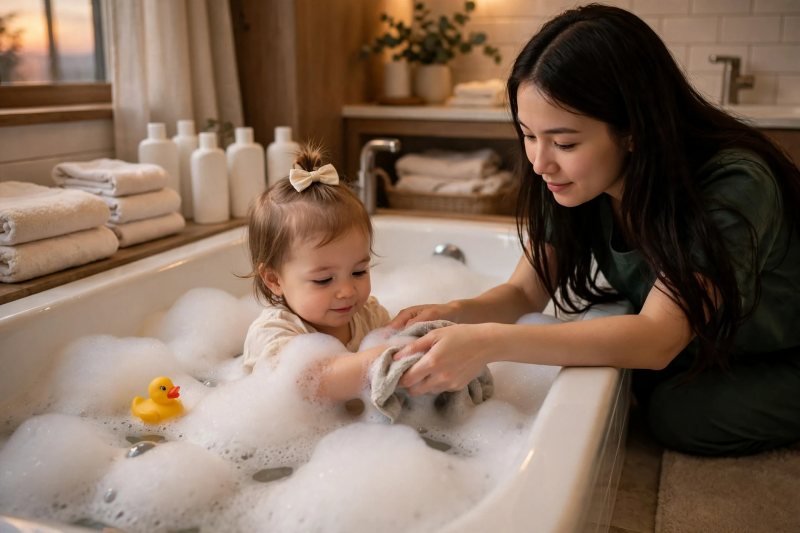
Wash in the same order every night. Give the bath a shape your toddler can learn: a few minutes of free play first — pouring from the cup, sailing the duck, popping bubbles — then washing in the same top-to-bottom order every night. Use a soft washcloth with warm water and, if you like, a small amount of gentle generic cleanser worked into the cloth rather than poured into the tub: face with plain water only; then neck and arms; then chest and back; then legs and feet; and the diaper area last, with a fresh part of the cloth. Keep it unhurried and narrated, because narration is how a two-year-old learns the sequence and starts joining in — holding the cloth, washing a knee, soaping the duck for practice. Rinse with cupfuls of warm tub water, shielding her eyes with your free hand when you pour near her head. Say, "Play first, then wash — top to bottom, same as always; you do your knee, I will do your back." A short bath is fine; clean and calm beats long and chilly every time.
-
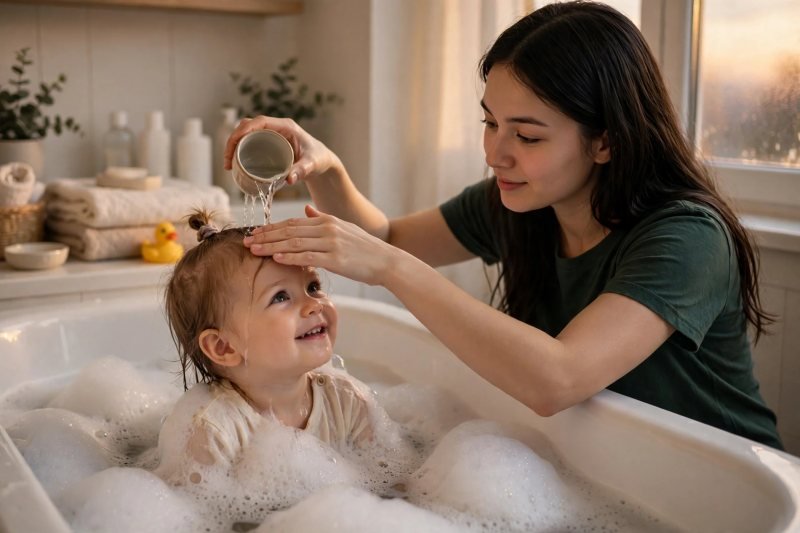
Wash hair the calm way. Hair washing goes smoothly when it is expected, brief, and playful, so keep it to your planned hair-wash nights — most toddlers need hair washed only two or three times a week, as this guide to how often to wash toddler hair explains — and use the same little ritual each time. Wet the hair with cupfuls of water while your toddler tips her head back for the face-tilt-back game — looking up at a sticker or picture you have placed high on the wall or ceiling gives her somewhere cheerful to aim her chin — and use your free hand as a shield across her forehead so water and suds run backward, away from her eyes. Massage in a small amount of gentle generic shampoo, rinse thoroughly with the cup, again pouring from front to back with her chin up, and praise the brave looking-up like it is a sport. If hair washing is a current battle, building comfort slowly between baths helps, and a calm first trim experience can too — see this toddler first haircut guide for gentle ways to make hair care feel safe and familiar. Say, "Chin up to the ceiling star — here comes the warm rain, eyes stay dry." One protest night does not break the routine; shorten the wash, stay kind, and try the full ritual again next hair night.
-
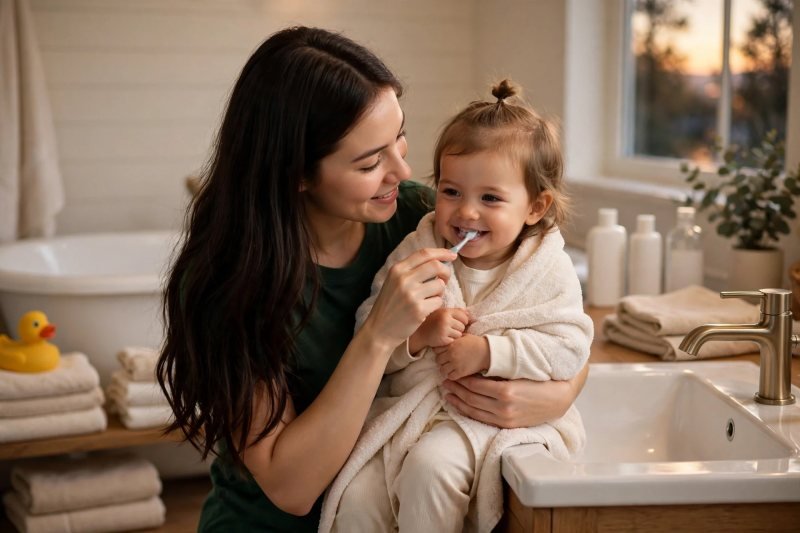
Brush teeth at the sink, right after the tub. Keep teeth in the same place in the routine every night so it never becomes a separate negotiation: once your toddler is out, wrapped, and dry (the next step's job on bath nights runs straight into this one while you are both still in the warm bathroom — on non-bath nights, use this same sink moment after pajamas), stand together at the sink for brushing. Put a pea-sized amount of generic toothpaste on a soft toddler toothbrush, let your toddler have her practice turn first — toddlers who get to try are far more willing to open up — and then you do the real brushing, gently, around every tooth, while she holds the cup or the duck for company. Keep claims simple and habits steady: brush morning and night, take your time, and let her spit into the sink like a grown-up, which most two- and three-year-olds find hilarious and motivating. A song timer helps — hum your bath cue tune once through and brushing lasts exactly as long as the song. Say, "Your turn to practice, my turn to polish — then spit like a fountain." Teeth done in the bathroom, in the routine, take two minutes and zero chasing around the house.
-
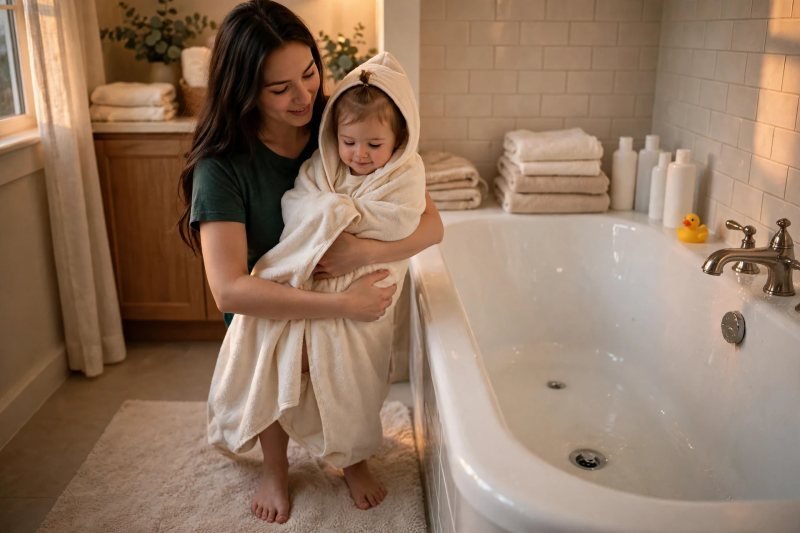
Out, wrap, and dry. When washing is done, end the bath before the water cools and the shivering starts — a cheerful, predictable ending line helps, the same one every night. Drain the tub as your toddler comes out, or straight after she is safely on the mat; never leave a filled tub sitting, because standing water is a risk to any small child who wanders back in, and emptying it is part of the routine, not an afterthought. Lift her out with both hands — wet toddlers are slippery — and set her straight onto the floor mat, then wrap her immediately in the big towel, hooded corner over her head if you have one, and hold her close for a warm minute. Pat dry gently all over, paying attention to creases and between toes, and dress her right there in the warm bathroom: clean diaper or underwear first, then pajamas, while she is still cozy from the wrap. Say, "Out we come, big wrap, big squeeze — pajamas on while you are still toasty." Toys stay in the empty tub to drain, or get scooped into a basket to drip, so the bathroom floor stays as dry as a bathroom floor can.
-
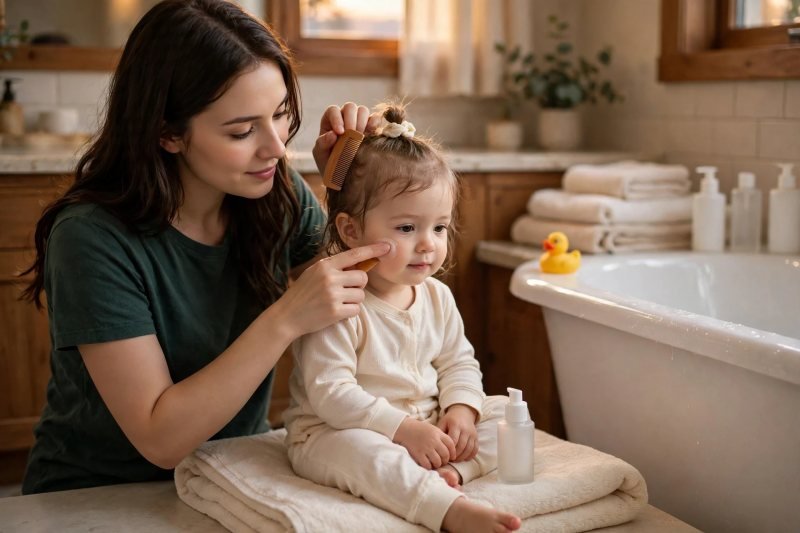
Moisturize and comb. With pajamas on, finish the bathroom jobs in one calm minute. Smooth a little gentle generic moisturizer onto the dry-prone spots — cheeks, elbows, knees, and any patch that tends to feel rough — with slow, warm hands, and let your toddler rub a dab into her own hands or feet as her helping job. If you want a fuller evening care rhythm to sit alongside this one, this simple kids skincare routine lays out easy steps you can borrow from without turning bedtime into a project. Then a quick, gentle comb through damp hair, working from the ends upward and never tugging through a tangle — two-year-old hair forgives almost everything if you are slow. Keep this step short and pleasant; it is care, not grooming perfection, and a wriggly finish is still a finished routine. Say, "Cream on the dry spots, comb through gently — all done, soft and ready for a story."
-
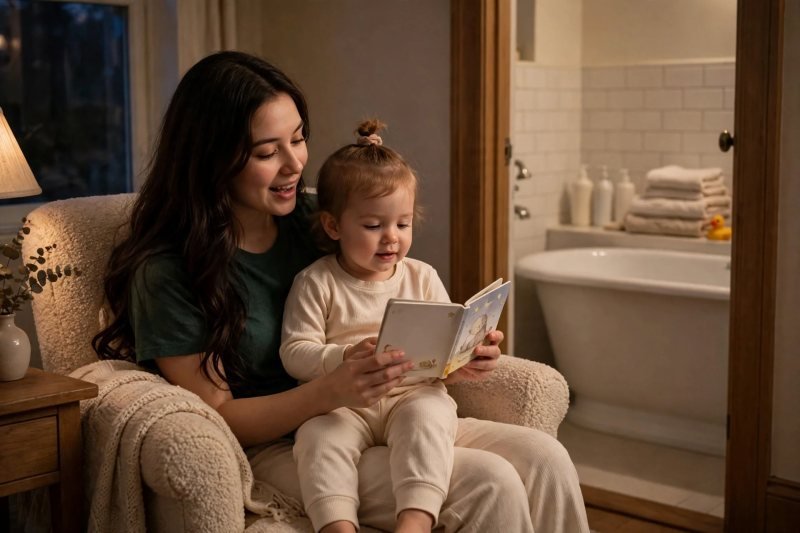
Finish with book, song, and lights-down. Leave the bathroom together and land the routine where it always lands: in bed, or in the same cozy chair, with one short book — one, chosen from a small pile you offer, so choosing takes a minute and not ten. Read it slowly, in a lower, quieter voice than your daytime voice, because volume is a sleep cue toddlers read perfectly. Then close with the same goodnight song every night; a familiar action song slowed right down works beautifully as a sing-together wind-down — pick a gentle favorite from these nursery rhymes for toddlers — the gentle motions of the Itsy Bitsy Spider at half speed, hands climbing softly and then resting, make a lovely last page to the day. Lights go down on the last verse, a kiss, the same goodnight words, and you leave while things are calm rather than waiting for fully asleep. Meanwhile, the adult closing jobs are already done or done on your way out: the tub is emptied, toys are drained and put to drip, towels are hung, and the bathroom is safe and tidy for morning. Say, "One book, one song, lights down — same as always, sleepyhead. Goodnight."


Make it easier
Shorten the whole arc on tired nights: cue, quick wash in the usual order, teeth, pajamas, and the song — skip free play and hair washing and keep only the steps that make it still feel like the routine. Offer two tiny choices and no open questions: the duck or the boat, the blue pajamas or the green ones — choice inside the routine gives control without derailing the order. Keep a spare set of everything in the bathroom — spare washcloth, spare pajamas, spare towel — so a drop, spill, or splash never tempts anyone to leave the tub to fetch something.
Make it harder
Let your toddler run more of the sequence herself: she carries the (empty) cup to the bathroom at the cue, washes her own arms and legs with the cloth, and puts her toys in the draining basket at the end — independence in the same safe order. Add a counting layer to play: count cupfuls poured over the duck, count bubbles popped, count toes while drying — early number practice hidden inside the warmest part of the day. Give her the routine to teach: let her lead the spoken order for a doll or teddy in the dry tub before dinner, naming each step — teaching the sequence is the surest sign she has learned it.
Other ways to play it
- Shower version: on nights when a shower suits better, keep every rule and the same order — gather first, adult tests the warm (never hot) water, non-slip mat underfoot, and the adult stays within arm's reach the whole time; a gentle showerhead, cup rinses, and a shorter wash keep it calm, and teeth, pajamas, book, and song finish exactly as usual.
- Bath-refusers version: if your toddler currently refuses the tub, shrink the steps, not the safety: start with feet-only splashing in a shallow basin or an empty-tub play session in clothes or pajamas with toys and no water at all, add an inch of warm water over several nights, and always stop while it is still fun — and on every version, the never-unattended rule restated plainly: an adult stays with the child, every second, whenever any water is involved.
- Siblings together version: siblings can share bath time happily with one extra layer of planning — one adult per small child if both are under three, or one adult whose whole job is the tub, with everything gathered first as always; each child gets their own washcloth and cup, washing still runs top-to-bottom per child, and the rule does not bend for company: never leave toddlers unattended in water together, not for a second — an older sibling is not supervision, the adult in the room is.
How it changes by age
- Age 2: Two-year-olds do best with the shortest, warmest version of this routine: ten to fifteen minutes in the water is plenty, hair washing kept brief and game-led, and teeth handled mostly by you with a short practice turn for them. Expect splashing, cup-dumping, and strong opinions about toys — all normal — and hold the safety frame exactly the same: gathered supplies, tested water, and you beside the tub without exception. Narrate every step in simple words; at two, your voice is the routine chart.
- Age 3: Three-year-olds can carry more of the routine themselves: washing their own arms, legs, and tummy with the cloth, choosing between two toy or pajama options, leading the spoken order, and managing a longer, more confident brushing practice turn before your finishing pass. Baths can run a little longer if the water stays warm and supervision stays constant — and constant means constant at three, too; confidence in the water grows faster than safety sense, so the never-alone rule stays absolute even as everything else loosens.
What they're learning
Sequencing: the same ten steps in the same order every night teaches before-and-after thinking — cue, water, wash, teeth, pajamas, book — the foundation of routines, stories, and early logic. Independence: washing a knee, carrying the cup, choosing the duck, and rubbing in their own dab of moisturizer are real jobs done by themselves, inside a frame an adult holds safe. Body awareness: naming and washing body parts top-to-bottom, feeling warm versus too warm, and learning that their body has a care routine builds a calm, practical map of themselves. Self-care habits: nightly teeth brushing, regular washing, and moisturizing dry spots become simply "what we do" — habits laid down now, without battles, carry quietly into childhood.
Clearing up
Clearing up is the adult's quiet closing job, built into the routine rather than left for later: the tub is drained during or straight after the lift-out, toys are scooped into a draining basket or left in the empty tub to drip, and the rinse cup goes upside down on the tub edge. Hang the big towel and washcloth to dry, drop any soaked pajamas or floor towels straight into the laundry, wipe the worst of the splashes off the floor so nobody slips on a midnight trip, and put bottles back in their out-of-reach spot with lids on. Set out tomorrow's pajamas and towel if you like — future-you, mid-dinner-rush, will be grateful — and leave the bathroom door in its usual safe state. Two minutes now, and the room is calm, dry, and ready.
Questions parents ask
How often should a toddler have a bath?
What temperature should toddler bath water be?
How do I keep my toddler safe in the bath?
How can I wash my toddler's hair without tears?
What if my toddler refuses the bath?

save it for later
Pin this for the next rainy afternoon
Keep it on a board so it is there when you need it, rather than when you happened to find it.
Save to Pinterest


